
No. Native Google Docs does not measure active writing time—it only displays snapshot timestamps and overall elapsed document age. If a student leaves a blank Google Doc open in a background browser tab for 8 hours while sleeping, native version history makes it appear as though the file was active for 8 hours. To calculate true, authentic drafting duration, schools use Checkmark Plagiarism, which automatically filters out idle pauses to report exact active typing minutes.
Understanding writing duration is one of the most common points of confusion for educators and students alike. A student accused of copying an essay might argue: "Look at my version history! The document was created on Monday and submitted on Friday, so I spent 5 days working on it!" In reality, elapsed calendar time tells you nothing about physical composition. A paper created 5 days ago could have had 1,500 words pasted in at the 4-day-and-23-hour mark in 10 seconds. Separating true active typing time from idle tab duration is essential for objective assessment.
Below is a comprehensive guide on how time is tracked in Google Docs and how educators measure active drafting.
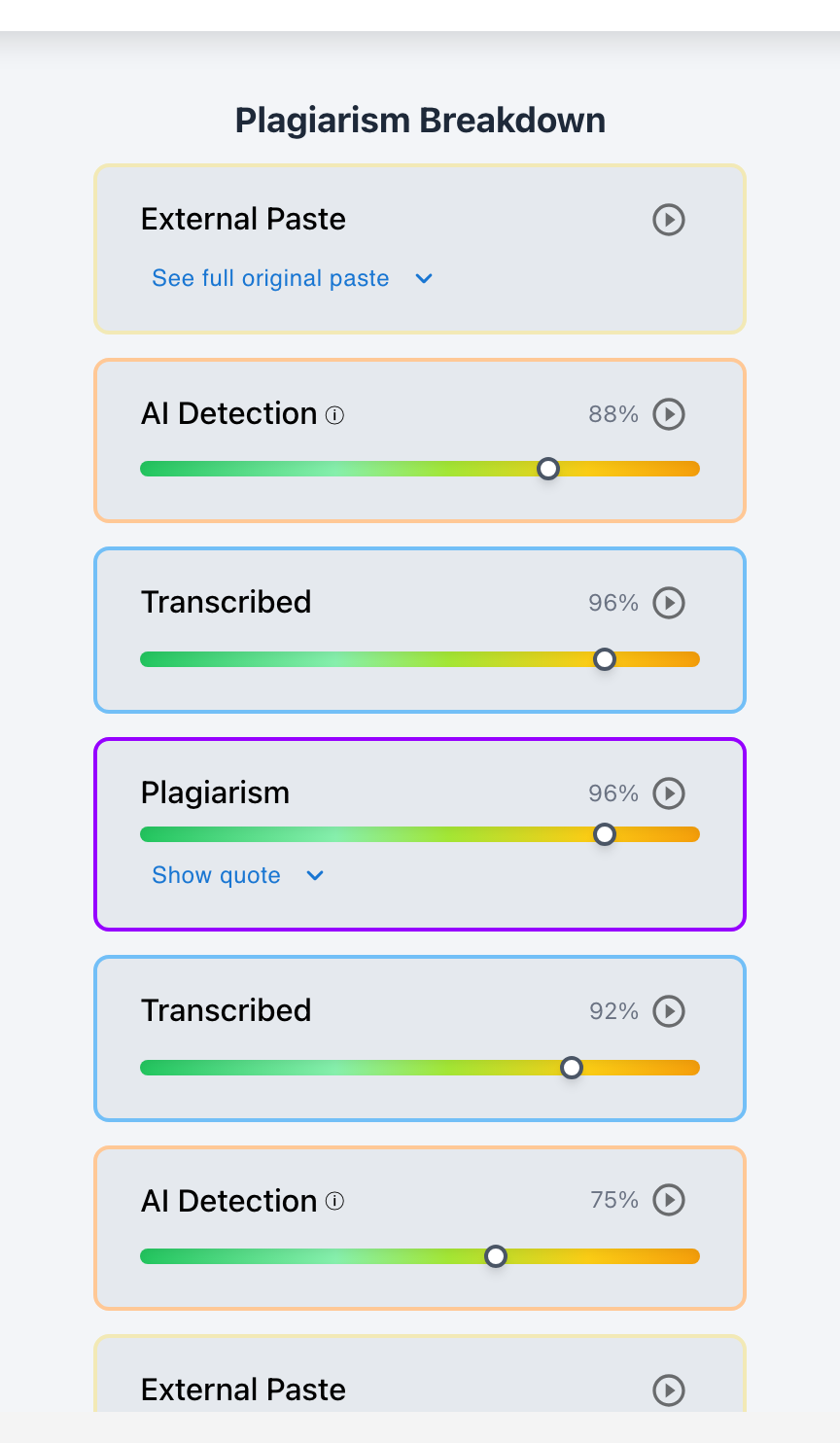
Checkmark Plagiarism calculates true drafting time by pairing essay writing playback with AI detection, plagiarism detection, autograding, and integrations with Google Classroom and Canvas.
The 3 Different Definitions of "Writing Time"
1. Elapsed Calendar Age
The total calendar time between file creation and submission (e.g., created Oct 1, submitted Oct 7 = 6 days elapsed). Tells nothing about effort.
2. Open Tab Duration
The total hours the Google Doc tab was open in Chrome. Vulnerable to leaving tabs open overnight without typing a single word.
3. True Active Typing Time
The exact duration when the student was actively typing keystrokes, deleting, and editing at the keyboard (measured by Checkmark).
How Checkmark Filters Idle Time from Active Typing
Understanding the telemetry algorithms behind active time measurement:
- The 60-Second Idle Threshold: When a student stops typing for more than 60 seconds (to research a source or take a break), Checkmark pauses the active timer, recording the pause as thinking or idle time.
- Keystroke Accumulation Engine: Active drafting time accumulates only while physical keystrokes, backspaces, and text selections are actively occurring.
- Benchmarking Authenticity: A genuine 1,500-word essay requires an average of 2.5 to 5 hours of active typing. An essay with 8 minutes of active time represents a paste payload or transcription shortcut.
Read more in how Checkmark writing process analysis works.
Comparison: Native Google Docs Timestamps vs. Checkmark Active Time
Checkmark Active Time (Precise Biometric Telemetry)
- Calculates exact active typing minutes (e.g., 3 hrs 14 mins).
- Automatically discounts idle pauses and background tabs.
- Displays active time vs. total elapsed time side-by-side.
- Integrates directly into Canvas SpeedGrader sidebar.
Native Google Docs Timestamps (Vague Calendar Dates)
- Shows only periodic snapshot save times (e.g., 10:14 PM).
- Cannot tell if student typed for 1 minute or 1 hour.
- Vulnerable to leaving tabs open to simulate effort.
- Requires tedious manual guesswork by educators.
A 5-Step Educator Protocol for Auditing Writing Time
Writing Time Audit Checklist:
- 1. Open the student's submission in Google Classroom or Canvas SpeedGrader.
- 2. Check the Active Typing Duration metric in the Checkmark sidebar.
- 3. Compare active hours against expected word count (rule of thumb: ~400–600 words per active hour).
- 4. If active time is under 15 minutes for a full essay, inspect the Clipboard Paste Log.
- 5. If active time is 3+ hours with healthy backspaces, confirm authentic human drafting.
How Checkmark Plagiarism Powers Time Forensics
Checkmark Plagiarism combines **AI detection, essay writing playback, static AI detection, plagiarism detection, autograding, and Canvas/Google Classroom integrations** to automatically calculate true active drafting hours and eliminate idle tab confusion.
Frequently Asked Questions
Can a student leave a Google Doc open overnight to fake writing time?
In native Google Docs, an open tab can make a document look active; however, Checkmark Playback filters out all idle time, recording 0 minutes of active drafting during inactivity.
How fast does a typical high school or college student write?
During genuine essay composition (including thinking, drafting, and self-editing), students produce between 300 and 600 words per active hour.
What does it mean if a 2,000-word essay has only 12 minutes of active time?
It proves that the essay was generated externally and pasted into the document, as no human can compose 2,000 original words in 12 minutes.
Does Checkmark record when a student takes a break?
Yes. Checkmark Playback logs writing sessions and pauses, showing the natural cadence of multi-day drafting habits.
How does Checkmark Plagiarism integrate with Google Classroom?
Checkmark displays active writing time badges directly inside Google Classroom assignments without requiring external plugins.
Can writing time prove that a student didn't use ChatGPT?
Yes. Having 4+ hours of recorded active typing with frequent backspaces provides undeniable proof that the student drafted the text manually.
What if a student drafted offline in Microsoft Word?
Ask the student to submit the original .docx file, which contains internal metadata properties and total editing time logs.
How does Checkmark Autograder use writing time?
Checkmark Autograder uses active drafting hours to assess writing effort and persistence, incorporating process metrics into formative feedback.
Is thinking time counted as writing time?
Short pauses (under 60 seconds) are counted as active formulation; extended pauses are logged as research or idle time to keep metrics precise.
Why is active writing time the most reliable integrity metric?
Because physical time spent at the keyboard is an unforgeable physical constraint: intellectual composition requires real human hours.
Grounding Assessment in Empirical Effort
Time is the true currency of intellectual labor. By measuring active writing time and filtering out idle noise with Checkmark Plagiarism, educators ensure that student effort is recognized, authentic habits are reinforced, and academic standards are upheld with precision.
Checkmark Plagiarism supports this comprehensive approach with AI detection, essay writing playback, static AI detection, plagiarism detection, autograding, and integrations with Google Classroom and Canvas.
See how Checkmark measures active typing duration and filters idle time in student writing. View a sample report or request a demonstration.