
Yes. Real student essays virtually always exhibit substantial deletions, backspaces, and revisions—statistically accounting for 15% to 30% of all recorded keystrokes.
Human thought is non-linear and iterative. When composing an authentic essay, writers constantly test word choices, correct typos, restructure awkward clauses, and delete entire paragraphs that fail to support their thesis. An essay that appears with 0 deletions, 0 backspaces, and 100% linear text entry is almost never authentic human writing—it is the signature footprint of an automated paste from ChatGPT or a manual transcription from another screen.
Through Checkmark Plagiarism's Writing-Process Evidence, educators can measure revision depth to separate genuine cognitive labor from artificial shortcuts.
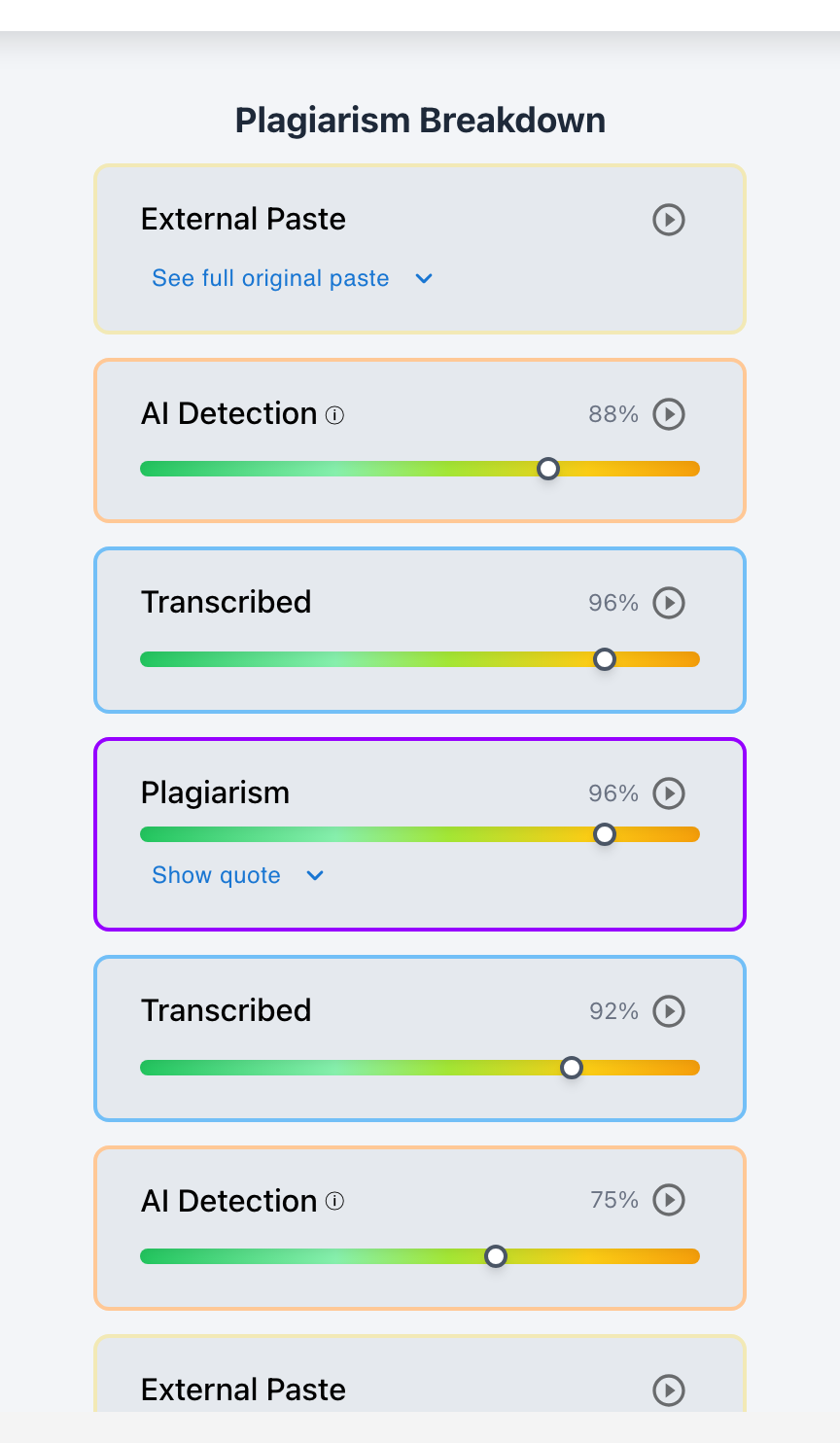
Checkmark Plagiarism powers revision tracking by pairing essay writing playback with AI detection, plagiarism detection, autograding, and integrations with Canvas and Google Classroom.
The 4 Types of Revisions Found in Authentic Student Writing
1. Micro-Revisions (Typo Corrections)
Immediate 1–3 character backspaces as a student types a word, makes a typo, and corrects it spontaneously within 0.5 seconds.
2. Syntactic Rephrasing
Deleting a 10-word clause midway through a sentence after realizing the phrasing is clumsy, followed by typing an alternative structure.
3. Structural Reorganization
Cutting a 150-word paragraph and moving it to a new location in the essay to improve the logical progression of the argument.
4. Evidence Replacement
Deleting an initial quoted source and replacing it with stronger academic evidence discovered during subsequent research.
Why 'First-Draft Perfection' Is a Myth
Generative AI models generate text sequentially based on next-token probabilities, outputting grammatically polished prose instantaneously. Humans, however, cannot hold an entire 1,500-word essay perfectly in working memory:
- Cognitive Load: Formulating an original idea while simultaneously managing syntax, grammar, and evidence creates friction that results in deletions.
- The "Zero-Revision" Red Flag: When a 1,500-word submission shows <1% backspaces and zero deleted words, it proves that the text was formulated elsewhere and copied into the document.
Read more in how Checkmark writing process analysis works.
Comparison: Authentic Human Revisions vs. Zero-Revision AI Shortcut
Authentic Student Writing (High Revision Depth)
- 15–30% of all keystrokes are deletions/backspaces.
- Frequent rephrasing of awkward sentences.
- Paragraphs moved and reorganized across sessions.
- Student fluently explains why revisions were made.
Zero-Revision AI Shortcut (Integrity Flag)
- <2% backspace rate across the entire paper.
- 100% linear text insertion with zero deletions.
- No structural changes or moved paragraphs.
- Student struggles to explain complex vocabulary orally.
A 5-Step Educator Protocol for Auditing Revisions
Educator Revision Audit Checklist:
- 1. Open the Checkmark Playback summary in Canvas SpeedGrader or Google Classroom.
- 2. Check the Revision Depth score: authentic student drafting averages 15–30% edits.
- 3. Inspect the playback replay to observe where clauses and paragraphs were reworked.
- 4. If an essay has <2% revisions, check for external paste events or linear transcription.
- 5. Praise students who demonstrate deep revision habits on their assignments.
How Checkmark Plagiarism Powers Revision Analytics
Checkmark Plagiarism combines **AI detection, essay writing playback, static AI detection, plagiarism detection, autograding, and Canvas/Google Classroom integrations** to quantify revision depth, turning backspaces and edits into objective proof of authentic human authorship.
Frequently Asked Questions
Is it normal to have lots of backspaces when writing an essay?
Yes! In authentic human writing, 15% to 30% of all keystrokes are backspaces or deletions. It is the clearest indicator of active critical thinking.
Can an essay be authentic if it has zero backspaces?
Virtually never. Writing a multi-page essay with zero deletions is practically impossible for human writers composing original thoughts.
How does writing playback show deleted text?
Checkmark Playback logs every backspaced letter and deleted paragraph, highlighting revisions in color so teachers can see how the paper evolved.
What if I write my paper in Microsoft Word and paste it in?
It will appear as a paste event. Retain your original Word file with version history to prove your authentic drafting revisions.
Does a high revision rate mean the student is a weak writer?
No. Highly skilled writers often have higher revision rates because they spend more time refining phrasing, polishing transitions, and perfecting arguments.
Can students fake deletions and backspaces?
Simulating hours of realistic typos, backspaces, and natural thinking pauses takes longer than actually writing the paper honestly.
How does Checkmark Plagiarism integrate with Canvas LMS?
Checkmark Plagiarism displays visual writing playback timelines, revision depth metrics, and dual AI/plagiarism scores directly inside Canvas SpeedGrader.
What should a teacher do if an essay has zero revisions?
Review the playback timeline, check for external paste events, and hold a supportive conference asking the student to explain their drafting process.
Does revision tracking protect honest students?
Yes. If an honest student is falsely flagged by an AI detector, their high backspace rate and active revision history prove authentic human authorship.
How can teachers encourage authentic revision?
Allocate 15–20% of assignment rubric points to drafting milestones and documented revision depth rather than evaluating only the final product.
Revision Is the Essence of Good Writing
Writing is rewriting. By celebrating the deletions, backspaces, and reorganizations that define genuine scholarship, Checkmark Plagiarism ensures that authentic human effort is recognized, valued, and defended.
Checkmark Plagiarism supports this comprehensive approach with AI detection, essay writing playback, static AI detection, plagiarism detection, autograding, and integrations with Canvas and Google Classroom.
See how Checkmark pairs essay writing playback with multi-signal detection to measure revision depth and authentic drafting inside your LMS. View a sample report or request a demonstration.