
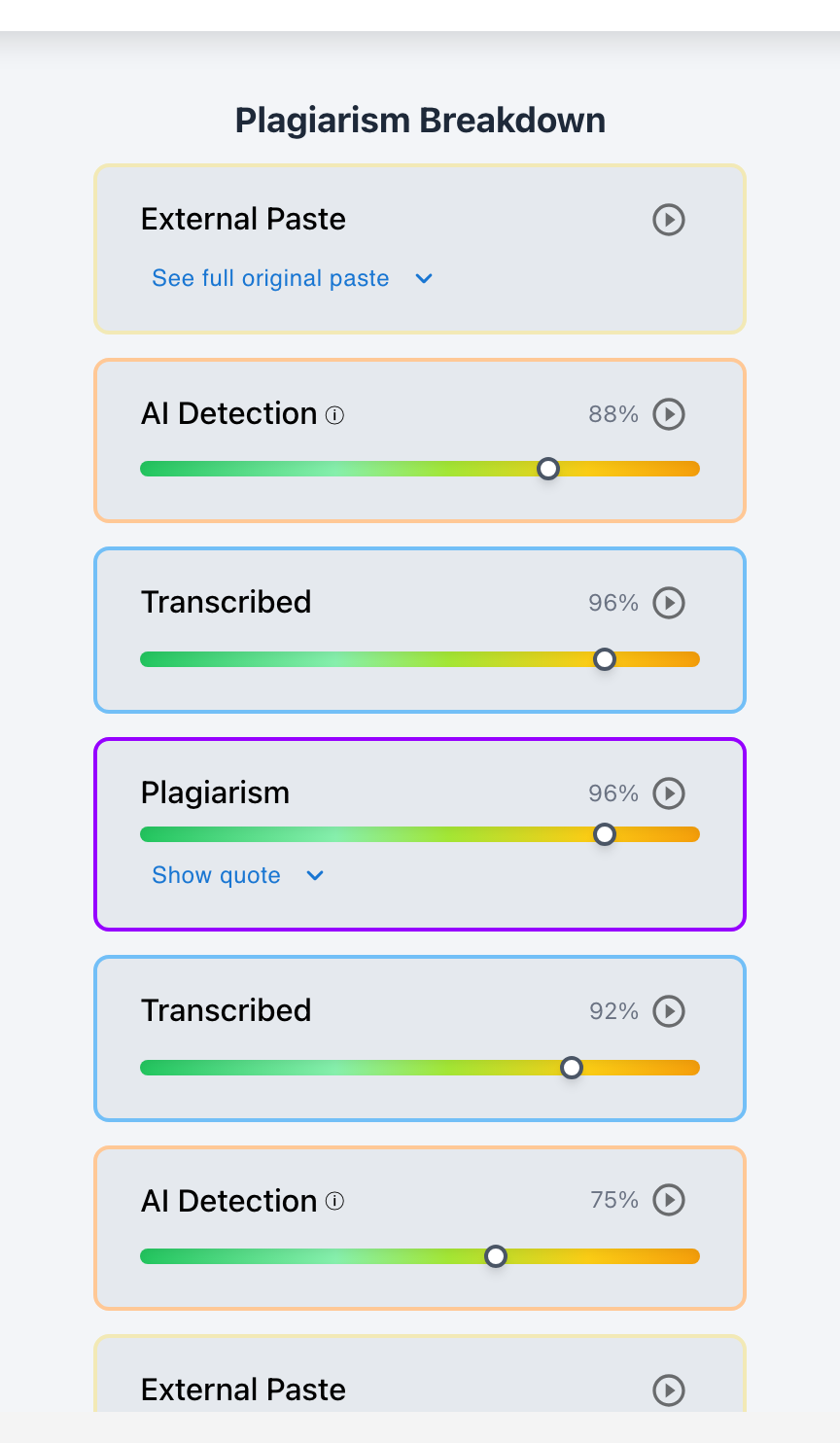
Yes. Writing speed and keystroke velocity variance provide definitive, unforgeable physical evidence of authorship—revealing whether a student was actively thinking and composing (variable 35–55 WPM with backspaces), transcribing from another screen (monotone 75 WPM without pauses), or pasting from an AI generator (600+ WPM).
When investigating suspected AI use or plagiarism, teachers often encounter conflicting statistical detector scores. The most reliable physical ground truth lies in the biomechanics of keyboard interaction. Authentic human composition is characterized by continuous velocity fluctuations: rapid typing on simple transition phrases, micro-pauses while considering complex vocabulary, and frequent backspace bursts to fix typos. By measuring typing speed curves with Checkmark Playback, educators gain objective proof of authentic human authorship.
Below is a comprehensive guide on using writing velocity and typing speed to evaluate student essays.
Checkmark Plagiarism powers velocity forensics by pairing essay writing playback with AI detection, plagiarism detection, autograding, and integrations with Canvas and Google Classroom.
The 3 Distinct Typing Velocity Profiles
1. Authentic Composition Velocity
Speed: 35–55 net WPM.
Characteristics: Highly variable rhythm, frequent cognitive pauses (30–90s) between paragraphs, and 15–30% backspaces.
2. Screen Transcription Velocity
Speed: 60–85 steady WPM.
Characteristics: Unnaturally flat, metronomic cadence without thinking pauses, sub-3% backspaces (retyping from phone/screen).
3. Clipboard Paste Inflow
Speed: 600–2,000+ effective WPM.
Characteristics: 1,200 words appear in 0.05 seconds with zero recorded keystroke intervals (AI or web text insertion).
Why Velocity Variance Is the Hallmark of Human Thought
Analyzing the rhythm of typing exposes the difference between thinking and copying:
- Cognitive Pauses: Human brains pause for 10 to 45 seconds at clause boundaries to formulate the next idea. In transcription or pasting, these pauses disappear completely.
- Vocabulary Speed Deceleration: When a student types a complex or unfamiliar word (e.g., "bourgeoisie"), their typing velocity drops significantly. In AI transcription, all words are typed at identical speed.
- Typing Fatigue: Over a 3-hour drafting session, human typing velocity naturally ebbs and flows as mental fatigue sets in.
Read more in how Checkmark writing process analysis works.
Comparison: Authentic Composition vs. Mechanical Transcription
Authentic Composition (Variable Velocity)
- Average speed: 42 WPM with wide speed variance.
- Pauses 45–90 seconds between major arguments.
- 24% backspaces; frequent self-edits.
- Active typing duration: 3.8 hours for 1,500 words.
Mechanical Transcription (Robotic Velocity)
- Average speed: 78 WPM with zero variance.
- Zero thinking pauses between complex sentences.
- <2% backspaces; only immediate letter fixes.
- Active typing duration: 19 minutes for 1,500 words.
A 5-Step Educator Protocol for Velocity Forensics
Typing Velocity Audit Checklist:
- 1. Open the student's submission in Checkmark Playback inside Canvas SpeedGrader.
- 2. Review the Average Words Per Minute (WPM) and Net Keystroke Velocity graph.
- 3. Inspect the Pauses and Backspace Rate metrics to verify cognitive variance.
- 4. Check if high-speed bursts coincide with clipboard paste events or flow-state typing.
- 5. If variable velocity and backspaces are verified, confirm authentic authorship with certainty.
How Checkmark Plagiarism Powers Velocity Forensics
Checkmark Plagiarism combines **AI detection, essay writing playback, static AI detection, plagiarism detection, autograding, and Canvas/Google Classroom integrations** to automatically calculate typing velocity profiles and provide actionable diagnostic proof.
Frequently Asked Questions
What is a normal student typing speed while writing an essay?
While drafting and thinking simultaneously, high school and college students average between 35 and 55 words per minute (WPM) with frequent pauses.
Can a student type 80 WPM while writing an essay?
A student can type 80 WPM during a typing test, but maintaining 80 WPM continuously while composing original analytical thoughts with zero pauses is impossible.
What does transcription typing look like in document history?
It shows continuous, metronomic typing at 70+ WPM with zero thinking pauses between complex paragraphs and a sub-2% backspace rate.
What does a paste event look like in velocity metrics?
A paste event produces an effective velocity of over 1,000 WPM, where hundreds of words appear in a single recorded millisecond.
How does writing speed protect students from false AI accusations?
If an articulate essay triggers an AI detector but shows 4 hours of typing at 40 WPM with 25% backspaces, the velocity curve conclusively exonerates the student.
How does Checkmark Plagiarism integrate with Canvas LMS?
Checkmark provides certified LTI 1.3 integration, SpeedGrader sidebar embeds, two-way grade passback, and single sign-on (SSO).
Can students fake realistic typing speed variations?
Simulating 4 hours of natural speed fluctuations, cognitive pauses, and spelling corrections requires more physical labor than simply writing honestly.
Does Checkmark track mobile phone typing speed?
Yes. Checkmark records mobile editing sessions, calculating typing velocity, touchscreen autocorrects, and mobile drafting timestamps.
What if a student types fast because they wrote an outline first?
Even with an outline, human phrasing and typing mechanics still produce cognitive pauses and a 15–30% backspace rate.
Why is typing speed more reliable than static AI detection?
Because static detectors make statistical guesses on text, whereas typing speed measures the immutable physical realities of human composition.
Physical Ground Truth for Academic Integrity
Words can be copied, but the physical rhythm of human thought cannot be replicated. By analyzing writing speed and keystroke velocity with Checkmark Plagiarism, educators gain the empirical evidence needed to evaluate student authorship with complete fairness and scientific accuracy.
Checkmark Plagiarism supports this comprehensive approach with AI detection, essay writing playback, static AI detection, plagiarism detection, autograding, and integrations with Canvas and Google Classroom.
See how Checkmark pairs typing velocity forensics with multi-signal detection to evaluate student writing inside your LMS. View a sample report or request a demonstration.