
Yes. Writing pauses provide direct physiological and cognitive evidence of authentic human authorship—mapping where a student stopped to think, choose vocabulary, verify a source, or formulate an argument.
Writing is fundamentally an act of thinking punctuated by keystrokes. When an authentic student composes an essay, their timeline is filled with a rich spectrum of pauses: brief 1-second micro-hesitations when selecting a word, 5-second pauses at clause boundaries, 30-to-60-second macro-pauses between paragraphs to plan transitions, and multi-minute breaks when reading research sources. In contrast, an AI paste has 0 pauses, while manual transcription exhibits an unnatural, metronomic 2-second rhythm.
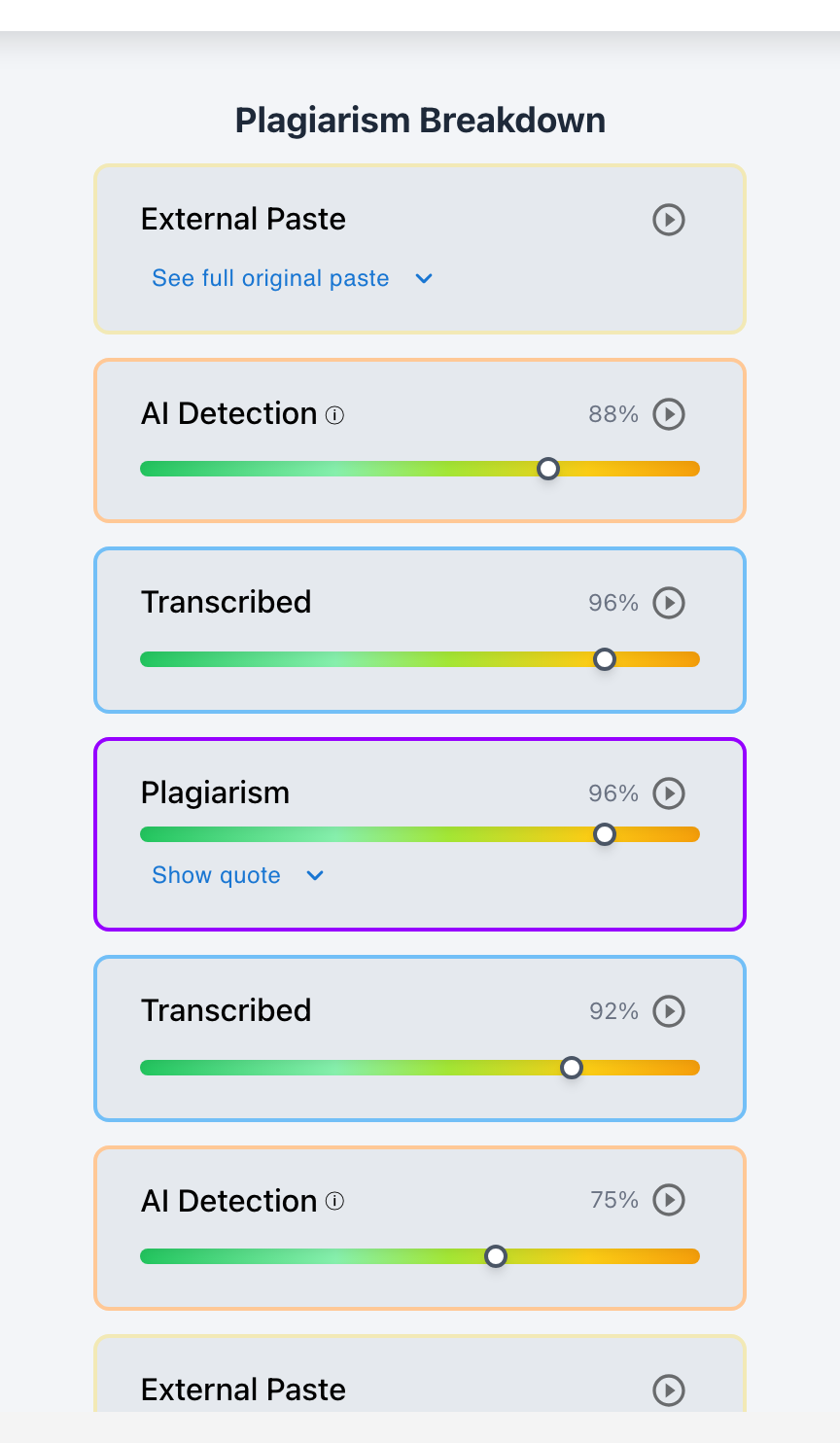
Through Checkmark Plagiarism's Keystroke Timeline & Pause Analytics, educators can visualize pause distributions to verify authentic cognitive effort with precision.
Checkmark Plagiarism powers pause analysis by pairing essay writing playback with AI detection, plagiarism detection, autograding, and integrations with Canvas and Google Classroom.
The 4 Types of Cognitive Pauses in Authentic Writing
1. Micro-Hesitations (1–3 Seconds)
Occur mid-sentence as the writer considers word choices, recalls spelling, or decides between synonyms.
2. Syntactic Pauses (4–10 Seconds)
Occur at commas, semicolons, and periods as the student mentally structures the next independent clause.
3. Macro-Ideation Pauses (20–90 Seconds)
Occur at paragraph transitions as the writer reviews previous arguments, plans the next section, and formulates evidence.
4. Research Pauses (2–8 Minutes)
Occur when the student switches tabs to search a library database, find a direct quotation, or verify an academic citation.
What Inauthentic Pause Profiles Look Like
Artificial shortcuts leave distinct, abnormal pause signatures in keystroke audit logs:
- The Zero-Pause Paste: 1,500 words appear in 0.05 seconds with zero intermediate pauses.
- The Metronomic Gaze-Shift: Rigid, unvarying 2-second pauses between every 5 words as the student glances back and forth at an external phone screen.
- The Flat Speed Profile: Zero hesitation when typing dense, complex academic jargon that should naturally trigger cognitive pausing.
Read more in how Checkmark writing process analysis works.
Comparison: Authentic Cognitive Pauses vs. Transcription Pauses
Authentic Cognitive Pause Distribution
- Variable pause lengths (1s to 90s) reflecting thought depth.
- Frequent macro-pauses at paragraph boundaries.
- Pauses accompanied by 15–30% backspaces and rewrites.
- Multi-minute breaks corresponding to active research.
Transcription / Copying Pause Profile
- Uniform, repetitive 2-second gaze pauses across all text.
- Zero macro-pauses for thesis or argument formulation.
- Near-zero backspaces (<2%) following pauses.
- Entire document typed in an unbroken linear sprint.
A 5-Step Educator Protocol for Analyzing Writing Pauses
Educator Pause Audit Protocol:
- 1. Open the Checkmark Essay Playback report in Canvas SpeedGrader or Google Classroom.
- 2. Review the Pause Distribution histogram to verify the presence of macro-ideation pauses.
- 3. Inspect paragraph transitions to confirm normal human formulation breaks (20–60s).
- 4. Check whether complex vocabulary is preceded by natural micro-hesitations.
- 5. Corroborate pause dynamics with dual AI and plagiarism detection scores.
How Checkmark Plagiarism Powers Pause Analytics
Checkmark Plagiarism combines **AI detection, essay writing playback, static AI detection, plagiarism detection, autograding, and Canvas/Google Classroom integrations** to analyze pause distributions automatically, providing visual proof of authentic student thinking.
Frequently Asked Questions
Why are pauses important in essay writing?
Pauses reflect cognitive effort: writers must pause to formulate thoughts, choose precise words, plan paragraph flow, and review research.
Can writing pauses prove an essay was not generated by AI?
Yes. Natural pause distributions showing variable hesitations and macro-ideation breaks cannot be replicated by AI pastes or robotic transcription.
What if a student takes a 20-minute break during writing?
Checkmark filters out long idle periods, calculating only active typing and normal cognitive formulation pauses for accurate drafting duration metrics.
How does writing playback visualize pauses?
Playback displays color-coded pause markers and velocity histograms on the timeline, allowing teachers to see where the student paused to think.
What is a gaze-shift pause?
A repetitive 2-second pause where a student glances at a secondary screen or phone to read the next phrase before retyping it without revisions.
How does pause analysis protect honest students?
If an articulate student is falsely flagged by an AI detector, their natural cognitive pause timeline proves the essay was composed through human effort.
What if a student writes an essay offline in Word?
Provide your original Word file with version metadata to verify your offline drafting hours and authentic pause history.
How does Checkmark Plagiarism integrate with Canvas LMS?
Checkmark Plagiarism displays visual writing playback timelines, pause histograms, and dual AI/plagiarism scores directly inside Canvas SpeedGrader.
Does pause analysis record student webcams?
No. Pause analysis measures only the time intervals between keystrokes within the document, maintaining complete student privacy.
Why is pause analysis better than static AI detection?
Detectors provide probabilistic estimates, whereas pause analysis provides objective physical proof of human thinking and drafting behavior.
Pauses Are the Footprints of Human Thought
The time spent thinking between keystrokes is where true learning happens. By analyzing pause dynamics and verifying drafting with Checkmark Plagiarism, educators ensure that authentic cognitive effort is recognized, celebrated, and protected.
Checkmark Plagiarism supports this comprehensive approach with AI detection, essay writing playback, static AI detection, plagiarism detection, autograding, and integrations with Canvas and Google Classroom.
See how Checkmark pairs essay writing playback with multi-signal detection to visualize writing pauses and cognitive effort inside your LMS. View a sample report or request a demonstration.