
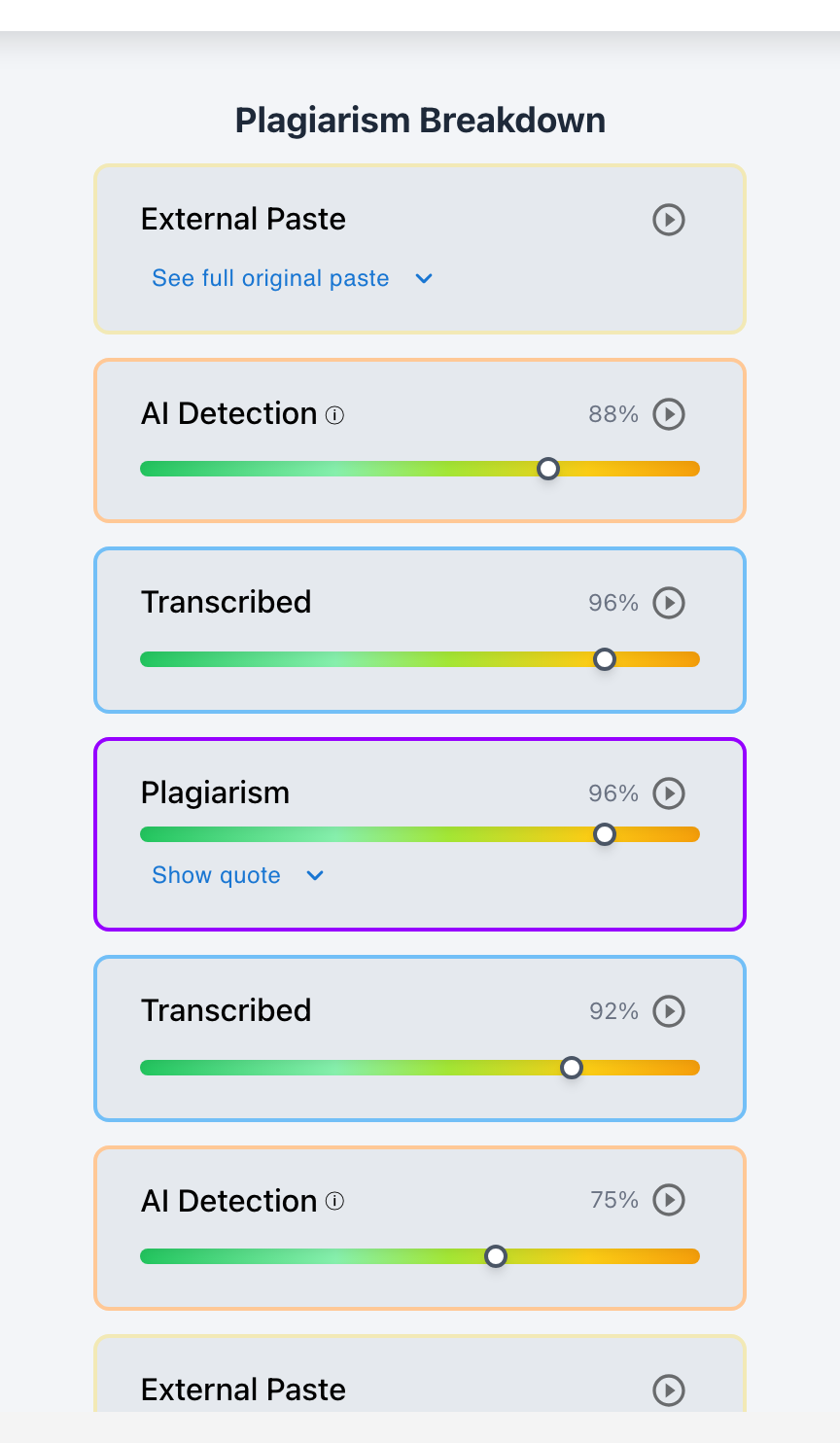
Yes—writing history can provide valuable evidence about how a student created an assignment, but it usually cannot prove by itself that the student used ChatGPT or another AI tool.
Writing history can show patterns such as gradual drafting, large blocks of text appearing at once, extensive revisions, deleted passages, rewritten sections, and minimal editing after a text insertion. Those patterns help teachers understand whether an essay developed through a multi-session drafting process or appeared in a way that warrants further inquiry.
However, writing history has an important limitation: it shows what occurred inside the document, not where the inserted text originated. A large text addition might come from ChatGPT, or it might come from an authentic student draft written in Microsoft Word or notes.
Checkmark Plagiarism helps teachers synthesize process and text evidence through AI detection, essay writing playback, static AI detection, plagiarism detection, autograding, and integrations with Canvas and Google Classroom.
What Is Writing History?
Writing history records how a document developed over time: outlines, rough introductions, multi-session body paragraphs, deleted sentences, added citations, reorganized arguments, and final proofreading. While the submitted paper answers "what was turned in," writing history helps answer "how did this document become what it is?"
Why Is Writing History Useful for AI Investigations?
AI Detection (The Product)
Evaluates statistical language patterns (perplexity, burstiness) in the final submitted text.
Writing Playback (The Process)
Evaluates timeline progression, multi-session keystrokes, revision cycles, and text insertion events over time.
Does a Large Paste Mean a Student Used ChatGPT?
No. When 900 words appear in an instant, it indicates that content was pasted or inserted. However, the source could be an authentic draft from Microsoft Word or Google Docs, research notes, quotations, or generative AI. Always ask: "I noticed this section was added all at once. Can you explain where it was drafted?"
Can Gradual Drafting Prove the Student Did Not Use AI?
No. A student could use AI for brainstorming, outlining, sentence rephrasing, or copy-typing AI generated text. Document history provides crucial context rather than an absolute authorship guarantee.
What Can Writing History Actually Show?
- Gradual Development: Step-by-step building of outlines, body paragraphs, and revisions over days.
- Large Text Additions: Hundreds of words appearing in a single timestamp block.
- Substantive Revisions: Sentences, vocabulary, and structural arguments being revised repeatedly.
- Minimal Revision: Finished academic prose inserted with near-zero subsequent editing.
- Reorganization: Moving paragraphs and refining argumentative flow throughout drafting.
How Checkmark Plagiarism's Essay Writing Playback Helps
Checkmark Plagiarism's essay writing playback allows teachers to examine drafting, large additions, revisions, and editing activity over time. Instead of relying on vague impressions like "this paper sounds like ChatGPT," educators can ask: "I noticed these three paragraphs appeared together. Can you tell me how you created that section?" Read more in how Checkmark writing process analysis works.
Can Writing History Show AI Text Being Edited?
Writing playback can reveal patterns consistent with AI editing: an initial instant block paste followed by sentence-level rephrasing, vocabulary substitution, and paragraph shuffling. However, this same pattern could reflect a student revising their own external draft. Evaluating comprehension and earlier drafts provides the necessary clarity.
Writing History When AI Detection Is Inconclusive
High AI Score + Gradual Drafting
A detector flags formal text, but playback reveals multi-day drafting, heavy revisions, and complete student mastery of the thesis and citations.
Low AI Score + Instant Paste
A detector misses heavily edited AI text, but playback reveals a wholesale paste with non-existent citations and inability to explain key terms.
What If the Student Says They Wrote It Somewhere Else?
Drafting across multiple applications (Word, notes, external Google Docs) is common. Ask whether the earlier draft or version history is available to verify the external writing process.
Writing History vs. AI Detection vs. Plagiarism Detection
Each tool answers a distinct academic integrity question: Plagiarism detection identifies matching web/database sources; AI detection analyzes text characteristics; writing playback reveals document creation progression. Checkmark Plagiarism combines all three for complete evidence clarity.
What If There Is No Writing History?
When students submit PDFs or Word files, Checkmark Plagiarism's static AI detection provides an objective analysis of completed submissions to pair with baseline comparisons, citation checks, and student conferences.
A Practical Writing-History Review Process
A Practical 12-Step Writing-History Review Sequence:
- 1. Review the final assignment submission thoroughly.
- 2. Identify unusual writing-history activity (sudden paste blocks, minimal edits).
- 3. Examine surrounding drafting and revision patterns across the document timeline.
- 4. Compare the submission against previous student work baselines.
- 5. Review AI detection reports as one corroborating signal.
- 6. Check plagiarism detection and suspicious citations in academic databases.
- 7. Ask the student neutrally where large text additions were drafted.
- 8. Inquire about the content and core reasoning of those inserted sections.
- 9. Provide the student an opportunity to share earlier external drafts or version logs.
- 10. Determine whether the student's explanation matches observable document history.
- 11. Compare any outside assistance against the published course policy.
- 12. Follow established school academic-integrity procedures if concerns persist.
How Checkmark Plagiarism Uses Writing Evidence in Practice
Checkmark Plagiarism combines **essay writing playback, AI detection, static AI detection, plagiarism detection, autograding, and Canvas/Google Classroom integrations** to evaluate both the finished essay and the drafting process behind it.
Frequently Asked Questions
Can writing history prove a student used ChatGPT?
Not usually by itself. Writing history shows how a document developed and identifies unusual additions or revision patterns, but it does not establish where inserted text originated.
Does a large paste mean a student used AI?
No. A large text addition could come from AI, but it could also come from an earlier draft in Word, another Google Doc, or research notes.
Can writing history show that a student really wrote an essay?
Writing history provides strong evidence of gradual drafting and revision, but is best considered alongside student explanations and citation checks.
What does suspicious writing history look like?
Large amounts of polished text appearing suddenly, very little revision, or writing patterns inconsistent with the student's explanation may justify further review.
Can a student use AI and still have normal-looking writing history?
Yes. AI used for brainstorming, outlining, or sentence-level rephrasing may not create obvious paste patterns in writing history.
Can writing playback detect edited ChatGPT text?
Writing playback can show an initial large text insertion followed by heavy revisions, which prompts teachers to inquire about the source draft.
What should I ask if writing history shows a large text addition?
Ask: "I noticed this section was added all at once. Can you explain where it came from?" Give the student an opportunity to provide earlier drafts.
What if the student says they drafted the assignment somewhere else?
Take the explanation seriously and, where appropriate, ask whether an earlier draft or version history is available.
Is writing history more reliable than AI detection?
They provide complementary evidence: AI detection analyzes the final product, while writing history shows document creation over time.
How does Checkmark Plagiarism help review writing history?
Checkmark Plagiarism combines essay writing playback, AI detection, static AI detection, plagiarism detection, autograding, and Canvas and Google Classroom integrations.
Writing History Shows the Process—Not Always the Source
Writing history provides invaluable insight into how an assignment was built. By pairing process evidence with AI detection, citation verification, and student conversations, educators can verify authorship fairly and accurately.
Checkmark Plagiarism helps teachers combine writing-process evidence with AI detection, static AI detection, plagiarism detection, autograding, and integrations with Canvas and Google Classroom.
See how Checkmark pairs essay writing playback with multi-signal detection to give teachers complete visibility into student drafting. View a sample report or request a demonstration.