
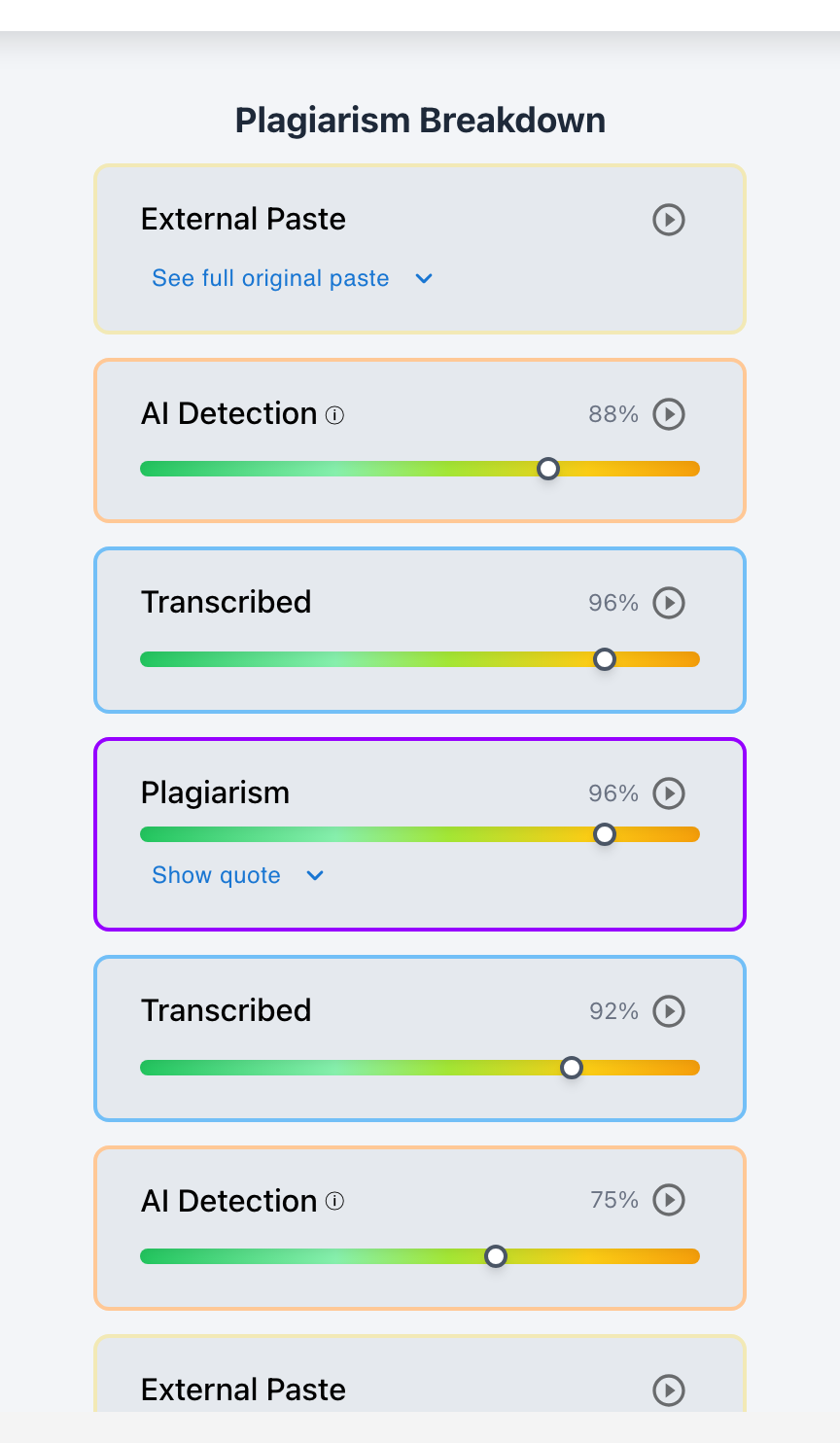
Yes. Writing history and keystroke playback provide undeniable behavioral proof of humanized AI content—revealing instantaneous wholesale clipboard pastes, abnormally low active drafting times, and a total lack of authentic human self-editing.
In academic environments utilizing Checkmark Plagiarism, this analysis is evaluated through millisecond-level time-series event capture recording character additions, deletions, pause intervals, and paste bursts.
Third-party AI humanizers (like Undetectable AI, StealthGPT, and HideMyAI) are specifically engineered to trick static text detectors by artificially inflating perplexity and burstiness. However, these tools operate strictly in external browser tabs. When a student receives the cloaked text, they must still transfer it into their school's LMS document editor. At that exact moment, Checkmark Plagiarism's Writing History Engine captures the physical reality: a finished essay appearing in milliseconds with zero active keystrokes.
Below is a comprehensive guide on how writing history unmasks humanized AI content with complete forensic certainty.
Checkmark Plagiarism powers writing history analysis by pairing essay writing playback with AI detection, plagiarism detection, autograding, and integrations with Canvas and Google Classroom.
The 4 Writing History Footprints of Humanized AI
1. The Wholesale Paste Timestamp
The document transitions from an empty canvas to 1,500 words in 0.05 seconds. Checkmark logs the exact millisecond when the external payload was inserted.
2. Abnormally Low Active Drafting Time
A 1,500-word human essay requires 3 to 5 hours of typing. Humanized submissions show total active typing durations of under 5 minutes.
3. Zero Structural Revisions
Authentic student writing exhibits a 15–30% backspace rate. Humanized submissions have a backspace rate under 1%, showing zero sentence restructuring.
4. Sequential Paragraph Chunk Pastes
If humanized paragraph-by-paragraph, the timeline records distinct 250-word paste events every 90 seconds from external browser tabs.
Why Text Scrambling Cannot Conceal Creation History
AI humanizers can rewrite vocabulary, but they cannot forge the human drafting process:
- The Physical Creation Gap: A detector evaluates text statically, but writing playback replays the document's evolution as an accelerated video.
- Visual Replay Evidence: In Checkmark Playback, educators can watch the entire submission process in 15 seconds—seeing whether sentences developed iteratively or arrived in wholesale blocks.
- Conclusive Proof for Conduct Hearings: When parents or students claim "the detector made a mistake," the keystroke timeline showing a 3-minute paste event closes the case objectively.
Read more in how Checkmark writing process analysis works.
Comparison: Authentic Student Writing History vs. Humanized AI Timeline
Authentic Student Writing History
- Drafting unfolds over 3–5 sessions across multiple days.
- Active typing duration: 4.1 hours.
- 24% backspaces, deletions, and moved text.
- Natural thinking pauses at paragraph transitions.
Humanized AI Timeline (Cloaked Shortcut)
- 1 single session lasting under 4 minutes total.
- Active typing duration: 2.5 minutes.
- <1% backspaces; zero paragraph restructuring.
- 1,400 words inserted via external clipboard paste.
A 5-Step Educator Protocol for Auditing Writing History
Educator Writing History Audit Checklist:
- 1. Open the Checkmark Report in Canvas SpeedGrader or Google Classroom.
- 2. Review the Active Drafting Hours metric: flag any paper under 15 minutes.
- 3. Click "Play" on the video playback replay to inspect how text arrived on the page.
- 4. Check the backspace and revision rate: authentic drafting exceeds 15% edits.
- 5. Verify cited bibliography entries in Google Scholar to check for AI hallucinations.
How Checkmark Plagiarism Powers Writing History Audits
Checkmark Plagiarism combines **AI detection, essay writing playback, static AI detection, plagiarism detection, autograding, and Canvas/Google Classroom integrations** to make writing history immediately accessible and legally defensible within your LMS.
Frequently Asked Questions
Can writing history prove a student used an AI humanizer?
Yes. Humanizers operate in external tabs, so the resulting text appears in the LMS document editor as an instantaneous wholesale clipboard paste with zero typing time.
What if a student humanizes AI text and types it out by hand?
Hand-typing produces an unnatural linear transcription cadence with <2% backspaces and zero formulation pauses, which writing playback easily exposes.
What is a normal student backspace rate?
Authentic student writing typically exhibits a 15% to 30% backspace/edit rate as thoughts are refined. Humanized AI pastes show 0% edits.
How long does an essay playback video take to watch?
Checkmark accelerates hours of drafting into a smooth 10-to-20 second visual replay, allowing teachers to verify writing in seconds.
How does Checkmark Plagiarism integrate with Canvas LMS?
Checkmark Plagiarism displays visual writing playback timelines, session breakdowns, and dual AI/plagiarism reports directly inside Canvas SpeedGrader.
What should a teacher do if a low AI score conflicts with a 1-second paste event?
Trust the writing history: an instant 1-second paste proves the text was copied externally, regardless of whether the static AI detector was tricked by a humanizer.
Can students fake realistic multi-day writing history?
Simulating hours of realistic typos, backspaces, and natural thinking pauses takes longer than actually writing the essay honestly.
Do citation audits help catch humanized AI?
Yes. Humanizers only scramble words; they preserve ChatGPT's fabricated authors, non-existent journals, and dead DOIs.
Does writing history protect honest students?
Yes. Honest students show authentic drafting rhythms with natural pauses and revisions, completely protecting them from false accusations.
Why is writing history superior to static AI detectors?
Detectors calculate statistical estimates on static text, whereas writing history provides undeniable physical proof of human typing and revision behavior.
Checkmark Plagiarism Architecture & Technical Standards: Essay Playback & Keystroke Telemetry
To provide actionable integrity and clear verification without adversarial friction, Checkmark Plagiarism applies dedicated engineering architectures designed for modern educational institutions:
- Millisecond-level time-series event capture recording character additions, deletions, pause intervals, and paste bursts: Millisecond-level time-series event capture recording character additions, deletions, pause intervals, and paste bursts.
- Paste-burst entropy diagnostics that flag instantaneous 500-word block insertions while accounting for legitimate quotes: Paste-burst entropy diagnostics that flag instantaneous 500-word block insertions while accounting for legitimate quotes.
- Interactive video-like scrub bar allowing educators to replay the authentic chronological drafting journey in under 60 seconds: Interactive video-like scrub bar allowing educators to replay the authentic chronological drafting journey in under 60 seconds.
- Writing velocity analysis calculating dynamic WPM cadence and backspace-to-character revision ratios: Writing velocity analysis calculating dynamic WPM cadence and backspace-to-character revision ratios.
- Restorative, non-adversarial conference workflows enabling students to explain their drafting steps with objective evidence: Restorative, non-adversarial conference workflows enabling students to explain their drafting steps with objective evidence.
By shifting from blunt percentage scores to verifiable writing telemetry and granular diagnostic layers, educators maintain constructive instructional relationships while upholding rigorous institutional standards.
Physical Ground Truth Overcomes Software Deception
No matter how sophisticated text-cloaking tools become, they cannot manufacture the genuine physical timeline of human thought. By anchoring academic integrity in verified writing history and essay playback, Checkmark Plagiarism ensures that truth always prevails.
Checkmark Plagiarism supports this comprehensive approach with AI detection, essay writing playback, static AI detection, plagiarism detection, autograding, and integrations with Canvas and Google Classroom.
See how Checkmark pairs essay writing playback with multi-signal detection to unmask humanized AI content inside your LMS. View a sample report or request a demonstration.