
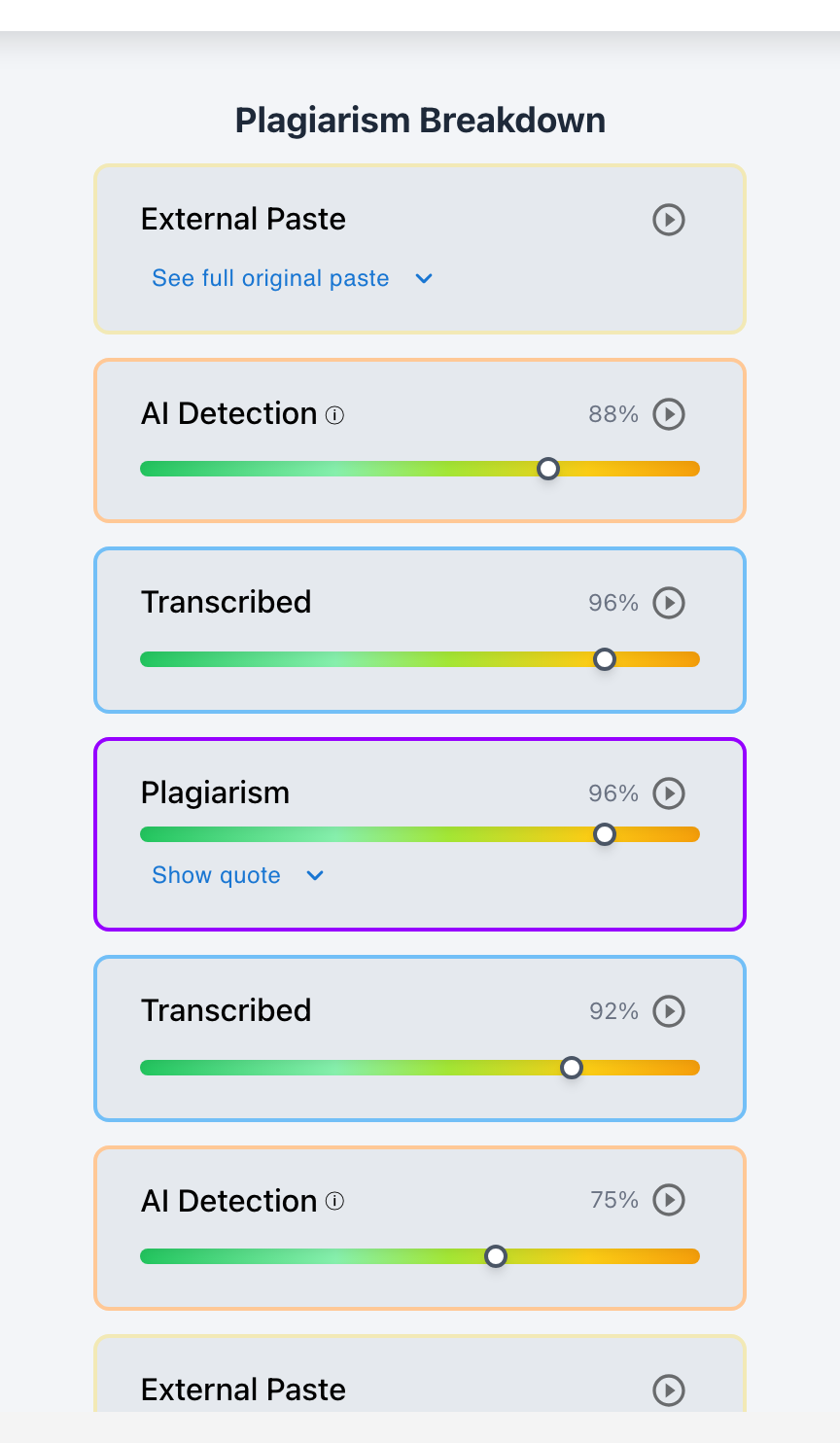
Yes. Writing-process analysis and keystroke dynamics provide behavioral evidence that clearly distinguishes between authentic intellectual composition and manual copying.
Every keystroke pressed on a keyboard carries a temporal signature: the time it took to press the key, the hesitation before the next word, the frequency of backspaces, and the duration of thinking pauses. When a student composes an authentic essay, their typing patterns reflect cognitive struggle—brainstorming, pausing, erasing, restructuring, and refining. In contrast, when a student copies text from another screen (such as ChatGPT, a phone, or a classmate's paper), their typing patterns reveal a mechanical transcription cadence.
Through Checkmark Plagiarism's Writing-Process Analysis, educators can visualize typing dynamics to uncover copying with objective, indisputable evidence.
Checkmark Plagiarism powers writing-process analysis by pairing essay writing playback with AI detection, plagiarism detection, autograding, and integrations with Canvas and Google Classroom.
The 4 Telltale Typing Patterns of Copying
1. The Linear Waterfall
The essay is typed strictly from the first word of the introduction to the last word of the conclusion in a single continuous stream with zero backtracking or sentence reorganization.
2. The Gaze-Shift Chunk Cadence
A rhythmic cycle of typing 4–6 words in 1.5 seconds, pausing for 2 seconds to glance at a secondary screen or phone, and repeating with zero cognitive pauses.
3. The Vanishing Revision Rate
Authentic drafting exhibits a 15–30% backspace rate. Copying produces an edit rate below 2%, with zero clause restructuring or deleted paragraphs.
4. Flat Vocabulary Velocity
Authentic writers slow down when typing complex, unfamiliar terminology. When copying, typing speed remains completely flat across all words.
What Checkmark Writing-Process Analysis Visualizes
In Checkmark Plagiarism's Essay Playback, typing patterns are transformed into clear visual evidence:
- Accelerated Video Replay: Watch an accelerated 10-second visual replay showing how every paragraph, pause, and sentence unfolded over time.
- Active Drafting Summary: Displays total active typing time vs. idle document time, highlighting impossible drafting speeds.
- Color-Coded Event Map: Displays authentic typing in green, human revisions in blue, and instant paste events in amber.
Read more in how Checkmark writing process analysis works.
Comparison: Authentic Drafting Patterns vs. Copying Typing Patterns
Authentic Drafting Patterns
- Variable typing speed based on cognitive difficulty.
- 15–30% backspaces, typos, and sentence rewrites.
- Thinking pauses (20–90 seconds) at paragraph breaks.
- Non-linear drafting across multiple distinct sessions.
Copying / Transcription Patterns
- Flat, unvarying typing speed across simple and complex words.
- <2% backspace rate; zero paragraph reorganization.
- Metronomic 2-second gaze-shift reading pauses.
- Entire essay typed linearly in a single continuous burst.
A 5-Step Educator Protocol for Investigating Typing Patterns
Educator Process Audit Checklist:
- 1. Open the Checkmark Essay Playback report in Canvas SpeedGrader or Google Classroom.
- 2. Review the session breakdown to evaluate total active typing duration and session count.
- 3. Inspect the backspace and deletion rate: authentic student drafting exceeds 15%.
- 4. Cross-reference with dual AI detection and direct plagiarism database matches.
- 5. Hold a supportive conference asking the student to explain their drafting choices.
How Checkmark Plagiarism Powers Writing-Process Analysis
Checkmark Plagiarism combines **AI detection, essay writing playback, static AI detection, plagiarism detection, autograding, and Canvas/Google Classroom integrations** to turn typing patterns into objective, actionable proof of authentic student authorship.
Frequently Asked Questions
Can teachers really tell I was copying just from my typing speed?
Yes. Typing patterns reveal when text is being transcribed from another source due to the lack of thinking pauses, near-zero backspaces, and linear execution.
What if I am naturally a fast and accurate typist?
Fast human typists still pause to think between arguments, delete words to improve phrasing, and organize their work non-linearly over multiple sessions.
How does writing playback prove an essay was copied from another screen?
Playback shows unbroken linear typing from start to finish without brainstorming pauses, deleted sentences, or structural reorganization.
Can students fake authentic typing patterns?
Simulating hours of realistic hesitation, spontaneous backspacing, and variable cognitive pauses takes longer than writing the essay honestly.
What is a normal student backspace rate?
Authentic student writing typically exhibits a 15% to 30% backspace/edit rate as thoughts are refined. Copying rates are usually under 2%.
What should a teacher do if copying patterns are detected?
Review the playback timeline alongside AI probability scores and citation audits, and hold a supportive conference to evaluate conceptual mastery.
How does Checkmark Plagiarism integrate with Canvas LMS?
Checkmark Plagiarism displays visual writing playback replays, keystroke velocity graphs, and pause histograms directly inside Canvas SpeedGrader.
Does writing-process analysis protect honest students?
Yes. Honest students show authentic drafting rhythms with natural pauses and revisions, completely protecting them from false accusations.
Can writing-process analysis detect copied math or code?
Yes. Coding and problem-solving exhibit distinctive debugging pauses and syntax revisions that separate original work from copied solutions.
Why is writing-process analysis better than static AI detection?
Detectors provide probabilistic estimates, whereas writing-process analysis provides objective physical proof of human typing and revision timelines.
Behavioral Integrity Defends True Scholarship
Writing is a reflection of the human mind at work. By capturing the authentic cadence of composition and pairing playback with student dialogue, Checkmark Plagiarism ensures that genuine intellectual effort is celebrated, evaluated, and protected with absolute fairness.
Checkmark Plagiarism supports this comprehensive approach with AI detection, essay writing playback, static AI detection, plagiarism detection, autograding, and integrations with Canvas and Google Classroom.
See how Checkmark pairs essay writing playback with multi-signal detection to analyze typing patterns and writing processes inside your LMS. View a sample report or request a demonstration.