
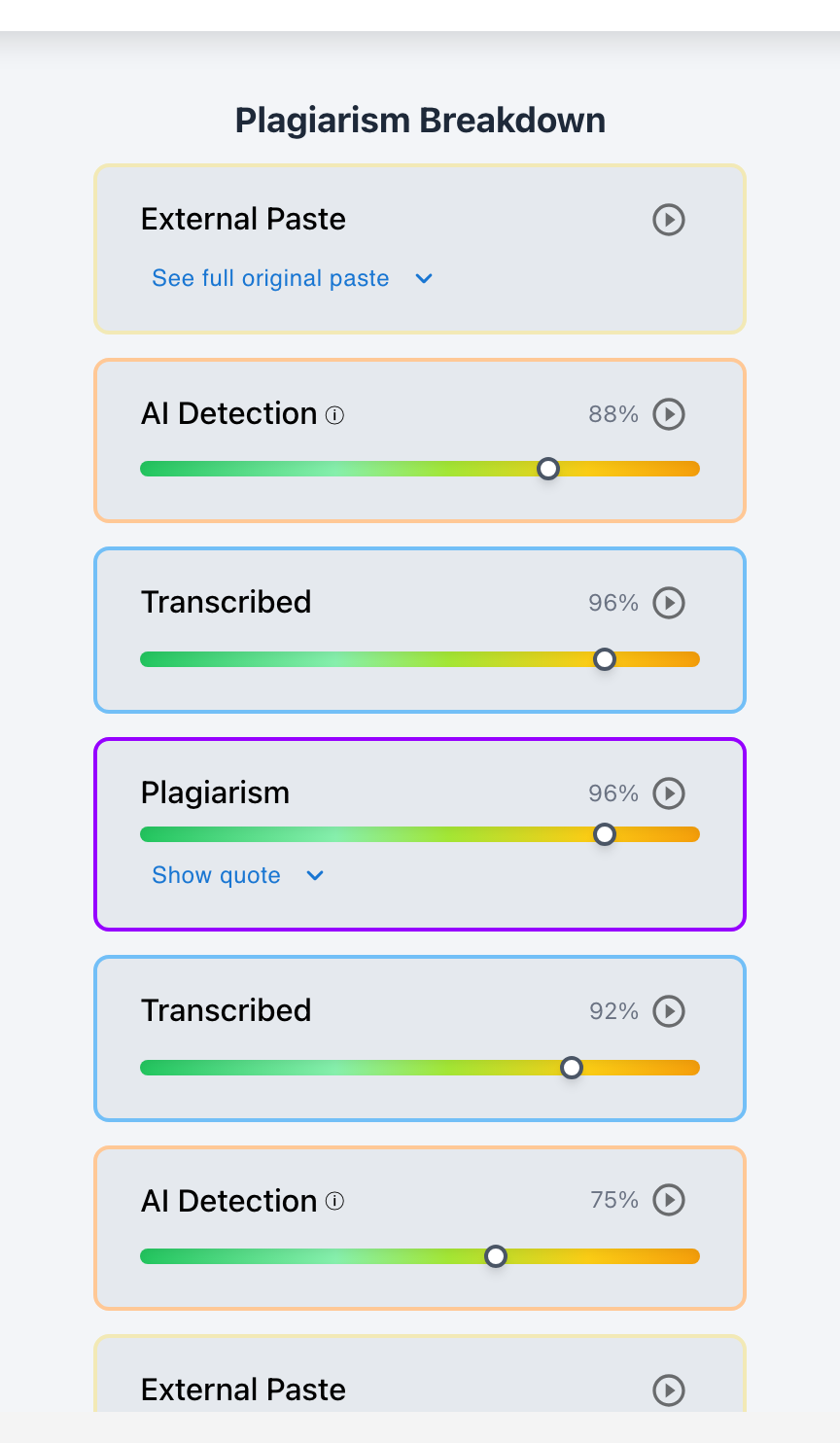
Yes. Teachers can see whether students used ChatGPT through document creation timelines, writing playback logs, version history metadata, and citation audits.
Many students mistakenly believe that because ChatGPT generates unique text without copying from an existing website, its use is invisible. While instructors cannot literally watch a student's private screen outside of proctored testing, generative AI leaves unmistakable digital, process, and physical footprints throughout the document lifecycle.
From instant wholesale paste events and zero-minute drafting sessions to hallucinated academic citations and statistical predictability maps, modern educational platforms provide teachers with comprehensive visibility into how an essay was assembled.
Checkmark Plagiarism gives educators complete process transparency by combining AI detection with essay writing playback, static AI detection, plagiarism detection, autograding, and integrations with Canvas and Google Classroom.
The 5 Digital Footprints Teachers Can See
1. Essay Writing Playback Timelines
Teachers can watch the exact assembly of the document: active keystroke duration, typing speed anomalies, and wholesale paste timestamps.
2. Document Version History
Revision logs in Google Docs and Word reveal when 1,200 words suddenly appear in a single revision snapshot with zero prior drafting.
3. Citation Hallucinations
Searching academic indices (JSTOR, Google Scholar) reveals non-existent journal titles, fabricated authors, and fake DOIs invented by AI.
4. Statistical Language Predictability
AI detection algorithms highlight paragraph-level perplexity and burstiness patterns characteristic of large language models.
1. What Essay Writing Playback Reveals to Teachers
The most direct visibility comes from Checkmark Plagiarism's essay writing playback. Rather than guessing from the final static text, teachers can watch the creation process unfold like a video replay:
- Active Drafting Time vs. Idle Time: Shows whether a 1,500-word essay was drafted over 4 hours of typing or assembled in 6 minutes of document activity.
- Instant Paste Blocks: Highlights the exact timestamp when a complete essay was copied and pasted into the document from an external source.
- Editing Depth: Shows whether the student engaged in authentic drafting—backspacing, reorganizing paragraphs, rephrasing sentences—or submitted pasted text with zero edits.
Read more in how Checkmark writing process analysis works.
2. What LMS and Learning Platforms Track
Integrated learning management systems (Canvas, Google Classroom) provide contextual metadata:
- Submission Timestamps: Submitting a complex 2,000-word research essay 20 minutes after the assignment was opened.
- External File Upload Metadata: Inspecting creation dates and author metadata in uploaded Microsoft Word or PDF files.
3. What Students Think Teachers See vs. Reality
What Students Assume
- "If I paste ChatGPT text and change 5 words, it looks like I wrote it."
- "Because it's not plagiarized from a website, teachers have no proof."
- "Teachers only see the final submitted PDF."
What Teachers Actually See
- Writing playback captures the exact paste timestamp and the 5 minor edits.
- Citation audits catch 3 non-existent academic articles in the bibliography.
- AI detection scans highlight uniform 20-word sentence predictability maps.
4. The Inability to Fake Authentic Oral Comprehension
Even if a student attempts to disguise digital footprints, teachers see the disconnect during real-time student conferences:
- Asking the student to explain the thesis in their own words.
- Asking the student to define advanced technical vocabulary used in the paper.
- Asking how they located specific sources in the bibliography.
A student who spent hours writing an essay understands their own work. An inability to explain basic arguments is immediately obvious to educators. Read our guide on what questions should I ask a student about a suspicious assignment?
A 6-Point Educator Visibility Audit Protocol
Educator Protocol to Check Document Creation:
- 1. Check essay writing playback logs for active drafting duration and paste events.
- 2. Inspect document revision history for sudden multi-paragraph insertions.
- 3. Audit cited sources in academic databases (JSTOR, Google Scholar) for hallucinations.
- 4. Review AI detection probability heatmaps for low perplexity clusters.
- 5. Compare submission against 2–3 verified historical baseline writing samples.
- 6. Conduct a brief student conference to verify oral conceptual comprehension.
How Checkmark Plagiarism Provides Complete Visibility
Checkmark Plagiarism combines **AI detection, essay writing playback, static AI detection, plagiarism detection, autograding, and Canvas/Google Classroom integrations** to make the writing process 100% visible, ensuring academic standards are transparently and fairly upheld.
Frequently Asked Questions
Can teachers see if you copy and paste ChatGPT into Google Docs?
Yes. Google Docs version history and Checkmark essay writing playback record the exact timestamp, character count, and location of wholesale paste events.
Can teachers see what you type in real time?
Through essay writing playback, teachers can review a complete replay of typing sessions, keystrokes, active drafting time, and revision cycles after submission.
Can Canvas detect ChatGPT?
Canvas tracks submission times and activity logs, but integrating Checkmark Plagiarism into Canvas provides direct AI detection, writing playback, and citation audits.
What if a student writes an essay in Microsoft Word and pastes it in?
Teachers see the paste event and ask the student to provide the original Word file with version history or timestamp metadata to confirm authentic drafting.
Can teachers tell if a student used ChatGPT to write an outline?
If the student drafted the actual essay independently, writing playback shows multi-session typing and revision, confirming authentic authorship of the final text.
Why do fake citations give away ChatGPT use?
ChatGPT invents non-existent journal titles, authors, and DOIs. When teachers search academic databases and find no record of the sources, it confirms AI generation.
Can paraphrasing ChatGPT hide it from teachers?
Paraphrasing may alter surface wording, but document playback logs (showing zero typing time) and lack of oral comprehension still reveal the shortcut.
What if an authentic student writes very quickly?
Writing playback distinguishes fast typing (with continuous keystrokes, typos, and backspaces) from instant wholesale paste events.
Can a teacher prove ChatGPT use without an AI detector?
Yes. Playback logs showing wholesale pastes, non-existent citations, and oral comprehension failure provide complete, defensible proof without relying on detector scores.
How does Checkmark Plagiarism give teachers full visibility?
Checkmark Plagiarism captures visual drafting playback, runs dual AI/plagiarism scans, validates sources, and integrates directly with Canvas and Google Classroom.
Process Transparency Protects Authentic Learning
Digital footprints, document creation playback, citation audits, and student dialogue make ChatGPT usage visible to educators. By focusing on process transparency rather than just the final text, teachers celebrate genuine student effort while upholding academic standards.
Checkmark Plagiarism supports this transparent approach with AI detection, essay writing playback, static AI detection, plagiarism detection, autograding, and integrations with Canvas and Google Classroom.
See how Checkmark pairs essay writing playback with multi-signal detection to give teachers 100% visibility into document creation. View a sample report or request a demonstration.