
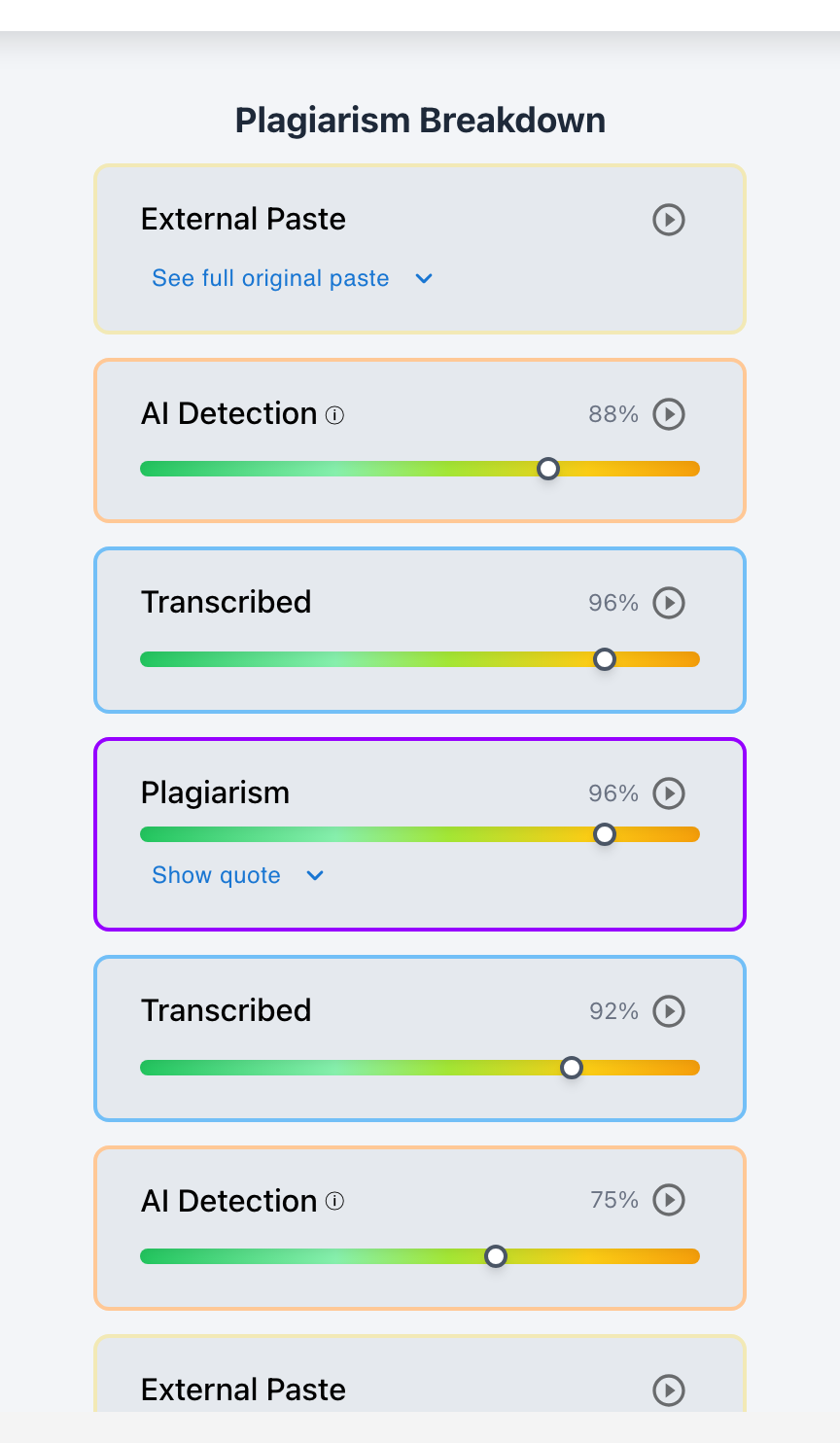
Yes. Teachers can easily detect students sharing or recycling old assignments from previous years through four forensic mechanisms: multi-year institutional repositories that index historical student submissions across semesters, prompt-evolution mismatches (where the recycled paper answers an older version of the prompt), stylometric disconnects with the student's in-class baseline, and writing playback telemetry showing a zero-drafting paste event.
A classic tactic in academic cheating is borrowing assignments from students who took the course in previous years—such as older siblings, friends who graduated, or fraternity and sorority "paper banks." Students often assume that because the essay is not published on the public internet, no plagiarism checker can find it. Modern integrity infrastructure closes this loophole by maintaining private, encrypted institutional archives that check new submissions against every paper ever submitted at the school. Checkmark Plagiarism pairs institutional matching with keystroke process telemetry to make recycling old assignments impossible to conceal.
Below is a comprehensive guide on how teachers detect and investigate recycled assignments from past school years.
Checkmark Plagiarism detects recycled assignments by pairing plagiarism detection with AI detection, essay writing playback, autograding, and integrations with Canvas and Google Classroom.
The 4 Forensic Red Flags of Recycled Assignments
1. Multi-Year Institutional Archive Matches
Checkmark automatically cross-checks new submissions against all papers submitted in previous school years, flagging exact matches with past student files.
2. Prompt Evolution Inconsistencies
The recycled essay answers a prompt from Fall 2024 (e.g., analyzing 3 themes) instead of the updated Fall 2026 prompt (which required 4 specific case studies).
3. Zero-Drafting Telemetry in Playback
Checkmark Playback shows the entire 2,000-word essay appeared in a single 0.05-second clipboard paste payload with zero active drafting or revision time.
4. Baseline Stylometric Disconnect
The recycled paper's vocabulary tier and syntax complexity radically diverge from the student's Week 1 In-Class Diagnostic baseline profile.
How Institutional Repositories Work Safely
Understanding how school archives preserve integrity while protecting student privacy:
- Encrypted Private Indexing: Papers submitted to Checkmark are indexed in an encrypted school repository, inaccessible to outside web crawlers or public internet searches.
- FERPA Compliance: When a match occurs with a past student, the platform alerts the teacher while maintaining appropriate student privacy protocols.
- Cross-Department Protection: The repository indexes papers across all teachers in the department, preventing students from submitting the same history paper in English class.
Read more in how Checkmark writing process analysis works.
Comparison: New Student Composition vs. Recycled Past Assignment
New Student Composition (Authentic)
- Drafted across multiple sessions with 20%+ backspaces.
- Directly answers the current updated prompt requirements.
- 0% match against institutional archives.
- Student speaks fluently about their arguments in person.
Recycled Past Assignment (Plagiarism)
- Pasted in 0.05s with zero drafting history in Playback.
- Subtle prompt mismatches from older syllabus versions.
- 95%+ match against Fall 2024 institutional archive.
- Student cannot explain complex terminology used in paper.
A 5-Step Educator Protocol for Recycled Paper Inquiries
Recycled Assignment Audit Checklist:
- 1. Open the student's submission in Checkmark Plagiarism inside Canvas SpeedGrader.
- 2. Review the Institutional Match report: check the date and course section of the matched historical paper.
- 3. Inspect the Writing Playback timeline: verify whether the text entered via an instant paste event.
- 4. Check the current prompt requirements against the submitted text to spot prompt version discrepancies.
- 5. Hold a 2-minute conference: show the historical match card and follow school academic honesty policy.
How Checkmark Plagiarism Powers Institutional Memory
Checkmark Plagiarism combines **AI detection, essay writing playback, static AI detection, plagiarism detection, autograding, and Canvas/Google Classroom integrations** to maintain secure, multi-year institutional repositories that detect recycled student work automatically.
Frequently Asked Questions
Can a plagiarism checker find an essay written by an older sibling 3 years ago?
Yes. If the older sibling submitted the paper through Canvas or Google Classroom at the same school, Checkmark's institutional repository will flag the exact match.
What if a student changes a few words in an old paper?
Checkmark's Semantic Plagiarism Engine detects matching structural logic, argument progressions, and paragraph blocks even when minor edits are made.
How does prompt tweaking help catch old assignments?
Changing minor details in the prompt each semester (e.g., changing required primary sources or case study dates) instantly exposes students who submit unedited older papers.
What does a recycled paper look like in Writing Playback?
Playback shows the entire paper appearing in a single clipboard paste within minutes of creating the document, with <1% backspaces.
Is using an old paper considered academic dishonesty?
Yes. Submitting work completed by someone else—or recycling your own previous work without permission (self-plagiarism)—violates standard academic integrity policies.
How does Checkmark Plagiarism integrate with Canvas LMS?
Checkmark provides certified LTI 1.3 integration, SpeedGrader sidebar embeds, two-way grade passback, and single sign-on (SSO).
Are student papers in the institutional repository shared with other schools?
School administrators can configure repository sharing settings to keep archives strictly internal or participate in secure multi-school consortiums.
What if a student claims they wrote the same paper by coincidence?
The mathematical probability of two students writing identical 1,500-word essays with identical sentences and citations independently is zero.
How can teachers design prompts that resist recycling?
Incorporate current events, specific classroom discussions, or localized school data into assignment rubrics each year.
Why is institutional memory essential for academic integrity?
Because historical student paper sharing is a widespread offline cheating vector that web-only scanners completely fail to detect.
Protecting Academic Standards Across School Generations
Educational integrity requires maintaining standards year after year. By leveraging multi-year institutional repositories and writing playback telemetry with Checkmark Plagiarism, educators ensure that past student work cannot be recycled and that every grade reflects genuine, current student effort.
Checkmark Plagiarism supports this comprehensive approach with AI detection, essay writing playback, static AI detection, plagiarism detection, autograding, and integrations with Canvas and Google Classroom.
See how Checkmark pairs institutional repository matching with writing playback to catch recycled student work. View a sample report or request a demonstration.