
Yes. Teachers can detect students copying from each other through automated peer submission matching, institutional repository cross-indexing, and timestamped writing history analytics.
One of the most common forms of academic dishonesty is peer collaboration that crosses the line into unauthorized copying—whether sharing an essay draft with a friend in another class section, copying homework answers, or purchasing a paper from an older sibling who took the course previously. Because these papers do not exist on the public internet, traditional search engines cannot find them. However, modern plagiarism platforms index every submission into a private, institutional database to catch peer-to-peer copying instantly.
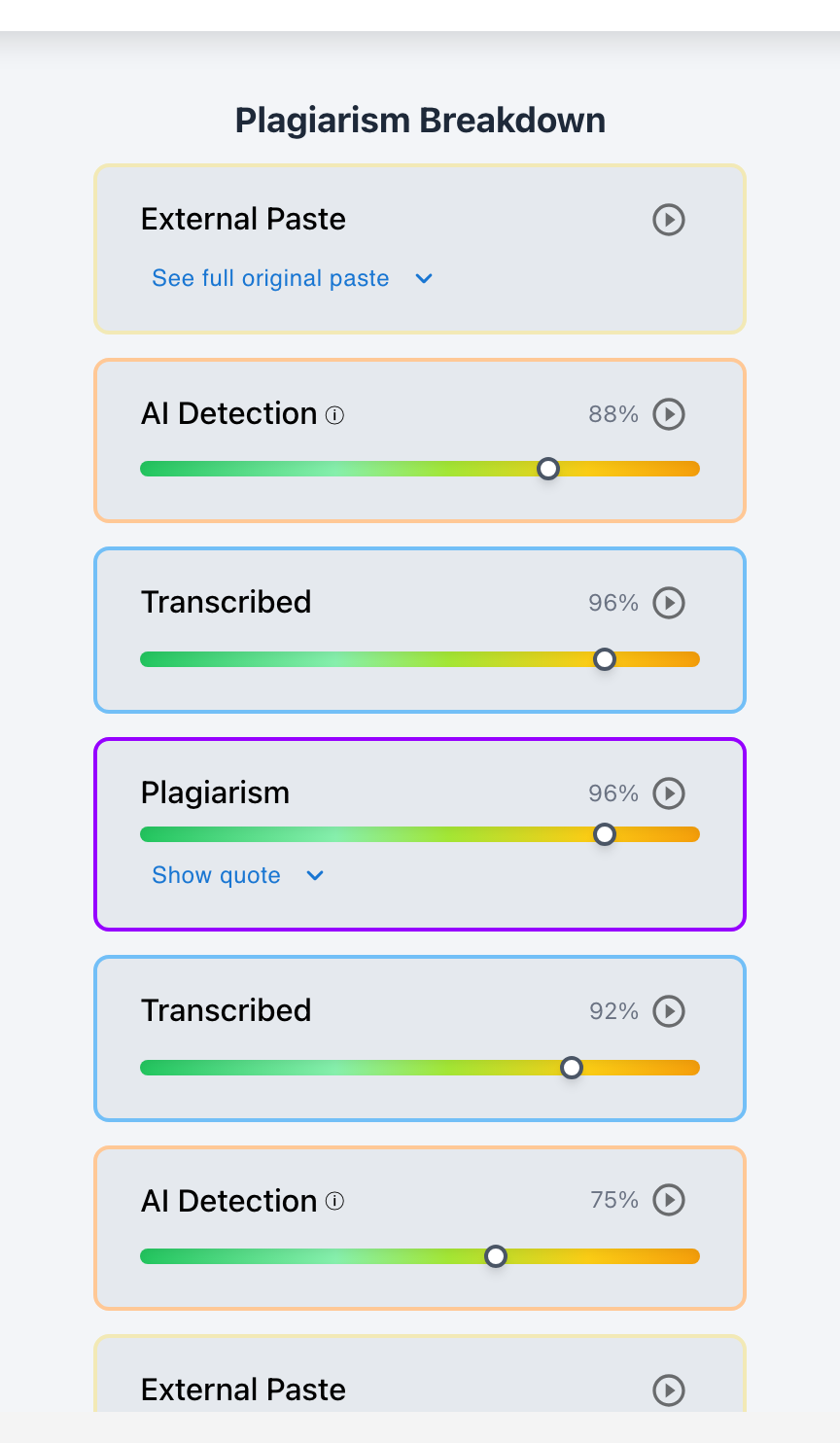
Through Checkmark Plagiarism's Peer Submission Matching, essays are automatically cross-referenced against all classmates, other course sections, and historical school archives.
Checkmark Plagiarism powers peer matching by pairing plagiarism detection with essay writing playback, AI detection, autograding, and integrations with Canvas and Google Classroom.
The 4 Mechanisms of Peer Submission Matching
1. Batch Class Cross-Scanning
Every essay submitted to an assignment is cross-matched against every other student's submission simultaneously upon deadline completion.
2. Multi-Section & Period Matching
Checks submissions across different class periods and teachers within the same school or district, catching shared papers across schedules.
3. Historical Multi-Year Indexing
Maintains a secure private repository of all assignments submitted in previous semesters and years to prevent reusing older student essays.
4. Semantic & Paraphrased Peer Matching
Detects when Student B rewrote or synonymized Student A's paper, matching identical underlying sentence structures and thesis flows.
How to Tell Who Copied from Whom
When two essays match, teachers face the crucial question: Who was the original author, and who was the copier? Checkmark provides clear forensic answers:
- Keystroke Writing Playback: The original author's document will show hours of multi-session drafting, high backspace rates (15–30%), and natural pauses. The copier's document will show an instant wholesale paste or an unbroken linear transcription.
- Document Creation Timestamps: Shows which document was created first and when the shared text was initially typed.
- Original Paste Preservation: Highlights the exact moment the copied text entered the second student's document.
Read more in how Checkmark writing process analysis works.
Comparison: Original Student Author vs. Peer Copier
Original Student Author (Creator)
- Drafting history spans 4 days (3.8 active hours).
- 22% backspace and revision rate (heavy self-editing).
- Document created days before peer submission.
- Fluently explains thesis, sources, and ideas orally.
Peer Copier (Unauthorized Recipient)
- Document contains 1 paste event lasting 3 minutes total.
- <2% backspace rate; zero structural edits.
- Document created hours before assignment deadline.
- Struggles to explain arguments or defined terms.
A 5-Step Educator Protocol for Investigating Peer Copying
Educator Peer Copying Investigation Protocol:
- 1. Open the Checkmark Plagiarism report to view side-by-side matching peer papers.
- 2. Compare the creation timestamps and active typing hours for both students in Playback.
- 3. Identify the original author through high revision rates and multi-day drafting.
- 4. Identify the copier through instant paste events or linear transcription logs.
- 5. Hold separate conferences with each student to discuss academic integrity policies.
How Checkmark Plagiarism Powers Peer Detection
Checkmark Plagiarism combines **AI detection, essay writing playback, static AI detection, plagiarism detection, autograding, and Canvas/Google Classroom integrations** to make peer submission matching instant, automatic, and fully defensible within your LMS.
Frequently Asked Questions
Can plagiarism checkers detect copying from another student in the same class?
Yes. Checkmark cross-scans all student submissions within the same class section and assignment batch immediately upon submission.
Can plagiarism checkers catch copying across different class periods?
Yes. Submissions are indexed across all course sections, teachers, and school-wide repositories in real time.
What if a student uses an essay submitted last year by another student?
Checkmark maintains a multi-year institutional archive that flags matching text from prior semesters and academic years.
How can a teacher prove which student wrote the essay first?
Checkmark Writing Playback shows active typing duration, backspaces, and timestamps—proving who authored the draft and who pasted it.
What if two students collaborated legitimately on a group project?
Teachers can mark group assignments in Checkmark or dismiss matching peer cards with one click, preventing false plagiarism flags.
How does Checkmark Plagiarism integrate with Canvas LMS?
Checkmark Plagiarism displays visual writing playback timelines, side-by-side peer comparisons, and dual AI/plagiarism reports directly inside Canvas SpeedGrader.
What if a student changes every third word from their friend's essay?
Checkmark's semantic matching detects matching sentence structures, argument flows, and paraphrased clauses across peer submissions.
Does peer submission matching violate student privacy?
No. Papers are securely stored in the school's private institutional repository and are never published publicly or shared with third parties.
What should a teacher do if both students claim they wrote the paper?
Compare the writing playback timelines and conduct a 2-minute oral check-in with each student asking them to explain the thesis and sources.
Why is peer matching essential in high schools and colleges?
Because peer-to-peer sharing is one of the most common forms of cheating and cannot be detected by standard web search engines.
Defending Originality Across the Entire School
Peer copying undermines fairness and academic rigor. By connecting institutional repository indexing with essay writing playback and timestamped creation analytics, Checkmark Plagiarism ensures that every student's individual intellectual labor is verified and protected.
Checkmark Plagiarism supports this comprehensive approach with AI detection, essay writing playback, static AI detection, plagiarism detection, autograding, and integrations with Canvas and Google Classroom.
See how Checkmark pairs essay writing playback with multi-signal detection to identify peer-to-peer copying inside your LMS. View a sample report or request a demonstration.