
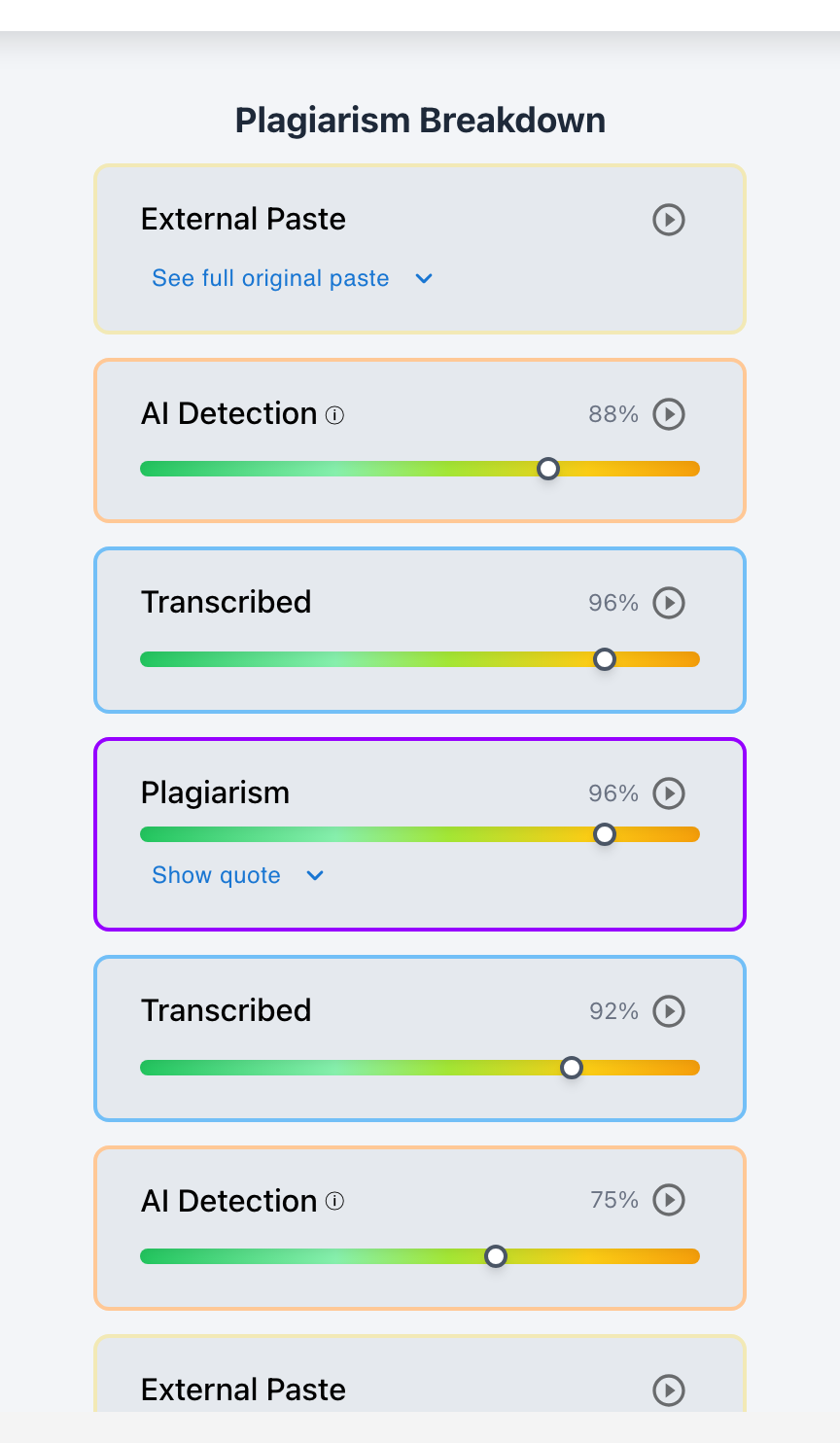
Yes. Teachers can detect partial AI use in an essay with high precision—because modern integrity platforms analyze text at the sentence and paragraph level rather than treating the essay as a single block. By evaluating sentence-by-sentence perplexity heatmaps, syntactic burstiness shifts, and keystroke writing playback telemetry in Checkmark, educators can pinpoint the exact sentences or paragraphs generated by AI within an otherwise human paper.
Many students believe that mixing human writing with AI generation will fool detection systems: "If I write 70% of the essay myself and only use ChatGPT for the hard 30%, the detector will get confused and average it out." While crude, first-generation AI checkers output a single ambiguous document score, advanced multi-signal platforms evaluate granular sentence-level probability. An essay with three human paragraphs followed by one AI-generated analysis section lights up with pinpoint accuracy. Checkmark Plagiarism pairs sentence heatmaps with keystroke playback to prove partial AI use conclusively.
Below is a comprehensive guide on how teachers detect and evaluate partial AI writing in student submissions.
Checkmark Plagiarism detects partial AI use by pairing AI detection with essay writing playback, plagiarism detection, autograding, and integrations with Canvas and Google Classroom.
The 4 Forensic Signals of Partial AI Use
1. Sentence-Level Perplexity Heatmaps
Checkmark evaluates each sentence independently, highlighting low-perplexity AI sentences in bright red while leaving authentic human sentences clear.
2. Abrupt Syntactic Burstiness Shifts
The document suddenly shifts from varied, organic human sentence lengths (4 to 35 words) to uniform 22-word synthetic AI clause structures.
3. Keystroke Telemetry Segmentation
Writing Playback shows paragraphs 1–3 were typed over 2.5 hours with 20% backspaces, while paragraph 4 entered in a single 0.05-second clipboard paste.
4. Isolated Lexical Tier Spikes
A sudden influx of doctoral-level vocabulary and AI clichés ("delve," "tapestry," "pivotal") appears only in the AI-assisted sections.
How Multi-Signal Classifiers Pinpoint Hybrid Writing
Understanding the mathematical and behavioral mechanics behind partial detection:
- Sliding-Window Neural Analysis: Rather than taking a global average, Checkmark uses a sliding window of tokens to calculate local perplexity across every paragraph.
- Corroborating Telemetry Timestamps: When a low-perplexity sentence coincides with a paste event in Playback, the probability of AI generation reaches near-100% certainty.
- Eliminating False Accusations: Teachers can see exactly which parts of the paper were authored by the student, allowing them to praise genuine human labor while addressing the AI shortcut.
Read more in how Checkmark writing process analysis works.
Comparison: Document-Level Average vs. Checkmark Sentence Heatmap
Checkmark Sentence Heatmap (Precision Forensics)
- Highlights exact AI sentences and paragraphs.
- Displays exact percentage breakdown (e.g., 32% AI).
- Synchronized with writing playback keystrokes.
- Protects the student's authentic human sections.
Document-Level Average (Unclear / Flawed)
- Outputs a single ambiguous number (e.g., "45% AI").
- Leaves teacher guessing which sections were generated.
- Risk of falsely accusing entire paper of being fake.
- Easily contested during formal grade appeals.
A 5-Step Educator Protocol for Partial AI Audits
Partial AI Audit Checklist:
- 1. Open the student's submission in Checkmark Plagiarism inside Canvas SpeedGrader.
- 2. Review the Sentence Heatmap: note which specific paragraphs light up with high AI probability.
- 3. Inspect the Writing Playback timeline: verify whether the flagged paragraphs correspond to clipboard paste events.
- 4. Check if the remaining paragraphs show genuine multi-hour human typing with healthy backspaces.
- 5. Hold a 2-minute conference: show the heatmap replay and guide the student to rewrite the flagged section.
How Checkmark Plagiarism Powers Precision Detection
Checkmark Plagiarism combines **AI detection, essay writing playback, static AI detection, plagiarism detection, autograding, and Canvas/Google Classroom integrations** to evaluate each paragraph and sentence independently, delivering pinpoint accuracy for hybrid writing.
Frequently Asked Questions
Can AI detectors tell if only part of an essay is AI-generated?
Yes. Checkmark evaluates text using sentence-level neural classification, highlighting isolated AI paragraphs within human documents.
What does a partial AI report look like in Canvas SpeedGrader?
SpeedGrader displays an interactive heatmap where human sentences are unhighlighted and AI-generated sentences are highlighted in red with probability scores.
What if a student wrote 80% and used AI for the last 20%?
Checkmark reports an exact breakdown (e.g., "20% AI Content Detected") and highlights the specific 20% section for teacher review.
How does writing playback confirm partial AI use?
Playback shows the 80% human text being typed over hours with backspaces, while the 20% AI text enters via a single paste event.
How does Checkmark Plagiarism integrate with Canvas LMS?
Checkmark provides certified LTI 1.3 integration, SpeedGrader sidebar embeds, two-way grade passback, and single sign-on (SSO).
What should a teacher do when partial AI use is detected?
Praise the student for their genuine human drafting, address the specific AI paragraph during a brief check-in, and require a self-written revision.
Can students hide AI text by sandwiching it between human paragraphs?
No. Sentence-level neural classifiers analyze local token perplexity, catching AI text regardless of where it is placed in the document.
What is 'burstiness' and how does it detect partial AI?
Burstiness measures sentence length variation; an abrupt switch from varied human sentences to uniform AI sentences flags partial generation.
Does partial AI use always mean an automatic zero?
Many schools use calibrated grading, deducting points specifically for the AI-generated section while grading the human sections on their merits.
Why is sentence-level precision essential for fairness?
Because it prevents entire essays from being condemned when only one paragraph was compromised, protecting student due process.
Surgical Precision for Fair Academic Assessment
Academic integrity in the AI era requires nuanced, sentence-level clarity. By combining granular perplexity heatmaps with keystroke writing playback in Checkmark Plagiarism, educators can identify partial AI use with surgical precision while honoring genuine student effort.
Checkmark Plagiarism supports this comprehensive approach with AI detection, essay writing playback, static AI detection, plagiarism detection, autograding, and integrations with Canvas and Google Classroom.
See how Checkmark pairs sentence-level AI heatmaps with writing playback to evaluate partial AI use. View a sample report or request a demonstration.