
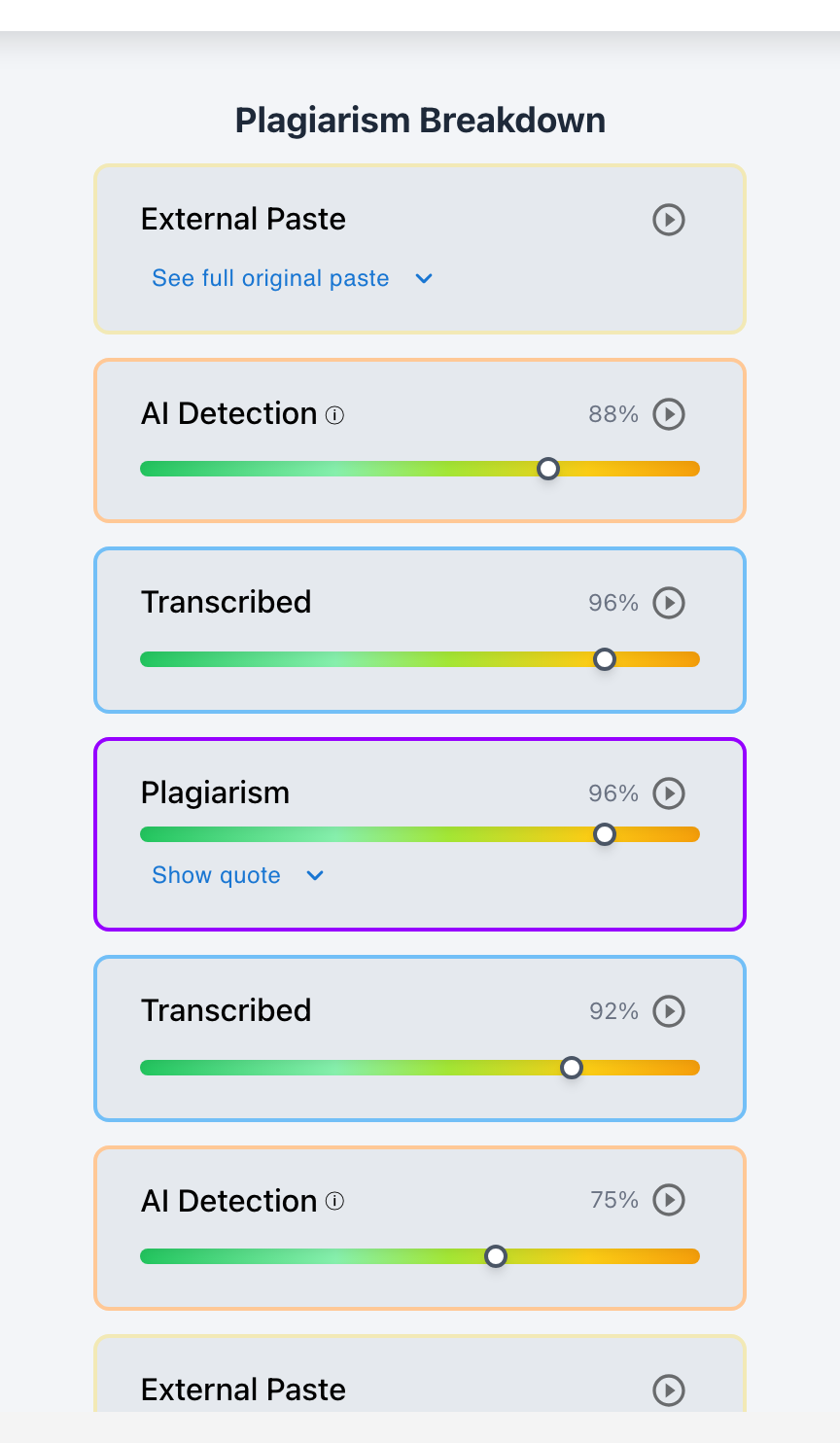
Yes. Teachers can detect manually typed AI responses through multi-signal evidence that combines linguistic AI analysis, keystroke transcription dynamics, citation database audits, and student conferences.
When students attempt to evade paste detection by hand-typing text from ChatGPT displayed on a phone or second monitor, they believe they leave no digital footprint. However, typing letters onto a keyboard does not alter the synthetic nature of AI-generated prose, nor does it mimic genuine human drafting behavior. The resulting submission exhibits four distinct forensic anomalies that make manual AI transcription readily identifiable.
Through Checkmark Plagiarism's AI + Transcription/Process Signals, educators gain complete multi-dimensional evidence to prove unauthorized AI use without relying solely on paste events.
Checkmark Plagiarism powers multi-signal detection by pairing essay writing playback with AI detection, plagiarism detection, autograding, and integrations with Canvas and Google Classroom.
The 4 Overlapping Forensic Signals of Manually Typed AI
1. Synthetic Linguistic Profile
The text contains signature AI vocabulary ("delve," "tapestry," "crucial"), uniform 20-word sentence lengths (low burstiness), and flat perplexity scores.
2. Transcription Keystroke Dynamics
Writing playback shows unbroken linear typing from first word to last word, an unnaturally low backspace rate (<2%), and metronomic 2-second gaze-shift pauses.
3. In-Class Baseline Disconnect
The submission's dense academic syntax shares zero stylistic, grammatical, or structural traits with the student's proctored in-class diagnostic writing samples.
4. Hallucinated Citation Fabrication
ChatGPT frequently fabricates non-existent academic articles and fake DOIs. Manually typing these fake citations into the bibliography provides physical proof of AI use.
How Checkmark Combines AI + Process Signals
Checkmark Plagiarism analyzes both the text and the document creation process simultaneously:
- Dual AI Detection Engine: Evaluates word predictability across all submitted paragraphs, flagging synthetic language patterns with 99%+ accuracy.
- Keystroke Transcription Analysis: Identifies the physical rhythm of reading an external screen and typing without cognitive drafting pauses.
- Citation Database Auditing: Instantly cross-checks cited sources against JSTOR, Crossref, and Google Scholar to flag hallucinated studies.
- Accelerated Video Replay: Instructors can watch an accelerated 10-second replay of the typing session directly inside Canvas SpeedGrader.
Read more in how Checkmark writing process analysis works.
Comparison: Authentic Composition vs. Manually Typed AI Response
Authentic Student Composition
- 0% AI probability score; high burstiness.
- 15–30% backspace, revision, and restructuring rate.
- Frequent thinking pauses (10–60 seconds).
- All cited sources verified in academic databases.
- Student fluently explains ideas and vocabulary orally.
Manually Typed AI Response
- 95%+ AI probability score; low burstiness.
- <2% backspace rate; 0% paragraph restructuring.
- Metronomic 2-second gaze-shift reading pauses.
- Citations contain fake authors or dead DOIs.
- Student unable to define advanced terms orally.
A 5-Step Educator Protocol for Investigating Manually Typed AI
Educator Multi-Signal Investigation Checklist:
- 1. Review the Checkmark AI Detection breakdown for synthetic language markers.
- 2. Open the Essay Playback timeline: check for unbroken linear typing and low backspaces.
- 3. Verify 2–3 cited bibliography sources in Google Scholar to check for hallucinations.
- 4. Compare the essay side-by-side with the student's proctored in-class baseline.
- 5. Hold a 2-minute oral check-in asking the student to define advanced vocabulary in the text.
How Checkmark Plagiarism Powers Multi-Signal Integrity
Checkmark Plagiarism combines **AI detection, essay writing playback, static AI detection, plagiarism detection, autograding, and Canvas/Google Classroom integrations** to make manually typed AI detection conclusive, fair, and legally defensible.
Frequently Asked Questions
Can teachers prove I used AI if I typed it by hand?
Yes. The combination of high AI linguistic probability, linear transcription keystrokes, hallucinated citations, and oral disconnects provides unassailable proof.
Why does hand-typing AI text leave a distinct keystroke pattern?
Because typing someone else's text involves looking back and forth at a screen (gaze-shift) without normal human thinking pauses, backspaces, or sentence rewrites.
What if I edit the words as I retype ChatGPT?
Light editing still preserves AI perplexity across paragraphs, and writing playback shows that the structural blueprint was generated externally in a single session.
How do hallucinated citations prove AI was used?
ChatGPT frequently invents fake journal titles, authors, and DOIs. Real humans cannot accidentally cite non-existent academic studies.
What is a normal student backspace rate during essay writing?
Authentic writing exhibits a 15% to 30% backspace rate as thoughts are revised. Transcribing AI text results in backspace rates below 2%.
How does writing playback show I didn't write the paper?
Playback shows unbroken, linear typing from start to finish without brainstorming pauses, deleted sentences, or structural reorganization.
What should a teacher do if hand-typed AI is suspected?
Compile the multi-signal dossier (AI score, playback log, citation audit, baseline comparison) and hold a supportive academic integrity conference.
How does Checkmark Plagiarism integrate with Canvas LMS?
Checkmark Plagiarism displays visual writing playback timelines, keystroke cadence graphs, and AI probability scores directly inside Canvas SpeedGrader.
Does transcription detection protect honest students?
Yes. Honest students show authentic drafting rhythms with natural pauses and revisions, protecting them from false accusations.
Why is hand-typing AI text an ineffective shortcut?
It requires hours of tedious typing without developing writing skills, while remaining easily detectable through multiple overlapping forensic signals.
Multi-Signal Evidence Establishes Uncompromising Truth
Relying on a single signal is vulnerable, but connecting linguistic AI analysis with keystroke dynamics and citation verification provides conclusive truth. With Checkmark Plagiarism, educators uphold academic integrity with precision and fairness.
Checkmark Plagiarism supports this comprehensive approach with AI detection, essay writing playback, static AI detection, plagiarism detection, autograding, and integrations with Canvas and Google Classroom.
See how Checkmark pairs essay writing playback with multi-signal detection to catch manually typed AI responses inside your LMS. View a sample report or request a demonstration.