
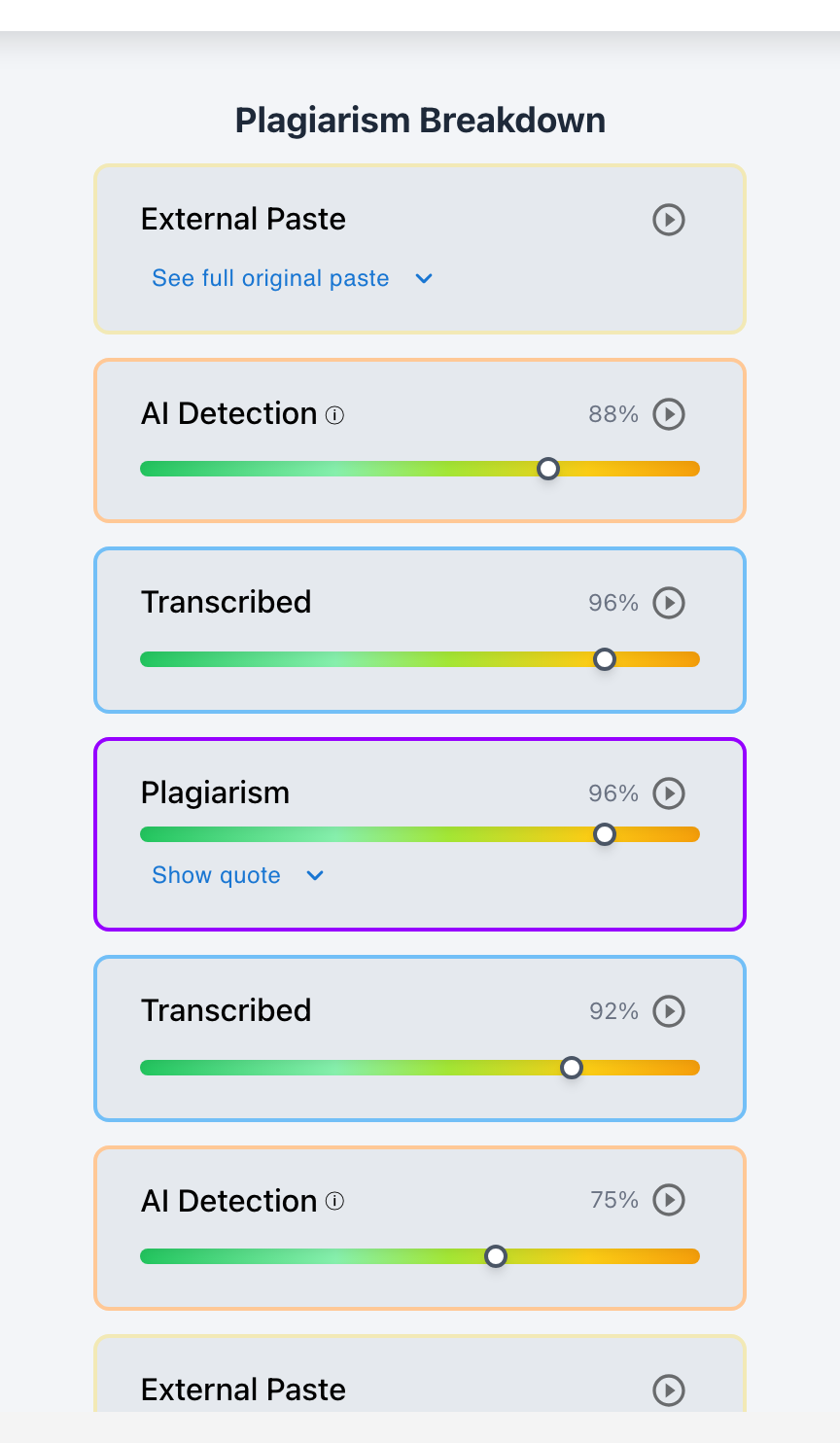
Yes. Teachers can easily detect when a student manually types ChatGPT's answer word-for-word—because while retyping avoids a clipboard paste event, it leaves distinct transcription keystroke signatures (metronomic 70+ WPM typing, sub-2% backspaces, zero cognitive thinking pauses) while still triggering high AI probability scores on the underlying text.
As paste detection tools become common in learning management systems, some students attempt to circumvent integrity checks by placing their smartphone next to their laptop keyboard and manually retyping an AI-generated essay character by character. Students assume that because every letter was physically struck on the keyboard, the essay will appear 100% authentic. In reality, transcription typing looks completely different from authentic composition under keystroke analysis, creating undeniable forensic proof of copying.
Below is a comprehensive guide on how teachers detect manually typed AI responses using Checkmark Plagiarism.
Checkmark Plagiarism detects AI transcription by pairing essay writing playback with AI detection, plagiarism detection, autograding, and integrations with Canvas and Google Classroom.
The 4 Forensic Red Flags of Word-for-Word AI Transcription
1. Metronomic Typing Cadence
The student types at a flat, robotic 65–85 WPM speed across the entire document—lacking the natural velocity fluctuations of genuine human thinking.
2. Abnormally Low Revision Rate (<2%)
The backspace rate is near zero; deletions are limited to immediate slip-of-the-finger letter corrections, with zero deleted sentences or reworked phrases.
3. Lack of Cognitive Clause Pauses
The student moves seamlessly from the end of one paragraph to the start of the next in 1.2 seconds, proving they were reading pre-existing text rather than thinking.
4. High Linguistic AI Probability
Retyping text does not alter the words: the resulting syntax exhibits low perplexity, uniform burstiness, and classic AI transition clichés.
Why Retyping Fails to Beat Modern Integrity Systems
Retyping text creates a severe contradiction in writing telemetry:
- The "Collegiate Perfection" Paradox: A student produces 1,500 words of sophisticated collegiate syntax with zero structural revisions in 20 minutes—a physical impossibility for real-time composition.
- Static AI Detectors Still Trigger: Linguistic AI detectors evaluate the final text arrangement; typing by hand does not change the statistical predictability of ChatGPT's vocabulary.
- The Oral Defense Trap: In follow-up conferences, students who transcribed from a screen cannot explain the definitions of the sophisticated words they typed minutes earlier.
Read more in how Checkmark writing process analysis works.
Comparison: Authentic Composition vs. Word-for-Word AI Transcription
Authentic Composition (Real Thinking)
- Speed: variable 35–50 WPM with thinking pauses.
- 18% to 28% backspaces and rewritten phrases.
- Pauses 45–90 seconds between complex paragraphs.
- Total time: 3.5+ hours for 1,500 words.
AI Transcription (Retyping from Phone)
- Speed: steady 75 WPM metronomic cadence.
- <1.5% backspaces; zero restructured ideas.
- Moves instantly between sentences without pausing.
- Total time: 20 minutes for 1,500 words.
A 5-Step Educator Protocol for Transcription Audits
Transcription Investigation Checklist:
- 1. Open the student's submission in Checkmark Playback inside Canvas SpeedGrader.
- 2. Review the Average WPM and Deletion Rate metrics: flag papers with 70+ WPM and <2% edits.
- 3. Inspect the AI Probability Heatmap to verify synthetic linguistic patterns.
- 4. Watch the 15-second video replay: look for continuous linear typing without cognitive pauses.
- 5. Hold a brief oral conference: ask the student to define 3 complex vocabulary words from their essay.
How Checkmark Plagiarism Powers Transcription Detection
Checkmark Plagiarism combines **AI detection, essay writing playback, static AI detection, plagiarism detection, autograding, and Canvas/Google Classroom integrations** to expose manual AI transcription with unassailable keystroke telemetry.
Frequently Asked Questions
Does manually typing ChatGPT prevent AI detection?
No. Retyping does not change the words, so linguistic AI detectors still trigger high probability scores, while keystroke telemetry reveals robotic transcription cadence.
What does transcription typing look like in Essay Playback?
It looks like a flat, steady stream of letters appearing at constant high speed without the natural pauses, deletions, and phrasing adjustments of real human thought.
Can a student type fast because they are an elite typist?
Even elite typists experience a 15–30% backspace rate and cognitive pauses when composing original arguments. Zero edits on complex prose proves transcription.
How long does it take to retype a 1,000-word ChatGPT essay?
Retyping 1,000 words takes 15 to 20 minutes, whereas composing 1,000 words honestly requires 2 to 3.5 active hours.
What if a student copied handwritten notes instead of AI?
Ask the student to present their handwritten notebook or outline during a brief check-in to confirm authentic offline drafting.
How does Checkmark Plagiarism integrate with Canvas LMS?
Checkmark provides certified LTI 1.3 integration, SpeedGrader sidebar embeds, two-way grade passback, and single sign-on (SSO).
What questions should a teacher ask to confirm transcription?
Ask: "Can you define [complex word from essay]?", "Why did you choose this specific phrasing?", and "Can you summarize your third body paragraph without looking?"
Does transcription detection work on Chromebooks?
Yes. Checkmark tracks keystroke velocity, pauses, and backspaces seamlessly across Chromebooks, Mac, Windows, and mobile devices.
Why do students retype AI responses instead of pasting?
Students believe that paste detection is the only tool teachers have, unaware that keystroke cadence and revision depth expose manual copying.
Why is multi-signal evidence essential for transcription cases?
Because pairing linguistic AI detection with keystroke velocity telemetry provides ironclad proof that resolves cases in minutes without dispute.
Defeating AI Transcription with Multi-Signal Telemetry
Retyping machine-generated text cannot hide the absence of human thought. By analyzing keystroke cadence, revision depth, and linguistic AI scores with Checkmark Plagiarism, teachers can expose manual transcription and ensure academic standards remain uncompromised.
Checkmark Plagiarism supports this comprehensive approach with AI detection, essay writing playback, static AI detection, plagiarism detection, autograding, and integrations with Canvas and Google Classroom.
See how Checkmark pairs transcription cadence analysis with multi-signal detection to catch manually typed AI text. View a sample report or request a demonstration.