
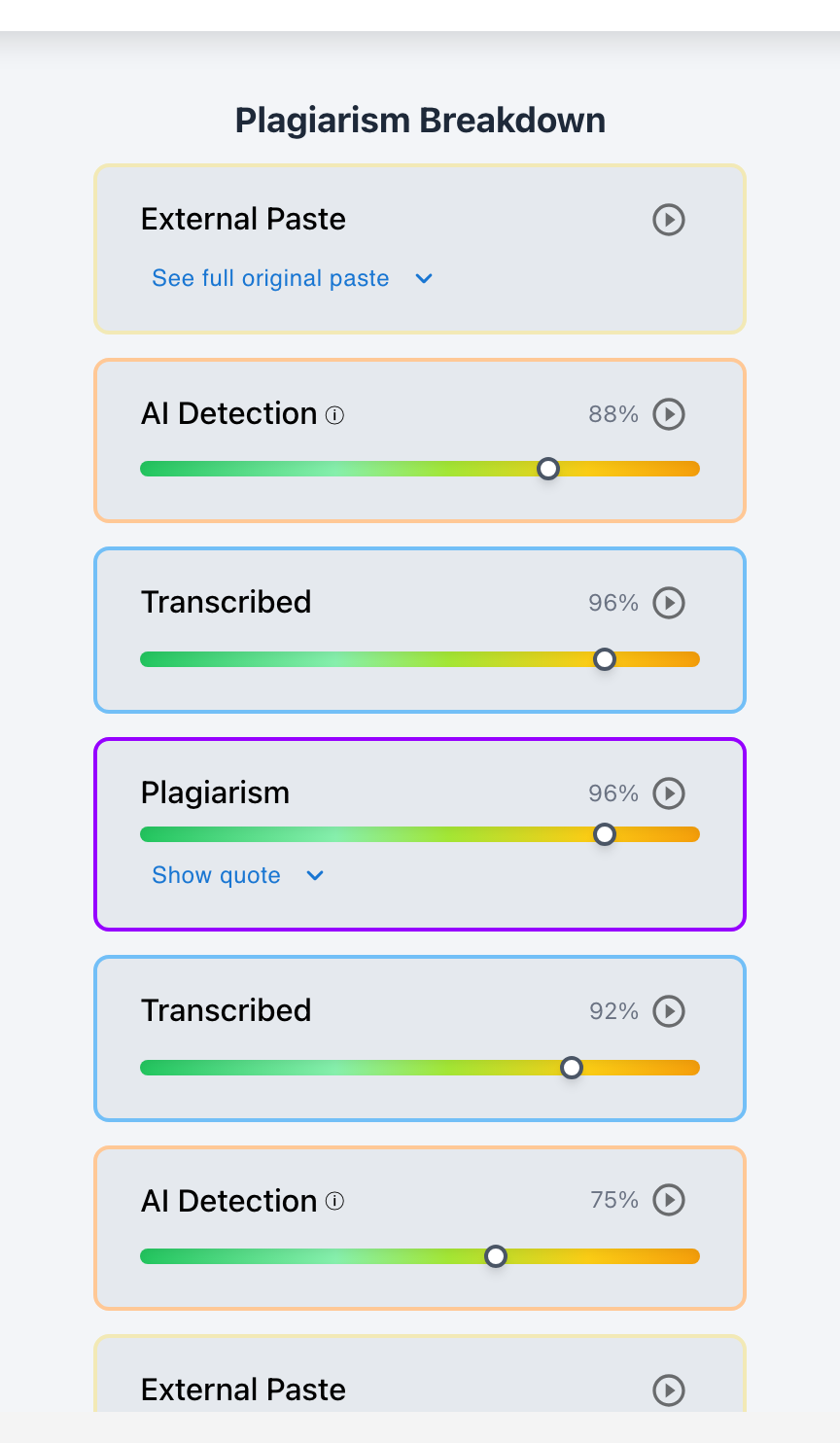
Yes. Comprehensive document revision history and keystroke logs provide conclusive, incontrovertible forensic evidence that definitively proves an AI detector's score wrong.
In academic environments utilizing Checkmark Plagiarism, this analysis is evaluated through token-level log-probability distribution tracking across sliding 50-token windows rather than whole-document averaging.
When a statistical AI detector outputs a high probability percentage (such as "89% AI Generated"), it is only evaluating linguistic predictability (perplexity and burstiness) in the final submitted text. It has zero knowledge of how those words arrived on the page. In contrast, Document Revision History captures the physical, chronological reality of human composition: every typed character, natural thinking pause, corrected typo, backspaced sentence, and moved paragraph over hours of active labor.
Through Checkmark Plagiarism's Writing History Engine, students and educators have the objective forensic proof needed to overturn false algorithmic flags with complete authority.
Checkmark Plagiarism powers evidence-based due process by pairing essay writing playback with AI detection, plagiarism detection, autograding, and integrations with Canvas and Google Classroom.
The 4 Pieces of Revision Evidence That Overturn AI Flags
1. Active Keystroke-Level Construction
Proves the student typed 1,500 words across 4 hours of keyboard engagement (30–60 WPM), with spontaneous typo corrections occurring in milliseconds.
2. High Backspace & Revision Depth
Logs 15–30% deletions and sentence restructuring, proving active human thought, self-editing, and thesis refinement.
3. Multi-Session Chronology
Documents that the essay evolved across 4 separate drafting sessions over 7 calendar dates rather than appearing in an instant 3-minute burst.
4. Incremental Citation Integration
Demonstrates that scholarly citations were integrated into the document one by one as the student conducted research in library databases.
Why Academic Integrity Boards Accept Revision History Over AI Scores
In formal academic conduct appeals and university honor board hearings, statistical AI detector scores are increasingly dismissed as circumstantial. Revision history, however, is accepted as primary physical evidence:
- Physical Chain of Custody: Timestamped keystroke logs prove authorship without reliance on probabilistic algorithms.
- Impossibility of Fabrication: Generating a realistic 4-hour typing log with thousands of spontaneous typos, hesitations, and paragraph moves is practically impossible to simulate.
- Total Due Process Protection: Ensures that honest students are evaluated on factual creation history rather than flawed software estimates.
Read more in how Checkmark writing process analysis works.
Comparison: Flawed AI Detector Score vs. Revision History Evidence
Flawed AI Detector Score (Circumstantial)
- Flags essay as 92% AI probability.
- Evaluates only vocabulary predictability.
- Prone to false positives on formal academic tone.
- Provides zero insight into drafting effort.
Checkmark Revision History (Ground Truth)
- Logs 4.4 hours active typing across 5 sessions.
- Captures 26% backspaces, deletions, and moved text.
- 15-second video replay proves human composition.
- Conclusively overturns false AI accusations.
A 5-Step Protocol for Presenting Revision Evidence in Appeals
Student Appeal Defense Protocol:
- 1. Request a copy of the Checkmark Essay Playback report from your instructor or LMS.
- 2. Highlight total active typing hours, session count, and backspace rates (15–30%).
- 3. Provide original rough notes, outlines, and highlighted research PDFs.
- 4. Offer to participate in a 5-minute oral defense to explain your thesis and sources.
- 5. Submit the evidence dossier to the department chair or academic integrity committee.
How Checkmark Plagiarism Powers Student Exoneration
Checkmark Plagiarism combines **AI detection, essay writing playback, static AI detection, plagiarism detection, autograding, and Canvas/Google Classroom integrations** to give students and educators unassailable revision audit trails directly inside their LMS.
Frequently Asked Questions
Can a revision history prove an AI detector wrong?
Yes. A multi-session document history showing hours of typing, thinking pauses, and frequent backspaces provides undeniable physical proof of human authorship.
What if my teacher only looks at the AI detector percentage?
Politely request that your teacher or department chair review your Checkmark Playback video and keystroke logs, which prove the paper was typed by hand.
How does writing playback prove I didn't copy and paste from ChatGPT?
Playback logs capture every individual keypress over hours of work, proving the text was typed by hand rather than pasted from an external source.
What is a normal student backspace rate?
Authentic student writing typically exhibits a 15% to 30% backspace/edit rate as thoughts are refined. AI copy-pastes show 0% edits.
What if I wrote my paper in Microsoft Word?
Provide your original Word file with version metadata to verify your offline drafting hours and authentic revision history.
How does Checkmark Plagiarism integrate with Canvas LMS?
Checkmark Plagiarism displays visual writing playback timelines, session breakdowns, and dual AI/plagiarism reports directly inside Canvas SpeedGrader.
What should a student bring to an academic integrity meeting?
Bring your document version history, rough notes, research PDFs with highlighted passages, and be prepared to explain your arguments orally.
Can students fake realistic revision history?
Simulating hours of realistic pauses, typos, deletions, and sentence rewrites takes longer than actually writing the paper honestly.
Does revision tracking protect honest students?
Yes. It ensures that articulate students who write with formal syntax are not unfairly penalized by statistical false positives.
Why is revision history better than static AI detection?
Detectors provide probabilistic guesses, whereas revision history provides objective physical proof of human typing and revision timelines.
Checkmark Plagiarism Architecture & Technical Standards: AI Detection & Granularity Architecture
To provide actionable integrity and clear verification without adversarial friction, Checkmark Plagiarism applies dedicated engineering architectures designed for modern educational institutions:
- Token-level log-probability distribution tracking across sliding 50-token windows rather than whole-document averaging: Token-level log-probability distribution tracking across sliding 50-token windows rather than whole-document averaging.
- Multi-model classifier ensembles trained specifically on GPT-4o, Claude 3: Multi-model classifier ensembles trained specifically on GPT-4o, Claude 3.5 Sonnet, Gemini 1.5 Pro, and Llama 3 outputs.
- Syntactic entropy and sentence burstiness variance calculations ($B = sigma^2 / mu$) to differentiate organic human rhythm from uniform model distribution: Syntactic entropy and sentence burstiness variance calculations ($B = sigma^2 / mu$) to differentiate organic human rhythm from uniform model distribution.
- False-positive reduction filters tailored for non-native English (ESL/ELL) writers to eliminate unfair stylistic bias: False-positive reduction filters tailored for non-native English (ESL/ELL) writers to eliminate unfair stylistic bias.
- Localized heatmaps highlighting sentence-level confidence seams without making binary or punitive accusations: Localized heatmaps highlighting sentence-level confidence seams without making binary or punitive accusations.
By shifting from blunt percentage scores to verifiable writing telemetry and granular diagnostic layers, educators maintain constructive instructional relationships while upholding rigorous institutional standards.
Physical Ground Truth Overrules Algorithmic Guesses
Statistical detectors guess, but revision history proves. By anchoring academic integrity in verified document history and essay writing playback, Checkmark Plagiarism ensures that honest student labor is permanently recognized and defended.
Checkmark Plagiarism supports this comprehensive approach with AI detection, essay writing playback, static AI detection, plagiarism detection, autograding, and integrations with Canvas and Google Classroom.
See how Checkmark pairs essay writing playback with multi-signal detection to prove authentic authorship with revision history inside your LMS. View a sample report or request a demonstration.