
Yes. Previous assignments are one of the most effective, objective tools for verifying student authorship—because an individual's authentic writing style (lexical preferences, syntactic rhythm, punctuation habits, and drafting speed) forms a consistent longitudinal "stylometric fingerprint" across multiple submissions.
When an essay triggers an AI detector or raises concerns about third-party ghostwriting, evaluating the paper in total isolation often leads to subjective disputes. In contrast, examining a student's cumulative portfolio of prior work provides an empirical benchmark: an articulate student whose earlier assignments exhibit rich vocabulary and complex syntax can be instantly cleared of false AI flags, while a sudden, uncharacteristic leap in prose stands out immediately. Checkmark Plagiarism automates longitudinal authorship cross-checks directly within Canvas and Google Classroom.
Below is a comprehensive guide on using previous assignments to verify authentic student authorship.
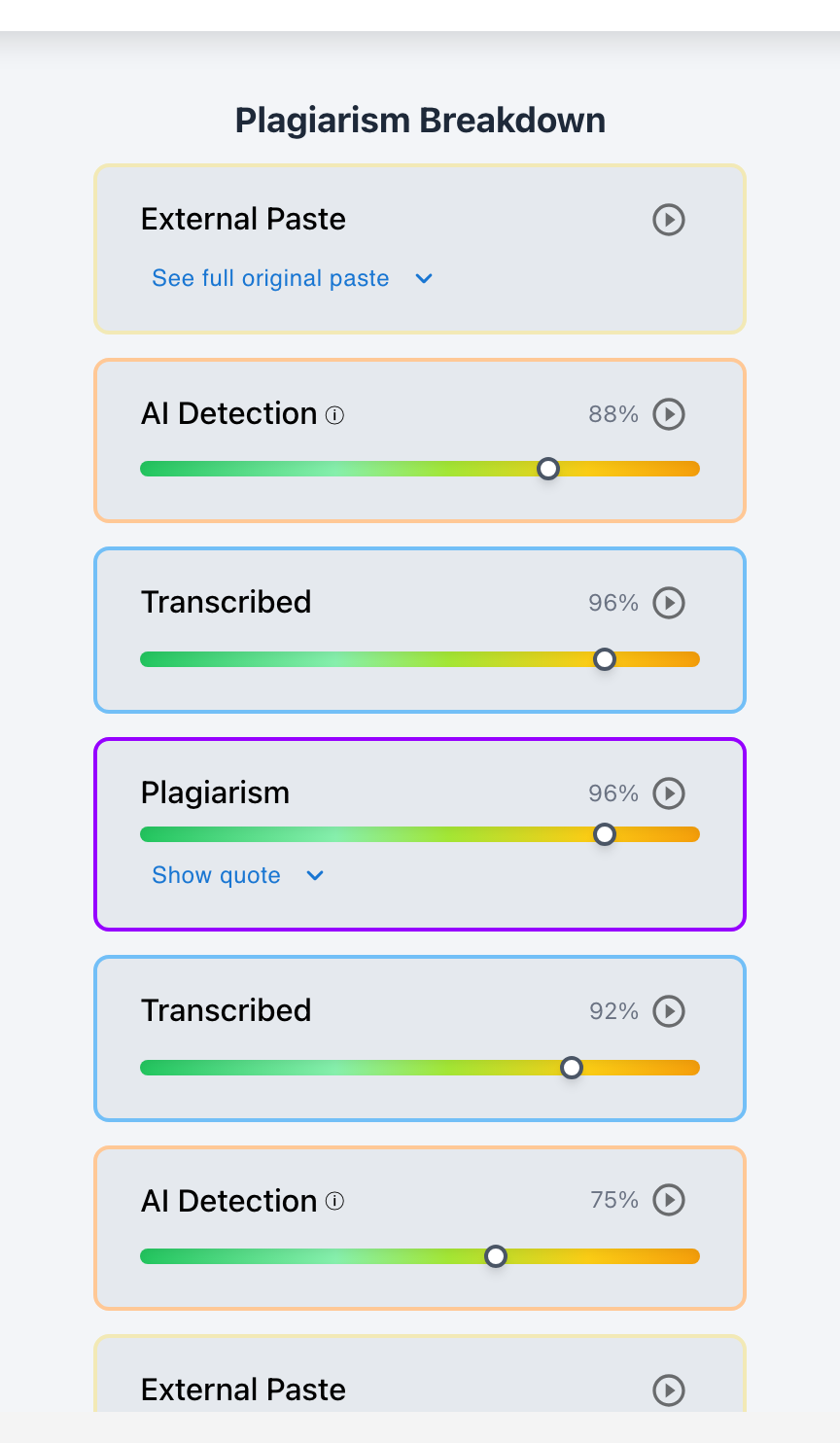
Checkmark Plagiarism verifies student authorship by pairing AI detection with essay writing playback, plagiarism detection, autograding, and integrations with Canvas and Google Classroom.
The 4 Stylometric Fingerprints Captured Across Prior Work
1. Lexical Preferences & Frequency
Every writer has favourite transition adverbs, verbs, and descriptive adjectives that recur naturally across different assignment topics.
2. Syntactic Rhythm & Sentence Length
A student's average sentence length, clause embedding patterns, and coordination style remain remarkably stable across the school year.
3. Punctuation Habits & Mechanics
Habitual usage of semicolons, em-dashes, parentheticals, or recurring comma habits provide unique personal signatures across essays.
4. Writing Process & Telemetry Consistency
Checkmark Playback compares active typing speeds, deletion rates, and drafting session distributions across historical submissions.
How Prior Work Protects Students from False Accusations
Understanding why longitudinal portfolios are essential for student due process:
- Exonerating Eloquent Writers: Gifted writers who naturally write with sophisticated vocabulary frequently trigger false AI alarms on static checkers. Pulling their prior essays immediately proves this is their authentic voice.
- Supporting English Language Learners: Multilingual students often have distinctive grammatical patterns; prior work demonstrates authentic progress rather than unauthorized AI humanizer edits.
- Eliminating "Single-Snapshot" Bias: Evaluating writing over time prevents isolated bad days or unexpected prompt interpretations from clouding fair judgment.
Read more in how Checkmark writing process analysis works.
Comparison: Single-Paper Evaluation vs. Longitudinal Portfolio Verification
Longitudinal Portfolio Verification (Checkmark)
- Evaluates essay against verified historical baseline.
- Instant exoneration for naturally eloquent students.
- Highlights genuine stylistic and telemetry deviations.
- Defensible, evidence-backed proof for conferences.
Single-Paper Evaluation (Isolated Scoring)
- Evaluates paper in a vacuum without context.
- High risk of falsely penalizing advanced writers.
- Subjective arguments over "how a student sounds."
- Easily contested during formal grade appeals.
A 5-Step Educator Protocol for Portfolio Authorship Audits
Portfolio Authorship Audit Checklist:
- 1. Open the student's submission in Canvas SpeedGrader with Checkmark Plagiarism enabled.
- 2. Click the "Authorship Portfolio" tab to view the student's longitudinal stylometric radar chart.
- 3. Compare the current essay's Lexical Diversity and Mean Sentence Length against prior assignments.
- 4. Inspect the Writing Playback telemetry: verify if active drafting hours and backspaces match past patterns.
- 5. If metrics align with historical baseline, confirm authentic authorship and proceed with grading.
How Checkmark Plagiarism Powers Automated Portfolio Forensics
Checkmark Plagiarism combines **AI detection, essay writing playback, static AI detection, plagiarism detection, autograding, and Canvas/Google Classroom integrations** to automatically build and maintain longitudinal writing portfolios for every student.
Frequently Asked Questions
How do prior essays help verify student authorship?
Prior essays establish a student's unique stylometric fingerprint (vocabulary choices, sentence rhythms, and typing telemetry), allowing teachers to confirm consistency.
Can a false AI flag be cleared by looking at past writing?
Yes. If an articulate student triggers an AI detector, showing that their earlier assignments exhibit identical complexity conclusively exonerates them.
How many prior assignments are needed to verify authorship?
Two to three prior assignments (including one in-class diagnostic write) provide a highly reliable comparative baseline.
What if a student's writing style changes due to an assignment genre?
Checkmark accounts for genre shifts (e.g., narrative vs. research), evaluating core syntactic habits that remain consistent across genres.
How does writing playback enhance portfolio verification?
Playback compares typing speeds, active hours, and deletion rates across all submissions to verify consistent drafting effort.
How does Checkmark Plagiarism integrate with Canvas LMS?
Checkmark provides certified LTI 1.3 integration, SpeedGrader sidebar embeds, two-way grade passback, and single sign-on (SSO).
What is a stylometric fingerprint?
It is a mathematical profile of a writer's unique language habits, including vocabulary diversity, average sentence length, and punctuation frequencies.
Can students see their writing portfolio in Canvas?
Yes. Students can view their portfolio progress and stylometric growth over time to reflect on their learning journey.
What should a teacher do if an essay completely diverges from prior work?
Review the Checkmark Playback telemetry and conduct a brief 2-minute oral check-in asking the student to explain their thesis and drafting process.
Why is portfolio verification superior to single AI scores?
Because portfolio analysis evaluates real human writing history, eliminating false positives and ensuring fair, evidence-based integrity standards.
Empirical Truth Across the Entire Writing Journey
True writing ability is not captured in a single moment—it is reflected across a semester of effort and growth. By comparing new essays against historical student work with Checkmark Plagiarism, educators can protect student due process, celebrate genuine progress, and uphold academic integrity with complete confidence.
Checkmark Plagiarism supports this comprehensive approach with AI detection, essay writing playback, static AI detection, plagiarism detection, autograding, and integrations with Canvas and Google Classroom.
See how Checkmark pairs longitudinal portfolio verification with multi-signal detection to verify student authorship. View a sample report or request a demonstration.