
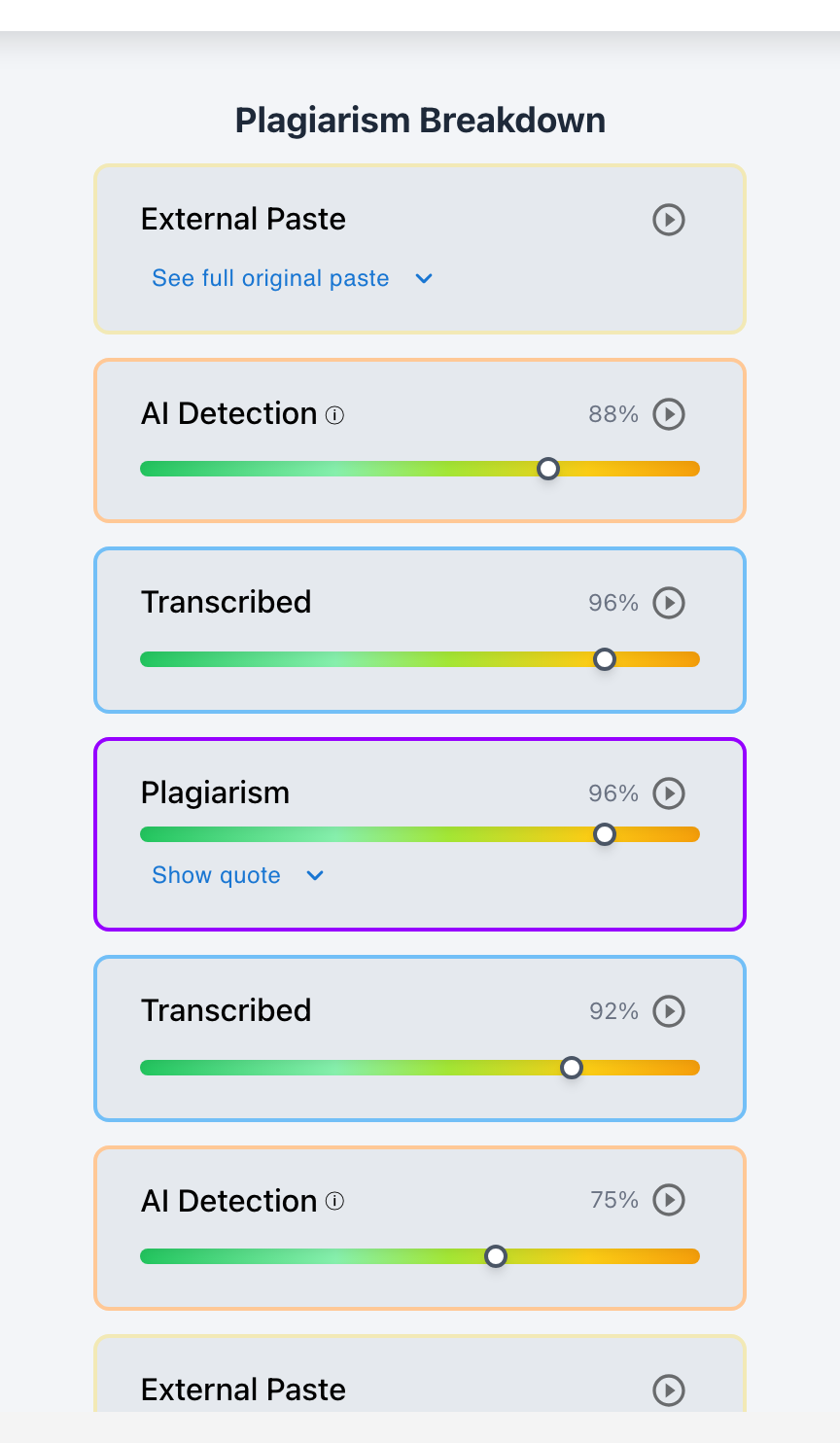
A student submits an unusually polished essay. The writing does not sound like their previous work, an AI detector flags portions of the assignment, and the student struggles to explain some of the ideas they submitted. At that point, a teacher may reasonably suspect that ChatGPT was involved. But suspicion leads to a harder question: can you actually prove that a student used ChatGPT?
In most cases, a teacher cannot prove from the final text alone that a specific AI tool such as ChatGPT produced an assignment. AI detection can provide useful evidence. Writing history can reveal unusual activity. Previous assignments can show major changes in writing style. A student conversation can expose gaps between the submitted work and the student's understanding.
But no single one of these signals should automatically be treated as definitive proof. A stronger approach is to combine multiple forms of evidence and determine whether the student's writing process is consistent with the work they submitted.
Checkmark Plagiarism helps educators do this by combining AI detection, essay writing playback, static AI detection, plagiarism checking, autograding, and integrations with Canvas and Google Classroom.
Why Is It So Difficult to Prove ChatGPT Use?
When a student copies text from a website, plagiarism detection may be able to identify the matching source.
AI-generated writing is different. ChatGPT does not necessarily copy an existing paragraph from somewhere on the internet. It generates new text based on the prompt it receives.
That means there may be no original webpage, article, or document that a teacher can point to and say: "This is where the student copied the paragraph."
There is also usually no visible marker embedded in ordinary text saying that it came from ChatGPT. Once AI-generated content is copied into a document, it can simply look like another piece of writing.
That makes identifying AI use fundamentally different from traditional plagiarism detection.
Can an AI Detector Prove a Student Used ChatGPT?
No AI detector should be treated as unquestionable proof that a specific student used ChatGPT.
AI detection systems analyze characteristics of writing and estimate whether text resembles content produced by generative AI. That can be extremely useful for identifying assignments that deserve additional review.
However, AI detection has technical limitations. A detector may flag human-written material (false positives), and AI-generated text can sometimes go undetected, particularly if it has been heavily edited.
An AI detection result also generally cannot establish:
- Exactly which AI tool was used
- Who entered the prompt
- Whether the entire assignment was generated
- Whether AI was used only for brainstorming
- Whether the student substantially rewrote AI-generated material
- Whether the AI use violated the instructor's policy
That is why an AI detection result is better treated as evidence to investigate rather than a final verdict. Learn more in our explainer on what an AI score can and cannot tell you.
Checkmark Plagiarism provides AI detection as part of a broader academic-integrity review rather than requiring teachers to rely on a single detector score.
What Evidence Can Teachers Use?
When determining whether a student may have used ChatGPT improperly, teachers can examine several types of evidence together. The more consistent the evidence is, the stronger the basis for a conversation or academic-integrity review.
Key Evidence Checklist for Educators
- • AI detection results
- • Document writing history
- • Large pasted text sections
- • Sudden writing style shifts
- • Previous student assignments
- • Fabricated or broken citations
- • Incorrect, confident assertions
- • Student's oral explanation of work
- • Description of writing process
- • Course or school AI policies
None of these necessarily proves ChatGPT use by itself. Together, however, they can provide a much clearer picture of how an assignment was produced.
Writing History Can Be More Useful Than the Final Essay
One of the biggest limitations of AI detection is that it examines the finished text. But teachers may learn more by examining how that text came into existence.
Consider two students who submit 1,500-word essays:
Student 1 (Normal Drafting)
- An outline appears first
- Several paragraphs are written
- Sentences are deleted and rewritten
- Evidence is added gradually
- Sections are reorganized
- Conclusion is revised several times
Student 2 (Instant Submission)
- Document contains almost no text
- Large portion of finished essay appears at once
- Little drafting or revision afterward
- Submitted immediately after creation
The second pattern does not automatically prove ChatGPT use. The student could have drafted the essay elsewhere and pasted it into the document. But it gives the teacher something concrete to ask about. That is much more useful than simply saying: "This essay sounds like AI."
How Essay Writing Playback Helps
Checkmark Plagiarism's essay writing playback allows educators to examine how a student's assignment developed.
Instead of reviewing only the submitted version, teachers can look at the progression of the document and identify patterns such as:
- Gradual drafting
- Large additions of text
- Editing activity
- Revisions
- Deleted material
- Changes made throughout the writing process
This gives teachers another layer of evidence when an assignment raises concerns. Read more about how Checkmark writing process analysis works.
For example, imagine that:
- AI detection flags a substantial portion of an essay.
- The writing sounds very different from the student's previous work.
- Writing playback shows several polished paragraphs appearing at once.
- The student cannot explain some of the arguments in those paragraphs.
No single piece of evidence is definitive. Together, however, they provide a much stronger basis for investigating whether the submitted work represents the student's own writing.
Does Pasted Text Prove ChatGPT Use?
No. Students paste legitimate content all the time. They may paste quotations, citations, research notes, assignment instructions, text written in another document, or drafts from another application.
That is why a teacher should not assume that every large paste came from ChatGPT.
Instead, pasted text becomes more significant when it appears alongside other warning signs. For example, a teacher may want to investigate further when a large block of polished prose appears at once and the student:
- Has no earlier draft
- Cannot explain the material
- Uses unfamiliar terminology
- Has an AI detection result that raises concerns
- Cannot describe where the pasted material came from
Writing playback provides context, but the teacher still needs to interpret that context.
Can Comparing Previous Student Work Help?
Yes. Teachers often have something AI detectors do not: familiarity with the student.
Previous assignments can provide a baseline for how the student normally writes. Look at:
- Sentence structure
- Vocabulary
- Grammar
- Organization
- Tone
- Typical errors
- Depth of analysis
- Citation habits
Suppose a student who consistently writes simple paragraphs suddenly submits a sophisticated research paper containing advanced terminology, perfect transitions, and almost no grammatical mistakes. That difference is worth examining.
But it still does not prove AI use. Students can improve, receive tutoring, spend more time, or use approved editing tools. The change matters most when it aligns with additional evidence.
What If the Student Cannot Explain Their Own Essay?
A conversation with the student can be one of the most useful parts of an AI-use investigation.
Teachers can ask questions such as:
- What is the main argument of your paper?
- Why did you include this example?
- What does this sentence mean?
- Where did you find this source?
- Why did you choose this quotation?
- What was the most difficult section to write?
- How did you organize your argument?
- Can you explain this paragraph without reading it?
These questions do not require the teacher to begin with an accusation. They simply test whether the student understands the work submitted under their name.
A student who genuinely wrote the assignment should generally be able to discuss its ideas, sources, and writing process.
Difficulty explaining one sentence is not proof of misconduct. However, repeated inability to explain major sections of an assignment may add to the broader evidence.
What About Fake Sources and Citations?
Fabricated citations can be another important signal. Generative AI systems can sometimes produce references that look convincing but are inaccurate or completely nonexistent.
A teacher reviewing a suspicious assignment may discover that:
- An article does not exist
- An author did not write the cited work
- A quotation does not appear in the source
- A journal title is fabricated
- Page numbers are incorrect
- A cited source does not support the argument
Again, students can make citation errors without using AI. But multiple fabricated references combined with other suspicious evidence can strengthen the reason for an academic-integrity review.
Can I Prove the Student Used ChatGPT Specifically?
That is even more difficult. Even when there is strong evidence that an assignment contains AI-generated material, determining which AI tool produced it may not be possible from the finished text.
The student could have used ChatGPT, Gemini, Claude, Microsoft Copilot, another generative AI system, or multiple AI systems.
For that reason, schools may want to frame academic-integrity policies around unauthorized AI assistance rather than requiring teachers to prove that a particular branded AI product was used.
The more relevant question may be: Did the student use AI in a way that violated the rules of the assignment?
What If the Student Admits Using AI?
A student admission can obviously change the situation. But even then, teachers should determine what kind of AI use occurred.
There is a significant difference between:
- Asking ChatGPT for brainstorming ideas
- Using AI to create an outline
- Asking AI to correct grammar
- Asking AI to rewrite several sentences
- Generating an entire essay and submitting it
Whether any of these actions violates academic-integrity rules depends on the assignment and the school's policy. A student saying, "I used ChatGPT," does not necessarily answer the full question. The teacher may still need to determine how it was used.
The Importance of Clear AI Policies
Proving that AI was involved is only part of the issue. Schools also need to define what students are allowed to do with AI.
For example, a policy might say that students may:
- Use AI for brainstorming
- Ask AI for feedback
- Use AI for grammar assistance
But may not:
- Generate final responses
- Submit AI-generated paragraphs
- Use AI during assessments
- Present AI-generated analysis as original work
Clear rules make academic-integrity decisions much easier. Without a defined policy, a teacher may be able to establish that a student used AI but still face uncertainty about whether that use was prohibited.
What Does Strong Evidence of AI Use Look Like?
Consider a hypothetical case. A teacher notices that a student's essay is dramatically different from previous work. The teacher reviews the assignment and finds:
- 1 AI detection flags multiple passages.
- 2 Essay playback shows approximately 900 words appearing in a short period of time.
- 3 Several citations cannot be verified.
- 4 The student's previous assignments use much simpler vocabulary.
- 5 The student cannot explain two major concepts in the submitted essay.
- 6 The student cannot clearly explain where the large block of text came from.
Would any one of those observations prove ChatGPT use? Probably not.
But taken together, they create a substantially stronger body of evidence. This is the key distinction between AI detection and an AI-use investigation. Detection is one signal; an investigation considers the full context.
How Checkmark Plagiarism Helps Build a Clearer Picture
Teachers should not have to rely entirely on intuition when they suspect AI-generated work. Checkmark Plagiarism provides several tools that can help educators examine student submissions from different angles:
- AI Detection: Analyzes student writing for patterns associated with AI-generated content to identify assignments requiring review.
- Essay Writing Playback: Reviews how an assignment developed over time, revealing drafting, revisions, and sudden text additions.
- Static AI Detection: Analyzes completed PDFs, Word docs, or uploaded files when writing history is unavailable.
- Plagiarism Detection: Identifies potential source matches alongside AI-related concerns.
- LMS Integrations: Connects with Canvas and Google Classroom.
- Autograding: Streamlines assignment review while keeping academic-integrity data visible next to student work.
A Better Process When You Suspect ChatGPT
If you think a student may have used ChatGPT improperly, avoid making the entire decision based on one detector result. A more complete process is:
- 1. Review the assignment for unusual writing patterns.
- 2. Compare it with the student's previous work.
- 3. Run AI detection.
- 4. Examine essay writing playback or document history when available.
- 5. Look for large or unexplained text additions.
- 6. Verify citations and quotations.
- 7. Ask the student to explain the assignment and writing process.
- 8. Determine whether the evidence conflicts with the course's AI policy.
- 9. Follow your school's normal academic-integrity procedures.
The purpose is not to find a single "gotcha." It is to determine whether the available evidence tells a consistent story.
Frequently Asked Questions
Can a teacher prove a student used ChatGPT?
It can be difficult to prove from the final text alone that a student used ChatGPT specifically. Teachers can build a stronger body of evidence by combining AI detection, writing history, previous student work, citation verification, and a conversation with the student.
Is an AI detector enough to accuse a student of cheating?
An AI detection result is better treated as one piece of evidence rather than definitive proof. Teachers should consider the result alongside other information about the assignment and the student's writing process.
Can writing history prove AI use?
Writing history can reveal how text appeared in a document, including large additions and patterns of drafting and revision. It may provide strong supporting evidence, but a large paste alone does not establish where the text originated.
Can teachers tell whether ChatGPT or another AI wrote an essay?
It may be possible to identify signs consistent with AI-generated writing, but determining which specific AI system produced the text can be difficult.
What should I ask a student suspected of using ChatGPT?
Ask the student to explain their argument, sources, terminology, writing process, and specific passages from the assignment. The goal is to compare their understanding with the work they submitted.
What if a student's AI detector score is high?
A high score can be a reason to investigate further. Review writing history, compare previous assignments, verify sources, and discuss the assignment with the student before reaching a conclusion.
How does Checkmark Plagiarism help investigate AI use?
Checkmark Plagiarism combines AI detection with essay writing playback, static AI detection, plagiarism checking, autograding, and integrations with Canvas and Google Classroom. This gives teachers multiple sources of information when reviewing suspicious work.
Proof Is Rarely One Score
The biggest mistake schools can make is treating AI detection as if it were a perfect answer key.
A detector can identify suspicious writing. It cannot always explain how the assignment was created.
A writing history can reveal unusual activity. It cannot always establish where pasted text came from.
A teacher can recognize a dramatic change in writing style. That change alone does not prove misconduct.
The strongest academic-integrity decisions come from multiple pieces of evidence that point in the same direction.
That is where Checkmark Plagiarism can help. By combining AI detection, essay writing playback, static AI detection, plagiarism checking, autograding, and Canvas and Google Classroom integrations, Checkmark Plagiarism gives educators more context than an AI detector alone.
Instead of asking teachers to trust a single percentage, the goal is to help them understand the evidence surrounding an assignment and make a more informed, defensible decision.
See how Checkmark helps teachers evaluate student writing with more context than an AI detector score alone. View a sample report or request a demonstration.