
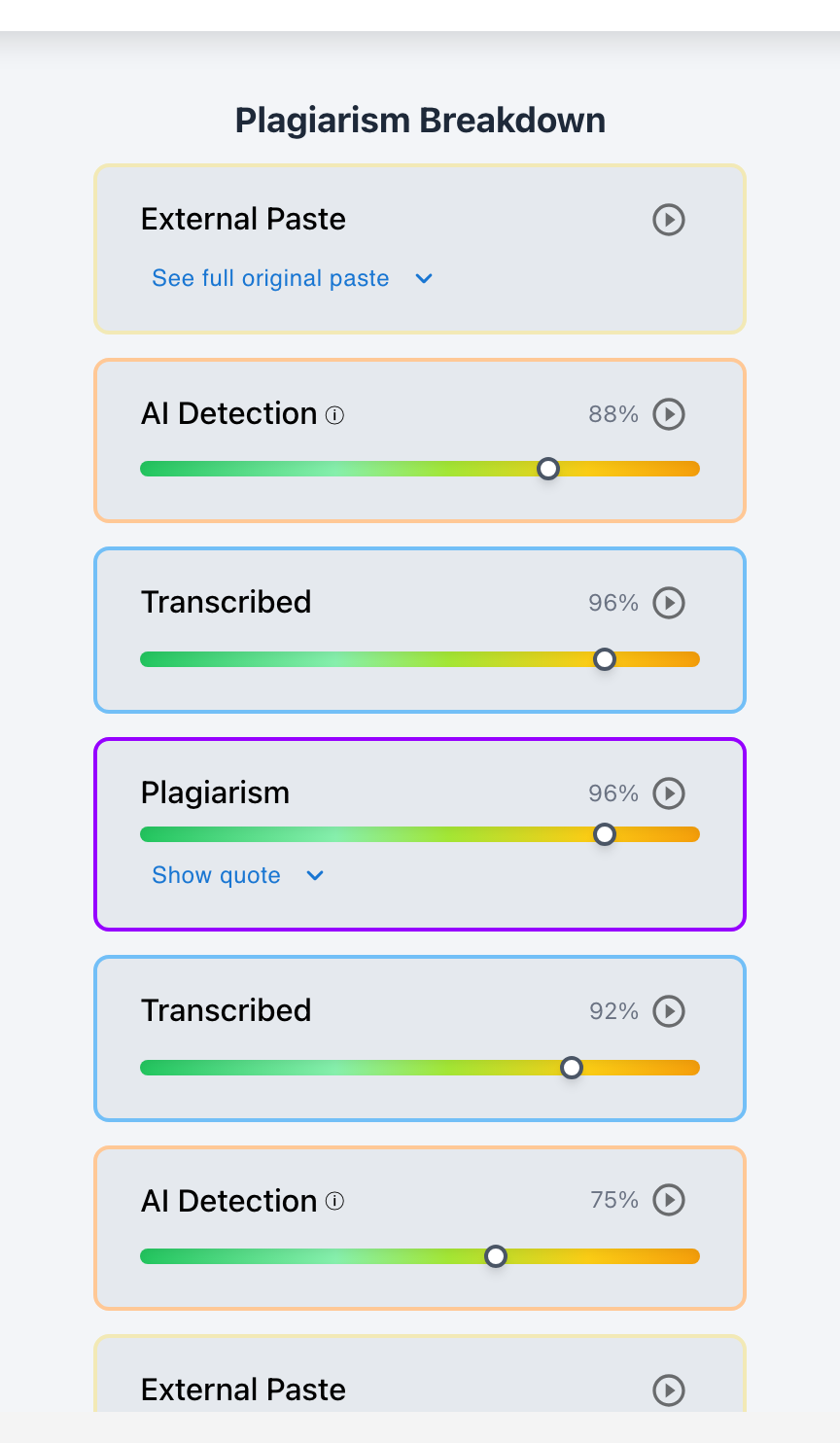
Yes. Document revision history can help teachers investigate possible AI writing by showing how an assignment developed over time.
It can reveal whether a student drafted gradually, revised ideas over multiple sessions, added large blocks of text at once, reworked paragraphs, deleted and replaced passages, or made only minor edits after a nearly complete essay appeared.
Those patterns provide valuable context when a teacher suspects ChatGPT or another AI tool was used. But revision history has an important limitation: it shows what happened inside the document, but it usually cannot prove where the text originally came from. A large block of text appearing at once could come from ChatGPT, or it could come from the student's own draft written in another document.
Checkmark Plagiarism helps educators examine both the finished assignment and the writing process through AI detection, essay writing playback, static AI detection, plagiarism detection, autograding, and integrations with Canvas and Google Classroom.
What Is Document Revision History?
Document revision history provides a timeline of document creation: when text was added, deleted, reorganized, or rewritten. While the submitted paper answers "what was turned in," revision history helps answer: "How did the student get from a blank page to this final submission?"
Why Can Revision History Be Useful for Detecting AI Writing?
AI text is often inserted into documents in patterns that diverge from multi-session human drafting: an empty document suddenly receiving 1,000 polished words with near-zero subsequent editing. Evaluating the drafting timeline helps distinguish authentic revision from sudden external insertions.
Does a Large Paste Prove AI Was Used?
No. A large text block indicates that content was pasted or inserted, but the source could be an authentic draft from Word or Google Docs, research notes, quotations, or generative AI. Ask: "I noticed this section was added all at once. Can you tell me where it came from?"
Can Revision History Prove a Student Wrote the Essay?
Not necessarily. A student could use AI for brainstorming, outlining, or sentence-level rephrasing, or copy-type AI text manually. Revision history shows document behavior rather than an absolute authorship guarantee.
What Revision Patterns Should Teachers Look For?
- Sudden Large Text Additions: Hundreds of words appearing in a single timestamp.
- Minimal Subsequent Revision: Polished academic prose inserted with only trivial comma or typo edits afterward.
- Sudden Stylistic Divergence: Inserted passages exhibiting completely different vocabulary and syntax from surrounding student text.
- Wholesale Section Replacement: Rough student paragraphs being instantly swapped for complex academic prose.
How Checkmark Plagiarism's Essay Writing Playback Helps
Checkmark Plagiarism's essay writing playback allows teachers to examine drafting, large additions, revisions, and editing activity over time. Instead of saying "Your essay looks AI-generated," a teacher can ask: "I noticed that these four paragraphs appeared together near the end of the writing process. Can you explain how that section was created?" Read more in how Checkmark writing process analysis works.
Revision History and AI Detection Measure Different Things
AI Detection (The Product)
Analyzes statistical language patterns (perplexity, burstiness) in the final submitted text.
Revision Playback (The Process)
Examines timeline changes, keystrokes, revision cycles, and text insertion events over time.
What If AI Detection and Revision History Disagree?
High AI Score + Multi-Day Drafting
A detector flags formal text, but playback reveals multi-day drafting, heavy revisions, and full student mastery of the arguments and sources.
Low AI Score + Sudden Paste
A detector misses edited AI text, but playback reveals a wholesale paste with non-existent citations and inability to explain key terms.
Can Revision History Detect Edited ChatGPT Writing?
Revision history can show a pattern of a large text insertion followed by vocabulary substitutions, sentence reordering, and paragraph swapping. However, this same pattern could reflect a student revising their own external draft. Evaluating comprehension and earlier drafts provides the necessary clarity.
What If the Student Drafted the Essay Somewhere Else?
Drafting across multiple applications (Word, notes, external Google Docs) is common. Ask whether the earlier draft or version history is available to verify the external writing process.
Revision History and Traditional Plagiarism
Not every suspicious paste involves AI. A 500-word inserted section might match an existing web source or student paper. Checkmark Plagiarism combines essay writing playback, AI detection, and plagiarism detection to cover both possibilities.
What If There Is No Revision History?
When students submit PDFs or Word files, Checkmark Plagiarism's static AI detection provides an objective analysis of completed submissions to pair with baseline comparisons, citation checks, and student conferences.
A Practical Revision-History Review Process
A Practical 13-Step Revision-History Review Sequence:
- 1. Review the finished assignment submission independently first.
- 2. Identify specific revision activity that appears unusual (sudden text blocks).
- 3. Examine the surrounding drafting and revision patterns across the document timeline.
- 4. Compare the submission against previous student work baselines.
- 5. Review AI detection reports as one corroborating signal.
- 6. Check plagiarism detection results for traditional web/database source matches.
- 7. Verify suspicious sources and citations in academic databases.
- 8. Ask the student neutrally where large text additions were drafted.
- 9. Ask the student to explain the content and reasoning of those sections.
- 10. Give the student an opportunity to provide earlier drafts or version notes.
- 11. Compare the student's explanation with the observable document history.
- 12. Determine whether any AI assistance violated published course policy.
- 13. Follow established school academic-integrity procedures if concerns remain.
How Checkmark Plagiarism Helps Teachers Review the Writing Process
Checkmark Plagiarism combines **essay writing playback, AI detection, static AI detection, plagiarism detection, autograding, and Canvas/Google Classroom integrations** to give educators complete context across both the writing process and the finished paper.
Frequently Asked Questions
Can revision history prove that a student used ChatGPT?
Usually not by itself. Revision history can show unusual drafting or text-addition patterns, but it may not reveal the original source of inserted text.
Does a large text addition mean AI was used?
No. The text could have come from AI, but it could also have come from the student's own draft in Word, another document, or notes.
What revision patterns may deserve further review?
Large amounts of polished text appearing suddenly, minimal revision afterward, abrupt style changes, or activity inconsistent with the student's explanation justify additional questions.
Can revision history prove that a student wrote an assignment?
It provides useful evidence of drafting and revision, but is not definitive proof of authorship.
Can students use AI without creating suspicious revision history?
Yes. Students may use AI for brainstorming, feedback, sentence-level assistance, or manually retype generated content.
Can revision history show edited AI writing?
It may reveal a pattern of a large text addition followed by revisions, but it usually cannot establish that the original text came from AI.
What should I ask about a large paste?
Ask: "I noticed this section was added at once. Can you explain where it came from?"
What if the student says they drafted somewhere else?
Consider that explanation and, when appropriate, ask whether they can provide the earlier draft or version history.
Is revision history better than an AI detector?
They measure different things: AI detection analyzes characteristics of the final text, while revision history provides evidence about the writing process.
How does Checkmark Plagiarism help review document history?
Checkmark Plagiarism combines essay writing playback, AI detection, static AI detection, plagiarism detection, autograding, and Canvas and Google Classroom integrations.
Revision History Shows the Process—Not Always the Source
Document revision history provides vital evidence about how an assignment developed. By pairing revision analysis with AI detection, citation verification, and student conferences, educators can evaluate academic integrity fairly and thoroughly.
Checkmark Plagiarism helps teachers combine writing-process evidence with AI detection, static AI detection, plagiarism detection, autograding, and integrations with Canvas and Google Classroom.
See how Checkmark pairs document writing playback with multi-signal detection to give teachers complete visibility into student revisions. View a sample report or request a demonstration.