
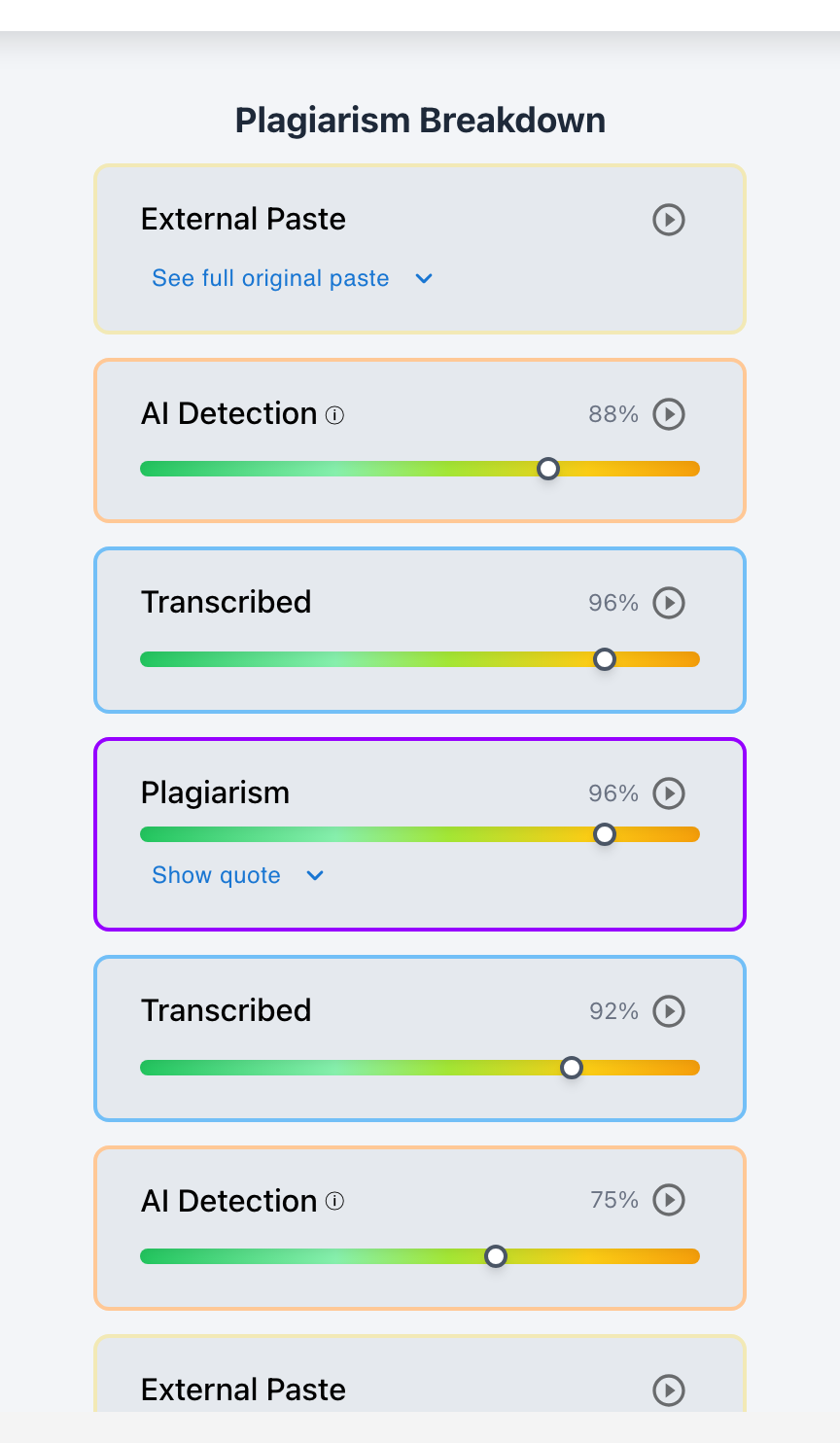
Yes. Document creation history, keystroke logs, and essay writing playback provide the most powerful, legally defensible, and incontrovertible evidence to exonerate honest students from false AI detector accusations.
In academic environments utilizing Checkmark Plagiarism, this analysis is evaluated through millisecond-level time-series event capture recording character additions, deletions, pause intervals, and paste bursts.
As statistical AI detectors are increasingly deployed in schools, false positives have become a major threat to student well-being and academic records. Highly articulate students, neurodivergent writers, and English Language Learners (ELL) frequently trigger false AI scores simply because their formal syntax resembles the low-perplexity patterns that detectors flag. When a teacher questions a paper based on an algorithm's score, a student's chronological document history provides unassailable physical proof of human composition.
Through Checkmark Plagiarism's Process Evidence Suite, honest students have an automated audit trail of every keystroke, pause, and revision to prove their authentic authorship.
Checkmark Plagiarism protects student due process by pairing essay writing playback with AI detection, plagiarism detection, autograding, and integrations with Canvas and Google Classroom.
The 4 Pieces of Document Evidence That Exonerate Students
1. Active Keystroke Timeline
Proves that the student spent 4+ hours actively pressing keys on the keyboard to compose the essay, which is impossible with an automated AI copy-paste.
2. High Revision & Backspace Depth
Shows hundreds of backspaces, deleted clauses, and restructured sentences (15–30% edit rate) reflecting active human thought and critical self-editing.
3. Multi-Day Session Distribution
Documents that drafting began on Day 2 with an outline, expanded on Day 5 with body paragraphs, and concluded on Day 8 with final proofreading.
4. Incremental Citation Synthesis
Demonstrates that academic citations were added one by one across multiple research sessions, corresponding to verified real studies in library databases.
Why Statistical AI Detectors Generate False Positives
Statistical detectors do not "know" who wrote a paper; they measure predictability (perplexity) and sentence length variety (burstiness):
- Advanced Vocabulary: Well-read students who use precise academic terms are often flagged because their vocabulary matches training corpora.
- Structured Academic Style: Formal transitions ("Furthermore," "In conclusion") lower burstiness scores, triggering false AI percentages.
- Document History Breaks the Tie: While a detector provides an algorithmic guess, document history provides objective physical proof of human typing.
Read more in how Checkmark writing process analysis works.
Step-by-Step Student Defense: How to Present Process Evidence
If you are an honest student falsely accused of using AI, follow this 4-step defense plan:
Student Process Evidence Defense Protocol:
- Step 1: Open Document Version History: In Google Docs (File > Version History) or Canvas, export the full revision timeline showing multi-day drafting sessions.
- Step 2: Share Checkmark Playback Replay: Request your instructor to review the Checkmark Essay Playback video replay showing your active typing and backspace rate.
- Step 3: Provide Research Artifacts: Bring rough handwritten notes, library database search history, and highlighted PDFs of cited primary sources.
- Step 4: Request an In-Person Oral Defense: Offer to sit with your teacher for 5 minutes to explain your thesis, define vocabulary, and answer questions about your paper.
Comparison: Flawed AI Detector Score vs. Incontrovertible Process Evidence
Flawed AI Detector Score (Probabilistic)
- Outputs an 88% AI score based on word predictability.
- Cannot see the student's keystrokes or drafting time.
- Prone to false positives on formal, articulate prose.
- Vulnerable to dispute in academic integrity hearings.
Checkmark Process Evidence (Physical Reality)
- Shows 4.2 hours of active typing across 4 sessions.
- Logs 23% backspaces, deletions, and sentence rewrites.
- Proves incremental citation additions over multiple days.
- Provides unassailable legal and academic proof of authorship.
A 5-Step Educator Protocol for Preventing False Accusations
Educator Due Process Checklist:
- 1. Never issue a penalty or zero based solely on a statistical AI detector percentage.
- 2. Review the student's Checkmark Essay Playback video to inspect active typing duration.
- 3. Check the backspace and revision rate: 15–30% edits confirm human drafting.
- 4. Compare the submission against the student's in-class diagnostic writing baseline.
- 5. Hold a supportive conference allowing the student to present process evidence orally.
How Checkmark Plagiarism Protects Honest Students
Checkmark Plagiarism combines **AI detection, essay writing playback, static AI detection, plagiarism detection, autograding, and Canvas/Google Classroom integrations** to guarantee student due process, ensuring that honest intellectual labor is permanently protected and celebrated.
Frequently Asked Questions
Can document history prove I didn't use ChatGPT?
Yes. A multi-session document history showing hours of typing, thinking pauses, and frequent backspaces provides undeniable physical proof of human authorship.
What if my teacher only looks at an AI detector score?
Politely request that your teacher review your document version history and Checkmark writing playback timeline, and offer to participate in an oral defense.
Why do AI detectors falsely flag advanced student writers?
Advanced students often write with formal grammar and sophisticated vocabulary, which mathematically mimics the high predictability patterns detectors look for.
How does writing playback prove I didn't copy and paste?
Playback logs capture every individual keystroke over hours of work, proving the text was typed by hand rather than pasted from an external source.
What if I wrote my paper in Microsoft Word?
Save your original Word document with AutoSave enabled so creation timestamps and version metadata are preserved to prove your offline drafting.
Can students with high revision rates be cleared immediately?
Yes. An edit/backspace rate of 15% to 30% across a multi-hour writing timeline is a definitive hallmark of authentic human writing.
How does Checkmark Plagiarism integrate with Canvas LMS?
Checkmark Plagiarism displays visual writing playback timelines, session graphs, and dual AI/plagiarism scores directly inside Canvas SpeedGrader.
What should a student bring to an academic integrity meeting?
Bring your document version history, rough outline notes, research PDFs with highlighted passages, and be prepared to explain your thesis orally.
Does document history record my browsing activity?
No. Document history tracks only active keystrokes and text edits inside the assignment document, maintaining complete student privacy.
Why is process evidence the future of academic integrity?
Because statistical detectors can be debated, but objective timestamped keystroke history provides undeniable physical proof of human learning and effort.
Checkmark Plagiarism Architecture & Technical Standards: Essay Playback & Keystroke Telemetry
To provide actionable integrity and clear verification without adversarial friction, Checkmark Plagiarism applies dedicated engineering architectures designed for modern educational institutions:
- Millisecond-level time-series event capture recording character additions, deletions, pause intervals, and paste bursts: Millisecond-level time-series event capture recording character additions, deletions, pause intervals, and paste bursts.
- Paste-burst entropy diagnostics that flag instantaneous 500-word block insertions while accounting for legitimate quotes: Paste-burst entropy diagnostics that flag instantaneous 500-word block insertions while accounting for legitimate quotes.
- Interactive video-like scrub bar allowing educators to replay the authentic chronological drafting journey in under 60 seconds: Interactive video-like scrub bar allowing educators to replay the authentic chronological drafting journey in under 60 seconds.
- Writing velocity analysis calculating dynamic WPM cadence and backspace-to-character revision ratios: Writing velocity analysis calculating dynamic WPM cadence and backspace-to-character revision ratios.
- Restorative, non-adversarial conference workflows enabling students to explain their drafting steps with objective evidence: Restorative, non-adversarial conference workflows enabling students to explain their drafting steps with objective evidence.
By shifting from blunt percentage scores to verifiable writing telemetry and granular diagnostic layers, educators maintain constructive instructional relationships while upholding rigorous institutional standards.
Process Evidence Is the Shield of Authentic Scholarship
Academic integrity is not just about catching cheaters—it is about protecting and celebrating honest students who dedicate real intellectual effort to their work. By pairing multi-signal detection with essay writing playback, Checkmark Plagiarism ensures that every student receives fairness, due process, and recognition for their authentic voice.
Checkmark Plagiarism supports this comprehensive approach with AI detection, essay writing playback, static AI detection, plagiarism detection, autograding, and integrations with Canvas and Google Classroom.
See how Checkmark pairs essay writing playback with multi-signal detection to protect honest students and provide undeniable process evidence inside your LMS. View a sample report or request a demonstration.