
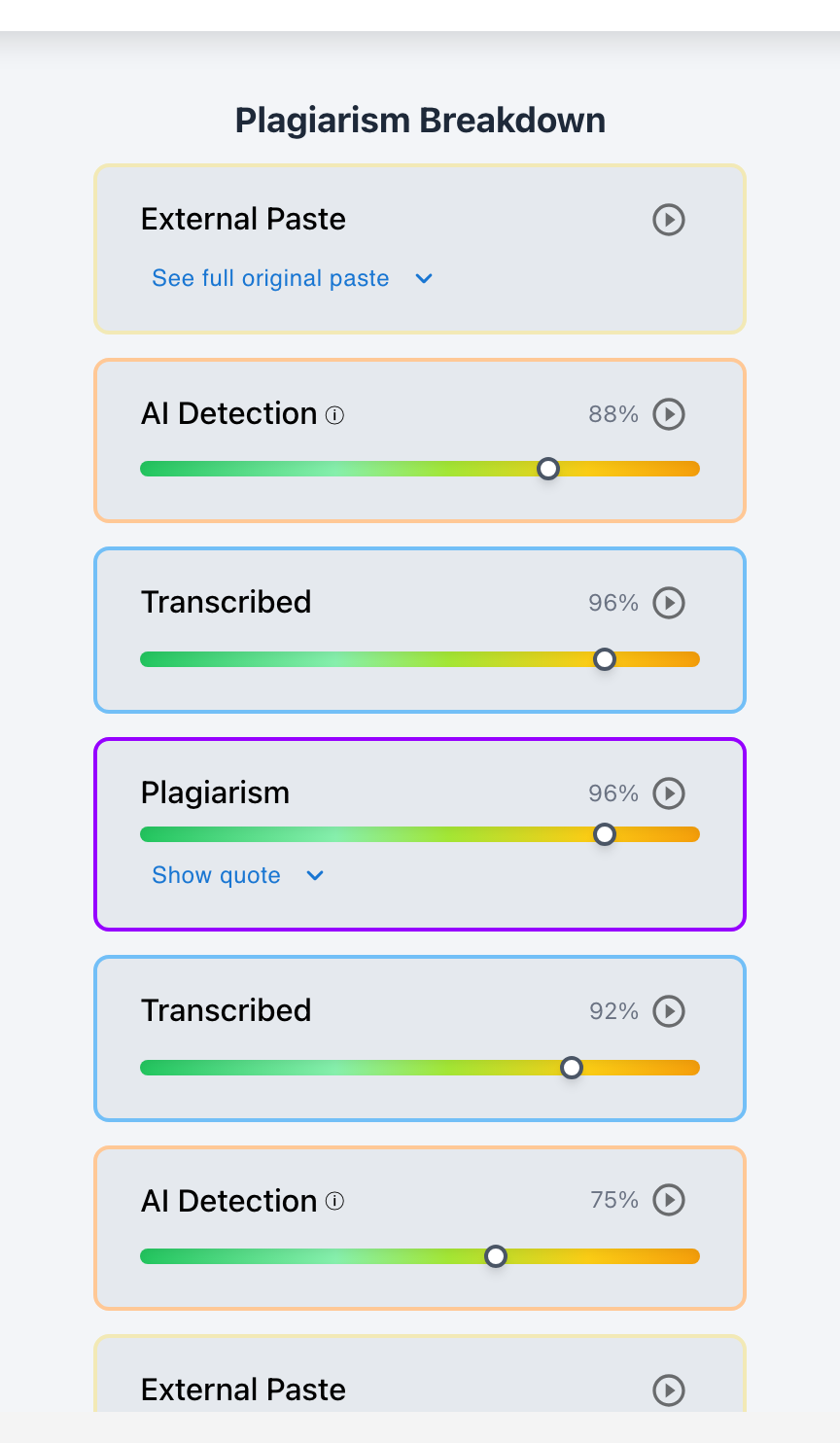
Whether ChatGPT can produce "original" writing depends on how we define originality: computationally, yes; intellectually and humanly, no.
From a purely mathematical standpoint, ChatGPT produces computational novelty—it generates unique combinations of words and sentences that have never appeared verbatim anywhere on the internet. However, from an academic, philosophical, and creative standpoint, ChatGPT cannot produce true human originality. It possesses no consciousness, lived experiences, original thoughts, or authentic agency; it is a statistical pattern-matching system that synthesizes past human writing.
For educators, this distinction is fundamental. An essay generated by ChatGPT may be technically "new" text, but submitting it represents zero original intellectual effort on the part of the student. Understanding the boundaries between synthetic novelty and authentic human creativity is essential for modern evaluation.
Checkmark Plagiarism helps educators verify authentic human writing by combining AI detection with essay writing playback, static AI detection, plagiarism detection, autograding, and integrations with Canvas and Google Classroom.
Computational Novelty vs. Authentic Human Originality
Computational Novelty (ChatGPT)
Statistical recombination of billions of training tokens into novel syntactic sequences that bypass traditional exact-match plagiarism filters.
Authentic Human Originality
Original synthesis born from personal lived experience, unique ethical reasoning, classroom discussions, creative struggle, and intellectual reflection.
Why ChatGPT Is Statistically Constrained Against True Originality
While ChatGPT can generate surprising metaphors or combine disparate concepts upon request, its underlying architecture prevents authentic creative breakthroughs:
- Regression to the Mean: Large language models are trained to predict the most probable next token. By definition, their outputs gravitate toward the statistical average of their training data, producing formulaic, conventional prose.
- Zero Semantic Grounding: ChatGPT does not understand what words mean in the real world. It manipulates linguistic symbols without consciousness, sensory experience, or emotional connection.
- Inability to Conduct Primary Research: AI cannot interview a local community member, run a laboratory experiment, or observe a classroom debate. It can only synthesize historical text.
Why Submitting "Original" AI Text Is Still Misconduct
Some students argue: "If ChatGPT generated a completely unique essay that never existed before, I didn't copy anyone, so it isn't cheating."
This argument fundamentally misunderstands academic integrity. The academic standard is not merely avoiding copyright theft; it is verifying that the student completed the intellectual labor. Submitting synthetic text generated by an algorithm as your own analysis is contract cheating and authorship fraud.
What Authentic Student Originality Actually Looks Like
Authentic student writing exhibits distinct hallmarks that synthetic models struggle to replicate:
Hallmarks of ChatGPT Prose
- Polished, symmetrical, and emotionally detached.
- Generic analysis that avoids class-specific details.
- Monotonous sentence lengths (low burstiness).
- Overused transitions ("furthermore," "testament to").
Hallmarks of Human Originality
- Unique personal voice, humor, or passionate argument.
- Direct references to specific lectures, handouts, and debates.
- Dramatic variations in sentence rhythm (high burstiness).
- Imperfect, idiosyncratic, but authentic analytical leaps.
How Essay Writing Playback Proves Human Originality
Original writing is not a single instant event—it is a process of drafting, struggling, and refining. Checkmark Plagiarism's essay writing playback captures this authentic creative process:
- Keystroke Timeline Evolution: Playback shows the student typing, pausing to think, deleting weak arguments, and rephrasing complex ideas over multiple hours.
- Multi-Session Development: Proves that the outline developed on Tuesday, body paragraphs were drafted on Thursday, and conclusions were revised on Saturday.
- Exposing Synthetic Insertions: Highlights instant wholesale paste events where 1,200 words of "original" AI text appeared in the document in 5 seconds.
Read more in how Checkmark writing process analysis works.
A 6-Point Checklist for Evaluating Writing Originality
Educator Originality Verification Checklist:
- 1. Does the essay engage deeply with specific classroom discussions and assigned materials?
- 2. Does the writing exhibit an authentic, idiosyncratic student voice rather than generic neutrality?
- 3. Are all cited sources verified in academic databases with accurate page numbers?
- 4. Does essay writing playback confirm multi-session active drafting and keystroke evolution?
- 5. Can the student fluently explain their core thesis, research journey, and revisions orally?
- 6. Does the submission reflect natural stylistic continuity with verified baseline writing samples?
How Checkmark Plagiarism Defends Authentic Student Originality
Checkmark Plagiarism combines **AI detection, essay writing playback, static AI detection, plagiarism detection, autograding, and Canvas/Google Classroom integrations** to give educators full visibility into student drafting, ensuring that authentic human creativity is protected and celebrated.
Frequently Asked Questions
Can ChatGPT create an essay that has never been written before?
Yes. Generative models assemble novel permutations of words that produce unique text strings, but this computational novelty is not the same as human intellectual originality.
Why isn't computational novelty considered authentic student writing?
Because the student did not formulate the arguments, research the evidence, or compose the sentences. Claiming credit for algorithm-generated prose is authorship fraud.
Can ChatGPT write with genuine emotion or personal experience?
No. ChatGPT simulates emotional language based on training patterns, but it has no consciousness, lived feelings, or personal background.
How can teachers tell if an essay is truly original?
By reviewing essay writing playback (verifying multi-hour drafting and keystroke history), auditing citations, and conducting oral student conferences.
Why do ChatGPT essays feel so generic despite having unique wording?
Because language models generate statistically probable text that averages out training data, avoiding bold, unconventional, or idiosyncratic perspectives.
Can a student use ChatGPT to brainstorm and still write an original essay?
Yes, if permitted by course policy. If the student outlines ideas with AI but drafts all paragraphs, sentences, and arguments independently, writing playback proves authentic human authorship.
What does human originality look like in document version history?
Non-linear drafting: pauses, backspacing, reorganizing paragraphs, rephrasing sentences, and working across multiple sessions over several days.
Can copyright law protect ChatGPT-generated writing?
Under current US Copyright Office rulings, purely AI-generated text without substantial human creative contribution cannot be copyrighted because copyright requires human authorship.
How does citation verification expose synthetic "original" writing?
ChatGPT frequently invents fake citations to support its synthetic claims. Verifying that cited sources exist confirms authentic research.
How does Checkmark Plagiarism protect authentic student originality?
Checkmark Plagiarism pairs visual essay writing playback with multi-signal detection, ensuring educators can verify the genuine drafting process behind every essay.
Human Originality Lies in the Struggle of Creation
True originality is not a string of unrepeated words; it is the authentic intellectual struggle of synthesizing knowledge, forming convictions, and articulating ideas. By recording and celebrating the writing process, educators uphold the true meaning of scholarship.
Checkmark Plagiarism supports this principled standard with AI detection, essay writing playback, static AI detection, plagiarism detection, autograding, and integrations with Canvas and Google Classroom.
See how Checkmark pairs essay writing playback with multi-signal detection to celebrate authentic student originality and verify document creation. View a sample report or request a demonstration.