
Yes. ChatGPT can paraphrase plagiarized text into completely new sentence structures—but doing so remains a serious violation of academic integrity and leaves unmistakable forensic footprints.
When a user pastes an article, book excerpt, or peer essay into ChatGPT and asks it to "rephrase this in formal academic English," the model analyzes the underlying semantic concepts and generates fresh sentences from scratch. Because the resulting prose does not use the exact word-for-word sequences of the original source, traditional plagiarism checkers often report a 0% similarity score.
However, bypassing a database scanner does not eliminate the plagiarism. The core intellectual ideas were still stolen without attribution, and the writing was generated externally. Modern integrity platforms expose this shortcut through essay writing playback timelines, statistical AI detection, and oral student conferences.
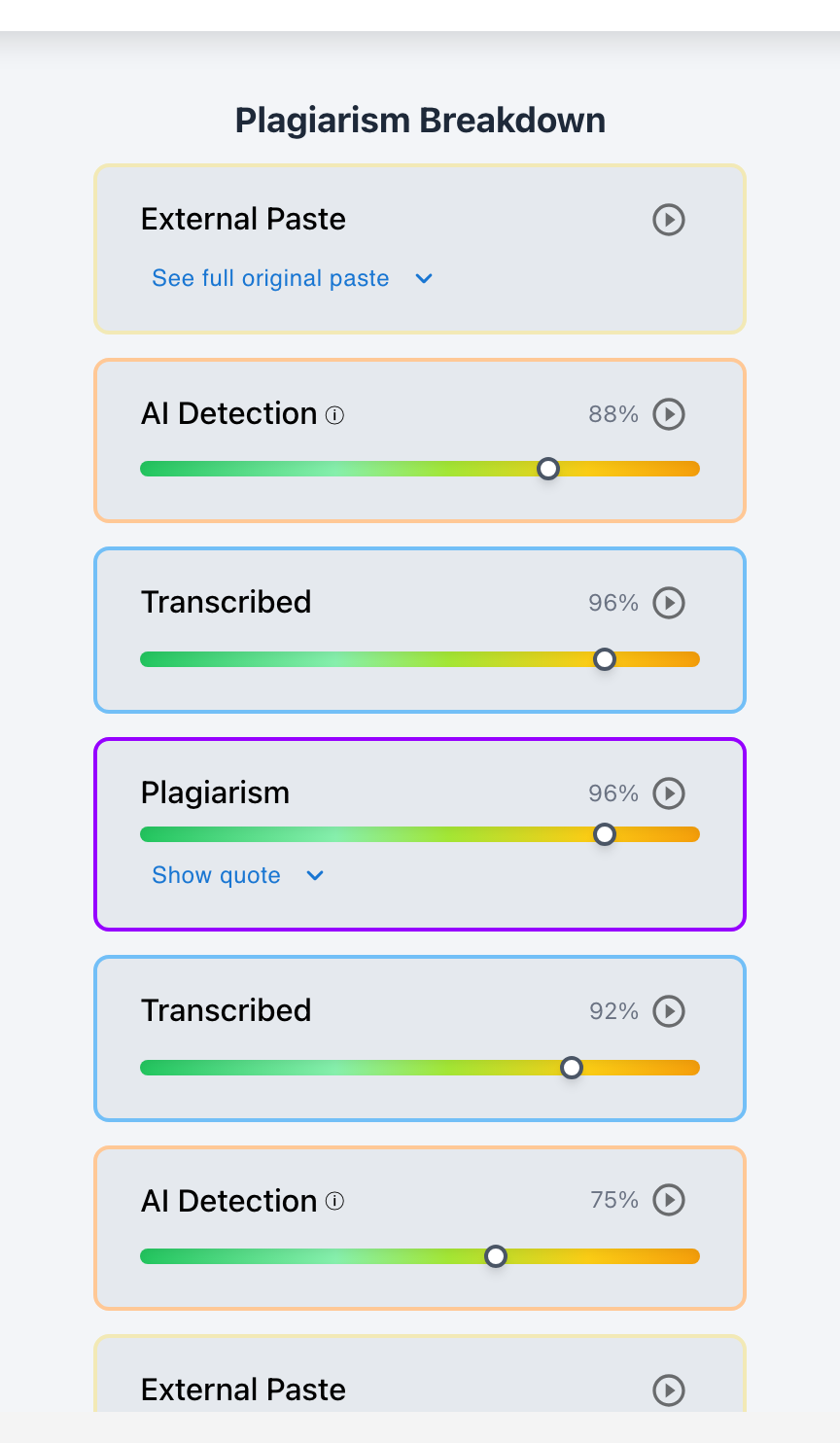
Checkmark Plagiarism uncovers AI-paraphrased text by combining plagiarism detection with AI detection, essay writing playback, static AI detection, autograding, and integrations with Canvas and Google Classroom.
How ChatGPT Paraphrases Copied Text
Semantic Reconstruction
ChatGPT identifies the key meaning of the input text and reconstructs the ideas using its own probabilistic language model, altering sentence rhythm and vocabulary.
Breaking Database N-Grams
By inverting clauses and replacing keywords, ChatGPT dismantles the 8–10 word matching strings that legacy plagiarism checkers rely on.
Why AI-Paraphrased Text Is Still Plagiarism
Submitting ChatGPT-paraphrased text without citing the original author violates core academic principles in two distinct ways:
- Conceptual & Structural Plagiarism: Stealing an author's unique arguments, data synthesis, and intellectual framework without attribution is plagiarism, regardless of how the sentences are phrased.
- Authorship Misrepresentation: Claiming that you synthesized and wrote the prose when it was generated by an artificial intelligence model is academic dishonesty.
How Multi-Signal Tools Expose ChatGPT Paraphrasing
1. Essay Writing Playback Exposes External Pastes
No matter how well ChatGPT rewrites the text, Checkmark Plagiarism's essay writing playback captures the creation timeline:
- Wholesale Paste Events: The entire paraphrased text appears in the document in one instant paste block at 11:20 PM.
- Minimal Active Drafting Time: Playback logs record only 5–8 minutes of document activity for a 1,500-word paper.
- Absence of Incremental Keystrokes: No natural typing pauses, backspacing, or sentence revisions.
Read more in how Checkmark writing process analysis works.
2. Statistical AI Language Predictability
Even when paraphrasing existing text, ChatGPT injects its signature linguistic habits: low burstiness (monotonous sentence lengths), flat perplexity, and distinctive vocabulary cliches ("delve," "tapestry," "crucial").
3. The Oral Conference (The Decisive Test)
During a brief student conference, a student who relied on ChatGPT to rewrite stolen text cannot explain the underlying concepts, define specialized terms, or explain why specific arguments were structured that way.
Comparison: Legitimate Paraphrasing vs. ChatGPT Rewriting
Legitimate Student Paraphrasing
- Student reads, comprehends, and synthesizes.
- Written in authentic student voice.
- Includes full in-text citation and bibliography.
- Writing playback shows multi-session typing.
ChatGPT Paraphrasing
- Generated mechanically by an AI model.
- Formulaic, neutral, and low burstiness.
- Omits citation to hide copied source material.
- Writing playback shows wholesale external paste.
A 5-Step Protocol for Teachers
Educator Protocol for Suspected AI Rewriting:
- 1. Inspect essay writing playback logs for wholesale paste events and active typing duration.
- 2. Run AI detection scans to evaluate language predictability maps.
- 3. Audit cited sources in academic databases (JSTOR, Google Scholar) for hallucinations.
- 4. Compare the submission against historical in-class student writing baselines.
- 5. Hold a brief student conference asking the student to explain and synthesize their sources orally.
How Checkmark Plagiarism Detects AI-Paraphrased Writing
Checkmark Plagiarism combines **AI detection, essay writing playback, static AI detection, plagiarism detection, autograding, and Canvas/Google Classroom integrations** to give educators complete visibility into rewritten text, paste events, and citation authenticity.
Frequently Asked Questions
Can ChatGPT rewrite text so it passes plagiarism checkers?
Yes. ChatGPT alters sentence structures and synonyms to bypass basic text-matching tools, but writing playback logs and AI probability scans easily expose the rewrite.
Is using ChatGPT to paraphrase an article considered plagiarism?
Yes. If you submit AI-paraphrased text without properly citing the original source and disclosing AI assistance, it constitutes plagiarism and academic misconduct.
Why do legacy plagiarism checkers miss ChatGPT paraphrasing?
Because legacy checkers search for exact strings of 8–10 consecutive words. ChatGPT generates fresh phrasing that breaks these continuous matches.
How does writing playback catch ChatGPT paraphrasing?
Writing playback proves that the rewritten text was pasted wholesale into the document in seconds rather than typed keystroke-by-keystroke over multiple drafting sessions.
Can teachers find the original article that was paraphrased?
Often yes. Unique data sequences, specific conceptual arguments, or unusual source examples frequently lead teachers back to the original publication.
What if a student claims they used ChatGPT only for grammar?
Basic grammar editing preserves the student's authentic vocabulary and structure, while full AI paraphrasing introduces formulaic phrasing and wholesale paste blocks in playback.
How does comparing previous writing help detect AI paraphrasing?
It reveals whether the analytical sophistication and vocabulary represent authentic student growth or an uncharacteristic leap in capability.
What should a teacher do if they suspect an essay was rewritten with ChatGPT?
Review the writing playback timeline, audit citations, and invite the student to discuss their drafting choices in a supportive conference.
Can authentic students be falsely accused of AI paraphrasing?
Authentic students have multi-session keystroke playback logs, verified sources, and clear oral mastery, protecting them from false accusations.
How does Checkmark Plagiarism protect schools from AI paraphrasing?
Checkmark Plagiarism pairs database plagiarism matching with visual essay writing playback, static AI analysis, and LMS integrations to provide full integrity coverage.
True Authorship Requires Authentic Synthesis
Prompting an AI to rewrite stolen text is not scholarship; it is automated disguise. By pairing traditional plagiarism detection with essay writing playback and citation audits, educators uncover AI shortcuts and celebrate genuine student effort.
Checkmark Plagiarism supports this comprehensive approach with AI detection, essay writing playback, static AI detection, plagiarism detection, autograding, and integrations with Canvas and Google Classroom.
See how Checkmark pairs essay writing playback with multi-signal detection to expose ChatGPT-paraphrased writing with objective timeline proof. View a sample report or request a demonstration.