
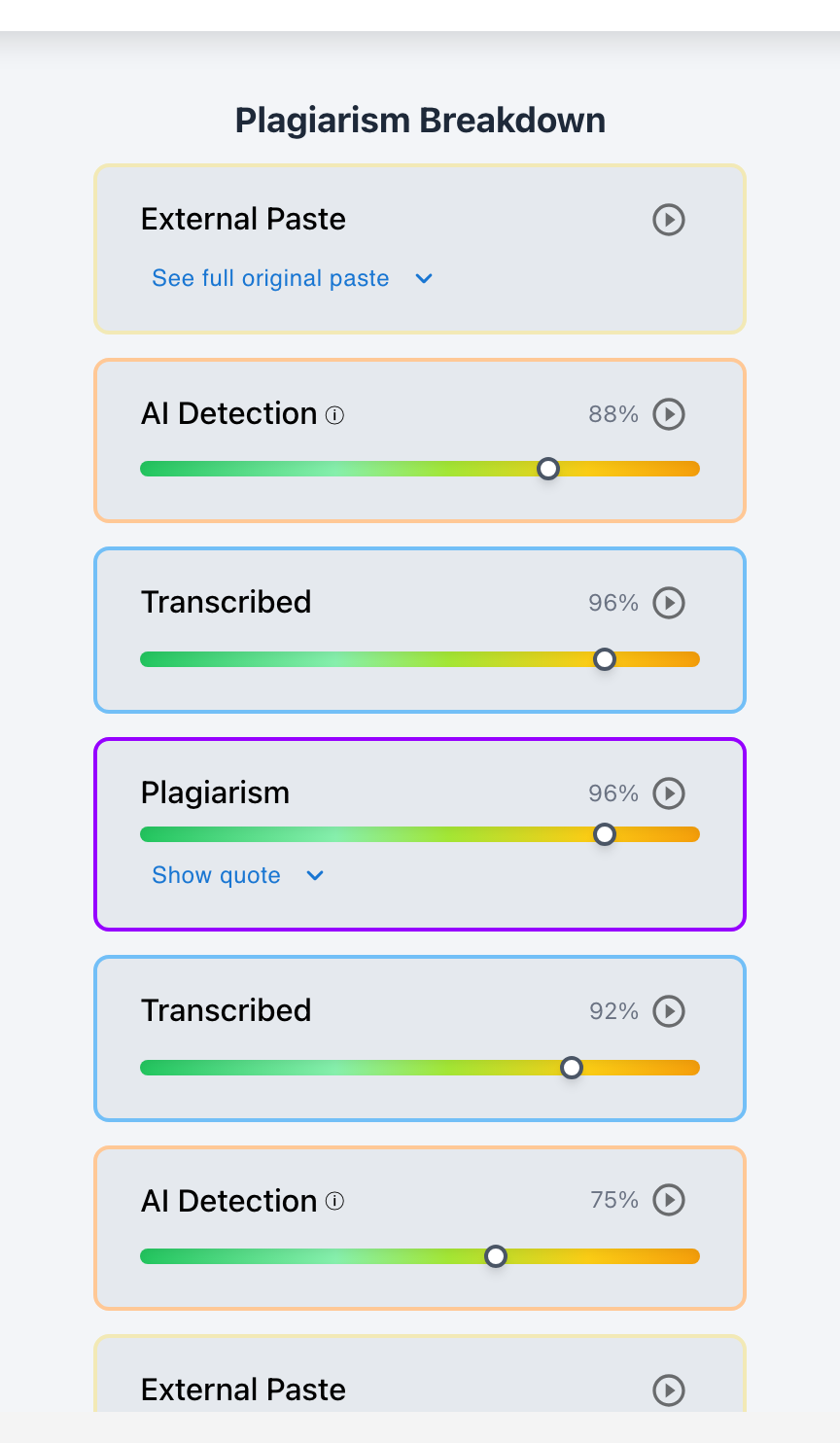
Yes. AI writing is easily detected even when typed manually instead of pasted—because physical keyboard typing does not alter the underlying synthetic sentence structure, low perplexity, and uniform burstiness of AI text, while simultaneously creating a robotic transcription keystroke footprint.
A common misconception among students is that AI detection software checks clipboard paste history alone. In reality, modern integrity platforms evaluate writing through two completely independent dimensions: linguistic text analysis (how the words are structured) and behavioral process analysis (how the words were created). When a student retypes an AI response, the linguistic patterns remain 100% synthetic, while the typing history exposes the absence of human cognitive struggle. Checkmark Plagiarism unifies these signals to catch typed AI writing with total certainty.
Below is a comprehensive technical and pedagogical guide on how typed AI text is detected.
Checkmark Plagiarism detects typed AI text by pairing AI detection with essay writing playback, plagiarism detection, autograding, and integrations with Canvas and Google Classroom.
The 2 Layers That Expose Typed AI Writing
Layer 1: Static Linguistic Analysis
Neural classifiers evaluate perplexity and burstiness on the submitted text. Whether pasted or typed, ChatGPT's predictable syntax and transition phrases score 85%+ AI probability.
Layer 2: Dynamic Keystroke Telemetry
Writing Playback records keystroke intervals and deletions: revealing a flat 75 WPM transcription speed with <2% backspaces and zero cognitive thinking pauses.
Why Typing Cannot Alter Linguistic AI Predictability
Understanding how AI detectors evaluate text on the page:
- Perplexity Calculations: AI detectors measure how "surprised" a language model is by the next word. Because the student typed ChatGPT's exact word choices, the perplexity score remains ultra-low.
- Burstiness Uniformity: AI models generate sentences of uniform length and structure. Retyping the text does not introduce the natural sentence length variations of authentic human writers.
- Formulaic AI Discourse Markers: Phrases like "delve into," "testament to," "multifaceted tapestry," and "in conclusion" persist regardless of the input method.
Read more in how Checkmark writing process analysis works.
Comparison: Typed AI Text vs. Authentic Human Composition
Authentic Human Writing (Natural Process)
- High perplexity with unique, idiosyncratic phrasing.
- 18% to 28% backspaces and self-editing deletions.
- Frequent 30–90 second cognitive thinking pauses.
- Drafting time: 3.5+ hours for 1,500 words.
Manually Typed AI Text (Transcription Footprint)
- Low perplexity with formulaic AI vocabulary patterns.
- <2% backspaces; zero sentence rewrites.
- Uninterrupted linear typing without thinking pauses.
- Drafting time: 20 minutes for 1,500 words.
A 5-Step Educator Protocol for Auditing Typed AI Writing
Typed AI Audit Checklist:
- 1. Open the student's submission in Checkmark Playback inside Canvas SpeedGrader.
- 2. Review the AI Probability Score: flag papers scoring above 50% AI probability.
- 3. Inspect the Deletion Rate and Active Typing Time metrics.
- 4. If the essay exhibits 80%+ AI score paired with <2% backspaces and 20-minute drafting, confirm transcription.
- 5. Hold a supportive conference: ask the student to explain how their thesis was developed.
How Checkmark Plagiarism Powers Multi-Layer Detection
Checkmark Plagiarism combines **AI detection, essay writing playback, static AI detection, plagiarism detection, autograding, and Canvas/Google Classroom integrations** to ensure that typing shortcuts cannot bypass academic integrity standards.
Frequently Asked Questions
Does typing an essay by hand remove AI detection flags?
No. AI detectors analyze linguistic patterns and word choices, which remain completely unchanged regardless of whether the text was typed or pasted.
What does typed AI text look like in writing history?
It shows continuous linear typing at 70+ WPM with zero thinking pauses between complex paragraphs and a sub-2% backspace rate.
Can an AI detector tell if text was typed on a keyboard?
Static detectors analyze text only, but Checkmark combines static AI detection with keystroke writing playback to analyze both text and keyboard behavior.
How fast does a student type when transcribing from another screen?
Transcription typing typically clocks in between 65 and 85 steady WPM, allowing 1,500 words to be retyped in under 25 minutes.
Why do authentic writers have higher backspace rates?
Because authentic writers constantly rethink ideas, fix spelling errors, and rephrase sentences—averaging 15% to 30% backspaces.
How does Checkmark Plagiarism integrate with Canvas LMS?
Checkmark provides certified LTI 1.3 integration, SpeedGrader sidebar embeds, two-way grade passback, and single sign-on (SSO).
What if a student typed an essay they wrote by hand on paper?
Ask the student to bring their handwritten notebook to a brief 2-minute conference to verify their authentic drafting process.
Can students fake natural typing rhythms?
Simulating hours of realistic keystroke speed fluctuations, pauses, and backspaces requires more mental effort than simply writing honestly.
What should a teacher do if typed AI writing is identified?
Review the combined AI score and playback replay with the student in a non-adversarial conference to discuss academic integrity.
Why is multi-signal evidence more reliable than single detectors?
Because corroborating synthetic language scores with transcription keystroke footprints provides unshakeable proof of copying.
Uncovering Shortcuts with Multi-Signal Precision
Retyping AI text cannot mask the absence of authentic thought. By combining neural linguistic detection with keystroke process analytics in Checkmark Plagiarism, teachers gain the comprehensive evidence needed to evaluate student writing with complete confidence.
Checkmark Plagiarism supports this comprehensive approach with AI detection, essay writing playback, static AI detection, plagiarism detection, autograding, and integrations with Canvas and Google Classroom.
See how Checkmark pairs linguistic AI detection with keystroke playback to catch manually typed AI text. View a sample report or request a demonstration.