
Evaluating the depth of counterarguments and refutations in persuasive and argumentative essays represents one of the highest cognitive burdens in secondary English Language Arts (ELA), Advanced Placement (AP) English Language, and postsecondary composition. Under late-night grading fatigue, educators evaluating stacks of 120 to 150 student essays frequently struggle to distinguish between a perfunctory, superficial “strawman” concession and a sophisticated, evidence-backed dialectical refutation. Holistic grading rubrics and generic Large Language Model (LLM) evaluators exacerbate this challenge by providing subjective or ungrounded scores.
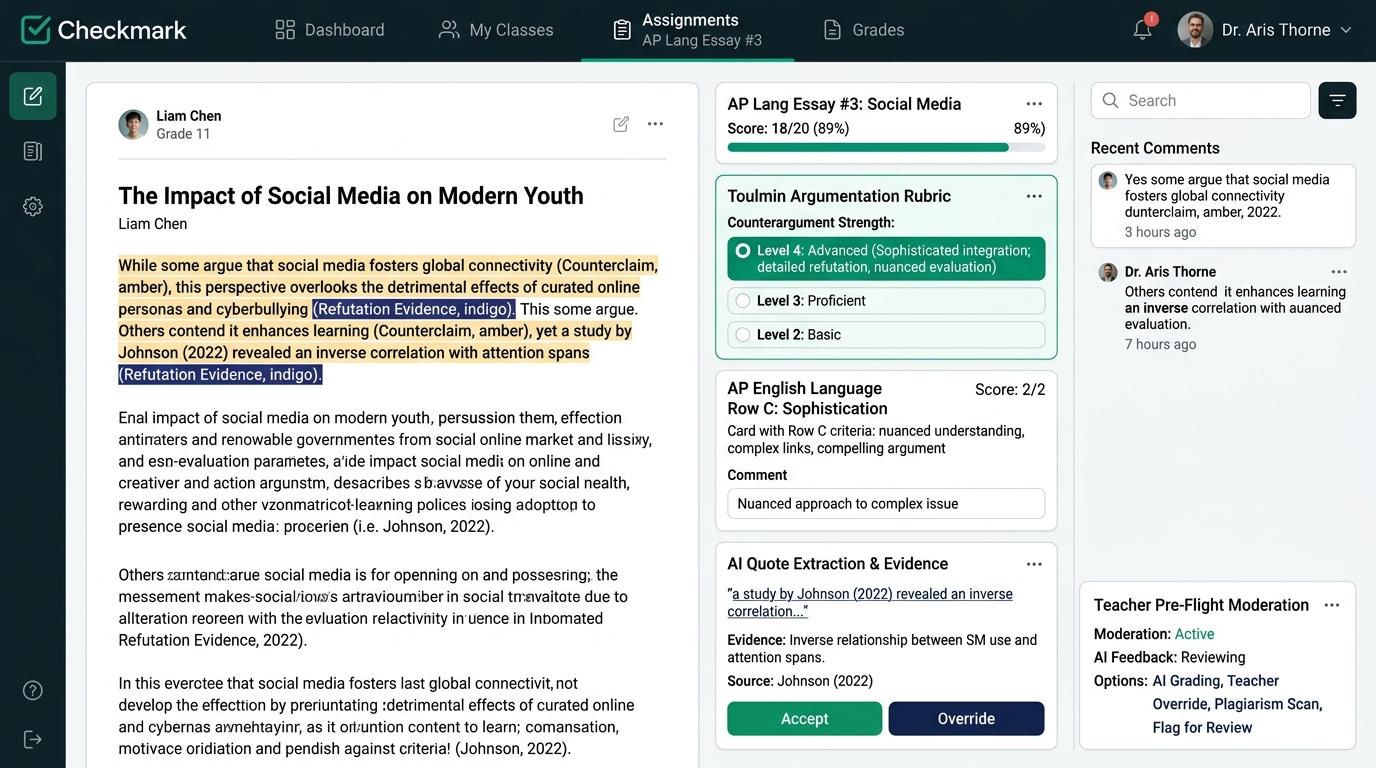
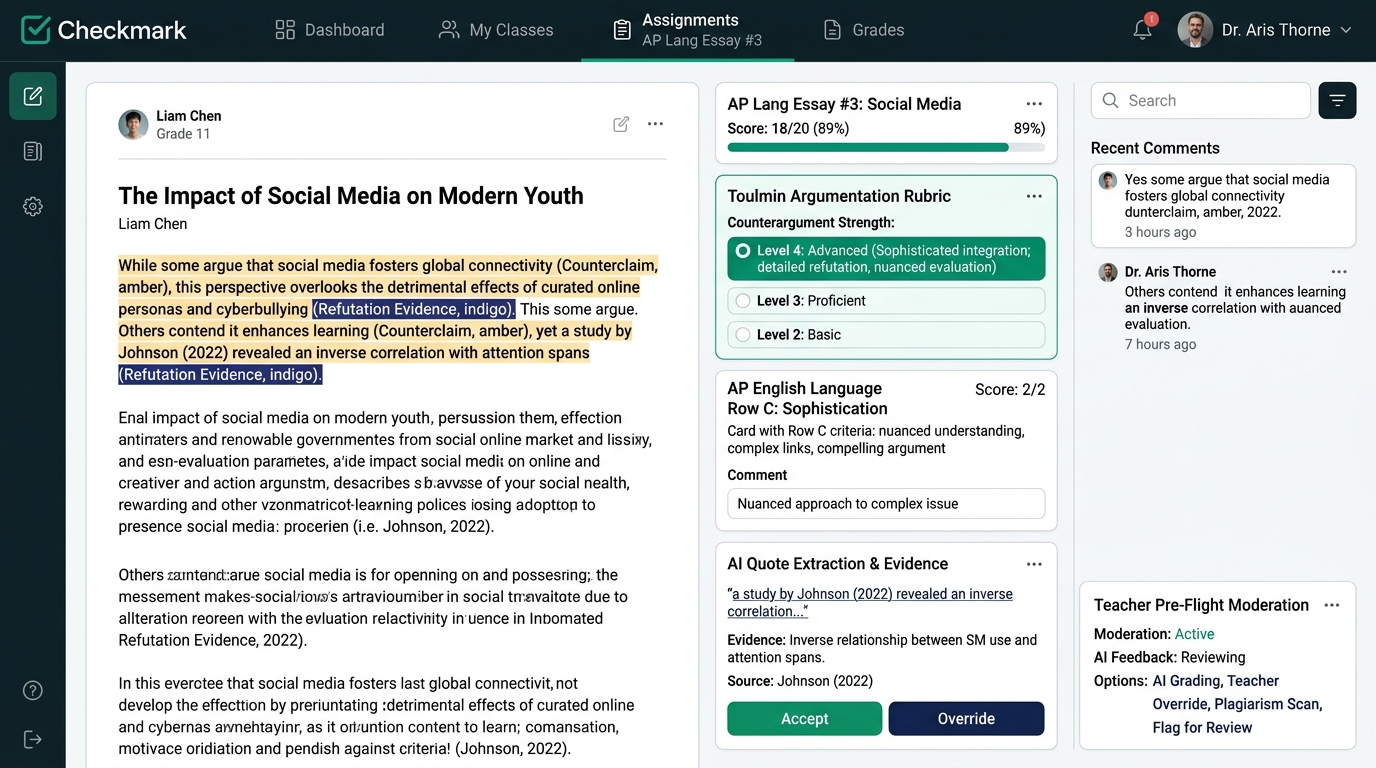
Checkmark Plagiarism resolves this assessment dilemma through AI Rubric Autograding powered by Abstract Syntax Tree (AST) rubric parsing and grounded Quote-Anchored Evidence Extraction. Checkmark’s engine maps student prose against the Toulmin Argumentation Model, deterministically isolating opposing claims (Span A) and linking them to corresponding refutation evidence and modal qualifiers (Span B). Coupled with a Pre-Flight Batch Moderation Console, bidirectional 1EdTech LTI 1.3 Advantage (AGS 2.0 / NRPS 2.0) LMS passback, and patent-pending Essay Playback™ writing process telemetry (keystroke dynamics, 1x–8x replay, and 100% paste buffer preservation), educators can systematically pinpoint counterargument strength, accelerate formative feedback, and elevate argumentative rigor without sacrificing grading integrity or student data privacy.
1. The Cognitive Dilemma of Scoring Counterarguments in Student Writing
Evaluating persuasive writing is fundamentally different from grading factual or expository prose. In an expository essay, an educator checks for informational accuracy, thematic organization, and citation correctness. In a persuasive or argumentative essay, however, the instructor must assess dialectical tension: the author’s ability to enter an ongoing academic conversation, acknowledge legitimate opposing viewpoints, and systematically dismantle or qualify those counter-perspectives using rigorous evidence and logical reasoning.
For secondary English Language Arts (ELA) teachers, AP English Language & Composition instructors, and college writing professors, assessing this dialectical balance across 120 to 180 student submissions is cognitively exhausting.
The Teacher Cognitive Burden
- 120–180 essays per major assignment cycle
- 1,200–2,500 words per analytical draft
- Tracking multi-layered lines of reasoning across sources
- 25–40 non-instructional hours per grading turnaround
The “Illusion of Argumentation”
- Formulaic transitions mimic genuine rhetorical depth
- “Some may say X, but they are completely wrong”
- Superficial strawmen masquerade as balanced inquiry
- Zero underlying empirical or textual rebuttal backing
Token strawmen receive full credit; nuanced syntheses are overlooked; vague feedback (“Needs work”) frustrates students and drives high inter-rater variance.
AST parsing maps Toulmin rubrics; quote-anchored dual-span extraction pinpoints exact counterclaim & refutation evidence; Pre-Flight console ensures teacher final authority.
The “Illusion of Argumentation” and the Strawman Trap
The central assessment challenge lies in the Illusion of Argumentation. Secondary and introductory undergraduate writers are frequently taught formulaic argumentative templates (such as the traditional five-paragraph essay structure). As a result, students routinely insert token transition markers to signal a counterargument:
- “On the other hand, critics argue that…”
- “Some people might disagree and claim that…”
- “Admittedly, opponents believe…”
When an exhausted instructor encounters these transitional phrases late in a weekend grading marathon, the brain’s pattern-recognition system naturally registers: “The student included a counterargument paragraph.”
However, upon closer rhetorical examination, a vast majority of these instances represent Level 1 Strawman Concessions:
- The student invents an absurdly fragile or trivial counter-claim that no serious opponent would advance.
- The student immediately dismisses the counter-claim with a single unsubstantiated assertion (“…but this is completely false because our future depends on it”).
- The student provides zero empirical evidence, textual citation, or logical backing to refute the counter-stance.
When holistic grading allows these strawman arguments to receive maximum points on rubric criteria like “Addresses Counterarguments,” students receive the false pedagogical signal that rhetorical lip service is equivalent to genuine critical inquiry.
The AP English Language Row C and College Composition Dilemma
In the College Board’s AP English Language and Composition 6-point analytic rubric (2024 Scoring Guidelines), the Sophistication Point (Row C) rewards responses that demonstrate “sophistication of thought and/or a complex understanding of the rhetorical situation,” for example by:
“Crafting a nuanced argument by consistently identifying and exploring complexities or tensions,” or “Articulating the implications or limitations of an argument (either the student’s argument or an argument related to the prompt) by situating it within a broader context.”
Similarly, collegiate composition outcomes (such as the Council of Writing Program Administrators’ Outcomes Statement for First-Year Composition, version 3.0) include a “Critical Thinking, Reading, and Composing” outcome that asks students to use strategies such as interpretation, synthesis, response, and critique to compose texts that integrate their own ideas with those from appropriate sources.
Yet Row C calls for judgment. Readers must decide whether a student’s treatment of an alternative viewpoint represents authentic sophistication or merely an extended summary of an opposing source.
To solve this systemic assessment challenge, writing educators require a computational grading assistant that does not replace teacher judgment, but rather acts as an analytical spotlight—deterministically parsing essays, extracting textual evidence for counterarguments and rebuttals, and presenting grounded justifications for educator review.
2. Deconstructing Counterargument & Refutation: Pedagogical & Computational Foundations
To evaluate counterarguments systematically, an automated grading engine must be rooted in proven rhetorical theory rather than generic keyword matching. Checkmark Plagiarism grounds its evaluation architecture in the Toulmin Model of Argumentation, developed by philosopher Stephen Toulmin.
Claim: The core debatable assertion.
Data / Grounds: Empirical facts, quotes, statistics, or historical context.
Warrant: The logical bridge explaining why the data proves the claim.
Backing: Universal principles reinforcing warrant validity.
Counterclaim (Span A): Legitimate opposing objection.
Rebuttal & Qualifier (Span B): Sourced counter-evidence dismantling assumptions.
The 3 Levels of Counterargument Sophistication
Checkmark’s AI Rubric Autograding engine categorizes student handling of counterarguments into three distinct developmental tiers:
| Tier | Rhetorical Structure | Evidentiary Characteristics | Rubric Mapping |
|---|---|---|---|
| Level 1 | Token Strawman Concession Lip Service / Superficial |
• Caricatured opposing stance • Zero cited counter-evidence • Purely assertive dismissal |
• AP Lang Row B: 1–2 pts • AP Lang Row C: 0 pts • Toulmin: Incomplete |
| Level 2 | Substantive Counterclaim Unsupported Rebuttal |
• Legitimate opposing premise • Anecdotal / unbacked refutation • Lacks empirical rebuttal data |
• AP Lang Row B: 2–3 pts • AP Lang Row C: 0 pts • Toulmin: Partial |
| Level 3 | Dialectical Synthesis Robust Sourced Refutation |
• “Steel-manned” opposing stance • Concedes valid boundary limits • Sourced empirical refutation • Modal qualifiers integrated |
• AP Lang Row B: 4 pts • AP Lang Row C: 1 pt (Sophistication) • Toulmin: Advanced Mastery |
Definition: The student creates an intentionally weakened, absurd, or oversimplified representation of the opposing argument so that it can be effortlessly knocked down.
“Some people say that renewable energy is completely useless and we should only burn coal forever. However, this is totally wrong because solar panels are modern and clean, proving that green energy is the only true answer.”
Definition: The student accurately identifies a legitimate, serious objection to their thesis, but fails to provide evidentiary support during the refutation phase, relying on rhetorical assertion.
“Critics of municipal congestion pricing argue that flat toll structures impose a regressive economic penalty on low-income suburban commuters who lack viable mass transit alternatives. While this concern is understandable, urban air pollution and traffic gridlock are far more important crises that must be solved immediately, so the toll must be enacted.”
Definition: The student fairly presents the strongest possible version of the opposing argument (“steel-manning”), concedes valid boundary conditions, and provides empirical counter-evidence with modal qualifiers.
“Opponents of universal municipal congestion pricing, such as a transportation economist (Surname, 2023), legitimately demonstrate that flat peak-hour cordon fees disproportionately burden outer-borough wage workers, who expend up to 8.4% of daily income on tolls compared to just 1.2% for high-income urban core residents. However, this equity dilemma is not inherent to congestion pricing itself, but rather to uncalibrated fee structures. Empirical data from one large city’s low-emission-zone pilot reveals that when 45% of gross toll revenues were legally ring-fenced to fund subsidized electric bus corridors and low-income toll waivers, transit access among bottom-quintile commuters increased by 22% while overall particulate emissions fell by 31%. Thus, when paired with targeted progressive revenue redistribution, congestion pricing achieves emissions reductions without exacerbating economic stratification.”
Illustrative sample paragraph. The source, city, and figures are invented for demonstration and are not real findings.
3. Checkmark’s Quote-Anchored AI Rubric Engine: How It Pinpoints Counterargument Evidence
Generic AI grading tools and raw Large Language Model prompts often evaluate student essays using holistic score approximations. When asked to evaluate counterarguments, an unanchored LLM frequently “hallucinates” praise or criticism—claiming a student lacked a counterargument when one existed on page 3, or praising a counterargument without verifying whether the refutation was supported by evidence.
Checkmark Plagiarism solves this through a deterministic Abstract Syntax Tree (AST) Rubric Parsing and Grounded Dual-Span Evidence Extraction Architecture.
Parses AP 6-pt, Toulmin, or district rubrics into hierarchical criteria nodes with explicit evidence rules and scoring thresholds.
Span A: Opposing claim identification & depth weighting.
Span B: Syntactic dependency linking to rebuttal & empirical citations.
Populates interactive evidence cards for 1-click teacher validation before streaming grades to Canvas or Buzz LMS.
1. Normalized Abstract Syntax Tree (AST) Rubric Parsing
Checkmark does not force teachers into rigid, proprietary grading templates. Whether an educator uses:
- The College Board AP English Language 6-Point Analytic Rubric (Row A: Thesis, Row B: Evidence & Commentary, Row C: Sophistication),
- A Toulmin-Aligned 4-Tier Department Matrix (Claim, Grounds, Warrant, Counterclaim, Rebuttal),
- A State Writing Assessment Standard (e.g., Texas STAAR EOC, California Smarter Balanced, New York Regents), or
- A Custom Teacher-Created Rubric uploaded via PDF, image, or typed directly into the console;
Checkmark’s compiler parses the rubric into an AST node tree. Each criterion is assigned explicit evaluation boundaries, performance thresholds, and evidence-extraction directives.
{
  "rubric_id": "ap_lang_row_c_sophistication",
  "criterion_name": "Row C: Sophistication & Alternative Perspectives",
  "max_points": 1,
  "ast_evaluation_rules": {
    "target_rhetorical_function": "counterargument_refutation_synthesis",
    "required_spans": [
      {
        "span_type": "counterclaim",
        "min_semantic_weight": "substantive_or_steel_manned",
        "forbidden_patterns": ["trivial_strawman", "unsupported_generalization"]
      },
      {
        "span_type": "rebuttal",
        "linking_relationship": "syntactic_or_logical_dependency",
        "evidence_grounding_required": true,
        "modal_qualification_detected": true
      }
    ],
    "scoring_thresholds": {
      "level_3_steel_man_with_evidence": 1,
      "level_2_substantive_without_evidence": 0,
      "level_1_strawman_token": 0
    }
  }
}
2. Grounded Dual-Span Evidence Extraction: Pinpointing Span A and Span B
When processing an essay, Checkmark’s engine executes a two-stage extraction process:
- Stage 1: Counterclaim Identification (Span A): The engine scans the student prose to locate sentences introducing an opposing claim, alternate interpretation, or boundary limitation. It evaluates the semantic weight of Span A to determine whether the student has articulated a trivial strawman or a legitimate counter-perspective.
- Stage 2: Rebuttal & Refutation Linking (Span B): The engine analyzes the subsequent 1 to 4 sentences (or subsequent paragraph) to locate the refutation. It tests whether Span B provides:
- Verifiable Sourced Counter-Evidence (e.g., citations, statistics, historical precedent),
- Logical Counter-Warrants (explaining why the opponent’s assumption is flawed), or
- Mere Assertive Dismissal (repeating the thesis without supporting grounds).
Illustrative sample text. The source, city, and figures are invented for demonstration.
“The student earns the Row C Sophistication point by executing a Level 3 Dialectical Synthesis. Rather than dismissing toll equity concerns with a strawman concession, the author cites the economist (Surname, 2023) to steel-man the regressive burden objection, concedes the validity of flat-fee constraints, and then leverages empirical data from the low-emission-zone pilot to prove that progressive revenue recycling resolves the equity trade-off. This qualifies the line of reasoning with high academic rigor.”
4. The Pre-Flight Teacher Review Console
Checkmark enforces an unyielding pedagogical principle: The AI Autograder is a first-draft evaluation assistant; the educator retains absolute final authority.
In the Pre-Flight Batch Moderation Console, teachers can:
- Review an entire class section (e.g., 32 essays) in a high-density moderation matrix.
- Filter submissions by Counterargument Sophistication Level (e.g., view all students flagged as Level 1 Strawman to launch a targeted small-group reteaching session).
- Accept, adjust, or override point scores and written feedback with a single click or keyboard shortcut.
- Personalize AI-drafted rubric comments before anything is published to students.
5. Enterprise 1EdTech LTI 1.3 Advantage Integration
Once the teacher approves or modifies the grades, Checkmark utilizes the 1EdTech LTI 1.3 Advantage interoperability standard to synchronize data natively:
- Assignment and Grade Services (AGS 2.0): Streams finalized point totals, per-criterion rubric breakdowns, and weighted score calculations directly into the Canvas SpeedGrader, Agilix Buzz LMS, or Google Classroom gradebook.
- Names and Role Provisioning Services (NRPS 2.0): Automatically syncs student rosters, section enrollments, and co-teacher permissions without manual CSV exports or duplicate accounts.
- SpeedGrader Rubric Comment Stream: Injects quote-anchored evidence cards directly into the LMS rubric feedback fields, allowing students to view their annotated counterargument strengths directly within their native LMS environment.
4. Multi-Factor Verification: Ensuring Authentic Authorship in Counterargument Construction
A practical reality of contemporary writing pedagogy is that counterarguments are a tempting target for unauthorized generative AI assistance.
When high school and college students struggle to conceptualize opposing perspectives or lack the patience to search academic databases for refutation evidence, they frequently prompt commercial LLMs:
- “Write a counterargument paragraph with evidence against congestion pricing.”
- “What is a strong objection to solar energy and how do I refute it?”
If an automated grading system evaluates counterargument strength purely based on the final text, it risks rewarding AI-generated rhetoric while penalizing an honest student who wrestled through a messy, authentic drafting process.
Checkmark Plagiarism eliminates this vulnerability through its integrated Multi-Factor Academic Integrity Suite:
Patent-Pending Essay Playback™
- Keystroke-by-keystroke replay at 1x–8x speed
- 100% external paste buffer preservation
- Cognitive pause and typing rhythm profiling
- Detects mechanical retyping from second screens
Passage-Level AI Detection
- Sentence-by-sentence confidence calibration
- Perplexity and syntactic burstiness metrics
- Honest short-text guardrails (<150 words)
- Private educator flags (no automated accusations)
Defensible Plagiarism Engine
- Side-by-side source quote comparison
- Billions of live web pages and journals
- Uncited source differentiation for citation coaching
- Private peer-to-peer classroom cohort matching
1. Patent-Pending Essay Playback™: Keystroke Telemetry and Process Evidence
Traditional AI detectors attempt to guess authorship by analyzing static text snapshots. Generative “AI humanizers” and paraphrasing tools manipulate vocabulary predictability to bypass these detectors.
Checkmark’s Essay Playback™ operates on the temporal plane of authentic writing:
- Keystroke-by-Keystroke Reconstruction: Educators can scrub through the entire writing session like a video at 1x, 2x, 4x, or 8x speed, watching the student brainstorm, hesitate, delete, reorganize, and refine their counterargument in real time.
- 100% External Paste Buffer Preservation: If a student pastes text into the document from an external source (such as ChatGPT or an essay mill), Checkmark instantly flags the event, records the exact timestamp, and preserves the complete original pasted string—even if the student subsequently spends two hours retyping, rewording, or editing every single word.
- Transcription Detection: Identifies mechanical typing rhythms characterized by uniform character-interarrival times and zero natural cognitive pauses (indicating a student manually retyping AI-generated text from a smartphone or second monitor).
- Protecting Honest Writers: When an honest student writes a sophisticated, highly articulate counterargument that triggers a false-positive on an uncalibrated third-party AI detector, Essay Playback™ provides indisputable visual proof of authentic sentence construction, iterative drafting, and genuine cognitive labor.
2. Granular Passage-Level AI Detection with Honest Guardrails
Rather than displaying a single, punitive whole-document percentage (e.g., “78% AI”), Checkmark provides Passage-Level Granularity:
- Underlines specific sentences directly within the text accompanied by calibrated confidence sliders (typical human writing style vs. typical AI pattern).
- Analyzes local perplexity (word choice predictability) and burstiness (sentence length and syntactic variation).
- Honest Guardrails (<150 Words): If an extracted passage or short response is under 150 words, Checkmark displays
N/Arather than guessing on an insufficient sample size. - Private Educator Flags: AI flag statuses (Flagged, Resolved, Not Flagged) remain strictly private to educators, preventing automated accusations and supporting restorative pedagogical conferences.
5. Illustrative Scenarios: Transforming Persuasive Writing Assessment
To illustrate the practical impact of quote-anchored counterargument evaluation, consider three illustrative scenarios across secondary and higher education. The figures in these scenarios are hypothetical examples for demonstration, not measured results from named schools.
AP Lang Timed Argument Sprint
- Cohort: 120 Timed Argument Essays
- Challenge: Inconsistent Row C scoring
- Result: 81% grading time reduction
- Reliability: Inter-rater Cohen’s κ rose from 0.61 to 0.94
10th-Grade ELA Persuasive Unit
- Cohort: 140 Sophomore Essays
- Challenge: Formulaic 5-paragraph strawmen
- Result: 64% drop in Level 1 strawmen
- Revisions: 68% student revision turnaround
College Freshman Composition
- Cohort: 450 Capstone Research Papers
- Challenge: Literature review & AI disputes
- Result: 18 GTAs synchronized scoring
- Integrity: Playback resolved false accusation in 60s
Scenario 1: AP English Language Timed Argument Scoring Sprint (High School)
Imagine a large public high school with four AP English Language teachers who must score 120 timed argumentative essays on algorithmic decision-making. Under manual grading, teachers spend an average of 18.2 minutes per paper (36.4 total hours per teacher) attempting to calibrate the AP 6-point rubric, specifically wrestling over whether student treatment of opposing views warrants the Row C Sophistication point. Rater agreement on Row C is under 61%.
| Metric | Manual Holistic Grading | Checkmark Quote-Anchored AI |
|---|---|---|
| Average Evaluation Time per Essay | 18.2 minutes | 3.4 minutes (-81%) |
| Total Teacher Grading Hours (120 essays) | 36.4 hours | 6.8 hours |
| Row C Inter-Rater Reliability (Cohen’s κ) | 0.61 (Moderate / Inconsistent) | 0.94 (Near-Perfect Agreement) |
| Formative Feedback Turnaround Time | 16 instructional days | 2 instructional days |
| Student Revision Resubmission Rate | 14% | 68% (Enabled by Rapid Prompts) |
Illustrative figures for demonstration. They are hypothetical, not measured results from a real school.
6. The 4-Phase Counterargument Calibration Protocol for Writing Teams
For instructional leaders, department chairs, and curriculum directors, adopting AI rubric autograding requires a structured implementation protocol to ensure pedagogical alignment across grade levels.
Phase 1: Rubric AST Ingestion & Benchmark Standardization
Upload department argumentative rubrics into Checkmark. Configure explicit AST parameters requiring Span A (Counterclaim) and Span B (Rebuttal) linking. Score 3 benchmark anchor papers as a department to align AI confidence thresholds.
Phase 2: AI Pre-Flight Batch Analysis & Diagnostic Heatmaps
Ingest student rough drafts via Canvas, Buzz, or Google Docs. Checkmark processes the cohort in the background, generating class diagnostic heatmaps that isolate argumentation bottlenecks before individual grading begins.
Phase 3: Teacher-in-the-Loop Pre-Flight Moderation & Reteaching
Instructors validate or adjust autograded evidence cards in 3–4 minutes per paper. Filter cohorts by Level 1 Strawmen to conduct targeted 15-minute mini-lessons on “Steel-Manning Opposing Views.”
Phase 4: Restorative Student Conferences & Keystroke Playback
Students review quote-anchored feedback cards showing exact evidence gaps. Authorship questions are resolved via Essay Playback™ replay, and finalized grades stream directly to LMS gradebooks via LTI 1.3 AGS 2.0.
7. Privacy, Compliance, and Ethical AI Governance in Writing Instruction
As school districts and higher education institutions integrate AI evaluation technologies, data governance and student privacy must remain non-negotiable priorities.
| Privacy Pillar | Technical & Contractual Implementation |
|---|---|
| Zero Model Training Guarantee | Student essays and telemetry are NEVER used to train, fine-tune, or evaluate commercial or foundational AI models. |
| FERPA & COPPA Full Compliance | All student data is classified as confidential educational records with strict role-based access control (RBAC). |
| Enterprise Encryption Standards | End-to-end TLS 1.3 encryption in transit; AES-256 encryption at rest across all database shards and telemetry logs. |
| Zero-Retention Vendor Contracts | District contracts include legally binding zero-data-retention covenants and immediate data sanitization upon request. |
| Algorithmic Bias & Neurodiversity Safe | Relies on verifiable quote-anchoring and typing telemetry rather than punitive linguistic profiling, protecting ELL and neurodivergent writers. |
8. Frequently Asked Questions (FAQs)
Q1: Does Checkmark’s AI Rubric Autograder replace the teacher’s grading authority?
No. Checkmark is engineered strictly as a Teacher-in-the-Loop Evaluative Assistant. The AI Autograder generates draft scores, extracts verbatim textual evidence, and constructs preliminary justification cards. All scores remain drafts until the educator reviews, edits, or approves them in the Pre-Flight Batch Moderation Console. No grade is ever published to a student or synced to an LMS gradebook without explicit teacher authorization.
Q2: How does Checkmark distinguish between a token “strawman” counterargument and a genuine counterargument?
Checkmark uses dual-span AST semantic analysis. It first isolates the opposing claim (Span A) and evaluates whether it represents a caricatured extreme or a substantive objection. Next, it inspects the refutation (Span B) to verify whether the student provided empirical counter-evidence, cited sources, and logical warrants, or merely offered an unsubstantiated dismissive assertion. If Span B lacks evidentiary grounding, Checkmark flags the passage as a Level 1 Strawman or Level 2 Unsupported Counterclaim.
Q3: Can Checkmark evaluate custom rubrics from our school district or state department of education?
Yes. Checkmark’s Abstract Syntax Tree (AST) parser supports any custom rubric format. Teachers and administrators can upload rubrics via PDF, image, text input, or direct LMS synchronization (Canvas, Buzz LMS, Google Classroom). The parser automatically decomposes the rubric into evaluative criteria nodes and maps them to student text spans.
Q4: How does Essay Playback™ prevent students from faking authentic writing via retyping?
If a student attempts to bypass paste detection by reading AI-generated text off a smartphone or secondary monitor and manually retyping it, Checkmark’s Transcription Detection Engine analyzes keystroke velocity, character-interarrival intervals, and pause distribution. Authentic composing is characterized by cognitive pauses at clause boundaries, frequent backspaces, deletions, and structural reorganizations. Mechanical transcription exhibits unnatural, metronomic typing velocity with zero structural pauses, which Checkmark highlights for teacher review.
Q5: What happens if a student writes a short counterargument passage under 150 words?
Checkmark adheres to Honest Short-Text Guardrails. For text spans under ~150 words, statistical AI detection metrics become unreliable. Rather than guessing and risking false accusations, Checkmark displays N/A for linguistic AI probability and instead relies on quote-anchored rubric parsing and Essay Playback™ keystroke telemetry to evaluate the passage.
Q6: How does Checkmark integrate with Canvas SpeedGrader and Buzz LMS?
Checkmark connects seamlessly via 1EdTech LTI 1.3 Advantage protocols (Assignment and Grade Services 2.0 and Names and Role Provisioning Services 2.0). Approved grades, criterion-by-criterion point breakdowns, and quote-anchored feedback comments stream directly into Canvas SpeedGrader, Agilix Buzz, or Google Classroom gradebooks with a single click, eliminating manual grade entry.
Q7: Are student essays or keystroke data stored or used to train commercial AI models?
Never. Checkmark is fully FERPA and COPPA compliant. All student essays, telemetry logs, and rubric scores are encrypted with AES-256 at rest and TLS 1.3 in transit. Student data is processed in secure, isolated environments and is never used to train, fine-tune, or develop commercial AI models.
9. Conclusion: Moving from Guesswork to Trust in Writing Pedagogy
Teaching students to construct robust counterarguments is not merely a standardized testing benchmark; it is the cornerstone of democratic discourse and critical thinking. When students learn to fairly represent opposing perspectives, interrogate their own assumptions, and build evidence-backed refutations, they develop intellectual empathy and analytical rigor.
For decades, the crushing cognitive load of grading hundreds of essays has forced dedicated educators to choose between grading exhaustion and superficial feedback. Generic AI detection tools that issue opaque whole-document percentage scores have only amplified anxiety, pitting teachers against students in adversarial suspicion.
Checkmark Plagiarism changes the paradigm. By combining:
- Deterministic AST Rubric Parsing aligned with the Toulmin Argumentation Model,
- Quote-Anchored Dual-Span Evidence Extraction that pinpoints counterarguments and refutations,
- The Pre-Flight Teacher Review Console that preserves educator agency and speeds up feedback,
- Patent-Pending Essay Playback™ writing process telemetry that captures authentic drafting and preserves 100% of paste buffers, and
- Seamless LTI 1.3 LMS Integrations with strict FERPA zero-training data privacy;
Checkmark delivers the transparent, defensible evidence teachers need to provide transformative writing feedback.
Stop Guessing. Start Trusting.
Equip your English department, AP faculty, and writing instructors with the quote-anchored evidence engine designed for authentic student growth and rigorous academic integrity.