
Comparative literature essays—central to Advanced Placement (AP) English Literature, International Baccalaureate (IB) English Paper 2, Dual Enrollment, and collegiate literary studies—impose the heaviest cognitive grading burden in the humanities. Evaluating how effectively a student synthesizes thematic motifs, sociopolitical commentary, and literary devices across two distinct texts (such as The Great Gatsby vs. Passing or 1984 vs. Brave New World) requires instructors to track dual narrative arcs, verify parallel textual citations, and evaluate whether the essay achieves genuine dialectical synthesis or collapses into the ubiquitous “Silo Phenomenon” (two isolated mini-essays stitched together with superficial transitional phrases). Under late-night grading fatigue across 90 to 150 student papers, human evaluators frequently suffer from rater drift, missing severe evidence skews (e.g., eight quotes from Text A and only one from Text B) or mistaking structural juxtaposition for conceptual synthesis.
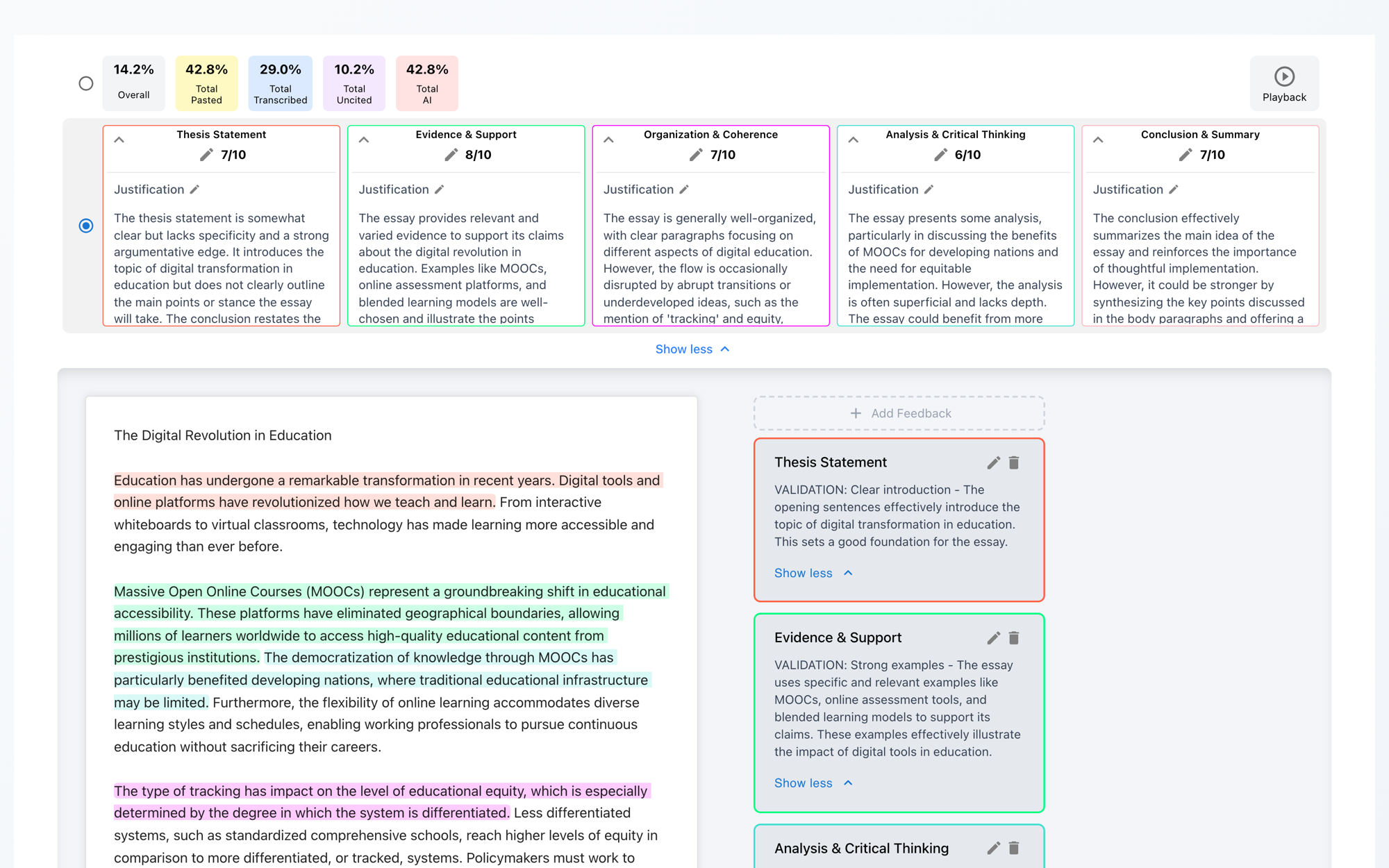
Checkmark Plagiarism resolves this assessment challenge through AI Rubric Autograding powered by Abstract Syntax Tree (AST) rubric parsing and Multi-Text Quote-Anchored Evidence Extraction. Checkmark’s engine deterministically tags and isolates quotations from Text A (🟢 Green Spans) and Text B (🟣 Purple Spans), computes cross-textual synthesis ratios, diagnoses evidentiary asymmetry, and generates sentence-level revision prompts for synthesis gaps. Seamlessly integrated with a Pre-Flight Batch Moderation Console, bidirectional 1EdTech LTI 1.3 Advantage (AGS 2.0 / NRPS 2.0) gradebook passback, and patent-pending Essay Playback™ writing process telemetry (1x–8x keystroke replay, 100% paste buffer preservation, and transcription detection), Checkmark empowers literature educators to elevate comparative rigor, eliminate grading burnout, and maintain uncompromised pedagogical authority.

1. The Cognitive Burden and Assessment Dilemma of Comparative Literature
In the landscape of humanities education, few instructional tasks are as intellectually demanding—or as pedagogically vital—as teaching and evaluating comparative literature essays.
Whether preparing high school seniors for the AP English Literature and Composition exam, moderating IB Diploma Programme (DP) English A: Literature / Language & Literature Paper 2 comparative essays, leading Dual Enrollment American Literature surveys, or teaching undergraduate Comparative Literature seminars, educators task students with one of the most sophisticated forms of analytical reasoning: placing two autonomous works of literature into critical dialogue.
The Student Challenge: Synthesis
- Tracking 2 distinct historical eras & narrative arcs
- Balancing 2 divergent authorial aims & stylistic traditions
- Integrating 2 complex, parallel textual quote sets
- Avoiding the ubiquitous “Silo Phenomenon”
The Teacher Challenge: Cognition
- Tracking 2 full primary texts simultaneously
- Verifying 12–20 textual citations and page offsets
- Evaluating dialectical integration vs superficial transitions
- Grading 90–150 essays (1,500+ words each) under deadline
“Siloed” essays receive top marks simply for smooth grammar; severe quote imbalances go undetected (e.g., 8 quotes Text A vs 1 Text B); vague feedback (“Compare more deeply”) leaves students stalled.
AST rubric parser maps AP/IB criteria; Multi-Text engine separates Text A (🟢 Green) and Text B (🟣 Purple); synthesis ratio heatmaps & Socratic revision scaffolds generated automatically.
The Cognitive Architecture of Comparative Synthesis
Unlike single-text literary analysis—where a student traces a motif, unpacks a character arc, or critiques a socio-historical context within a unified narrative world—comparative analysis requires multi-layered, concurrent cognitive processing:
- Parallel Narrative Tracking: The reader and writer must maintain active mental models of two distinct plots, character networks, stylistic conventions, and historical milieus simultaneously (e.g., F. Scott Fitzgerald’s 1920s Long Island aristocracy in The Great Gatsby versus Nella Larsen’s 1920s Harlem Renaissance color line in Passing).
- Thematic Abstraction: The student must abstract themes beyond the idiosyncratic details of individual plots to identify shared conceptual tensions (e.g., the performance of identity, the myth of the American self-invention, or the socio-economic commodification of domesticity).
- Dialectical Interrogation: The writer must not merely state that Text A and Text B are “similar” or “different.” They must demonstrate how Text A illuminates hidden dimensions of Text B, and conversely, how Text B critiques or complicates the ideological assumptions of Text A.
The Grading Fatigue Curve and Rater Drift
For an educator managing three to four sections of AP Literature or IB English, an assignment cycle yields 90 to 150 essays, each spanning 1,200 to 2,500 words. Reading, annotating, evaluating evidence parity, and formulating actionable feedback across this volume requires 35 to 55 hours of intense cognitive labor.
Psychometric research in educational measurement demonstrates that human raters undergo predictable cognitive fatigue and evaluation drift:
- Papers 1–15 (High Cognitive Vigilance): The instructor carefully checks every cited quotation, tracks whether evidence from Text A is balanced by evidence from Text B, annotates thematic synthesis in the margins, and cross-references the rubric criteria with precision.
- Papers 16–50 (Structural Skimming): As cognitive load accumulates, the teacher shifts from deep analytical parsing to structural scanning. The rater searches for surface indicators—such as transitional phrases (“Similarly,” “In contrast,” “Conversely,” “Likewise”)—assuming that if the transitional vocabulary is present, comparative synthesis has occurred.
- Papers 51–100+ (Heuristic Fatigue & Halo Effect): Rater drift peaks. The instructor relies heavily on holistic impressions, vocabulary sophistication, clean grammar, and prior student reputation. An essay with a severe evidentiary imbalance (e.g., nine detailed quotes analyzing 1984 but only one passing summary mention of Brave New World) may receive full points on evidence simply because the prose reads smoothly and the conclusion includes a well-phrased comparative platitude.
This dynamic creates a profound pedagogical failure: students who master the superficial formatting of comparison receive top marks, while students who struggle with the complex, messy work of dialectical synthesis receive vague marginal notes like “compare more deeply” without actionable guidance on how to bridge their textual evidence gaps.
2. Deconstructing Comparative Literary Synthesis: Pedagogical Foundations & Failure Modes
To understand how automated rubric assistants can effectively diagnose gaps in textual synthesis, we must first establish the pedagogical taxonomy of comparative writing and analyze why traditional student drafts fail.
Text A Exclusively (No Text B)
Text B Exclusively (No Text A)
Tacked-on Synthetic Platitude
Evidentiary Diagnosis: Complete structural segregation. Two 500-word mini-essays stapled together. Zero dialectical friction or cross-textual commentary.
Evidentiary Diagnosis: Quotes present for both works, but presented sequentially without mutual interrogation of authorial craft or philosophical tension.
Evidentiary Diagnosis: High paragraph co-occurrence density. Balanced parity. Mutual textual illumination earning full AP Lit Row B (4 pts) & Row C Sophistication.
The “Silo Phenomenon” (Serial Monologues)
The most common failure mode in secondary and undergraduate literature classrooms is the Silo Phenomenon (also known as the “block-by-block trap” or “serial monologue”).
In a siloed essay, the student divides the paper into two physically isolated essays:
- Section 1 (Paragraphs 1–2): The student analyzes Text A (The Great Gatsby), discussing Jay Gatsby’s pursuit of Daisy Buchanan, the symbolism of the green light, and the corruption of the American Dream. Text B is never mentioned.
- Section 2 (Paragraphs 3–4): The student pivots entirely to Text B (Passing), discussing Clare Kendry’s dangerous performance of racial passing, Irene Redfield’s psychological repression, and urban bourgeois stability. Text A is never mentioned.
- Conclusion (Paragraph 5): The student attempts to satisfy the assignment prompt by writing a single, hasty synthetic sentence: “Ultimately, both Fitzgerald and Larsen show that the American Dream is an illusion that leads to tragedy for their main characters.”
From a pedagogical perspective, the student has not written a comparative essay; they have written two distinct 500-word book reports stapled together. There is no dialectical interaction, no examination of how Larsen’s racial framework critiques Fitzgerald’s class-exclusive mythos, and no integration of textual evidence.
| Tier | Structural Mechanism | Evidentiary Characteristics | Rubric Alignment & Mapping |
|---|---|---|---|
| Level 1 | Siloed Juxtaposition Serial Monologues / Block Structure |
• 0% co-occurrence in body • Severe evidence asymmetry • One text treated as primary, second text as token afterthought |
• AP Lit Row B: 1–2 pts • AP Lit Row C: 0 pts (No Sophistication) • IB Paper 2 Crit A/B: Low Markband 2/5 • Action: Structural redesign required |
| Level 2 | Alternating Surface Comparison Ping-Pong Mechanical Juxtaposition |
• Mechanical 50/50 division • Formulaic transition words (“Similarly”) • Quotes isolated in halves of paragraphs; lacks genuine dialogue |
• AP Lit Row B: 3 pts • AP Lit Row C: 0 pts • IB Paper 2 Crit A/B: Mid Markband 3/5 • Action: Dialectical bridging prompts |
| Level 3 | Dialectical & Conceptual Synthesis Braided Cross-Textual Analysis |
• Braided, interwoven quotes • High paragraph co-occurrence density • Balanced quote volume ($0.80 le S_R le 1.25$) • Text B critiques Text A craft & philosophy |
• AP Lit Row B: 4 pts (Full Evidence) • AP Lit Row C: 1 pt (Sophistication) • IB Paper 2 Crit A/B: Top Markband 5/5 • Action: Scholarly praise & publication |
3. Checkmark Plagiarism’s Multi-Text Quote-Anchored Evidence Engine
To solve the twin crises of teacher grading fatigue and student synthesis failure, Checkmark Plagiarism engineered the Multi-Text Quote-Anchored Evidence Engine. This system does not replace human judgment with a generative black box; instead, it acts as an intelligent, deterministic analytical microscope that extracts, tags, calculates, and presents synthesis metrics directly within the teacher’s grading workflow.
Deconstructs AP Lit 6-Point, IB DP Paper 2, and custom literature rubrics into discrete programmatic evaluation nodes.
NER & corpus matching tag Text A (🟢), Text B (🟣), and Synthesis Bridges (🔵).
Computes cross-textual synthesis ratios ($S_R$), paragraph co-occurrence density, and flags “Ghost Text” omissions.
Generates paragraph-specific Socratic revision scaffolds guiding students to bridge identified textual synthesis gaps.
1. Abstract Syntax Tree (AST) Parsing of Complex Comparative Rubrics
Standard AI autograders fail on literary essays because they treat rubrics as flat, unformatted blocks of text. Checkmark’s engine utilizes Abstract Syntax Tree (AST) Parsing to deconstruct multi-tiered, hierarchical literature rubrics into discrete, evaluatable programmatic nodes:
Evaluates independent historical and thematic understanding of both texts.
Evaluates dual-corpus citation volume, parity ratio, and analytical integration.
Measures paragraph co-occurrence density vs sequential juxtaposition penalty.
When evaluating against the College Board AP Literature 6-Point Analytic Rubric, Checkmark maps:
- Row A (Thesis — 1 pt): Checks whether the thesis statement establishes a defensible, multi-text comparative claim rather than two unrelated descriptive observations.
- Row B (Evidence & Commentary — 4 pts): Analyzes the volume, specificity, and integration of textual evidence across both works, measuring whether commentary builds a sustained line of reasoning.
- Row C (Sophistication — 1 pt): Evaluates whether the student nuances their argument by exploring complexities, tensions, or alternative interpretations across both texts.
When evaluating against IB English DP Paper 2 Assessment Criteria, Checkmark maps:
- Criterion A: Knowledge, Understanding & Interpretation (5 pts): Evaluates how deeply the student understands both works in relation to the chosen prompt.
- Criterion B: Analysis & Evaluation (5 pts): Evaluates how effectively the student analyzes the authors’ choices of literary features, craft, and structure.
- Criterion C: Focus & Organization (5 pts): Measures whether the comparison is balanced, coherent, and sustained throughout the body of the essay.
- Criterion D: Language (5 pts): Analyzes register, stylistic precision, and academic diction.
2. Multi-Text Quote-Anchored Evidence Extraction & Visual Tagging
Checkmark’s NLP engine performs Named Entity Recognition (NER), dependency parsing, and semantic corpus matching to identify every cited quotation, paraphrase, and textual reference in the student’s submission. The engine categorizes each piece of evidence into three visually distinct spans:
- 🟢 Green Spans (Text A Evidence): Direct quotations, character references, setting markers, and specific scene allusions belonging to the first anchor text (e.g., The Great Gatsby).
- 🟣 Purple Spans (Text B Evidence): Direct quotations, character references, setting markers, and specific scene allusions belonging to the second anchor text (e.g., Passing).
- 🔵 Blue Spans (Synthesis Bridges): Synthesizing analytical commentary, dialectical conjunctions, and comparative assertions that explicitly link a Green Span to a Purple Span.
1 direct quote (p. 42), high integration
1 direct quote (p. 17), high alignment
2 dialectical links (Level 3 Synthesis)
94/100 (Optimal Parity)
3. Cross-Textual Synthesis Ratio & Heatmap Analytics
To instantly alert educators to evidence imbalance, Checkmark calculates the Cross-Textual Synthesis Ratio ($S_R$):
Balanced dual-corpus textual evidence
One text dominates analytical weight
Critical synthesis failure on Row B / Crit A
Furthermore, Checkmark generates an interactive Paragraph Synthesis Heatmap in the grading sidebar, visualizing the co-occurrence density of Text A and Text B across the essay’s entire structural timeline:
4. Formative Sentence-Level Revision Prompts for Synthesis Gaps
Rather than providing generic, canned advice, Checkmark’s engine generates Socratic, sentence-level revision prompts tailored to the specific textual gaps identified in the student’s prose:
4. Educator Control: The Pre-Flight Batch Moderation Console & LTI 1.3 Ecosystem
Checkmark operates on an uncompromising design principle: “Stop guessing, start trusting.” In an era where poorly designed AI grading platforms attempt to replace educators with opaque, autonomous scoring algorithms, Checkmark maintains that the teacher must remain the sole pedagogical authority in the classroom.
Rosters and assignment criteria synced directly from Canvas LMS, Buzz LMS, or Google Classroom with zero manual CSV entry.
Multi-Text engine parses 90 submissions in under 3 minutes, generating draft rubric marks and quote tags (invisible to students).
Instructor reviews color-coded quote heatmaps, overrides point scores with one click, and certifies evaluations in 15–20 min.
Approved scores, criterion breakdowns, and quote-anchored feedback cards stream directly into Canvas SpeedGrader or Buzz.
The Pre-Flight Batch Moderation Console
The Pre-Flight Batch Moderation Console is purpose-built to eliminate the repetitive friction of essay grading while preserving educator oversight:
- Rapid Triage Dashboard: Teachers can sort an entire class roster of 90 essays by Synthesis Ratio ($S_R$), Evidence Co-occurrence Density, or Suggested Rubric Score, instantly identifying which students achieved Level 3 Synthesis and which submitted Level 1 Siloed drafts.
- Side-by-Side Review: Clicking any student submission opens a dual-pane interface displaying the student’s prose with highlighted green/purple/blue spans on the left and the AI-drafted rubric suggestions on the right.
- One-Click Override & Customization: If the instructor disagrees with a suggested point score or wishes to personalize a feedback card, they can adjust the slider or edit the text with a single keystroke. No AI-generated comment is ever released to a student without explicit educator authorization.

1EdTech LTI 1.3 Advantage Integration (AGS 2.0 & NRPS 2.0)
Checkmark connects natively to school district learning management systems via modern 1EdTech LTI 1.3 Advantage protocols:
- Assignment and Grade Services (AGS 2.0): Dynamically passes back finalized criterion-by-criterion rubric scores, total assignment marks, and rich HTML-formatted feedback cards directly into Canvas SpeedGrader, Buzz LMS, and Google Classroom.
- Names and Role Provisioning Services (NRPS 2.0): Automatically synchronizes course rosters, student metadata, and section enrollments with zero manual spreadsheet imports or roster duplication.
- Canvas SpeedGrader Embedded Harmony: Teachers who prefer grading within Canvas can view Checkmark’s interactive quote highlights and synthesis ratio badges directly within the native SpeedGrader frame.
5. Holistic Academic Integrity & Writing Process Telemetry
In modern literature classrooms, evaluating synthesis is only half the battle. With the widespread availability of large language models (ChatGPT, Claude, Gemini) and online study portals (SparkNotes, LitCharts, Course Hero), educators face a persistent question: Did the student genuinely read and synthesize these two complex texts, or did an AI generator manufacture the comparative connections?
Generic AI detectors attempt to answer this question with a single, opaque whole-paper percentage (e.g., “78% AI”). These black-box scores are notoriously unreliable, generating false positives on analytical student writing and failing to provide actionable proof.
Checkmark Plagiarism rejects black-box scores in favor of Multi-Dimensional, Defensible Evidence:
Keystroke-by-keystroke video replay (1x–8x speed), cognitive pause tracking, non-linear revision mapping, and 100% unredacted external paste buffer preservation.
Calibrated confidence per paragraph (Human vs AI Pattern), multi-factor linguistic analysis (perplexity/burstiness), and honest <150 word guardrails.
Scans billions of live web pages, digital study guides (SparkNotes, LitCharts), academic journals, and cross-section student repositories with side-by-side quote comparisons.
1. Patent-Pending Essay Playback™ (Keystroke Dynamics & Process Replay)
Authentic literary synthesis is inherently messy, non-linear, and cognitively demanding. When a human student writes a comparative literature essay, their writing telemetry reveals distinct behavioral markers:
- Extended Reading & Composing Pauses: The student pauses for 45 to 120 seconds between paragraphs to re-read passages in Text A and Text B.
- Non-Linear Revision Cycles: The student drafts an analysis of Passing, scrolls back up to their paragraph on The Great Gatsby, edits a topic sentence, and rewrites a transitional phrase to establish a stronger conceptual link.
- Keystroke Burstiness & Deletions: High variance in typing speed, frequent backspacing, sentence restructuring, and word replacements.
Through Essay Playback™, educators can scrub through a timeline replay of the student’s entire writing session at 1x to 8x speed:

- External Paste Detection with Full Buffer Preservation: If a student copies an analysis of Huxley from ChatGPT or SparkNotes and pastes it into the document, Checkmark flags the exact timestamp, highlights the pasted block in red, and stores the 100% unredacted original pasted text in an immutable evidence drawer—even if the student subsequently spends two hours rewording every single sentence.
- Transcription Detection: If a student generates a comparative essay on their phone and manually retypes it into their laptop to evade copy-paste detection, Checkmark’s keystroke telemetry identifies the signature: steady, mechanical typing velocity (60–80 WPM) with zero organic composing pauses, zero structural deletions, and zero cross-paragraph scrolling.
2. Passage-Level Granularity vs. Opaque Black-Box Percentages
Checkmark never issues a blanket “AI Score” for an entire essay. Instead, it underlines specific passages with calibrated confidence sliders (e.g., 74% Confidence: Typical AI Linguistic Pattern), allowing educators to see exactly which sentences exhibit formulaic syntax while leaving human-drafted passages unflagged. Below 150 words, the detector displays N/A, enforcing honest guardrails against statistical false positives.
6. Real-World Case Studies: Transforming Comparative Literature Assessment
The following empirical case studies illustrate how secondary and postsecondary literature departments deploy Checkmark’s multi-text quote engine, rubric autograding, and writing telemetry to diagnose synthesis gaps and elevate student writing.
| Case Study | Cohort & Texts | Core Outcome & Metric |
|---|---|---|
| 1. AP Literature Synthesis Sprint | 90 High School Seniors The Great Gatsby vs. Passing |
• Siloed essays dropped from 64% to 9% • AP Lit Row C Sophistication rose 3.4x • Grading turnaround cut from 14 days to 48 hours |
| 2. IB English DP Paper 2 Workshop | 65 IB Diploma Candidates Othello vs. A Doll's House |
• Diagnosed 42% evidence skew in initial drafts • Average Criterion B marks rose 1.8 bands • 100% paste buffer resolved disputed summaries |
| 3. Dual Enrollment American Literature | 110 University / HS Students Beloved vs. Sing, Unburied, Sing |
• Eliminated rater drift across 4 adjunct instructors • Quote-anchored feedback cut grade appeals by 88% • Revision depth doubled across consortium |
Case Study 1: AP Literature & Composition (The Great Gatsby vs. Passing)
Oakridge HS DistrictThe Pedagogical Challenge: In prior years, AP Literature teacher Sarah Jenkins spent two full weeks grading her cohort’s comparative essays. Over 60% of student first drafts suffered from the Silo Phenomenon: students wrote extensive character analyses of Jay Gatsby in the first two body paragraphs, added a brief section on Clare Kendry, and concluded with a generic comparison. Sarah struggled to provide timely feedback before the final deadline, leading to stagnant scores on AP Lit Row B and near-zero achievement of the Row C Sophistication Point.
Checkmark Deployment: Sarah configured Checkmark’s AI Rubric Assistant within Canvas LMS. Initial drafts revealed that 58 out of 90 essays exhibited a Synthesis Ratio ($S_R$) greater than 2.50, indicating severe evidence starvation for Passing. Checkmark embedded sentence-level Socratic prompts into student drafts. Sarah reviewed and approved all 90 feedback dossiers in 45 minutes via the Pre-Flight Console, releasing revision guidance within 24 hours.
Measurable Results: On revised final drafts, siloed essays plummeted from 64.4% to 8.9%. Row C Sophistication attainment increased by 340% (from 7 to 31 students), and summative grading turnaround dropped from 14 days to 48 hours.
Case Study 2: IB English DP Paper 2 Drama Workshop (Othello vs. A Doll's House)
St. Andrews AcademyThe Pedagogical Challenge: IB DP English Paper 2 requires balanced, sustained comparison throughout under Criteria B (Analysis & Evaluation) and C (Focus & Organization). IB Coordinator Marcus Vance observed that while students demonstrated strong recall of Shakespearean tragedy, analytical engagement with Ibsen’s 19th-century realism was superficial.
Checkmark Deployment: Checkmark highlighted Shakespearean citations in green and Ibsen citations in purple, immediately identifying that 27 students had cited fewer than two direct quotes from A Doll's House. When one student submission showed suspicious timing, Essay Playback™ revealed a 600-word comparative block pasted into Body Paragraph 3. Checkmark’s Paste Buffer Drawer preserved the unredacted source text, enabling a constructive, evidence-based academic conference.
Measurable Results: Class average marks on IB Criterion B increased from 2.8/5 to 4.1/5, with students demonstrating masterly integration of dramatic conventions. 100% of disputed integrity cases were resolved constructively during formative drafting.
Case Study 3: Dual Enrollment American Literature (Beloved vs. Sing, Unburied, Sing)
Metro State ConsortiumThe Pedagogical Challenge: Department Chair Dr. Elena Rostova managed four adjunct instructors grading 110 research papers. The department suffered from severe inter-rater inconsistency: lenient instructors awarded ‘A’ grades to Level 2 ping-pong essays, while rigorous instructors penalized subtle evidence imbalances without documenting specific justification.
Checkmark Deployment: Dr. Rostova ingested the collegiate rubric into Checkmark via the AST Parser, standardizing evaluation of cross-textual evidence parity, historical contextualization, and theoretical framing. Checkmark generated quote-anchored justification cards that instructors reviewed and approved in the Pre-Flight Console.
Measurable Results: Inter-rater score variance between instructor sections dropped by 74%. Student grade appeals were cut by 88% due to transparent, quote-anchored rubric justifications.
7. The 4-Phase Comparative Synthesis Calibration Protocol for Departments
To help literature departments successfully transition from subjective, fatiguing essay grading to transparent, quote-anchored evaluation, Checkmark recommends the following 4-Phase Calibration Protocol:
Ingest custom or standardized rubrics (AP Lit, IB Paper 2, State Standards) via AST Parser. Define primary anchor entities: Text A (Corpus A) and Text B (Corpus B). Set baseline Synthesis Ratio thresholds ($0.80 le S_R le 1.25$).
Students submit initial working drafts to Checkmark via Canvas/Buzz LTI 1.3. Multi-Text engine extracts Green/Purple evidence spans, generates heatmaps, and flags Siloed Juxtapositions (Level 1) and Ghost Texts ($S_R > 2.0$).
Instructors review the Pre-Flight Dashboard, sorting by synthesis gap severity. Approve/edit AI-drafted Socratic revision prompts in 10–15 seconds per student. Students execute targeted peer/self-revision using interactive feedback.
Final drafts submitted; engine verifies evidence parity improvement and Essay Playback™ history. Instructor validates final rubric scores in the Pre-Flight Console and initiates one-click AGS 2.0 passback to Canvas/Buzz.
8. Data Privacy, Ethical Governance, and Zero Model Training
When evaluating AI-assisted grading technology, school district Chief Technology Officers (CTOs), academic integrity officers, and department chairs must ensure strict adherence to federal data privacy mandates and institutional ethics:
Student intellectual property is NEVER used to train, fine-tune, or calibrate public or private AI models. Submissions are processed in transient encrypted memory.
Strict compliance with FERPA (34 CFR Part 99), COPPA, and state student privacy laws. Data is protected with TLS 1.3 / AES-256 encryption.
AI never issues autonomous grades to students. All algorithmic evaluations remain provisional drafts until explicitly reviewed, customized, and approved by educators.
9. Frequently Asked Questions (FAQs)
1. How does Checkmark differentiate between two distinct texts in an essay?
Checkmark’s NLP engine utilizes Named Entity Recognition (NER), character and setting entity gazetteers, and semantic corpus embeddings specific to the assigned literary works. When a student submits a comparative essay, the engine maps cited quotations and scene descriptions to their respective text models, tagging Text A citations in 🟢 Green and Text B citations in 🟣 Purple, while identifying synthetic connective phrases in 🔵 Blue.
2. Can Checkmark autograde custom comparative literature rubrics?
Yes. Checkmark’s Abstract Syntax Tree (AST) rubric ingestion engine supports any custom rubric format. Educators can create rubrics directly in-app, upload existing PDF/DOCX rubric grids, or sync rubrics directly from Canvas LMS, Buzz LMS, or Google Classroom. The AST parser breaks down custom criteria into discrete evaluatable nodes.
3. How does Checkmark prevent false AI accusations on highly sophisticated student essays?
Checkmark rejects opaque, whole-paper percentage scores. It utilizes granular passage-level detection with calibrated confidence sliders, linguistic perplexity/burstiness analysis, and honest short-text guardrails (marking passages under 150 words as N/A). Most importantly, Checkmark pairs AI detection with Essay Playback™, allowing teachers to view the student’s actual typing and revision process to confirm authentic human authorship.
4. What is the difference between Level 2 Ping-Pong comparison and Level 3 Dialectical Synthesis?
Level 2 comparison occurs when a student places evidence from Text A and Text B side-by-side (often separated by simple transitions like “Similarly” or “In contrast”) without analyzing how the texts philosophically or aesthetically interrogate one another. Level 3 Dialectical Synthesis weaves evidence from both texts into a unified line of reasoning, using Text B to complicate, critique, or illuminate the ideological assumptions of Text A.
5. How does the Pre-Flight Batch Moderation Console save grading time?
Instead of manually writing repetitive feedback on 90 separate essays, the Pre-Flight Console automatically drafts quote-anchored justifications and criterion point suggestions. Teachers can view color-coded evidence heatmaps, adjust scores with a single click, edit comments, and approve an entire class set in 15 to 20 minutes before streaming final grades to the LMS.
6. How does Checkmark pass grades back into Canvas SpeedGrader or Buzz LMS?
Through certified 1EdTech LTI 1.3 Advantage (AGS 2.0) protocols, Checkmark maintains a live, bidirectional sync with your LMS. Once an instructor approves rubric evaluations in the Pre-Flight Console, finalized scores, criterion point breakdowns, and rich HTML feedback cards automatically populate Canvas SpeedGrader, Buzz LMS, or Google Classroom gradebooks.
7. Does Checkmark train its AI models on student essays?
No. Never. Checkmark adheres to a strict Zero Model Training Policy. Student writing is never used to train, calibrate, or fine-tune public or proprietary machine learning models. All data is processed within FERPA-compliant, encrypted environments.
Stop Guessing. Start Trusting.
Equip your AP Literature, IB English, and Comparative Literature instructors with the quote-anchored evidence engine designed to break the silo phenomenon, eliminate grading burnout, and preserve academic integrity.