
Yes. AI essay grading platforms like Checkmark Autograder excel at maintaining unwavering evaluation consistency across multiple class sections, academic periods, and different teachers teaching the same course. By applying the exact same rubric criteria, point distributions, and descriptor standards mathematically, Checkmark eliminates the "harsh grader vs. easy grader" disparity, ensuring complete institutional grading equity across hundreds of students.
One of the most persistent challenges in school departments is inter-rater grading variance: two students who write essays of identical quality in 10th-grade English can receive wildly different grades (e.g., an "A-" from Teacher A and a "C+" from Teacher B) simply because of subjective teacher grading styles. Furthermore, a single teacher often grades their morning Period 1 class with high energy and strictness, but grades their afternoon Period 6 class with exhaustion and looser standards. Cross-class AI rubric normalization ensures that every student is evaluated against a unified, fair academic benchmark.
Below is a comprehensive guide on how AI standardizes essay grading across multiple classes and departments.
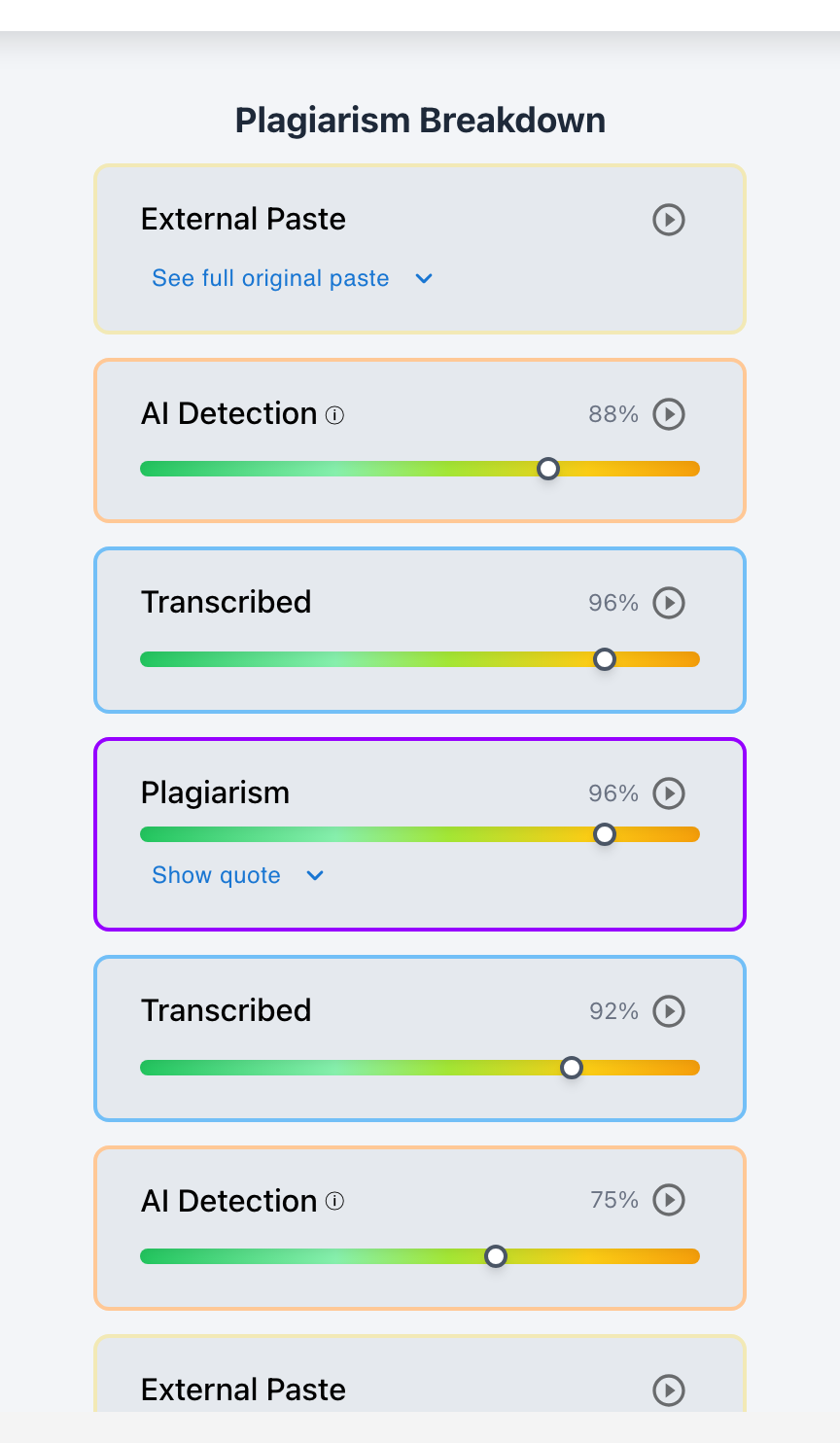
Checkmark Plagiarism standardizes multi-class grading by pairing autograding with essay writing playback, AI detection, plagiarism detection, and integrations with Canvas and Google Classroom.
The 4 Mechanisms of Cross-Class Grading Consistency
1. Department Rubric Standardization
Deploys a shared, department-approved rubric across all sections of a course, ensuring every teacher's students are evaluated on identical criteria.
2. Zero Section-to-Section Drift
Autograder evaluates essays submitted across Periods 1, 3, 5, and 7 with identical analytical precision, completely immune to time-of-day fatigue.
3. Eliminating "Easy vs. Harsh" Inequity
Provides a calibrated, objective baseline score for every submission, protecting students from idiosyncratic teacher grading disparities.
4. Department-Wide Aggregate Analytics
Provides department chairs with visual analytics showing score spreads across all sections to identify curricular gaps and strengths.
How Department-Wide Calibration Operates in Practice
Understanding how AI unifies standards across diverse teaching teams:
- The Common Assessment Workflow: All English 11 teachers assign a common argumentative research paper and link the shared departmental Canvas rubric to Checkmark Autograder.
- Synchronized First-Pass Scoring: Checkmark generates preliminary scores and highlighted textual evidence for all 400 students across 14 sections simultaneously in under 2 minutes.
- Professional Learning Communities (PLCs): Teachers meet in PLC teams to review the calibrated baseline, discuss edge cases, and align instructional strategies based on shared rubric data.
Read more in how Checkmark writing process analysis works.
Comparison: Subjective Department Variance vs. Checkmark Calibrated Consistency
Checkmark Calibrated Consistency (Equitable & Aligned)
- Identical rubric standard applied across all 14 sections.
- Eliminates teacher-to-teacher grading disparities.
- Every student receives evidence-grounded feedback.
- Department chairs view cohort-wide mastery analytics.
Subjective Department Variance (Inequitable & Inconsistent)
- Grades depend heavily on which teacher a student is assigned.
- Harsh graders penalize students; easy graders inflate marks.
- Late-night grading fatigue causes significant score drift.
- Departments struggle to benchmark true student growth.
A 5-Step Department Protocol for Cross-Class Consistency
Department Grading Standardization Checklist:
- 1. Standardize a shared department rubric in Canvas or Google Classroom for the common writing task.
- 2. Enable Checkmark Autograder across all course sections and periods.
- 3. Run automated scoring to generate pre-calibrated rubric proposals for all submissions.
- 4. Teachers review and approve grades within Canvas SpeedGrader using Teacher-in-the-Loop oversight.
- 5. Department chair reviews the Cross-Section Mastery Dashboard to identify cohort strengths and areas for growth.
How Checkmark Plagiarism Powers Department Alignment
Checkmark Plagiarism combines **AI detection, essay writing playback, static AI detection, plagiarism detection, autograding, and Canvas/Google Classroom integrations** to ensure rigorous, reliable, and equitable evaluation across entire academic departments.
Frequently Asked Questions
How does Checkmark prevent grading discrepancies between teachers?
By applying a standardized rubric algorithm to every paper, Checkmark provides a consistent baseline score that teachers can review and refine.
Can individual teachers still adjust scores for their own students?
Yes. Teachers retain full override authority in SpeedGrader to adjust scores and add personal commentary tailored to their students.
How does cross-class consistency help students preparing for AP exams?
Checkmark applies official AP scoring rubrics uniformly across all sections, giving students authentic benchmark feedback aligned with national exam standards.
Can department chairs see if one teacher overrides scores heavily?
Yes. Department analytics display override frequencies and score distributions across sections to promote collaborative calibration discussions.
How does Checkmark Plagiarism integrate with Canvas LMS?
Checkmark syncs with Canvas Blueprint courses and shared rubrics, deploying autograding settings across all linked course sections automatically.
What if two teachers have different instructional emphases?
Teachers can add section-specific instructions or focus areas to their prompt settings while maintaining common core rubric standards.
Does cross-class consistency reduce student grade appeals?
Yes. When grading is grounded in objective rubric evidence and consistent across all classes, students perceive grading as fair and transparent.
How does Autograder handle large cohorts (e.g., 500+ students)?
Checkmark processes hundreds of submissions in parallel, populating the SpeedGrader rubrics for an entire grade level in under 2 minutes.
Can cross-class data help identify effective teaching strategies?
Yes. If one section excels on "Evidence Synthesis," teachers can share their instructional strategies during PLC department meetings.
Why is grading equity essential for school accreditation and trust?
Because consistent, transparent grading guarantees that course grades reflect genuine student mastery rather than arbitrary teacher variance.
Institutional Equity and Academic Excellence
Every student deserves fair, consistent, and transparent assessment regardless of which classroom they sit in. By leveraging Checkmark Autograder to normalize standards across classes and departments, educators ensure uncompromising equity and inspire academic excellence across their entire institution.
Checkmark Plagiarism supports this comprehensive approach with AI detection, essay writing playback, static AI detection, plagiarism detection, autograding, and integrations with Canvas and Google Classroom.
See how Checkmark standardizes essay grading consistency across course sections in Canvas. View a sample report or request a demonstration.