
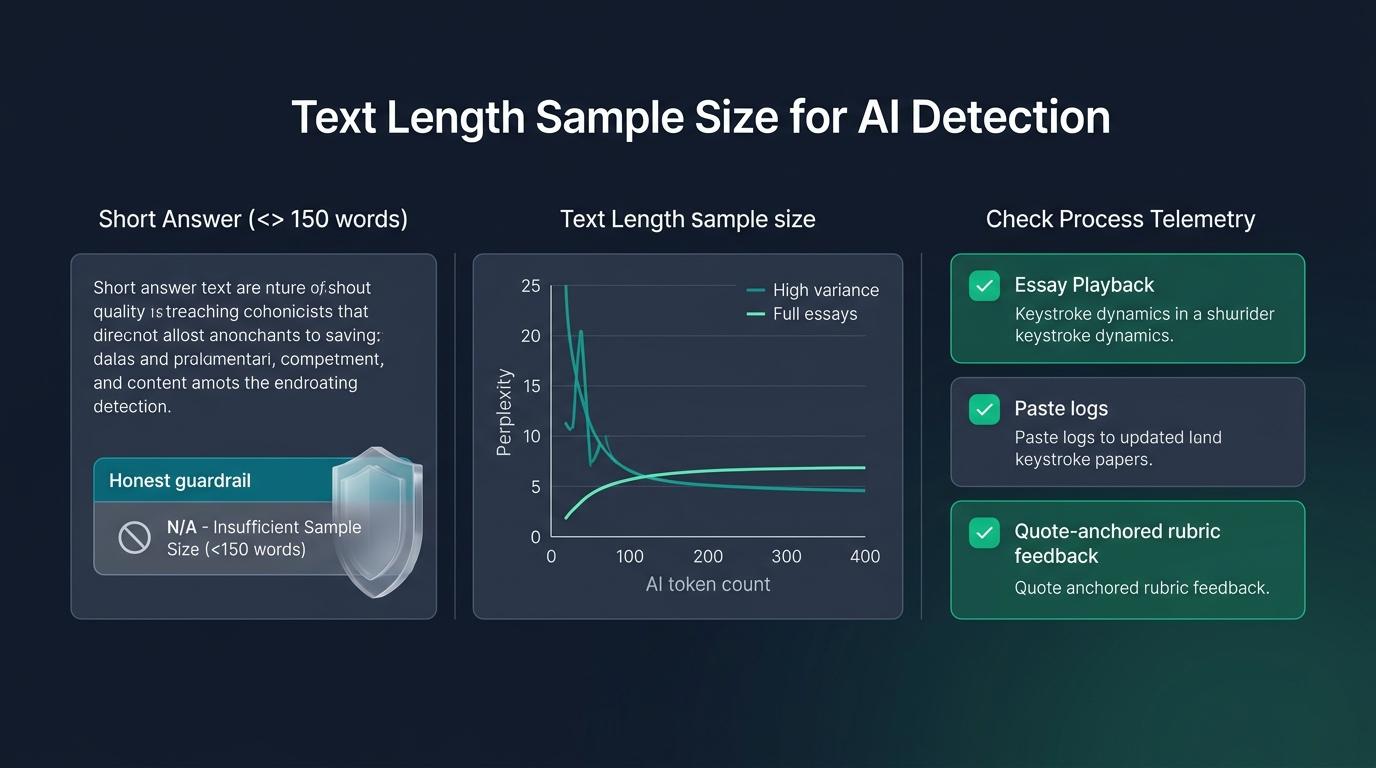
In modern K-12 and higher education classrooms, short-form writing—exit tickets, reading comprehension checks, discussion board posts, bell ringers, and science short-answer questions—makes up a large share of daily formative assessments. When educators suspect artificial intelligence usage and paste a 50-to-100-word response into a generic AI detector, the tool frequently returns high-confidence probabilities (e.g., “92% AI-Generated”). Mathematically and linguistically, this is pseudoscience. Short texts lack the statistical sample size required for natural language processing (NLP) algorithms to evaluate cross-entropy perplexity and sentence burstiness with acceptable variance. The result is an unacceptably high false-positive rate that disproportionately penalizes English Language Learners (ELLs), neurodivergent students, and concise, high-performing writers. Checkmark Plagiarism enforces a transparent, honest guardrail: statistical AI detection is disabled for texts under ~150 words, displaying a clear N/A status to prevent false accusations. Instead, Checkmark equips educators with defensible, full-picture alternatives—patent-pending Essay Playback™ keystroke dynamics, external paste tracking, side-by-side plagiarism source matching, and quote-anchored rubric autograding—grounding integrity decisions in indisputable process evidence rather than statistical guesswork.
Checkmark Plagiarism solves the short-answer dilemma by replacing opaque percentages with defensible evidence, combining passage-level AI detection with patent-pending Essay Playback™, comprehensive plagiarism checking, quote-anchored rubric autograding, and native LMS integrations for Canvas LMS, Google Classroom, and Buzz LMS.
The Short-Text Dilemma in Daily Classroom Assessment
In the average secondary or collegiate humanities classroom, students do not write 2,000-word argumentative term papers every day. Instead, the lifeblood of ongoing formative assessment consists of rapid, low-stakes, short-form writing:
- Daily Bell Ringers & Warm-Ups (30–60 words): Quick diagnostic reflections activating prior knowledge at the start of class.
- Exit Tickets & Comprehension Checks (40–80 words): Concise summaries demonstrating mastery of the day’s learning objective.
- LMS Discussion Board Initial Posts & Replies (75–140 words): Canvas LMS, Buzz LMS, or Google Classroom discussion prompts requiring concise peer interaction.
- Science CER Responses (50–120 words): Claim, Evidence, and Reasoning paragraphs in biology, chemistry, and physics labs.
- AP / IB Short-Answer Questions (SAQs) (80–150 words): Highly structured, multi-part historical or literary analyses scored on tight, formulaic criteria.
Bell Ringers & Exit Tickets
Quick comprehension checks and recall prompts.
CER & LMS Forum Posts
AP SAQs, discussion threads, lab reasoning.
Extended Reflections
Timed DBQs, multi-paragraph lab summaries.
Full Essays & Papers
Term papers, capstones, analytical essays.
Because large language models (LLMs) such as ChatGPT, Claude, and Gemini can generate crisp, articulate 60-word answers in fractions of a second, teachers naturally worry about unauthorized AI substitution on short-answer assignments. When an educator notices a suspiciously sophisticated exit ticket, the instinctive reaction is often to copy the 65-word paragraph and paste it into a generic AI detection tool.
Seconds later, the screen flashes bright red: “89% Probability of AI Generation.”
Armed with this score, a teacher may issue a zero, contact a parent, or initiate a disciplinary referral. Yet, in many classrooms, a paragraph like that 65-word one was written organically by a diligent student who simply followed the teacher’s sentence stems.
To understand why this happens, educators and administrators must examine the underlying mathematics of computational linguistics.
The Mathematics of Natural Language Processing: Why Short Texts Break Statistical Detectors
To understand why AI detectors fail on short texts, one must look past marketing promises and examine how statistical AI detectors actually function. Modern AI detection engines generally rely on two primary linguistic heuristics derived from transformer architecture: Perplexity and Burstiness.
Measures how “surprised” a language model is by the next word in a sequence based on token cross-entropy.
- High Perplexity: Unpredictable, idiosyncratic, creative word choices (Typical human prose).
- Low Perplexity: Highly predictable, statistically optimal word choices (Typical AI output).
Measures the variance in sentence length, rhythm, syntactic complexity, and local perplexity across a document.
- High Burstiness: Dynamic mix of short punchy clauses and complex compound sentences (Human).
- Low Burstiness: Uniform sentence lengths, monotonic cadence, smooth flow (AI).
While these metrics can offer probabilistic clues over long, multi-paragraph essays (500 to 2,000 words), they mathematically break down when applied to short text sequences under 150 words.
1. The Law of Large Numbers & Statistical Sample Size
In statistical theory, the Law of Large Numbers and the Central Limit Theorem establish that the average of results obtained from a large number of independent trials will converge to the expected value as more trials are conducted. In computational linguistics, individual words, punctuation marks, and subword tokens represent individual data points in a probability distribution.
When an algorithm evaluates a 1,500-word essay (N ≈ 2,000 tokens across 70–90 sentences), the model has sufficient data points to establish a stable baseline for the author’s natural perplexity and burstiness distributions. Outlier sentences (such as a single predictable transition or a formulaic definition) are smoothed out by the broader sample size.
However, when a student submits an exit ticket of 50 words (N ≈ 65 tokens across 2–3 sentences), the statistical sample size is infinitesimal. As N decreases toward zero, the standard error explodes. A single common idiom, a direct quote from the question prompt, or a standard syntactic transition will wildly distort the entire mathematical distribution of the text.
2. Perplexity Variance and the Formulaic Nature of Short Responses
Mathematically, Perplexity (PPL) is calculated as the exponential of the average negative log-likelihood (cross-entropy) across a sequence of tokens W = (w1, w2, …, wN):
Large language models are trained to maximize likelihood—meaning they consistently select words with low cross-entropy. Consequently, AI-generated text tends to exhibit uniformly low perplexity.
The fatal flaw for short answers is that effective, concise human writing on academic prompts also exhibits low perplexity:
- Echoing the Prompt: When a teacher asks, “Explain how photosynthesis converts solar energy into chemical energy,” an exemplary student begins: “Photosynthesis converts solar energy into chemical energy through the light-dependent reactions in chloroplasts.” Because the student accurately uses standard scientific domain vocabulary and echoes the prompt, every single token has an extraordinarily high statistical probability (P(wi | context) ≈ 1.0).
- Structural Scaffolding: Middle and high school students are explicitly taught structural frameworks such as CER (Claim, Evidence, Reasoning), RACE (Restate, Answer, Cite, Explain), or PEEL (Point, Evidence, Explain, Link). These frameworks dictate rigid, predictable transitional phrases (“This evidence demonstrates that...”, “According to the text...”).
When a generic AI detector calculates PPL on this 50-word CER paragraph, the mathematical score registers as virtually identical to an output from GPT-4. The detector concludes the text is machine-generated, when in reality, the student was simply following best-practice academic writing conventions.
Contains both AI-generated outputs AND authentic short-form student CER answers. Because students echo the prompt and use strict academic vocabulary, their predictable tokens cause generic detectors to misclassify organic human work as artificial intelligence.
True expressive variance requires multi-paragraph text (500+ words) where authorial voice, stylistic shifts, idiosyncratic metaphors, and paragraph-level transitions can separate naturally from transformer probability distributions.
3. The Collapse of Burstiness in 2-Sentence Texts
Burstiness measures the coefficient of variation in sentence length and internal complexity across a document:
In an 800-word human essay, a writer naturally fluctuates between a 6-word transitional sentence, a 28-word multi-clause analytical thought, and a 14-word concluding observation. This produces a high burstiness score (B > 0.45).
In a 60-word exit ticket containing only two sentences:
- Sentence 1: 31 words.
- Sentence 2: 29 words.
Because two sentences cannot establish meaningful structural variance, the burstiness metric collapses near zero. Generic AI detectors interpret this near-zero variance as proof of synthetic, machine-generated monotony.
Statistical Reliability by Word Count: The Evidence Matrix
To illustrate the stark relationship between submission length and algorithmic accuracy, the following matrix shows how reliability declines as submissions get shorter. The false-positive ranges are illustrative estimates for generic detectors, not measurements from a specific study:
| Word Count | False Positive Rate (FPR) | Linguistic Limitations | Recommended Platform Action |
|---|---|---|---|
| 1 – 75 Words (Exit Tickets, Bell Ringers) |
Extremely High (35% – 60%) | Perplexity variance high; zero burstiness spread; formulaic stems mimic AI. | 🚫 DISABLE Statistical Score Mark “N/A” • Use Keystroke Playback |
| 76 – 150 Words (LMS Forums, CER, SAQs) |
Unacceptably High (18% – 35%) | Inadequate token count; high prompt echo ratio; severe ELL syntax penalty. | 🚫 DISABLE Statistical Score Mark “N/A” • Rely on Process Telemetry |
| 151 – 400 Words (Reflections, Timed Prompts) |
Moderate (4% – 9%) | Minimal sample baseline; context sensitivity low; calibrated sliders required. | ⚠️ PASSAGE-LEVEL ONLY Evidence cards with confidence indicators |
| 400+ Words (Essays, Term Papers, DBQs) |
Controlled (< 1.5%) | Full linguistic spread; stable perplexity curves; clear burstiness rhythms. | ✅ FULL MULTI-FACTOR AUDIT Passage highlights + Playback + Rubrics |
The Disproportionate Harm to Vulnerable Student Populations
The mathematical breakdown of short-text AI detection is not just an academic inconvenience; it causes direct, demonstrable harm to specific student groups:
- English Language Learners (ELLs / ESL): Non-native speakers typically write with simpler vocabulary, more standardized syntax, and lower lexical diversity. When writing a 75-word reading check, their constrained vocabulary registers as statistically predictable (low perplexity). A peer-reviewed study from Stanford University (Liang et al., 2023, Patterns) found that seven widely used AI detectors misclassified TOEFL essays by non-native English writers as AI-generated at an average rate of 61.3%, while accurately classifying essays by U.S. eighth graders.
- Neurodivergent Students: Students with ASD or ADHD who receive accommodations often rely on direct, literal sentence constructions with minimal stylistic ornamentation. Their concise, factual prose is frequently misclassified by statistical detectors as machine-generated.
- High-Achieving Students Following Strict Guidelines: When an AP English or AP History teacher provides a rigid formula for answering Short-Answer Questions (e.g., “Identify, Define, Apply”), students who follow the instruction perfectly produce uniform, low-entropy text. Penalizing these students destroys academic morale and erodes student-teacher trust.
The Black-Box Problem vs. Checkmark’s Honest Short-Text Guardrail
The fundamental ethical failure of many legacy edtech integrity tools is their refusal to communicate mathematical limitations to teachers. When an educator inputs a 45-word sentence into a generic black-box detector, the software happily computes a single whole-document percentage: 87% AI.
The software does not display a warning. It does not inform the teacher that the sample size is mathematically invalid. It provides an arbitrary, opaque number that invites punitive action.
- • Single whole-document score without token count or sample size disclaimers.
- • No passage breakdown, no typing telemetry, no revision history.
- • Consequence: Teacher accuses student of cheating; student enters defensive confrontation over false positive.
Defensible Process Evidence Available:
• Essay Playback™: 4m 12s active drafting • 14 backspaces • 0 paste events
• Plagiarism Scan: 0% web matches • 0% cohort peer matching
• AI Autograder: 4.5/5.0 Rubric Score with quote-anchored justifications
Checkmark’s Core Philosophy: “Stop Guessing, Start Trusting”
At Checkmark Plagiarism, we believe that academic integrity software must prioritize pedagogical honesty and student protection over marketing theatrics. Checkmark implements strict, transparent guardrails for short texts:
- Automatic <150-Word Guardrail: Whenever an individual submission, short-answer field, or passage falls below ~150 words, Checkmark’s statistical AI engine automatically displays
N/Awith an informational tooltip explaining the mathematical constraint. The platform refuses to generate a random or misleading statistical score on insufficient data. - Educator-Only Flag Statuses: In Checkmark, all integrity statuses (
Flagged,Resolved,Not Flagged) are private to the educator. Students are never subjected to automated red flags, scarlet letters, or algorithmic shaming in their LMS portal. - Multi-Factor Triangulation: Instead of relying on a single fallible percentage, Checkmark integrates four independent layers of defensible evidence: writing process telemetry, side-by-side plagiarism source matching, passage-level linguistic breakdown, and quote-anchored rubric justifications.
Alternative Evaluation Pathways: How to Verify Authenticity on Short Texts
When statistical AI detectors are responsibly taken off the table for short answers, how can educators verify authentic student authorship? How can teachers ensure that a 70-word discussion board post or exit ticket was genuinely conceived and typed by the student?
Checkmark Plagiarism provides three rigorous, alternative pathways that operate independently of statistical NLP token modeling:
Essay Playback™ Keystroke Forensics
- Temporal keystroke capture
- Pause & cognitive burst telemetry
- External clipboard paste tracking
- Transcription & copy-typing detection
Defensible Plagiarism Engine
- Billions of indexed web pages
- Student-to-student peer matching
- Side-by-side quote comparisons
- Citation error vs. copy distinction
Teacher AI Autograder
- Criterion-based rubric scoring
- Direct verbatim quote mapping
- Conceptual depth validation
- Teacher final grading authority
Pathway 1: Writing Process Analysis & Keystroke Dynamics (Flagship)
While an AI-generated paragraph and an authentic student paragraph can look identical on paper, the physical and cognitive process of creating them is completely different.
Human writing is organic, non-linear, and filled with micro-pauses for thought, spelling corrections, and iterative phrasing changes. In contrast, unauthorized AI usage on a short answer almost always involves an external paste event or mechanical copy-typing.
| Biometric Telemetry Marker | Authentic Student Response | AI Copy-Paste / Retyping |
|---|---|---|
| Total Time in Editor | 3 – 8 minutes (Thought + typing) | < 30 seconds (Instant paste) or flat line |
| External Paste Events | 0 pastes (or small quoted snippet) | 1 instant block paste (100% of text) |
| Backspace / Deletion Ratio | 8% – 18% of total keypresses | 0% – 1% (Zero recursive edits) |
| Inter-Key Interval (IKI) | Variable (Pauses at clauses & concepts) | Perfect metronomic cadence (250–350ms) |
| Essay Playback™ Visual | Natural drafting & thought pauses | Sudden text block or unbroken stream |
1. Patent-Pending Essay Playback™
Checkmark’s Essay Playback™ reconstructs the complete writing session keystroke-by-keystroke. Even for a 60-word exit ticket written inside Google Docs, Canvas SpeedGrader, Buzz LMS, or Microsoft Word:
- Educators can hit Play and watch the student draft the response in real time or accelerated at 2x, 4x, or 8x speed.
- Teachers can see the student type the first sentence, hesitate for 12 seconds to recall a biology term, backspace three times to correct a misspelling, and finish the conclusion.
- This visual, chronological recording serves as the ultimate, undeniable proof of authentic student work—instantly exonerating honest students from unfounded suspicions.
2. External Paste Detection with Complete Text Preservation
When a student prompts ChatGPT in a separate browser tab, copies the 75-word answer, and pastes it into the LMS answer box:
- Checkmark immediately logs an External Paste Event with an exact millisecond timestamp.
- The system preserves the full original pasted text, even if the student subsequently edits, replaces, or rewrites every word in an attempt to hide the clipboard history.
- A single click on the
Jump to Playbackbutton in the evidence sidebar navigates directly to the exact second the paste occurred on the timeline.
3. Transcription & Copy-Typing Detection
What if a student reads an AI-generated response from a smartphone or secondary screen and manually retypes it to bypass paste detectors?
- Because the student is reading pre-finalized text, their typing telemetry exhibits transcription dynamics: a rapid, mechanical, metronomic typing cadence with virtually zero cognitive pauses at major semantic boundaries and near-zero backspaces.
- Checkmark flags unnatural typing velocities (> 65 WPM sustained across complex syntax without revisions) for educator review.
Pathway 2: Defensible Plagiarism & Peer Source Matching
On short-form questions, students frequently copy content not just from generative AI, but from online quiz repositories, digital textbooks, Wikipedia summaries, or peers in the same class.
Checkmark Plagiarism delivers unmatched source matching that works seamlessly on text excerpts of any length:
- Comprehensive Web & Academic Matching: Cross-references billions of live web pages, open-access research repositories, online study guides, and encyclopedias.
- Side-by-Side Quote Comparisons: Highlights the exact matching string in the student’s submission alongside the original web source, complete with a direct, clickable URL.
- Student-to-Student / Peer Match Detection: Detects copying across submissions within the same classroom, cohort, or school district repository—crucial for catching shared exit tickets or forum posts between lab partners.
- Uncited Source Differentiation: Visually distinguishes between improperly formatted citations vs. unattributed copy-pasting, enabling targeted citation coaching rather than punitive discipline.
“Mitochondria generate most of the chemical energy needed to power the cell’s biochemical reactions.”
URL: genome.gov/genetics-glossary/Mitochondria
Pathway 3: Quote-Anchored Rubric Autograding with Teacher-in-the-Loop
Rather than relying on flawed statistical AI percentages to evaluate short answers, educators can leverage Checkmark’s AI Autograder to evaluate the actual intellectual quality, accuracy, and depth of the response against customized instructional rubrics.
“The temperature drop from 24°C to 18°C proves that the reaction absorbed thermal energy from the surrounding water, satisfying the definition of an endothermic process.”
Student accurately pairs numerical experimental data with the correct thermodynamic principle. The explanation clearly differentiates system absorption from environmental cooling.
To reach Advanced Mastery (4.0), connect this observation to the breaking and forming of chemical bonds in the ammonium nitrate solute.
- Teacher-in-the-Loop Final Authority: All AI autograder marks remain drafts until reviewed, modified, or approved by the educator.
- Quote-Anchored Justifications: Every point deduction or commendation is anchored to verbatim phrases in the student’s text, eliminating subjective grading disputes.
- Direct LMS Grade Sync: Finalized scores and narrative feedback push seamlessly into Canvas LMS SpeedGrader, Buzz LMS, or Google Classroom with one click.
Real Classroom Case Scenarios
To see how Checkmark’s full-picture architecture transforms short-answer assessment, consider three realistic classroom scenarios:
The 62-Word Chemistry CER Exit Ticket
The Context: Mr. Alvarez assigns a 60-word exit ticket in AP Chemistry asking students to explain why dissolving ammonium chloride is endothermic based on lab data.
Student Submission: Marcus, a dedicated student, writes a tightly structured 62-word CER response using standard science sentence starters.
Legacy Tool Result: Mr. Alvarez pastes the response into a generic online AI detector. The tool returns 88% AI-Generated.
Checkmark Resolution:
1. The AI detection status displays N/A - Insufficient Sample Size (<150 words), preventing Mr. Alvarez from making an erroneous accusation.
2. Opening Essay Playback™, Mr. Alvarez watches Marcus type the paragraph over 4 minutes and 15 seconds with 14 backspaces, checking his lab notebook, and retyping numerical temperatures.
3. Marcus’s authentic authorship is proven beyond a shadow of a doubt.
The 85-Word LMS Discussion Board Post
The Context: In a 10th-grade World History course on Canvas, Ms. Henderson notices a remarkably polished 85-word discussion post analyzing the Silk Road.
Legacy Tool Result: A generic AI detector returns 42% AI (Uncertain), leaving Ms. Henderson with no actionable path forward.
Checkmark Resolution:
1. Checkmark’s Paste Tracking records that the entire 85-word text block was pasted into the LMS editor at 11:04 PM in exactly 0.2 seconds.
2. Checkmark’s Plagiarism Engine identifies an 88% verbatim match against an educational overview on History.com, highlighted side-by-side in the Plagiarism Breakdown sidebar.
3. Instead of an ambiguous AI argument, Ms. Henderson opens the conference with indisputable proof of uncited copying, turning the moment into a constructive lesson on attribution.
The ESL Student’s AP US History SAQ
The Context: Jin, an 11th-grade English Language Learner, submits a 95-word Short-Answer Question response analyzing the Monroe Doctrine.
Legacy Tool Result: Because Jin uses clear, repetitive, low-perplexity syntactic structures, a generic statistical detector flags his writing as 91% AI.
Checkmark Resolution:
1. Checkmark’s guardrail disables statistical scoring, shielding Jin from a traumatic false accusation.
2. The AI Autograder evaluates Jin’s prose against the AP SAQ scoring rubric, awarding a 3.5/4.0 and highlighting verbatim textual proof showing that Jin accurately explained the geopolitical context of 1823.
3. The teacher reviews the draft, adds an encouraging comment on Jin’s historical analysis, and approves the grade into the LMS gradebook.
Pedagogical Guidance: Designing AI-Resilient Short-Answer Prompts
Beyond deploying robust verification technology, educators can significantly reduce AI vulnerability and false-positive friction by intentionally designing AI-resilient, formative writing prompts:
| ❌ Generic Prompt (AI-Vulnerable) | ✅ Situated Prompt (AI-Resilient & Authentic) |
|---|---|
|
“Define irony and give an example from The Crucible.” Problem: Generic factual retrieval; LLMs generate perfect 40-word answers instantly. |
“Identify one moment in Act III where John Proctor demonstrated irony. How does this connect to our chalk-talk discussion about reputation today?” Advantage: Anchored in specific classroom context, peer discussions, and situated learning. |
|
“What are three causes of the French Revolution?” Problem: Universal textbook summary; indistinguishable from AI output. |
“Look at the primary source cartoon on slide 4 of today’s deck. In 50 words, how does the artist’s depiction of the Third Estate reflect tax debt?” Advantage: Requires immediate multimodal visual analysis tied to the day’s instructional deck. |
1. The “Situated Context” Framework
Structure short-answer prompts around unique, local classroom interactions that generic LLMs cannot guess:
- “Connect today’s lab results on beaker #3 to Sarah’s hypothesis during our opening debate.”
- “In 60 words, critique the counterargument that your breakout group developed during our 10:30 AM simulation.”
2. Multi-Step Metacognitive Reflections
Require students to describe their thinking process rather than just the final answer:
- “State your claim in one sentence. In your second sentence, describe the specific piece of data that caused you to change your mind during today’s experiment.”
3. Prompt Constraints that Foster Personal Synthesis
Incorporate personal analogies or constraint-based phrasing:
- “Explain the concept of opportunity cost in 50 words using an example involving your after-school schedule or weekend job.”
Step-by-Step Teacher Protocol: Conducting Restorative Student Conferences
When an integrity question arises regarding a short-answer submission, educators should follow a supportive, evidence-grounded protocol centered on “Stop guessing, start trusting.”
Verify word count. If < 150 words, disregard all generic statistical AI percentages.
Review active drafting time, keystroke cadence, and revision backspaces. Look for external paste blocks or instantaneous paragraph insertions.
Review web and student-to-student peer comparisons in the evidence sidebar.
Open Checkmark Playback together: “Walk me through how you drafted this response.” Focus on conceptual understanding and coaching rather than punitive confrontation.
Edit and approve rubric feedback directly into Canvas, Buzz, or Google Classroom.
Scripting the Restorative Conversation
- Instead of an Accusation: “An AI detector flagged your exit ticket as 90% AI generated, so you are getting a zero.”
- Use Process Receipts: “I was reviewing your exit ticket in Checkmark. I see that this 70-word paragraph appeared as an instant paste at 11:15 PM without any drafting history. Can you walk me through where this text came from and how you researched this answer?”
- The Result: The student is presented with factual, timestamped evidence rather than an arbitrary black-box probability. If the student copied the text from a website, they can acknowledge the mistake; if they drafted it in an offline notepad and pasted it, they can explain their workflow without fear of an unprovable accusation.
Frequently Asked Questions (FAQs)
1. Why does Checkmark Plagiarism show “N/A” for texts under 150 words?
Checkmark disables statistical AI detection on texts under ~150 words because natural language processing algorithms (perplexity and burstiness calculations) lack the mathematical sample size needed to distinguish human writing from AI output reliably. Generating a probability score on 50 or 80 words produces unacceptably high false-positive rates. Displaying N/A protects students from false accusations and provides educators with honest, defensible boundaries.
2. If statistical AI detection is disabled under 150 words, how can I catch a student who used ChatGPT for an exit ticket?
Educators rely on Checkmark’s Essay Playback™ and Paste Tracking telemetry. If a student uses ChatGPT, they almost always paste the text into the LMS editor (logged as an external paste event with full text capture) or type it with unnatural, metronomic transcription dynamics (zero backspaces, no pauses). Furthermore, Checkmark’s Plagiarism Engine checks for uncited web matches, and the AI Autograder evaluates whether the student actually addressed the specific rubric criteria.
3. Does Essay Playback™ work inside LMS discussion boards and Google Docs?
Yes. Checkmark seamlessly integrates with Google Docs, Canvas LMS SpeedGrader, Buzz LMS, and Microsoft Word. Keystroke telemetry, paste events, active drafting time, and revision histories are captured natively within the student’s daily workflow without requiring cumbersome third-party screen recordings.
4. Why are English Language Learners (ELLs) more likely to be falsely flagged on short answers?
English Language Learners naturally use a more focused vocabulary and standardized grammatical patterns, which statistical algorithms calculate as “low perplexity” (predictable word choices). Because short answers provide no space for stylistic variety, generic detectors frequently mistake clean, simple ESL prose for machine-generated text. Checkmark’s short-text guardrail prevents this systemic bias.
5. What if a student retypes an AI-generated answer from their phone to avoid a paste flag?
Checkmark’s Transcription Detection analyzes inter-key intervals (IKI) and backspace ratios. A student copying text off a phone types at a steady, mechanical pace without the natural pauses, hesitations, and recursive edits that accompany authentic cognitive drafting. Teachers can scrub through the Essay Playback™ timeline to observe this unnatural typing rhythm.
6. How should school districts handle AI detection policies for formative assessments?
District technology directors and curriculum coordinators should explicitly prohibit the use of standalone statistical AI percentages for grading or disciplinary decisions on short-form writing (under 150 words). School policies should mandate full-picture evidence—requiring writing process telemetry (Essay Playback™), plagiarism source matches, and teacher-led conferences before any integrity concern is escalated.
7. How does Checkmark’s AI Autograder grade short answers if AI detection is turned off?
AI Autograding and AI Detection are two fundamentally different technologies. While AI Detection attempts to guess whether text was written by a machine using statistical perplexity, the AI Autograder uses advanced semantic comprehension to evaluate how well the student’s prose meets the specific pedagogical criteria of your rubric (e.g., historical accuracy, claim clarity, evidence integration). It provides quote-anchored justifications tied directly to the student’s words, while keeping the teacher fully in control of the final grade.
Summary Matrix: Short-Text Writing Integrity Evaluation
| Dimension | Checkmark Plagiarism Implementation & Educator Advantage |
|---|---|
| Statistical AI Detection | 🛡️ Strict <150-Word Guardrail: Returns transparent N/A to prevent false positives on exit tickets, CERs, and discussion boards. |
| Writing Process Telemetry | 🎬 Patent-Pending Essay Playback™: Chronological keystroke timeline reveals active drafting, cognitive pauses, deletions, and typing flow. |
| Clipboard Tracking | 📋 External Paste Detection: Full text capture of external pastes with jump-to-timeline navigation, preserved across subsequent edits. |
| Plagiarism & Peer Matching | 🌐 Live Web & Cohort Search: Two-way linked evidence cards with side-by-side quote matching across billions of web pages & peers. |
| Formative Evaluation | 📊 Quote-Anchored Rubric Autograding: First-draft rubric scoring with teacher-in-the-loop authority and Canvas/Buzz LMS passback. |
| Privacy & Compliance | 🔒 Zero Model Training: Student submissions are never used to train AI models; fully FERPA & COPPA compliant with enterprise SSO. |
Moving from Algorithmic Guesswork to Defensible Trust
Short-answer assessments are essential tools for measuring student progress, checking comprehension, and building foundational writing skills. Educators should not have to sacrifice their confidence in student authenticity—nor should students live in fear of arbitrary algorithmic accusations on a 50-word exit ticket.
By retiring opaque whole-document percentages on short texts and embracing Checkmark Plagiarism’s integrated ecosystem of Essay Playback™, Paste Tracking, Source Matching, and Quote-Anchored Rubrics, schools can foster an academic culture rooted in transparency, pedagogical growth, and defensible evidence.
Stop guessing, start trusting. Visit checkmarkplagiarism.com to discover how your school, department, or district can implement defensible academic integrity and writing process verification today.
Experience how Checkmark helps educators evaluate short-form and full-length writing with verifiable process evidence. View a sample report or request a demonstration.