
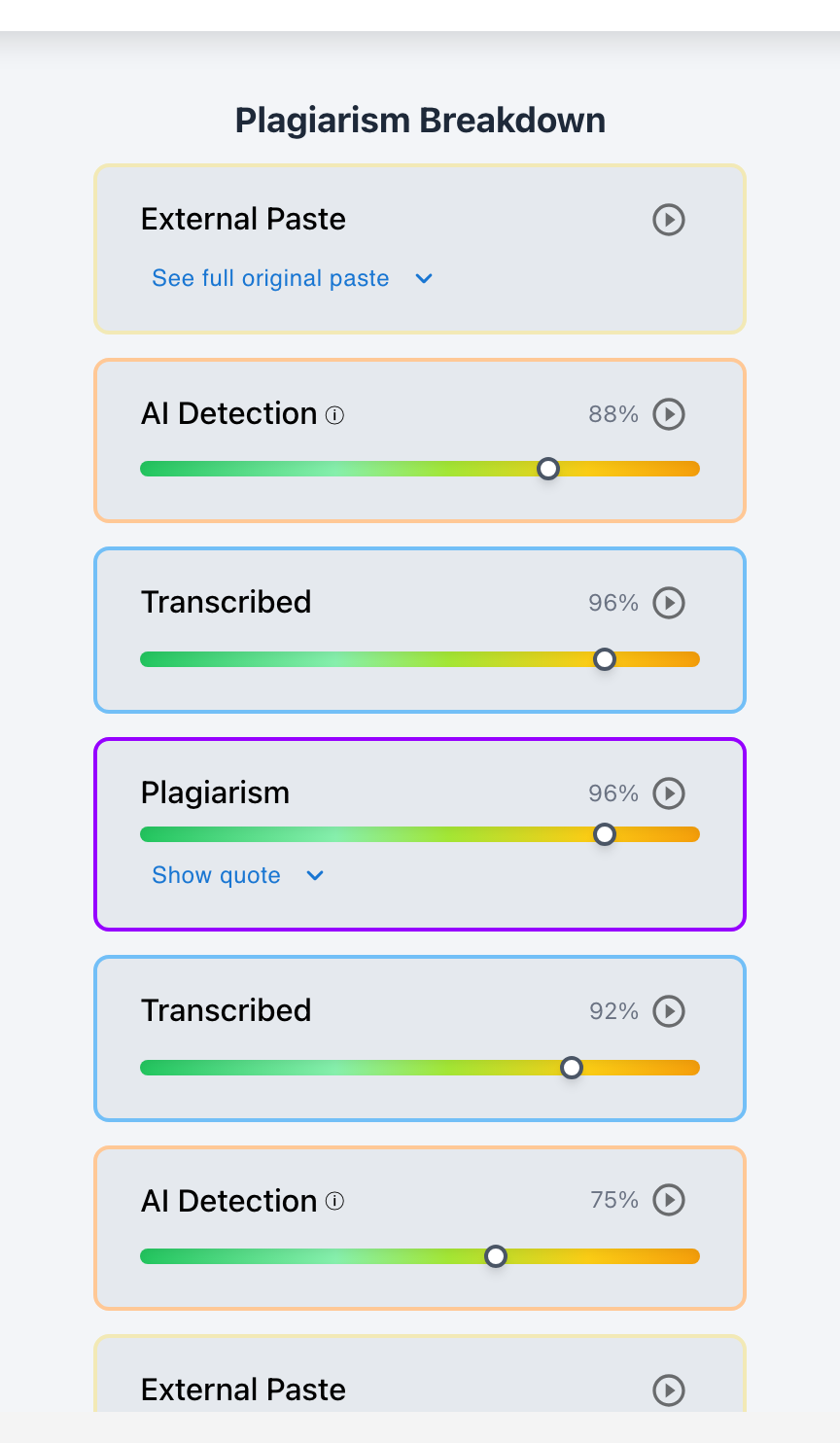
In live digital composition, it is a cognitive and statistical impossibility for a student to write a complex, sophisticated, high-scoring essay without making any edits or revisions. When a polished 1,500-word paper exhibits zero deletions, it means the drafting occurred elsewhere—either via an external AI generator, transcription from another device, or prior handwritten composition.
Every educator has heard the claim: "I'm just a really fast writer who plans everything in my head and writes it out perfectly on the first try." While exceptional students can produce clean sentence structures, human working memory cannot simultaneously manage high-level thesis argumentation, evidence synthesis, quote integration, and grammatical mechanics without making a single deletion, typo correction, or sentence restructuring. Understanding why unedited perfection is an unnatural artifact helps teachers evaluate student writing with scientific clarity.
Below is an analysis of the cognitive science of writing and what zero-edit submissions reveal in document history.
Checkmark Plagiarism powers process forensics by pairing essay writing playback with AI detection, plagiarism detection, autograding, and integrations with Canvas and Google Classroom.
The Cognitive Science of Human Writing
1. Working Memory Bottlenecks
Human short-term memory can only hold 4 to 7 items at once. Synthesizing complex historical evidence while crafting sophisticated subordinate clauses requires iterative self-correction.
2. Non-Linear Thought Organization
Real thinkers generate ideas recursively—drafting a point, realizing a stronger counterargument, and deleting or rewording previous sentences to maintain cohesion.
3. Mechanical Typo Correction
Even elite typists typing at 80 WPM experience a 5% to 10% mechanical keystroke error rate. Zero backspaces means the text was not typed in real-time on that keyboard.
4. The "Linear Generation" Signature of AI
Large Language Models generate text sequentially by predicting the next most probable token in one forward pass—producing mathematically unedited prose instantly.
The Only 3 Scenarios Where an Unedited Essay Appears
When an essay exhibits zero revisions in document history, only three scenarios are physically possible:
- Scenario A: Generative AI Paste (85% of cases): The student prompted ChatGPT or Claude and pasted the polished output directly into Google Docs or Canvas.
- Scenario B: Screen Transcription / Peer Copying (10% of cases): The student placed a phone next to their laptop and typed out an external essay word-for-word.
- Scenario C: Prior Offline / Handwritten Drafting (5% of cases): The student wrote the entire paper out by hand in a notebook or offline software and typed up the finalized draft.
Read more in how Checkmark writing process analysis works.
Comparison: Authentic Human Drafting vs. The "Zero-Edit" Anomaly
Authentic Student Writing (Iterative & Real)
- 15% to 30% backspaces across multiple drafting sessions.
- Frequent rephrasing of clunky transitions and thesis ideas.
- Spelling typos corrected in real time.
- Active typing duration: 3.5+ hours for 1,500 words.
The "Zero-Edit" Anomaly (External Text Influx)
- <1% backspaces across the entire document.
- Zero restructured sentences or deleted paragraphs.
- Flawless syntax and collegiate vocabulary on first attempt.
- Active typing duration: under 10 minutes (or single paste).
A 5-Step Educator Protocol for Zero-Edit Essays
Zero-Edit Evaluation Checklist:
- 1. Open Checkmark Playback to inspect the document's total deletion count and typing duration.
- 2. Review the Paste Event Log: verify if text entered via a bulk clipboard insertion.
- 3. Cross-reference the submission with the AI Probability Score and Paragraph Heatmap.
- 4. Hold a supportive conference: "This essay has zero typos or edits. Did you write this in a physical notebook or another app first? Can you share your notes?"
- 5. If the student has zero notes and cannot explain their thesis, initiate an official academic integrity inquiry.
How Checkmark Plagiarism Powers Scientific Writing Analysis
Checkmark Plagiarism combines **AI detection, essay writing playback, static AI detection, plagiarism detection, autograding, and Canvas/Google Classroom integrations** to ground writing evaluation in empirical cognitive telemetry.
Frequently Asked Questions
Can an extremely smart student write a great essay with zero edits?
No. Even professional academics and published authors make thousands of edits as they draft. Zero revisions on complex prose strongly points to external copying or AI generation.
What is a normal human backspace rate?
Authentic human drafting exhibits a 15% to 30% backspace/edit rate as sentences are drafted, revised, and polished.
Why does AI writing have zero edits?
Because LLMs generate complete, grammatically perfected text in a single mathematical pass without human revision struggle.
What if a student says they planned the entire essay in their head?
While students can outline ideas mentally, producing 1,500 words of collegiate vocabulary with zero typographical errors or phrasing revisions is physically impossible.
How does writing playback show student self-editing?
Playback visually records every keystroke, showing words being typed, deleted, rephrased, and restructured in real time.
How does Checkmark Plagiarism integrate with Canvas LMS?
Checkmark provides certified LTI 1.3 integration, SpeedGrader sidebar embeds, two-way grade passback, and single sign-on (SSO).
What should a teacher do when a zero-edit essay is submitted?
Ask the student to show their rough notes, handwritten outlines, or previous drafts during a brief 2-minute conference.
Can students fake realistic human typing and editing?
Simulating 3+ hours of realistic typos, backspaces, and pauses requires more physical effort than actually writing the paper honestly.
What if a zero-edit essay passes a standard AI detector?
Even if it evades a static detector, zero-revision telemetry paired with rapid typing proves the text was copied from an external source.
Why is writing process evidence more reliable than student claims?
Because keystroke telemetry provides unforgeable physical facts about how the document was created, eliminating subjective guesswork.
Celebrating the Messy, Beautiful Human Writing Process
Writing is thinking on paper. True learning happens in the pauses, the deleted sentences, and the struggle to find the right word. By using Checkmark Plagiarism to track revision depth, educators can celebrate authentic student effort and ensure that every paper is evaluated with fairness and truth.
Checkmark Plagiarism supports this comprehensive approach with AI detection, essay writing playback, static AI detection, plagiarism detection, autograding, and integrations with Canvas and Google Classroom.
See how Checkmark pairs revision depth analytics with multi-signal detection to evaluate unedited student essays. View a sample report or request a demonstration.