
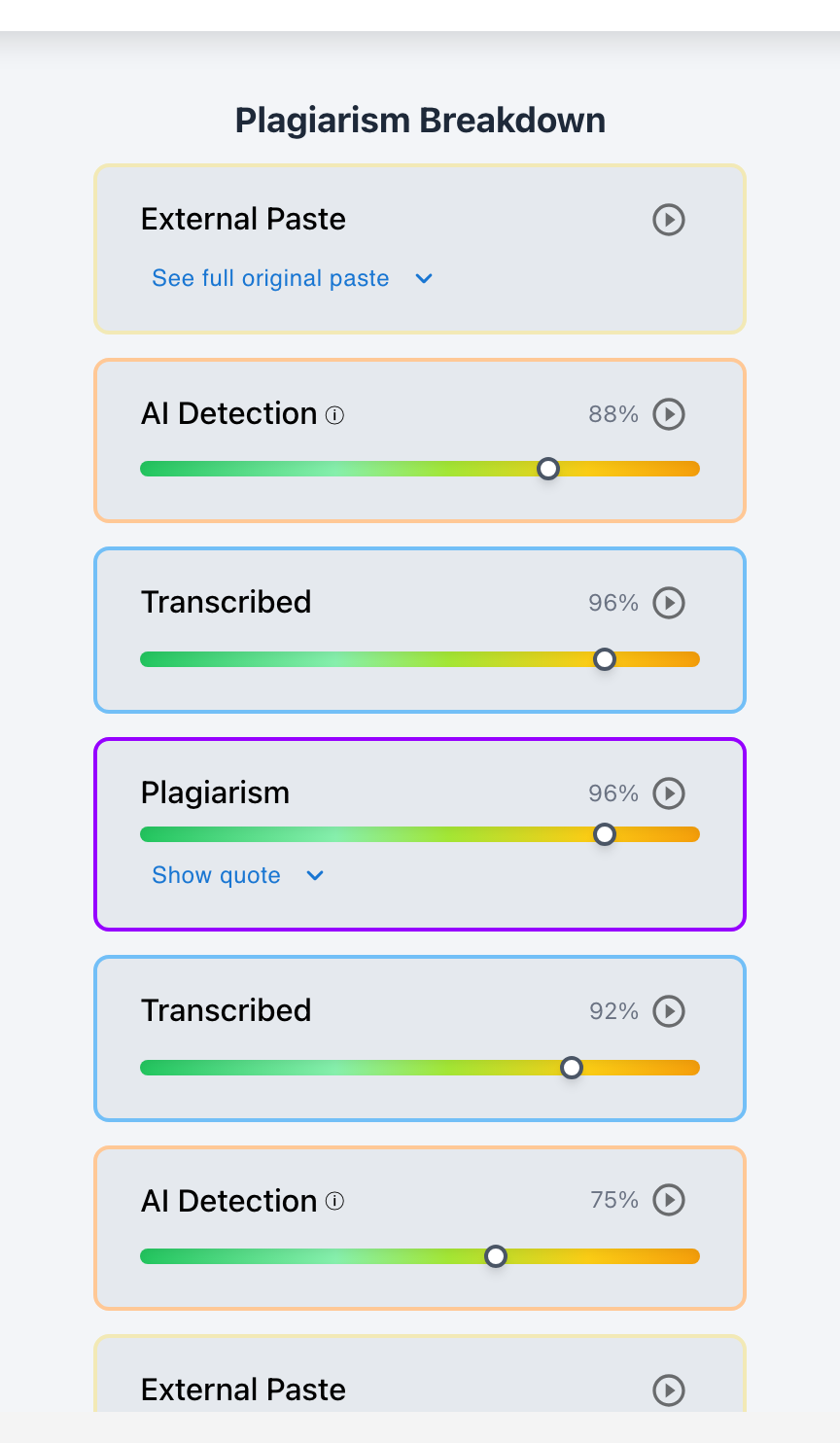
No. A student cannot safely copy an essay from someone who took the class last year without being caught. Modern school plagiarism platforms like Checkmark maintain comprehensive, multi-year institutional repositories that store and cross-reference every student paper ever submitted—meaning an essay from last year will trigger an immediate 95%+ exact match alert in Canvas SpeedGrader.
A common urban legend among high school and college students is that essays reset every semester: "My friend got an A on this paper last year, and it's not on the internet, so the teacher won't know." In reality, learning management systems (LMS) and modern integrity engines do not delete past submissions. Every paper submitted through Canvas or Google Classroom becomes part of the school's encrypted institutional archive. Furthermore, even if the text was slightly altered, keystroke writing process playback instantly exposes that the document was pasted in seconds rather than drafted over hours.
Below is a comprehensive guide on how school systems detect papers copied from previous academic years.
Checkmark Plagiarism catches past student paper reuse by pairing plagiarism detection with AI detection, essay writing playback, autograding, and integrations with Canvas and Google Classroom.
The 4 Mechanisms That Catch Copied Past Papers
1. Multi-Year Institutional Repositories
Every assignment submitted in prior terms remains indexed in Checkmark's secure database, triggering an automatic match when submitted again.
2. Zero-Drafting Telemetry in Playback
The student cannot reproduce the drafting history of the original author. Playback shows a single 0.05-second clipboard paste or unnatural mechanical retyping.
3. Prompt & Rubric Evolution
Teachers frequently update assignment requirements, required sources, or formatting rules each year; older papers fail to address the new rubric details.
4. Baseline Stylometric Disconnect
The past student's unique vocabulary and syntax habits will completely diverge from the current student's Week 1 In-Class Diagnostic baseline profile.
The Anatomy of a Past Student Paper Match in Canvas
Understanding what happens when a student submits an older assignment:
- Instant Match Alert: SpeedGrader displays an Integrity Card highlighting matching paragraphs and links to the original submission date (e.g., "Matched 94% with Fall 2025 submission by Student ID #4081").
- Side-by-Side Comparison: The teacher can view the two essays side-by-side to verify matching thesis statements, citations, and grammatical phrasing.
- Playback Verification: Checkmark Playback confirms that the current submission has zero active typing hours, removing any doubt about whether the match was a coincidence.
Read more in how Checkmark writing process analysis works.
Comparison: New Student Composition vs. Copied Past Paper
New Student Composition (Original)
- Drafted across 3+ active hours with 20%+ backspaces.
- Answers the specific prompt details for the current year.
- 0% match against institutional archives.
- Matches student's verified in-class diagnostic baseline.
Copied Past Paper (Academic Dishonesty)
- Pasted in 0.05s with zero drafting telemetry.
- Fails to address updated rubric requirements.
- 90%+ match against previous semester institutional file.
- Radical stylometric departure from student's normal voice.
A 5-Step Educator Protocol for Investigating Past Paper Copies
Past Paper Copy Audit Checklist:
- 1. Open the student's submission in Checkmark Plagiarism inside Canvas SpeedGrader.
- 2. Review the Institutional Match Card: confirm the date and course section of the original paper.
- 3. Inspect Writing Playback: confirm the lack of active drafting duration and deletion depth.
- 4. Hold a brief 2-minute conference: "Our institutional archive shows this paper matches a submission from Fall 2025. Can you walk me through your drafting process?"
- 5. Follow standard institutional honor code procedures for plagiarized submissions.
How Checkmark Plagiarism Powers Multi-Year Integrity
Checkmark Plagiarism combines **AI detection, essay writing playback, static AI detection, plagiarism detection, autograding, and Canvas/Google Classroom integrations** to automatically index and cross-match student work across school years while protecting student privacy.
Frequently Asked Questions
Do schools keep student essays in a database?
Yes. Schools maintain secure, encrypted institutional repositories in their LMS and integrity platforms to check for recycled student work across years.
What if a student rewrites a friend's old essay in their own words?
Checkmark's Semantic Plagiarism Engine detects matching argumentative structures and evidence sequences, while Playback shows the rapid transcription telemetry.
Can a teacher see the name of the past student who wrote the essay?
Within the same school district, authorized educators can see historical submission metadata (date, term, section) to verify the source of the paper.
What if a student submits their own essay from a different class?
This is considered self-plagiarism under most school policies; Checkmark will flag the previous submission and alert the teacher.
How does Checkmark Plagiarism integrate with Canvas LMS?
Checkmark provides certified LTI 1.3 integration, SpeedGrader sidebar embeds, two-way grade passback, and single sign-on (SSO).
What happens if a student retypes the old paper manually?
Manual retyping results in an unnaturally flat typing speed with <2% backspaces and zero structural revisions, which Playback immediately flags as transcription.
Can students delete past submissions from the school archive?
No. Institutional archives are managed at the administrative level and cannot be modified or deleted by students.
How does changing prompts each year help?
Updating small requirements (such as required primary sources) ensures that unedited older papers stand out immediately due to rubric non-compliance.
What should a teacher do if a past paper match is flagged?
Document the match report, check the Playback telemetry, and conduct a brief conference with the student to apply the school honor code policy.
Why is institutional archive indexing essential for fairness?
Because it ensures that students who complete original work are evaluated on an equal playing field with those attempting to reuse past assignments.
Ensuring Lasting Academic Integrity Across Cohorts
True academic growth requires every student to engage with course material for themselves. By leveraging multi-year institutional repositories and writing playback with Checkmark Plagiarism, educators ensure that copying from past students is impossible to hide, protecting standards for years to come.
Checkmark Plagiarism supports this comprehensive approach with AI detection, essay writing playback, static AI detection, plagiarism detection, autograding, and integrations with Canvas and Google Classroom.
See how Checkmark pairs multi-year institutional indexing with writing playback to catch recycled student work. View a sample report or request a demonstration.