
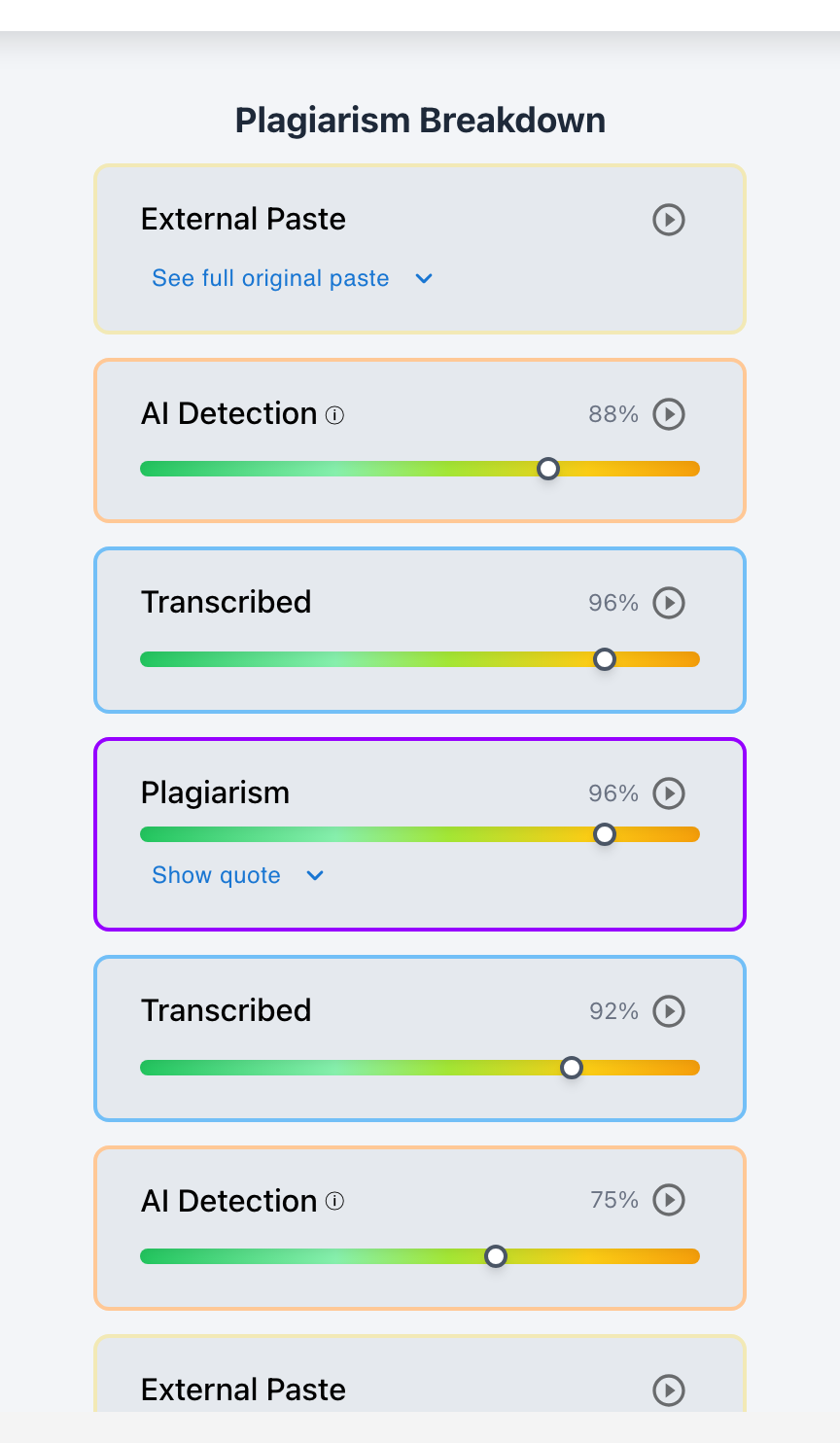
Yes. A professional plagiarism checker detects another student's essay by indexing submissions into secure institutional paper repositories and cross-matching text across classmates, different course sections, and past academic years.
A common assumption among students is that because their classmate's paper is not published on a public website like Wikipedia or CNN, a plagiarism detector will not be able to find it. In reality, modern plagiarism detection systems like Checkmark Plagiarism maintain extensive, encrypted institutional student paper repositories. When an assignment is submitted, it is scanned not only against billions of internet web pages but also against millions of student papers submitted across schools, districts, and previous terms.
Below is an in-depth breakdown of how student-to-student matching operates, how student privacy is safeguarded, and how educators can investigate matching papers.
Checkmark Plagiarism powers student-to-student matching by pairing plagiarism detection with essay writing playback, AI detection, autograding, and integrations with Canvas and Google Classroom.
The 4 Tiers of Student Paper Repositories
Tier 1: Real-Time Section Indexing
Every essay submitted to an assignment batch is cross-matched against all peers in the class roster simultaneously upon submission.
Tier 2: School & District Repository
Cross-checks papers across different teachers, course sections, and grade levels within the entire school district.
Tier 3: Multi-Year Historical Archive
Maintains an indexed archive of papers from prior semesters and academic years to catch reused essays from older siblings or friends.
Tier 4: Commercial Paper Mill Indexing
Indexes commercial "study sharing" websites, essay-for-sale databases, and contract cheating portals to catch purchased papers.
How Checkmark Protects Student Privacy While Matching
FERPA and student data privacy regulations require that student intellectual property is protected:
- Encrypted Fingerprinting: Documents are converted into mathematical n-gram vectors and linguistic hash tables, meaning the raw text is never published to the public internet.
- Internal School Access Only: Instructors can only view student names and details from within their own authorized institutional domain.
- FERPA & GDPR Compliant: No student data is sold to third parties or used to train commercial generative AI models.
Read more in how Checkmark writing process analysis works.
Comparison: Public Web Search vs. Institutional Student Matching
Standard Google Web Search
- Only indexes public, unpassworded web pages.
- Cannot see essays submitted behind LMS logins.
- 0% match rate for classmate papers.
- Easily bypassed by peer sharing.
Checkmark Student Repository Matching
- Indexes all LMS submissions across classes and years.
- Detects identical and paraphrased peer text instantly.
- Shows side-by-side comparison cards and timestamps.
- Completely secure and FERPA compliant.
A 5-Step Educator Protocol for Student-to-Student Matches
Educator Peer Match Checklist:
- 1. Open the Checkmark Plagiarism report in Canvas SpeedGrader or Google Classroom.
- 2. Review the highlighted Peer Match card to inspect matching text passages.
- 3. Compare the writing playback timelines of both submissions to establish authorship.
- 4. Verify submission dates, active typing hours, and revision rates.
- 5. Hold an academic integrity meeting with both students to resolve the situation.
How Checkmark Plagiarism Powers Student-to-Student Matching
Checkmark Plagiarism combines **AI detection, essay writing playback, static AI detection, plagiarism detection, autograding, and Canvas/Google Classroom integrations** to make student-to-student matching automatic, secure, and legally defensible within your LMS.
Frequently Asked Questions
Can plagiarism checkers tell if I copied my friend's essay?
Yes. Submissions are instantly cross-matched against all classmates in the assignment batch and across all other course sections.
What if my friend goes to a different school?
Checkmark's cross-institutional network checks submissions across participating school districts and universities, catching shared essays.
Can a plagiarism checker detect an essay submitted 3 years ago?
Yes. Checkmark maintains a multi-year historical institutional repository that flags matching papers submitted in prior academic years.
How does writing playback prove who wrote the essay first?
Playback logs show active typing hours, backspaces, and timestamps—proving who spent hours drafting and who pasted the finished text.
What if I share my Google Doc with a friend for peer review?
Peer review is normal, but if the friend copies whole paragraphs into their own submission, Checkmark flags the matching text blocks.
How does Checkmark Plagiarism integrate with Canvas LMS?
Checkmark Plagiarism displays visual writing playback timelines, peer match comparisons, and dual AI/plagiarism reports directly inside Canvas SpeedGrader.
Can teachers see the other student's name if they are at another school?
To protect privacy, Checkmark displays the matching text and school domain; instructors can request permission from the other school's administrator for details.
Does student-to-student matching violate FERPA?
No. Papers are stored in an encrypted, secure institutional database and are never published publicly or shared outside authorized academic channels.
What should a teacher do if two students submit identical papers?
Examine the playback logs to identify the authentic author vs. copier, and conduct separate conferences to evaluate conceptual understanding.
Why is student-to-student matching essential for fair grading?
It ensures that students who complete assignments independently are not disadvantaged compared to those copying peer work.
Guaranteed Fairness Across Every Classroom
Peer copying undermines the foundation of authentic academic evaluation. By combining institutional repository matching with essay writing playback and student due process, Checkmark Plagiarism ensures that every student's genuine work is protected and rewarded fairly.
Checkmark Plagiarism supports this comprehensive approach with AI detection, essay writing playback, static AI detection, plagiarism detection, autograding, and integrations with Canvas and Google Classroom.
See how Checkmark pairs essay writing playback with multi-signal detection to detect student-to-student copying inside your LMS. View a sample report or request a demonstration.