
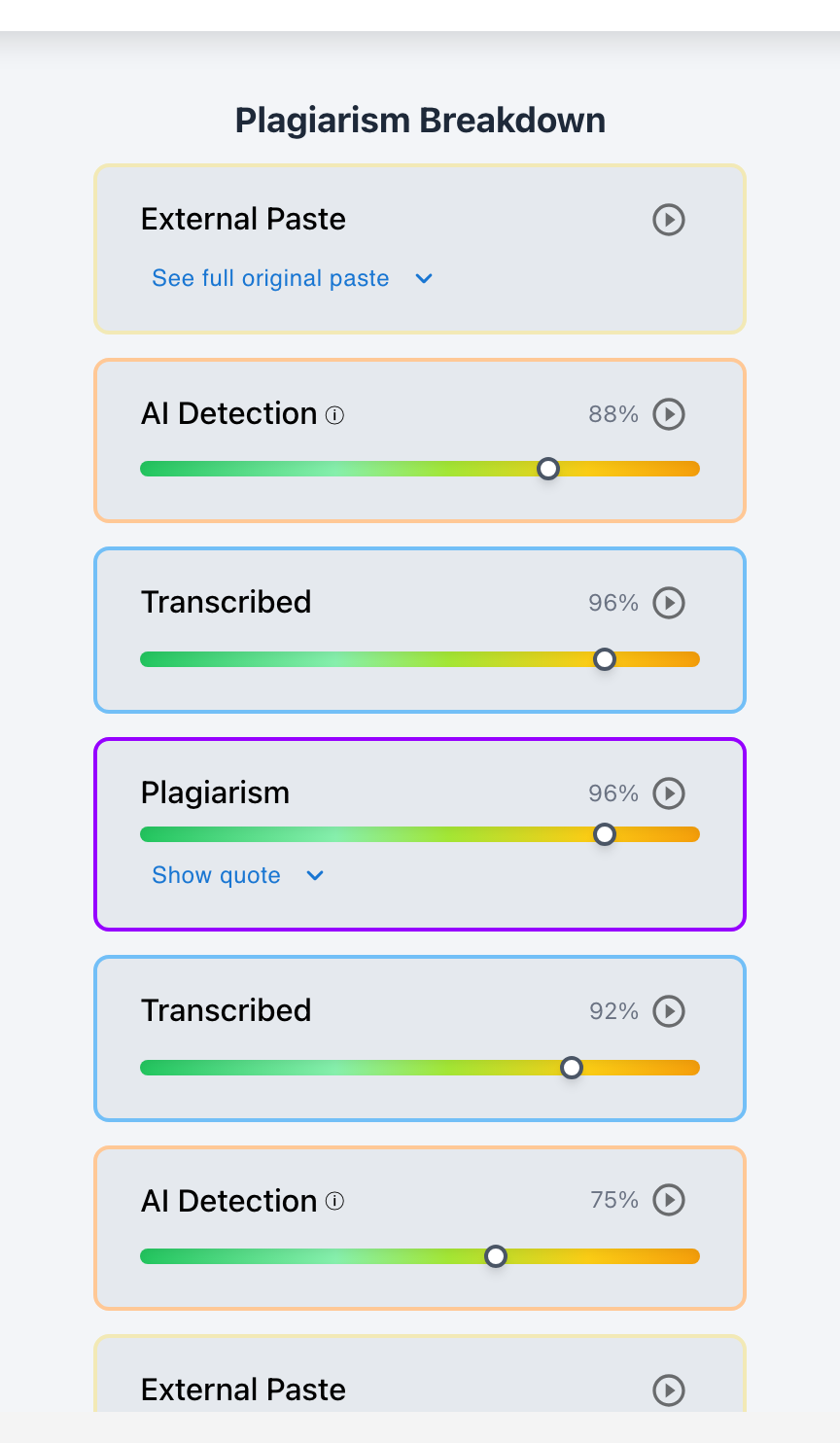
Yes. Advanced integrity platforms like Checkmark Plagiarism automatically flag the most suspicious assignments by computing a composite "Integrity Risk Index"—which triangulates four independent forensic signals: 1) High-Density Passage Clustering (concentrated plagiarism); 2) Process Telemetry Anomalies (zero drafting hours and instant paste payloads); 3) Neural AI Probability Spikes; and 4) Citation Verification Failures (hallucinated DOIs). Submissions triggering multiple signals are automatically sorted to the top of the grading queue for immediate educator review.
Traditional plagiarism checkers output a single, blunt similarity percentage (e.g., "22%"). This creates massive inefficiency: a paper with 22% similarity consisting entirely of properly cited quotes is flagged as high risk, while a paper with 12% similarity consisting of a single stolen conclusion is overlooked. Modern academic integrity requires intelligent, multi-dimensional risk scoring. By automatically weighing drafting duration, paste forensics, citation reality, and textual similarity, Checkmark Plagiarism highlights the exact 3–5% of submissions in a cohort that warrant manual investigation.
Below is a comprehensive guide on how automated suspicious assignment flagging works.
Checkmark Plagiarism calculates automated risk indices by pairing plagiarism detection with AI detection, essay writing playback, autograding, and integrations with Canvas and Google Classroom.
The 4 Multi-Signal Triggers of the Integrity Risk Index
1. High-Density Passage Clustering
Flags concentrated, verbatim text matches in analytical sections, distinguishing lethal 100-word stolen blocks from scattered common idioms.
2. Process Telemetry Collapse
Flags documents where active typing time is <15 minutes, deletion ratios are under 3%, or text appeared via a single 0.05-second clipboard paste.
3. Neural AI Probability & Perplexity Spikes
Flags uniform, low-perplexity synthetic sentence structures, formulaic participial clauses, and balanced triadic lists.
4. Citation & DOI Verification Failures
Flags unresolvable DOIs, phantom journal volumes, and synthetic author combinations generated by Large Language Model hallucinations.
How Multi-Signal Triaging Eliminates False Alarms
Understanding the mathematical advantage of composite risk scoring:
- The Quote-Heavy Innocent Paper: A student with 28% similarity from properly formatted block quotes has 4 hours of typing telemetry and verified DOIs → Risk Score: GREEN (Clean).
- The Cleverly Disguised AI Essay: A student with 0% plagiarism similarity who pasted an essay in 0.05s with 3 hallucinated DOIs → Risk Score: RED (Priority Flag).
- Immediate Educator Clarity: Teachers open their gradebook and instantly see which papers are genuine and which require a 2-minute oral check-in.
Read more in how Checkmark writing process analysis works.
Comparison: Single-Metric Checkers vs. Checkmark Multi-Signal Risk Index
Checkmark Multi-Signal Risk Index (Intelligent & Precise)
- Combines similarity, paste telemetry, AI, and DOIs.
- Ranks submissions by composite severity score.
- Eliminates false alarms on properly cited essays.
- Surfaces sophisticated AI and paraphrased text instantly.
Single-Metric Checkers (Blunt & Noisy)
- Relies exclusively on a single percentage number.
- Flags innocent students with extensive bibliographies.
- Completely misses AI writing with 0% web similarity.
- Wastes educator hours on manual false alarm audits.
A 5-Step Educator Protocol for Managing Flagged Papers
Flagged Assignment Review Checklist:
- 1. Open the Assignment Overview in Canvas SpeedGrader or Google Classroom.
- 2. Sort by "Integrity Risk Level": view the top Red submissions first.
- 3. Click the highest-risk submission to view its Multi-Signal Breakdown Card.
- 4. Launch Writing Playback to verify whether text entered via paste or organic typing.
- 5. If multi-signal triggers are confirmed, schedule a private 2-minute oral check-in.
How Checkmark Plagiarism Powers Automated Risk Scoring
Checkmark Plagiarism combines **AI detection, essay writing playback, static AI detection, plagiarism detection, autograding, and Canvas/Google Classroom integrations** to evaluate submissions across all four forensic dimensions simultaneously, surfacing true integrity risks automatically.
Frequently Asked Questions
How does Checkmark calculate the composite Suspicion Index?
Checkmark weighs similarity percentage, active typing duration, paste payload size, neural AI probability, and DOI verification status into a single unified risk score.
Can an essay with a 0% plagiarism score be flagged as suspicious?
Yes. If an essay has 0% plagiarism but was pasted in 0.05 seconds with a 95% AI score and fake citations, Checkmark flags it as high risk.
Why do traditional plagiarism checkers generate so many false alarms?
Because they count cited quotes, assignment instructions, and bibliographies toward similarity scores without analyzing drafting process telemetry.
Can teachers customize which signals trigger an automatic flag?
Yes. Educators can set custom thresholds for typing hours, similarity percentages, and AI sensitivity in assignment settings.
How does Checkmark Plagiarism integrate with Canvas LMS?
Checkmark embeds risk index badges directly inside Canvas SpeedGrader, sorting submissions automatically in the grading sidebar.
What does a 'Green' status badge mean?
A Green badge indicates verified human authorship: low similarity, multi-hour active typing, healthy backspaces, and valid citations.
How does automated flagging prevent educator fatigue?
By pre-screening and ranking papers by risk, teachers immediately know which papers need deep review and which can be graded directly.
Can students see their Suspicion Index score?
Students see clear formative feedback, similarity breakdowns, and citation advice without seeing administrative risk ratings.
How does Autograder utilize composite risk flags?
Autograder automatically pauses automated grade release on high-risk submissions, routing them to the teacher for manual review.
Why is multi-signal risk scoring the future of academic integrity?
Because modern digital shortcuts are complex, and only multi-signal triangulation can provide fair, accurate, and foolproof integrity screening.
Intelligent Screening for Modern Academic Rigor
Educators deserve grading tools that work as intelligently as they do. By leveraging Checkmark Plagiarism's automated multi-signal risk scoring, teachers cut through the noise, eliminate false alarms, and identify genuine academic integrity risks in seconds.
Checkmark Plagiarism supports this comprehensive approach with AI detection, essay writing playback, static AI detection, plagiarism detection, autograding, and integrations with Canvas and Google Classroom.
See how Checkmark calculates automated integrity risk indices in Canvas SpeedGrader. View a sample report or request a demonstration.