
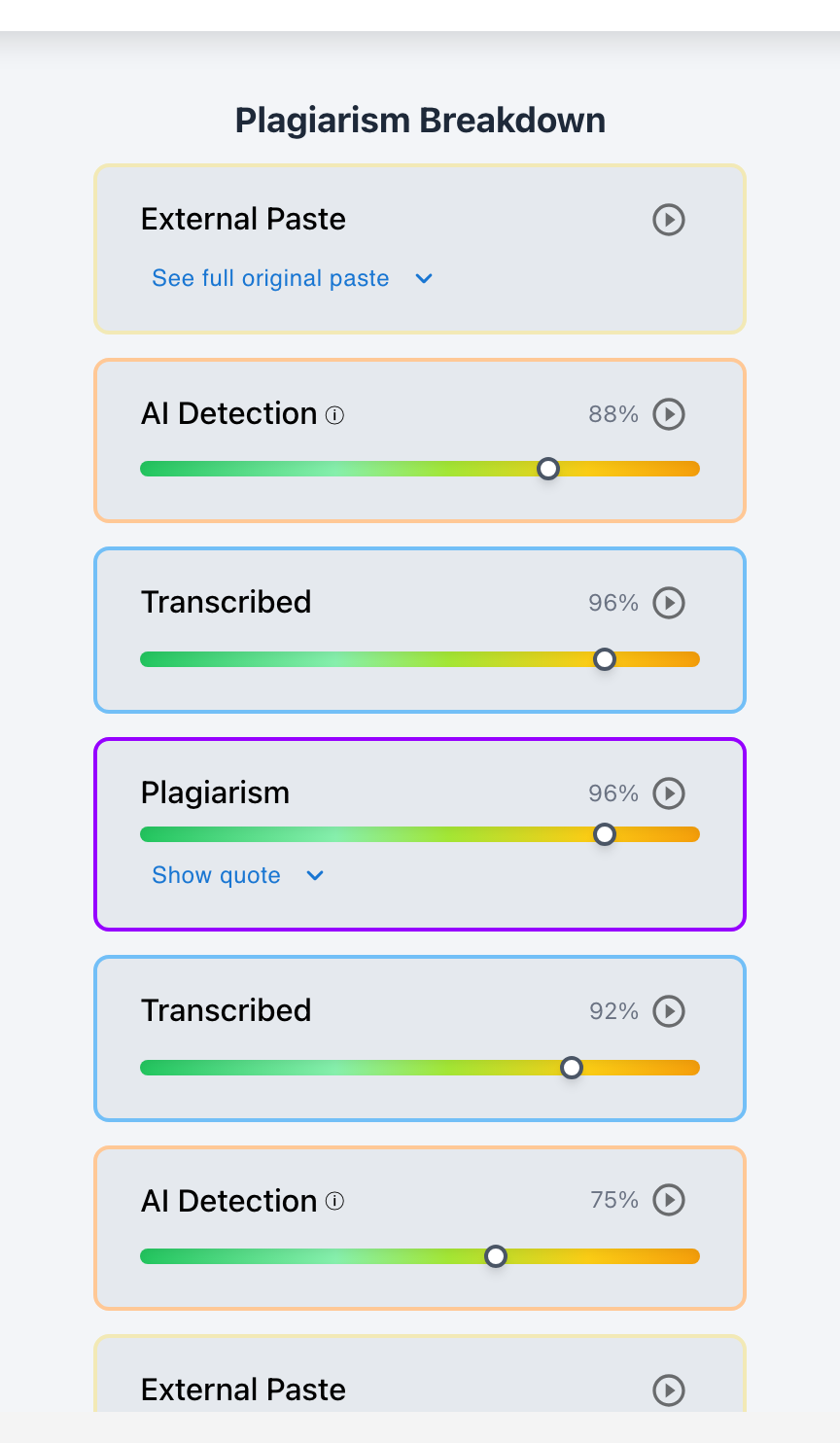
When an essay receives a low AI detector score (<20%) but still looks undeniably AI-written, teachers should check four forensic evidence layers in Checkmark Plagiarism: 1) Checkmark Writing Playback Telemetry (checking if the text was pasted into the document in 0.05 seconds with zero typing history); 2) AI Humanizer & Paraphraser Artifacts (spotting archaic synonyms, odd prepositions, and forced sentence length variation from tools like QuillBot); 3) Citation & DOI Verification (confirming if cited sources are hallucinated); and 4) A 2-Minute Diagnostic Oral Check-In.
Students have quickly discovered that free AI paraphrasers and "AI humanizer" apps (like QuillBot or Undetectable AI) can artificially scramble word order and inject random synonyms to fool traditional statistical detectors. When an educator reads an essay that feels hollow, formulaic, or detached, seeing a "5% AI Detected" badge can make them feel powerless. AI detectors only evaluate surface text statistics; process telemetry evaluates reality. Checkmark Plagiarism exposes bypassed and humanized AI text by uncovering how the document was constructed.
Below is a comprehensive forensic guide on investigating essays that bypassed statistical AI detectors.
Checkmark Plagiarism catches humanized AI text by pairing essay writing playback with AI detection, plagiarism detection, autograding, and integrations with Canvas and Google Classroom.
The 4 Hidden Signals of Humanized AI Writing
1. The Paste Payload Signature
Even if an AI humanizer fooled a statistical classifier, the student still had to copy the output from the humanizer site and paste it into Canvas in 0.05 seconds.
2. Thesaurus Substitution Glitches
Paraphrasers replace common terms with awkward, overly formal synonyms (e.g., changing "important cause" to "consequential instigation") that distort meaning.
3. Hallucinated Academic Citations
Humanizer tools scramble sentence structures but leave fake, hallucinated DOIs intact, providing immediate binary disproof in Crossref.
4. Oral Defense Conceptual Failure
Because the humanizer output is convoluted and difficult to read, the student is completely unable to explain the mangled arguments during a check-in.
Why Statistical Detectors Fail Against Paraphrasers
Understanding the limits of statistical algorithms vs. process telemetry:
- Perplexity Manipulation: Statistical detectors look for low perplexity (predictable word choices). AI humanizers intentionally inject random, low-probability words to artificially spike perplexity and trick detectors into classifying text as human.
- Process Telemetry Is Immune to Humanizers: An AI humanizer cannot simulate 4 hours of typing, natural clause pauses, and 20% backspace deletions in Google Docs. Keystroke telemetry exposes the shortcut regardless of text scrambling.
- The Two-Pillar Rule: Combining a 0.05-second paste event with non-existent citations creates an open-and-shut integrity case without needing a high detector score.
Read more in how Checkmark writing process analysis works.
Comparison: Surface AI Scores vs. Checkmark Multi-Signal Telemetry
Checkmark Multi-Signal Telemetry (Unassailable Truth)
- Reveals 0.05-second paste payload of humanized text.
- Checks DOIs against Crossref database automatically.
- Flags bizarre paraphrasing synonym artifacts.
- Corroborates findings with 2-minute oral check-in.
Surface AI Scores Alone (Easily Bypassed)
- Displays a misleading "5% AI Detected" green check.
- Blind to whether text was typed or pasted.
- Ignores fake citations and distorted vocabulary.
- Leaves teachers second-guessing their professional instincts.
A 5-Step Educator Protocol for Investigating Bypassed AI
Bypassed AI Investigation Checklist:
- 1. The essay sounds unnatural despite a low AI score: open Checkmark Writing Playback in SpeedGrader.
- 2. Check Active Typing Hours: confirm if the essay materialized in minutes or via a single paste.
- 3. Inspect the Bibliography: run automated Crossref DOI verification to catch hallucinated sources.
- 4. Highlight 2 awkward phrases: ask the student to explain what they meant by those specific words.
- 5. If paste logs and fake citations are verified, export the Checkmark PDF dossier for referral.
How Checkmark Plagiarism Defeats AI Humanizers
Checkmark Plagiarism combines **AI detection, essay writing playback, static AI detection, plagiarism detection, autograding, and Canvas/Google Classroom integrations** to bypass statistical manipulation and verify true human authorship through empirical telemetry.
Frequently Asked Questions
What is an 'AI humanizer'?
A software tool that takes AI-generated text and automatically rewrites it with random synonyms and varied sentence lengths to evade statistical AI detectors.
Can an AI humanizer bypass Checkmark Writing Playback?
No. Writing Playback tracks physical keystrokes, active drafting duration, and clipboard paste events, which no online paraphrasing tool can simulate.
What are the telltale vocabulary signs of paraphrased AI?
Look for bizarre synonym choices (e.g., "celestial body" instead of "moon," "lucrative remuneration" instead of "good pay") that make the text difficult to parse.
How does Checkmark Plagiarism integrate with Canvas LMS?
Checkmark displays playback duration badges and paste timestamps directly beside AI scores in Canvas SpeedGrader.
What if the student claims they used a thesaurus while writing?
Checkmark Playback records the exact editing steps; if a student used a thesaurus organically, their typing timeline will show gradual, multi-hour drafting.
How does citation verification expose paraphrased AI?
Paraphrasers scramble text but copy fake AI citations directly into the document; verifying DOIs against Crossref immediately exposes synthetic generation.
What should I ask the student during the oral check-in?
Ask: "Can you explain what this sentence means in your own words?" Students who ran text through a humanizer usually cannot decipher their own sentences.
How does Autograder evaluate humanized AI writing?
Autograder flags awkward phrasing, semantic incoherence, and paste telemetry, alerting the teacher to inspect the submission.
Can students bypass playback by retyping the humanized text?
Retyping humanized text produces the same robotic, pause-free transcription cadence and 0% backspaces that Checkmark flags instantly.
Why should teachers trust their professional instincts over a low detector score?
Because an experienced educator's intuition is a powerful diagnostic tool; pairing that intuition with Checkmark's process telemetry provides decisive proof.
Beyond the Limitations of Statistical Detectors
Cheating tactics evolve, but physical reality cannot be faked. By utilizing Checkmark Plagiarism's writing playback telemetry and citation audits, educators easily look past manipulated AI scores, uncovering humanized shortcuts and upholding authentic scholarship with total confidence.
Checkmark Plagiarism supports this comprehensive approach with AI detection, essay writing playback, static AI detection, plagiarism detection, autograding, and integrations with Canvas and Google Classroom.
See how Checkmark exposes humanized AI text with writing playback telemetry in Canvas. View a sample report or request a demonstration.