
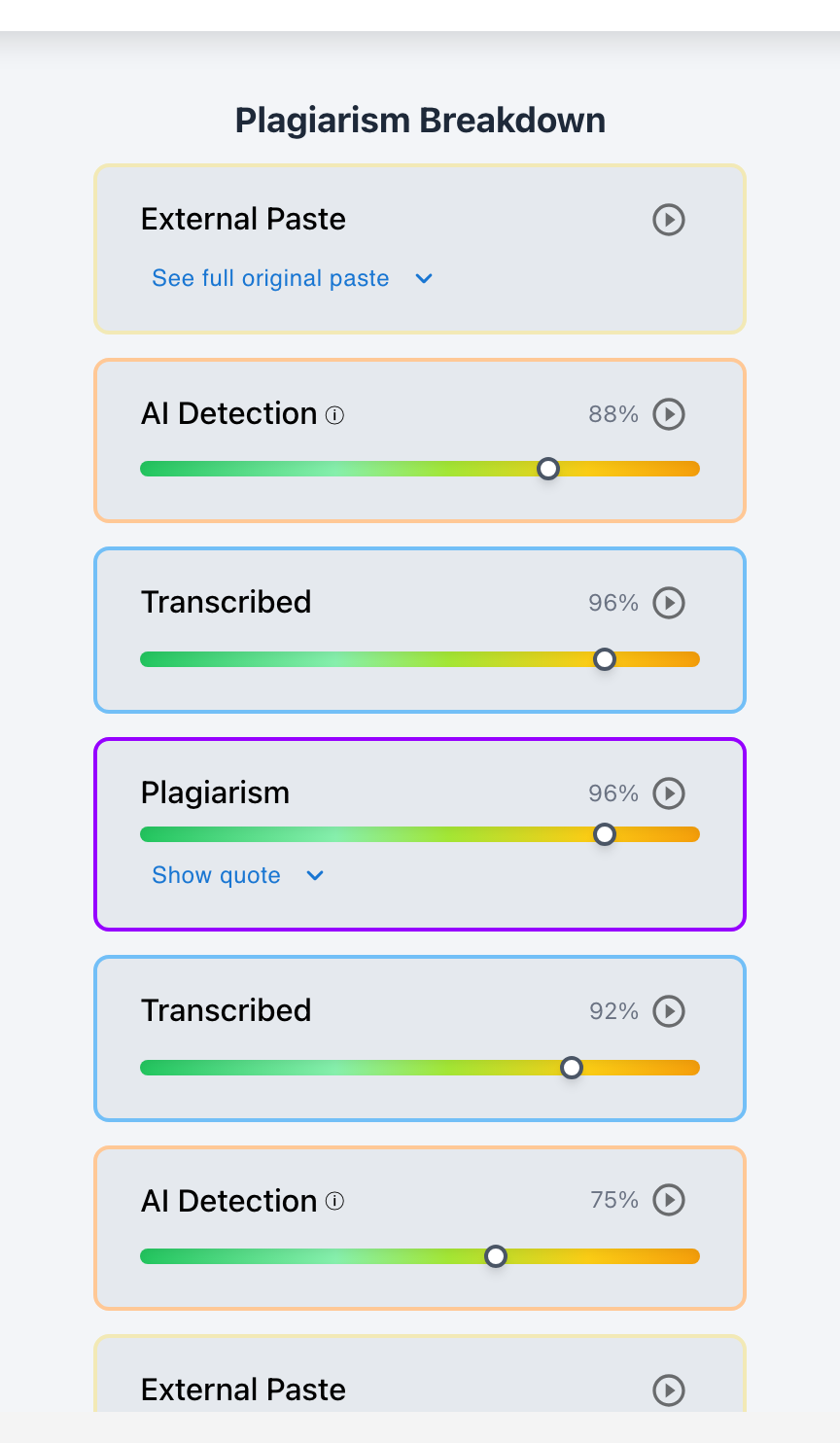
Yes. Teachers can easily detect when a student manually retyped ChatGPT instead of copying and pasting it. Retyping AI text leaves four unmistakable forensic fingerprints in Checkmark Plagiarism: 1) Biometric Keystroke Cadence (flat, robotic typing speed with no cognitive pauses); 2) Abnormally Low Deletion Ratios (<3% backspaces compared to 15–25% for real human drafting); 3) Persistent Linguistic AI Classifiers (the written text still possesses low token perplexity and synthetic syntax); and 4) Hallucinated Citations (the student faithfully retypes fake DOIs generated by the chatbot).
A widespread myth on student social media claims that you can "fool any AI detector" by reading ChatGPT's answer on your phone or split screen and manually typing it into your assignment document. Students believe that because physical keypresses are recorded in Google Docs or Canvas, the document will appear 100% human. In reality, manual transcription produces an even more obvious evidentiary footprint than copy-pasting. Checkmark Plagiarism pairs keystroke telemetry with neural language analysis to expose retyped AI text in seconds.
Below is a comprehensive guide on how retyped AI text is detected and how educators investigate transcription cases.
Checkmark Plagiarism detects retyped AI text by pairing essay writing playback with AI detection, plagiarism detection, autograding, and integrations with Canvas and Google Classroom.
The 4 Forensic Fingerprints of Retyped ChatGPT Text
1. Robotic Typing Cadence (Flat IKI)
The student types at a uniform metronome speed (e.g., 50 WPM) for 45 continuous minutes, lacking the natural pause-and-burst cycles of creative human composition.
2. Near-Zero Backspace Ratio (<3%)
Because the student is copying ready-made text, they never rephrase clauses, restructure sentences, or discard rough paragraphs (average backspace rate <2%).
3. Neural Classifiers Still Trigger
Retyping text does not alter its underlying mathematical probability; Checkmark's neural engine flags the text as 95%+ synthetic based on token perplexity.
4. Faithfully Transcribed Fake DOIs
The student faithfully types out hallucinated scholarly references (e.g., non-existent journal articles) generated by ChatGPT, proving external origin.
Why Retyping Fails to Hide AI Authorship
Understanding the dual-layer trap of manual transcription:
- Physical Keypresses Don't Change Words: An AI detector evaluates the statistical distribution of words and sentences. Whether the text entered via
Ctrl+Vor 5,000 keystrokes, the vocabulary and syntax remain identically synthetic. - The Video Replay Tells the Whole Story: When an educator watches Checkmark's 15-second time-lapse playback, the essay appears in a single flawless linear pass from top to bottom—looking like a court reporter transcribing audio rather than a student writing an essay.
- Inability to Defend Content: Because the student spent their energy looking back and forth between screens rather than thinking about the argument, they falter during brief oral check-ins.
Read more in how Checkmark writing process analysis works.
Comparison: Genuine Drafting vs. Retyped ChatGPT Transcription
Genuine Human Drafting (Cognitive Bursts)
- Dynamic typing bursts with 5–15 second thinking pauses.
- 15% to 25% backspaces and organic self-corrections.
- Sentences rewritten and reorganized across paragraphs.
- Passes oral defense and has valid academic citations.
Retyped ChatGPT Transcription (Screen Copying)
- Continuous metronome cadence with <2s pauses.
- Less than 3% backspaces across thousands of words.
- Text appears in final polished syntax in a single pass.
- High AI linguistic score paired with hallucinated DOIs.
A 5-Step Educator Protocol for Investigating Retyped AI Text
Transcription Investigation Checklist:
- 1. Open Checkmark Writing Playback in Canvas SpeedGrader: inspect the Typing Cadence Graph.
- 2. Check the Deletion Ratio: note if backspace usage is abnormally low (<3%).
- 3. Inspect the Source Verification Card: check for fabricated academic DOIs.
- 4. Hold a private conference: show the student their continuous, pause-free writing playback video.
- 5. Ask: "Your playback shows continuous typing without any pauses or revisions. Were you copying this from another screen or notes?"
How Checkmark Plagiarism Detects Manual Transcription
Checkmark Plagiarism combines **AI detection, essay writing playback, static AI detection, plagiarism detection, autograding, and Canvas/Google Classroom integrations** to automatically correlate keystroke cadence with neural text classifiers, exposing manual transcription effortlessly.
Frequently Asked Questions
Does retyping ChatGPT change the AI detection percentage?
No. Retyping does not change the words, sentence structure, or perplexity; neural AI classifiers will flag the text exactly the same as if it were pasted.
What does a transcription cadence look like in Checkmark Playback?
It appears as a flat, horizontal line on the cadence graph, showing uniform keystroke intervals with zero 5+ second cognitive pauses.
Can a student claim they are just an extremely fast, confident writer?
Even the most confident human writers make typographical mistakes, pause to think, and delete words (averaging 15–25% backspaces); 0% deletions is biometrically impossible for original human composition.
How does Checkmark Plagiarism integrate with Canvas LMS?
Checkmark embeds transcription alerts and cadence timelines directly in Canvas SpeedGrader, highlighting pause anomalies with one click.
What if the student claims they typed it from their own handwritten notes?
Ask the student to bring in their handwritten notes; if the notes were also generated by AI, they will contain the same hallucinated citations and formulaic structure.
Why do students spend 45 minutes retyping AI text?
Because widespread online rumors mislead students into believing that physical keypresses create an impenetrable shield against detection.
How do parents react to transcription playback evidence?
Showing parents the 15-second video replay of their child typing 1,500 words with zero pauses or backspaces makes the external copying undeniable.
How does Checkmark Autograder handle transcribed essays?
Autograder flags transcribed submissions with an elevated Integrity Risk Index, prompting the educator to review writing telemetry before finalizing grades.
Is manual transcription considered academic misconduct?
Yes. Submitting AI-generated text as your own original composition is academic dishonesty regardless of whether it was pasted or retyped.
Why is multi-signal telemetry essential for catching transcription?
Because combining biometric cadence, deletion ratios, AI heatmaps, and citation checks creates an unassailable evidentiary record.
Biometric Clarity for Modern Classrooms
Effort cannot mask external authorship. By utilizing Checkmark Plagiarism's typing cadence telemetry and neural text classifiers, educators easily see through manual transcription tricks, upholding academic honesty with unwavering precision and fairness.
Checkmark Plagiarism supports this comprehensive approach with AI detection, essay writing playback, static AI detection, plagiarism detection, autograding, and integrations with Canvas and Google Classroom.
See how Checkmark detects retyped AI text and transcription cadence in Canvas SpeedGrader. View a sample report or request a demonstration.