
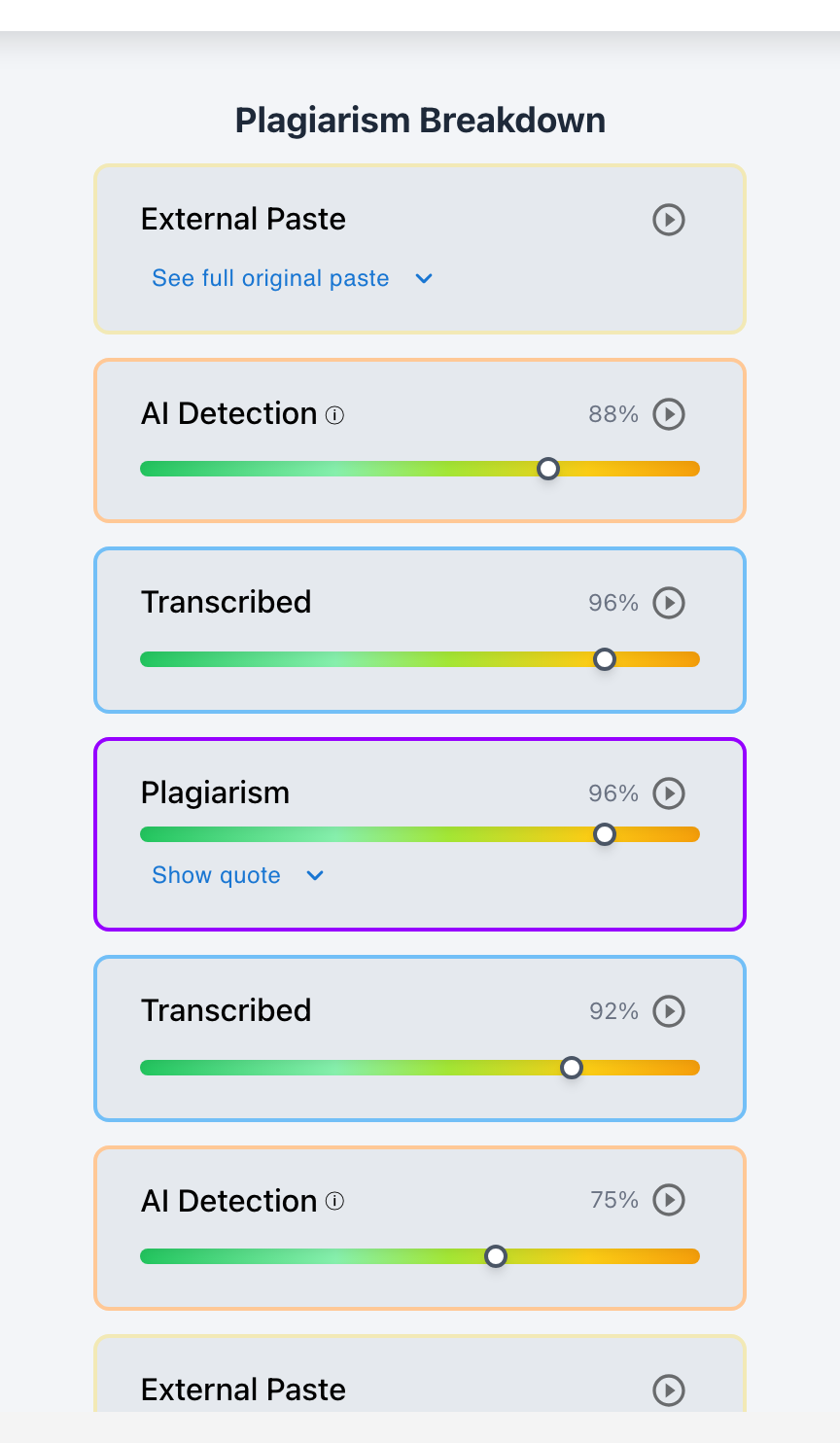
No. A student pasting half their essay does not automatically prove plagiarism or AI cheating. There are three legitimate reasons a student might paste a large section of text: 1) Internal Cut-and-Paste Restructuring (moving a previously typed paragraph from the bottom to the top); 2) Merging Pre-Writing Notes (importing research quotes or rough outlines from a separate doc); or 3) Restoring Accidentally Deleted Text. Checkmark Plagiarism proves whether a partial paste is legitimate or unauthorized by checking internal document provenance, web similarity, and AI linguistic telemetry.
When reviewing a student's document history, seeing a sudden 600-word paste block in the middle of a 1,200-word essay immediately raises eyebrows. However, jumping to an accusation without investigating the origin of the pasted text can penalize innocent students who were merely editing their work. Partial paste forensics requires analyzing where the text originated—distinguishing between internal document reorganization, legitimate research note integration, and unauthorized synthetic insertions.
Below is a comprehensive guide on diagnosing partial paste events and evaluating authentic authorship.
Checkmark Plagiarism analyzes partial paste events by pairing essay writing playback with plagiarism detection, AI detection, autograding, and integrations with Canvas and Google Classroom.
The 4 Scenarios Behind Partial Paste Events
1. Internal Cut-and-Paste Reorganization (Legitimate)
The student highlighted a paragraph they previously typed, cut it (Ctrl+X), and pasted it (Ctrl+V) elsewhere in the essay to improve structural flow.
2. Merging Research Notes & Quotes (Legitimate/Formative)
The student copied long primary source quotes or rough outline notes from an external document they created earlier during research.
3. Synthetic AI Paragraph Insertion (Misconduct)
The student hit writer's block on their counter-argument paragraph, generated the section with ChatGPT, and pasted it into their draft.
4. Uncredited Web Plagiarism (Misconduct)
The student copied a multi-paragraph explanation directly from Wikipedia, a blog, or a peer's shared paper without quotation marks.
How Checkmark Establishes Pasted Text Provenance
The 3 diagnostic checks to verify partial paste legitimacy:
- Check 1: Internal Document Provenance: Checkmark Playback checks if the pasted characters existed earlier in the document's keystroke timeline. If the text was previously typed in the same session, it is an internal cut-and-paste reorganization.
- Check 2: Isolated Block Plagiarism & AI Scan: Checkmark scans the specific pasted text block independently against 90B+ web pages and neural AI models, isolating external origins in seconds.
- Check 3: The 2-Minute Diagnostic Oral Check-In: Ask the student to walk through the pasted section: "Can you explain why you moved or inserted this specific paragraph here?"
Read more in how Checkmark writing process analysis works.
Comparison: Legitimate Text Movement vs. AI Insertion Payload
Internal Text Reorganization (Legitimate Human)
- Text was typed in the same document 20 minutes prior.
- Corresponds to a Cut (Ctrl+X) event in keystroke logs.
- Matches the student's surrounding vocabulary and voice.
- Student fluently explains structural reasons for the move.
Synthetic AI Insertion (Unauthorized Misconduct)
- Text originated from an external clipboard with 0 prior history.
- Isolated block triggers a 95%+ AI linguistic score.
- Contains abrupt shifts in syntactic sophistication and tone.
- Student struggles to explain vocabulary in the pasted section.
A 5-Step Educator Protocol for Investigating Partial Pastes
Partial Paste Investigation Checklist:
- 1. Open Checkmark Writing Playback in Canvas SpeedGrader: click on the purple-highlighted paste block.
- 2. Check Internal Provenance: verify if the text was previously typed in the document and cut.
- 3. Inspect the Isolated AI and Plagiarism Risk Cards for that specific pasted section.
- 4. If external, ask the student: "Where was this section originally composed? Can you show me your notes?"
- 5. If the student provides original research notes, guide them on proper quotation mechanics; if uncredited AI, apply school integrity policy.
How Checkmark Plagiarism Powers Partial Paste Forensics
Checkmark Plagiarism combines **AI detection, essay writing playback, static AI detection, plagiarism detection, autograding, and Canvas/Google Classroom integrations** to automatically track clipboard origins, internal text moves, and isolated paragraph integrity.
Frequently Asked Questions
Why do students cut and paste their own text while drafting?
Because mature writers constantly reorganize their thoughts—moving their thesis to the introduction, swapping body paragraphs, or refining transitions.
How does Checkmark distinguish internal cut-and-paste from external copying?
Checkmark indexes every keystroke in the document session; when text is pasted, it checks whether those exact character hashes were deleted or cut earlier in the same document.
What if a student pasted raw research notes from another doc?
Ask the student to show the original notes doc. If it contains their legitimate research, treat any missing quotation marks as a citation formatting lesson.
How does Checkmark Plagiarism integrate with Canvas LMS?
Checkmark embeds color-coded paste blocks directly in Canvas SpeedGrader, allowing teachers to click any paragraph to inspect its origin timestamp.
What if only one paragraph in an essay was written by AI?
Checkmark's sentence-level heatmaps isolate the specific AI-generated paragraph, allowing teachers to address partial AI use with precision.
Can students hide an external paste by typing a few words around it?
No. Checkmark Playback logs every character insertion individually, highlighting the exact boundary where typed text meets pasted payloads.
How does Autograder handle partial paste events?
Autograder benchmarks the internal provenance of pasted blocks, evaluating whether the text movement reflects sophisticated revision or uncredited copying.
What should a teacher do if the student pasted an outline they made in ChatGPT?
Follow your school's AI policy regarding AI brainstorming vs. synthetic prose generation, using the conference to teach proper disclosure.
Can students see their own paste analysis in Checkmark?
Yes. Students can review their writing analytics to understand how their editing actions and text movements are documented.
Why is investigating partial paste provenance essential for fairness?
Because penalizing a student for simply moving their own sentences destroys the revision mindset that writing teachers work so hard to cultivate.
Protecting Revision, Exposing Misconduct
Editing is the heart of good writing. By utilizing Checkmark Plagiarism's internal document provenance and paste telemetry tools, educators encourage healthy revision and structural experimentation while swiftly uncovering unauthorized external text insertions with total forensic clarity.
Checkmark Plagiarism supports this comprehensive approach with AI detection, essay writing playback, static AI detection, plagiarism detection, autograding, and integrations with Canvas and Google Classroom.
See how Checkmark tracks internal text movement and partial paste payloads in Canvas SpeedGrader. View a sample report or request a demonstration.