
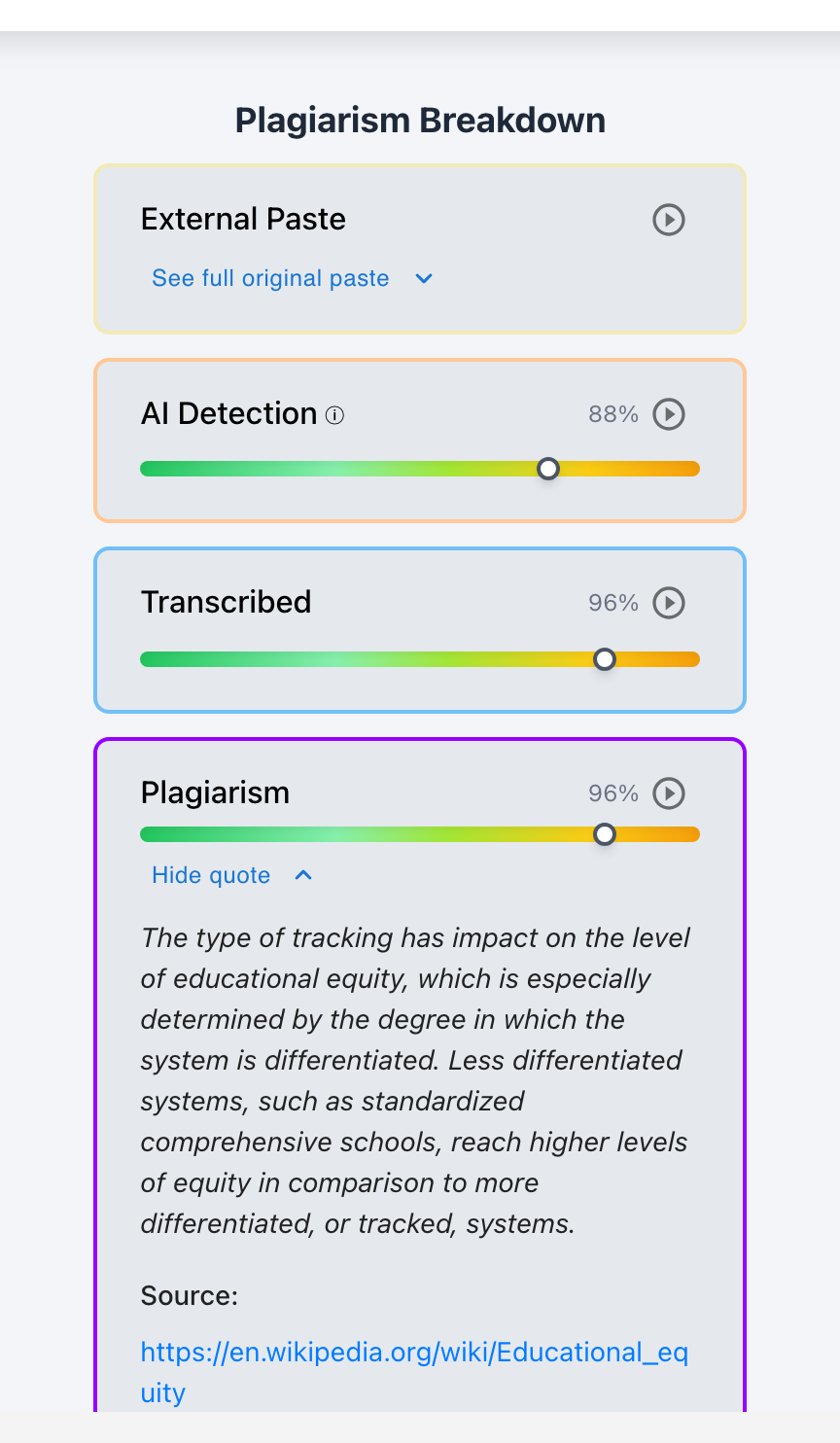
For more than two decades, educational institutions have evaluated student writing authenticity through a blunt, monolithic metric: the aggregate “Similarity Score.” By pooling legitimate quotations, minor formatting lapses, developmental patchwriting, and deliberate copy-paste theft into a single undifferentiated percentage, legacy plagiarism checkers create profound pedagogical and administrative crises. They force educators into adversarial police roles, falsely penalize earnest learners, and obscure true authorship fraud. Checkmark Plagiarism resolves this systemic flaw through its Multidimensional Integrity Reporting Architecture. By decoupling uncited source overlap from direct plagiarism matches using discrete visual taxonomy badges (🟢 Quoted & Cited, 🟡 Cited but Unquoted, 🔴 Uncited External Match, 🟣 Peer Cohort Match), synchronized two-pane source verification, patent-pending Essay Playback™ keystroke dynamics, and passage-level AI detection, Checkmark replaces punitive guesswork with defensible, transparent evidence (“receipts”).
Checkmark Plagiarism empowers educators with comprehensive authorship verification, uniting side-by-side source comparison with keystroke process playback, passage-level AI writing detection, quote-anchored rubric autograding, and direct LTI 1.3 integrations for Canvas LMS and Agilix Buzz LMS.
1. The Pedagogical Breakdown of Monolithic “Similarity Scores”
In secondary English classrooms, AP Capstone seminars, college composition courses, and graduate writing programs, the submission of a major research paper is frequently accompanied by a familiar anxiety: the arrival of the automated similarity index.
How single-percentage metrics collapse legitimate research, mechanical lapses, and fraud into one number
Legacy Scanner Computes Crude n-Gram Token String Overlap Relative to Total Word Count
- 18% — Properly cited block quotations & primary evidence
- 8% — Standard assignment prompt headers & DBQ questions
- 6% — Disciplinary formulas (“p < 0.05”, APA headings)
- 3% — Works Cited bibliographic entries
- 2% — Developmental patchwriting (1 missing quotation mark)
- 0% — Intentional, malicious academic fraud
- Automated threshold flags essay for administrative review
- Teacher receives high-risk alert across class inbox
- Student falsely accused of academic dishonesty
- Teacher spends 45 minutes manually cross-referencing URLs
- Trust between educator and student breaks down
- Writing anxiety escalates across the entire cohort
For over twenty years, commercial plagiarism checkers have operated on a mathematical premise that is fundamentally disconnected from the cognitive reality of writing and research. Legacy scanners compute similarity using straightforward string-matching algorithms, measuring overlapping character n-grams relative to total document length:
This naive calculation produces a single, aggregate percentage that collapses fundamentally distinct textual events into one metric:
- Legitimate Scholarly Direct Quotes: Long primary source passages enclosed in quotation marks with flawless APA/MLA/Chicago parenthetical citations.
- Assignment Prompts & Headers: Common assignment instructions, institutional cover sheets, lab protocol summaries, and standard exam questions.
- Disciplinary Collocations & Technical Nomenclature: Fixed domain phraseology such as “randomized double-blind placebo-controlled trial”, “the Supreme Court held in a 5-4 majority opinion”, or “adenosine triphosphate synthesis via oxidative phosphorylation”.
- Works Cited & Bibliographic Entries: Standardized reference citations that naturally match library repositories and global web indexes.
- Clerical Citation Lapses: A novice researcher who cites an author in-text with a page number but neglects to wrap a 14-word clause in quotation marks.
- Developmental Patchwriting: An English Language Learner (ELL) or introductory student who struggles to synthesize dense academic prose and mimics source syntax while citing the original text.
- Direct Plagiarism & Authorship Fraud: Verbatim cut-and-paste copying from commercial blogs, paywalled journals, unacknowledged peer papers, or generative AI models with zero attribution and clear deceptive intent.
The Institutional Consequences of Aggregate Scoring
When educational systems rely on a single aggregate number, they create systemic failures across every level of the institution:
- The Arbitrary “20% Cutoff” Trap: To manage crushing grading loads, many school districts, department chairs, and university honor councils adopt administrative shortcuts—such as requiring formal academic dishonesty hearings for any essay exceeding a 20% or 25% similarity threshold. As a result, exemplary students who conduct rigorous primary source analysis with multiple block quotes are subjected to humiliating investigations, while dishonest students who run stolen text through synonym spinners (returning an aggregate 6% similarity) escape detection entirely.
- The Criminalization of Novice Writers: Treating mechanical citation errors as ethical transgressions harms developmental, first-generation, and neurodivergent students. Writing is a high-cognitive-load developmental process; learning how to synthesize, paraphrase, and cite sources takes semesters of intentional practice. When a software engine labels a missing quotation mark with the same red banner it uses for wholesale theft, it sends a destructive message: making a formatting mistake makes you a criminal.
- Educator Triage Burnout: High school English teachers grading 150 essays over a weekend do not have time to conduct a forensic 20-minute deconstruction of every submission flagged at 28% similarity. When the software fails to isolate genuine concerns from noise, teachers either burn out trying to manually cross-reference sources or turn off the software entirely, leaving both honest and dishonest work unexamined.
- The Rise of Adversarial Writing Environments: When students realize that their grades depend on an opaque, black-box percentage, they stop focusing on substantive argumentation, critical synthesis, and rhetorical voice. Instead, they become obsessed with “gaming the score”—deleting legitimate quotations, using awkward synonyms to evade n-gram matches, or submitting unedited AI text that registers low web similarity.
To establish an academic culture grounded in “Stop guessing, start trusting,” educational institutions must dismantle single-score scanning and adopt a multi-layered integrity architecture that explicitly separates uncited source overlap from direct plagiarism matches.
2. Uncited Source Overlap vs. Direct Plagiarism: Anatomy of the Difference
The core pedagogical failure of legacy integrity software is its inability to distinguish between mechanical competence and deceptive intent. When textual overlap is detected between a student submission and an external source, educators must evaluate the passage across two distinct axes:
Evaluating student writing across deceptive intent and mechanical citation competence
Cloaked / Spun Fraud
- Synonym-spun articles (QuillBot / Word spinners)
- Translated foreign text without attribution
- White-font zero-width character hacks
- Fragmented mosaic copy-paste evasion
Direct Plagiarism & Fabricated Authorship
- Verbatim cut-and-paste from uncredited websites/journals
- Unacknowledged generative AI prompt outputs
- Contract cheating and purchased essays
- Cross-period unauthorized peer paper duplication
Uncited Source Overlap & Developmental Patchwriting
- Missing quotation marks around cited direct quotes
- Citation format drift & incomplete page numbers
- Syntax mimicry by ELLs and emerging scholars
- Novice difficulty synthesizing complex academic arguments
Legitimate Academic Integration
- Correctly cited and quoted primary and secondary texts
- Flawless APA/MLA/Chicago attributions and signal phrases
- Standardized disciplinary domain nomenclature
- Accurately formatted Works Cited and bibliography lists
Deconstructing the Textual Categories
To respond appropriately to student work, educators and integrity officers must understand the mechanical and cognitive distinctions between these categories:
| Dimension | Uncited Source Overlap (Mechanical Lapse) | Direct Plagiarism (Academic Fraud) |
|---|---|---|
| Primary Root Cause | Mechanical error, working memory cognitive load, developmental synthesis struggles. | Intentional circumvention of effort, deliberate academic deception. |
| Citation Presence | Source often named in bibliography or cited nearby, but lacks enclosing quotation marks. | Zero acknowledgment of source anywhere in the document, footnotes, or references. |
| Writing Process Telemetry (Playback™) | Gradual drafting, multiple rewrites, authentic composing pauses, and backspaces. | Massive external paste blocks, instantaneous text insertion, or rapid transcription with zero pauses. |
| Text Structure | Patchworked phrases interspersed with student's own voice and imperfect transitions. | Sustained multi-sentence or full-paragraph verbatim text duplication with sudden vocabulary leaps. |
| Pedagogical Remedy | Citation coaching, paraphrase instruction, formative revision opportunity. | Honor code review, assignment reset, formal disciplinary consequence. |
1. Uncited Source Overlap (Mechanical Lapses & Developmental Patchwriting)
Uncited source overlap occurs when a student incorporates external prose or concepts into their paper with defective or incomplete attribution mechanics:
- The “Orphan Quote” Lapse: The student includes a direct 20-word excerpt from a secondary source and includes an accurate parenthetical citation
(Smith, 2024, p. 45), but forgets to enclose the excerpt in quotation marks. - The “Bibliography-Only” Attribution: The student lists the source in their Works Cited section and references the author’s name in the introductory paragraph, but fails to include in-text citations for specific data points or clauses borrowed in the body.
- Developmental Patchwriting (Syntactic Scaffolding): As documented by writing researcher Rebecca Moore Howard, patchwriting—copying from a source text and then deleting some words, altering grammatical structures, or plugging in one-for-one synonym substitutes—is a developmental stage for novice writers grappling with unfamiliar academic discourse. The student is not attempting to steal ideas; they are using the source text as a linguistic scaffold to comprehend and discuss complex concepts.
2. Direct Plagiarism Matches (Deliberate Authorship Fraud)
Direct plagiarism matches represent an intentional decision to pass off another author's intellectual work as one's own:
- Wholesale Verbatim Cut-and-Paste: Inserting multi-sentence or paragraph-length blocks of text copied directly from commercial websites, Wikipedia, open-access journals, or study guides without quotation marks, in-text citations, or bibliographic entries.
- Peer-to-Peer Cohort Copying: Copying lab calculations, analytical paragraphs, or complete essays written by peers in the same school or across different class periods.
- Paraphrased / Cloaked Fraud: Deliberately processing stolen text through automated synonym exchangers (e.g., QuillBot) or using micro-character substitution tricks to bypass basic n-gram filters.
When integrity software treats these two phenomena as identical by outputting a single red similarity percentage, it destroys pedagogical nuance. By separating them into discrete, actionable categories, teachers can transform mechanical lapses into formative coaching moments while reserving disciplinary action for genuine academic dishonesty.
3. Checkmark’s Multidimensional Integrity Reporting Architecture
Checkmark Plagiarism eliminates one-dimensional ambiguity by replacing the monolithic similarity score with a Multidimensional Integrity Report. Instead of a single number, Checkmark generates an interactive visual workspace that separates source overlap into discrete categories, provides side-by-side evidence, and offers inline citation coaching.
In the textbook’s analysis, “the transformation of urban infrastructure during the Gilded Age created unprecedented economic stratification (Author 88).” Furthermore, industrial capitalism concentrated wealth in the hands of corporate monopolies, which reshaped the political landscape of major cities.
3.1 Discrete Visual Taxonomy Badges
Checkmark categorizes every instance of textual overlap into one of four distinct, color-coded visual taxonomy badges directly within the student's submission and sidebar breakdown:
Exact string match enclosed in quotation marks with nearby valid citation and verified bibliography entry. Excluded from risk index; validated for rubric credit.
Significant text overlap (>8 tokens) with nearby in-text citation, but missing enclosing quotation marks. Triggers formative coaching overlay; zero honor code risk.
Verbatim/near-verbatim text overlap with live web or academic publication with ZERO citation or author mention. Requires verification via Essay Playback™ and side-by-side diff.
Text matches a current or historical submission in the school or district repository. Highlights cross-period or cross-section matching while strictly maintaining student privacy.
3.2 Synchronized Two-Pane Source Verification Workstation
When reviewing flagged passages, educators need rapid access to the original source text to make an accurate determination. Checkmark’s Synchronized Two-Pane Workstation provides a side-by-side comparative interface designed for fast, accurate evaluation:
“The primary vector of microplastic contamination in estuarine environments stems from untreated stormwater runoff, which carries synthetic polymer fibers directly into tributary waters.”
- Two-Way Linked Evidence Cards: Clicking any highlighted sentence in the essay automatically scrolls the right-hand evidence sidebar to the exact source match. Conversely, clicking any source card in the sidebar brings the corresponding paragraph in the student’s essay into focus.
- Live URL Resolution & Real-Time Web Crawl: Rather than providing static or broken snippets, Checkmark resolves live, active URLs across digital libraries, encyclopedias, and current web pages, allowing teachers to verify context with a single click.
- Verbatim Substring Alignment & Diff Highlighting: The interface renders an exact word-by-word diff comparison between the student's prose and the source text, highlighting identical phrases, minor word substitutions, and deleted clauses in real time.
3.3 Formatting and Citation Coaching Overlays
To support student growth, Checkmark includes an interactive Citation Coaching Overlay directly within the educator and student report views. When an educator encounters a 🟡 Cited but Unquoted passage, they can click a single button to open an instructional coaching card:
➜ Insert quotation marks: “Industrial capitalism concentrated wealth...” (Author 88).
➜ Prompt Student: “You have cited the author, but used the exact sentence structure. To paraphrase effectively, restate the historical argument in your own syntax.”
By providing targeted citation coaching overlays, teachers can address formatting errors in seconds. This allows educators to turn mechanical mistakes into productive learning opportunities while keeping their focus on student growth.
4. Multi-Factor Verification: Triangulating Process, Text, and AI
A complete writing assessment requires looking beyond surface-level text matching. Checkmark combines citation analysis with two additional pillars of integrity verification: patent-pending Essay Playback™ writing process telemetry and granular passage-level AI detection.
- Visual Taxonomy Badges (🟢 🟡 🔴 🟣)
- Side-by-side live web & academic diff
- Uncited source separation
- Keystroke dynamics & typing cadence
- Composing pauses & deletions
- Full external paste preservation
- Perplexity & burstiness analysis
- Calibrated confidence sliders
- Strict <150-word N/A guardrail
4.1 Patent-Pending Essay Playback™ (Writing Process Telemetry)
The most definitive proof of authorship is the observable writing process. Even if surface text is modified using synonym tools, AI paraphrasers (e.g., QuillBot), or text humanizers, deceptive manipulation cannot replicate authentic keystroke dynamics.
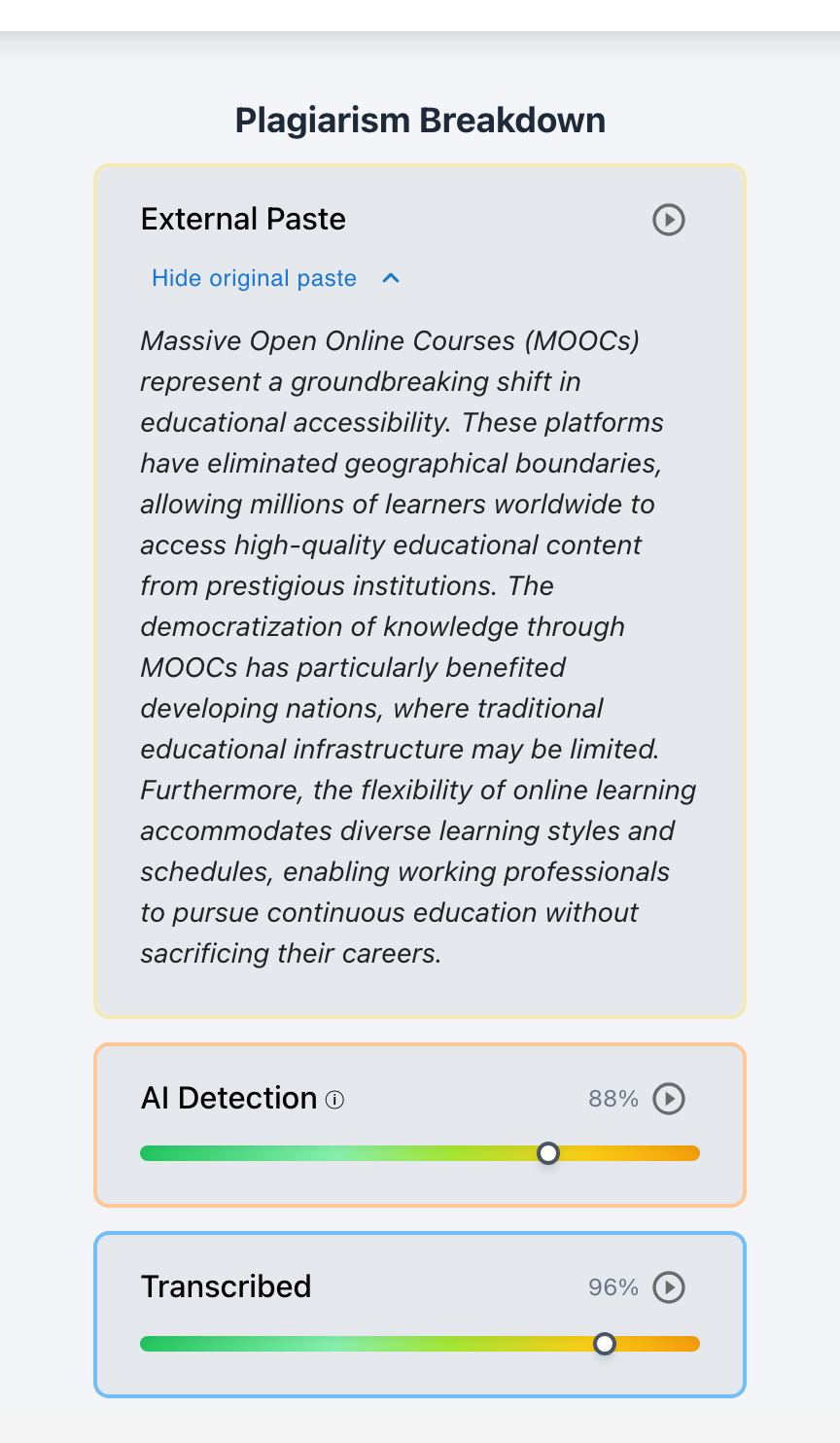
- Complete Keystroke Reconstruction: Checkmark captures the document's evolution in Google Docs, Word, Canvas LMS, or Buzz LMS editors. Teachers can scrub through a session timeline at 1x, 2x, 4x, or 8x speed to watch drafting, composing pauses, deletions, and sentence reorganizations in real time.
- External Paste Detection with Full Buffer Preservation: When text is pasted from an outside application, Checkmark logs the exact timestamp, word count, and—crucially—preserves the full original pasted text. Even if a student manually rewrites every word of a pasted paragraph over the next hour to disguise it, teachers can click “Jump to Playback” to view the original pasted source text.
- Transcription Detection: Identifies mechanical, steady typing without natural composing pauses or structural revisions, catching students who manually retype text from a phone or second monitor to evade copy-paste detection.
- Protection for Honest Students: For English Language Learners, neurodivergent students, or advanced writers falsely flagged by generic AI detectors, Essay Playback™ provides clear evidence of authentic work, showing their entire drafting and revision history.
4.2 Granular Passage-Level AI Writing Detection
Rather than generating an opaque whole-document probability score (e.g., “78% AI”), Checkmark provides passage-level AI detection that evaluates specific sentences and paragraphs on their individual linguistic characteristics.
- Calibrated Confidence Sliders: Every flagged passage is paired with a sidebar card displaying a confidence slider (Typical Human Writing Style vs. Typical AI Signature), explaining the underlying linguistic metrics (perplexity, burstiness, rhythm, and formulaic transitions).
- Honest Guardrails on Short Passages (<150 Words): Large language model detection requires adequate sample length to reach statistical reliability. For short answers, discussion board posts, or fragments under ~150 words, Checkmark displays
N/Arather than guessing, protecting students from false accusations on short assignments. - Immunity to AI Humanizers & Paraphrasers: Third-party tools like Undetectable AI or QuillBot modify surface vocabulary to bypass simple statistical detectors. However, because Checkmark pairs linguistic analysis with Essay Playback™ keystroke dynamics, it easily detects when humanized text is pasted into an essay without an authentic drafting history.
- Educator-Only Flag Statuses: Flag statuses (
Flagged,Resolved,Not Flagged) remain private to educators until reviewed, preventing automated, unsubstantiated accusations from reaching students or parents before a teacher evaluates the context.
4.3 Teacher-in-the-Loop AI Rubric Autograding
Checkmark combines its integrity suite with an AI Autograder that accelerates grading while maintaining teacher authority over all final scores and feedback.
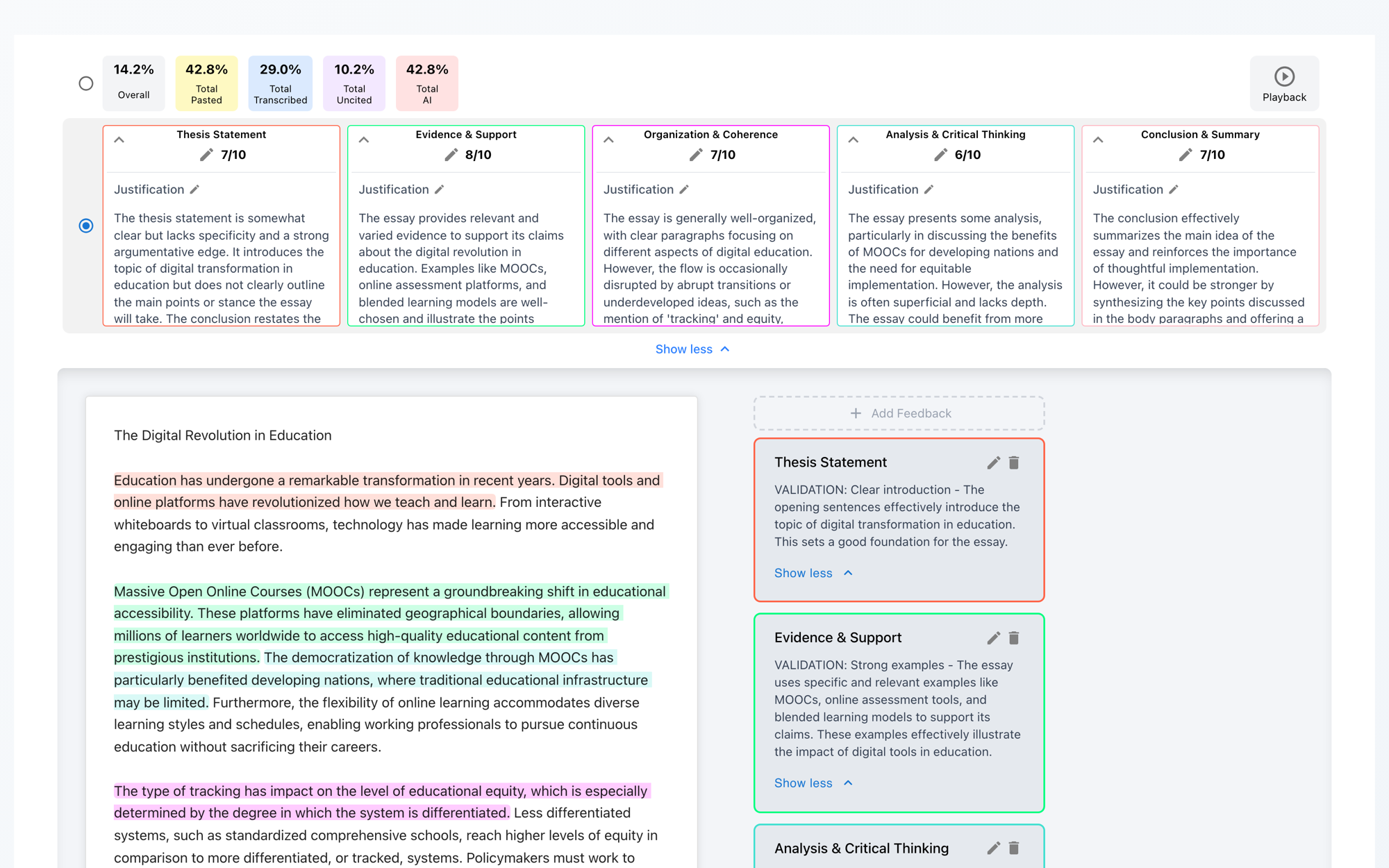
- Quote-Anchored Justifications: The autograder grounds every score in specific textual evidence. For example, under “Evidence & Citation Quality,” the system highlights the exact sentences where the student successfully integrated quotations alongside notes identifying where citations were missing.
- Teacher Final Authority: All AI-drafted evaluations remain unshared drafts until reviewed, modified, and approved by the teacher.
- Direct LMS Gradebook Passback: With a single click, approved rubric scores, point breakdowns, and customized feedback push directly into Canvas SpeedGrader or Agilix Buzz LMS, eliminating manual data entry.
5. Illustrative Case Studies: How Separation Resolves Integrity Crises
The following illustrative case studies demonstrate how separating uncited source overlap from direct plagiarism—backed by Essay Playback™ and multidimensional evidence—resolves common classroom assessment dilemmas.
Original Source (illustrative): “Grid-scale lithium-ion battery systems experience accelerated capacity degradation during continuous high-temperature thermal cycling.”
6. The 4-Phase Educator Triage & Restorative Conferencing Protocol
To implement multidimensional integrity reporting effectively, English departments, humanities teams, and academic integrity committees can follow this structured 4-phase review protocol:
Sort queue by badge colors. Clear 🟢 Green quotes; route 🟡 Amber to coaching; flag 🔴 Red and 🟣 Purple for audit.
Open Essay Playback™ on flagged essays. Verify drafting time, typing cadence, and inspect external paste buffers.
Conduct collaborative student meeting. Share two-pane workstation screen and review writing process history together.
Assign targeted revisions or apply institutional policy. Sync finalized rubric scores directly back to LMS gradebook.
Phase 1: Automated Multidimensional Triage
- Step 1.1: Sort the assignment grading queue using Checkmark’s badge filters. Instantly clear all submissions containing only 🟢 Green (Quoted & Cited) badges from manual integrity review.
- Step 1.2: Direct all submissions with 🟡 Amber (Cited but Unquoted) badges into the formative feedback workflow. These papers do not require honor code investigations; they need citation formatting feedback.
- Step 1.3: Flag submissions containing 🔴 Red (Uncited External Matches) or 🟣 Purple (Peer Cohort Matches) exceeding substantive length thresholds (>30 consecutive uncredited words) for telemetry review.
Phase 2: Telemetry & Process Audit
- Step 2.1: Open Checkmark’s Essay Playback™ on flagged submissions. Check the total active drafting time against assignment expectations (e.g., a 2,000-word essay drafted in under 6 minutes warrants immediate inspection).
- Step 2.2: Review the External Paste Log. Check whether pasted sections match legitimate reference quotes or uncredited external text.
- Step 2.3: Inspect the AI Passage Breakdown. Review individual confidence sliders and ensure flagged text contains sufficient sample length (>150 words).
Phase 3: The Restorative Evidence Conference
- Step 3.1 Non-Punitive Opening: Open the conference with a supportive tone focused on understanding the student's writing process: “I'm looking at your draft in Checkmark, and I’d love for you to walk me through how you developed your thesis and gathered your research.”
- Step 3.2 Shared Screen Review: Share your screen with the student, showing the Synchronized Two-Pane workstation and Essay Playback™ timeline together. This transparent approach removes adversarial tension by grounding the discussion in visible facts.
- Step 3.3 Collaborative Process Review: Ask the student to reflect on specific sections: “I notice that this paragraph closely mirrors the phrasing in this journal article, but you included the citation right here in parentheses. Let's look at how we can turn this into a proper paraphrase or quotation.”
Phase 4: Formative Resolution & LMS Passback
- Step 4.1 Citation Lapses: Assign a targeted revision task (e.g., reformatting quotes or rewriting patchwritten sentences) using the Citation Coaching Overlay.
- Step 4.2 Confirmed Integrity Violations: If telemetry confirms uncredited copying or wholesale external pasting, document the findings using Checkmark’s exportable report package (complete with timestamped keystroke logs, paste text captures, and side-by-side source diffs) and follow institutional policy.
- Step 4.3 Direct Gradebook Sync: Complete the rubric evaluation using the AI Autograder, adjust scores and feedback as needed, and publish final grades directly into Canvas LMS, Buzz LMS, or Google Classroom.
7. Institutional Syllabus Policies & Rubric Calibration Models
To ensure consistent application across departments, schools should define explicit distinctions between citation errors, patchwriting, and academic fraud in course syllabi and grading rubrics.
7.1 Sample Syllabus Policy Language
Our writing community is built on academic honesty, authentic inquiry, and rigorous scholarship. In this course, we use Checkmark Plagiarism not as a punitive surveillance tool, but as a transparent, formative integrity partner that supports your development as an academic writer.
- Legitimate Quoting & Paraphrasing (🟢): When you use another author's exact words, enclose them in quotation marks and provide a complete citation (MLA/APA). When you paraphrase, restate their core ideas entirely in your own sentence structure and voice while still acknowledging the source.
- Citation & Formatting Lapses (🟡): Inadvertently omitting quotation marks around a quoted phrase, leaving out a parenthetical page number, or struggling to synthesize complex academic prose (patchwriting) are mechanical writing errors, not intentional fraud. These errors will receive targeted citation coaching and revision opportunities rather than disciplinary penalties.
- Academic Dishonesty & Plagiarism (🔴 / 🟣): Submitting text copied from web sources, academic journals, peer papers, or generative AI models without attribution and presenting it as your own authentic work constitutes an academic integrity violation, resulting in assignment resubmission and standard honor code review.
All major writing assignments must be drafted within our authorized LMS editor (Canvas / Buzz) or connected Google Docs/Word environments. Checkmark's patent-pending Essay Playback™ records drafting history, revisions, and typing cadence. If an integrity question arises, this process record serves as your definitive evidence of authentic authorship.
7.2 Departmental Rubric Calibration Matrix (Source Integration Criterion)
| Performance Level | Exemplary / Advanced (Grade: A - B) | Developing / Mechanical Lapses (Grade: C - D) | Incomplete / Uncited (Grade: Resubmit / 0) |
|---|---|---|---|
| Visual Badge Profile | 🟢 Quoted & Cited Matches Only | 🟡 Cited but Unquoted Matches Present | 🔴 Uncited External / 🟣 Peer Matches |
| Textual Integration Mechanics | Direct quotes framed with attributive signal phrases, correct quotation marks, and accurate citations. | In-text citations present, but student relies on patchwriting or omits enclosing quotation marks. | Substantial text copied directly from outside sources or peers with zero parenthetical attribution. |
| Process Telemetry (Playback™) | Continuous organic drafting, substantive revisions, and active sentence restructuring. | Authentic drafting history with composing pauses; no unauthorized external paste blocks. | Telemetry reveals massive external paste blocks or mechanical second-screen transcription. |
| Pedagogical Action | Full rubric credit awarded for source integration. | Formative citation coaching; mandatory revision for credit. | Academic integrity review, assignment reset, or honor referral. |
8. Frequently Asked Questions (FAQs)
1. How does Checkmark distinguish between a citation formatting mistake and deliberate plagiarism?
Checkmark’s parsing engine evaluates both attribution proximity and writing process telemetry. If a passage matches an external source but contains an accompanying author attribution, parenthetical reference, or Works Cited entry, the system applies a 🟡 Cited but Unquoted (Amber) badge. This flags the passage as a mechanical formatting error or developmental patchwriting rather than intentional theft. Furthermore, educators can open Essay Playback™ to verify that the student drafted and revised the section organically over time rather than pasting uncredited text in a single event.
2. Why is legacy “Similarity Percentage” considered harmful to student learning?
A single aggregate percentage is mathematically indiscriminate: it combines valid direct quotations, common assignment prompts, disciplinary terminology, and bibliographic citations with actual copied text. This aggregate approach leads to high false-positive rates for diligent researchers, criminalizes novice writers making routine formatting mistakes, and overwhelms teachers with false alarms. Checkmark replaces aggregate scores with discrete visual badges (🟢, 🟡, 🔴, 🟣) and side-by-side evidence cards.
3. What is developmental patchwriting, and how should educators address it?
Patchwriting is a recognized stage in writing development where students—particularly English Language Learners (ELLs) and novice researchers—copy source sentences while changing, deleting, or rearranging a few words. Research in composition pedagogy demonstrates that patchwriting is a cognitive strategy for engaging with unfamiliar academic discourse, not an attempt to deceive. Checkmark highlights patchwriting in 🟡 Amber, allowing teachers to use its two-pane diff viewer and citation coaching overlays to teach effective summarizing and paraphrasing techniques.
4. How does Essay Playback™ protect students from false accusations of AI writing?
Generic AI detectors often produce false positives on human-written work—especially for non-native English speakers who rely on standard transitional phrases. Checkmark’s patent-pending Essay Playback™ captures the entire keystroke history, typing cadence, composing pauses, deletions, and structural reorganizations of a writing session. This observable drafting timeline provides verifiable proof of authentic human authorship, protecting honest students from unsubstantiated AI flags.
5. What happens when a student pastes text from their own notes or an external outline?
Checkmark’s External Paste Log logs the timestamp, character count, and full preserved content of every external paste event. If a student pastes notes from their own research document, they can review the session timeline during an educator conference to show how those notes were expanded into complete paragraphs. The teacher can also inspect the preserved paste buffer to verify that the pasted material was an original outline rather than uncredited source text or an AI-generated response.
6. Why does Checkmark display “N/A” for AI writing detection on texts under 150 words?
Linguistic pattern analysis (evaluating perplexity, burstiness, and syntactic variation) requires sufficient text length to establish statistical validity. Applying AI detection algorithms to short discussion board posts, paragraph excerpts, or short-answer responses leads to unacceptably high false-positive rates. Checkmark adheres to strict ethical guardrails by displaying N/A on passages below ~150 words rather than guessing on insufficient sample sizes.
7. How does Checkmark integrate with Canvas LMS and Buzz LMS gradebooks?
Checkmark connects directly to Canvas LMS, Buzz LMS, and Google Classroom via standard LTI integrations. Teachers can access Multidimensional Integrity Reports, view Essay Playback™ timelines, and review AI Autograder suggestions directly within SpeedGrader or the Buzz grading view. Finalized scores, rubric point breakdowns, and quote-anchored feedback sync back to the LMS gradebook with a single click.
9. Conclusion: Moving From Suspicion to Formative Trust
The goal of academic integrity software is not to turn educators into forensic detectives or treat student writing with baseline suspicion. When integrity tools rely on opaque percentages that conflate mechanical errors with intentional fraud, they undermine student-teacher trust and hinder authentic writing development.
By adopting a Multidimensional Integrity Reporting Architecture, institutions can separate mechanical citation errors from deliberate plagiarism. Combining discrete visual taxonomy badges, synchronized two-pane source verification, Essay Playback™ keystroke dynamics, and teacher-in-the-loop rubric grading equips schools to support emerging writers, celebrate diligent scholarship, and defend academic integrity with transparent, defensible evidence.
To learn how your school district, department, or university can deploy Checkmark Plagiarism's Multidimensional Integrity Reports, Essay Playback™, and LMS integrations, explore our Plagiarism Detection Engine or schedule a live institutional walkthrough.