
For more than two decades, educational institutions have relied on single aggregate “similarity percentages”—such as a blunt 34% Similarity Index—to adjudicate academic honesty. These one-dimensional metrics create catastrophic pedagogical blind spots: they treat novice developmental patchwriting, missing quotation marks, standard disciplinary phrasing, and properly cited block quotes identically to deceptive mosaic plagiarism, contract cheating, and unauthorized AI generation. Building on the foundational research of composition scholar Rebecca Moore Howard and the Citation Project, this guide demonstrates why educators need granular Side-by-Side Source Viewers combined with multi-dimensional process evidence. By integrating two-pane synchronized text alignment, color-coded citation badges (Quoted & Cited, Cited but Unquoted, Uncited External, Peer Cohort Match), patent-pending Essay Playback™ keystroke dynamics, passage-level AI detection, and quote-anchored rubric autograding, Checkmark Plagiarism equips teachers, department chairs, and academic integrity officers with defensible “receipts” to separate developmental struggle from deliberate deception.
Checkmark Plagiarism empowers educators with comprehensive authorship verification, uniting side-by-side source comparison with keystroke process playback, passage-level AI writing detection, quote-anchored rubric autograding, and direct LTI 1.3 integrations for Canvas LMS and Agilix Buzz LMS.
1. The Pedagogy of Source Integration: Rebecca Moore Howard and the Discovery of Patchwriting
When an educator opens a high school research essay or a first-year college composition paper and discovers sentences that mirror a published academic article almost word-for-word, the instinctive reaction under legacy integrity paradigms is punitive: the student copied, so the student cheated.
Yet thirty years of empirical writing research tell a radically different story.
How emerging scholars navigate disciplinary gaps, cognitive load, and academic discourse
High Disciplinary Gap • Dense Vocabulary • Working Memory Cognitive Overload
- Patchwriting & synonym swapping in Zone of Proximal Development
- Syntactic skeleton mimicry while learning academic voice
- Citation formatting confusion (missing quotation marks)
- Vocabulary scaffolding for complex disciplinary concepts
- Wholesale cut-and-paste cloaking without attribution
- Intentional mosaic masking and URL concealment
- Second-screen manual transcription from secondary devices
- Contract cheating, essay mills, and unacknowledged generative AI
In the early 1990s, composition scholar Rebecca Moore Howard introduced the term “patchwriting” to describe a ubiquitous, misunderstood phenomenon in student prose:
Howard defined patchwriting as “copying from a source text and then deleting some words, altering grammatical structures, or plugging in one-for-one synonym substitutes” (Howard, 1992, p. 233).
Howard’s landmark findings, later extended through the Citation Project (Howard, Serviss, & Rodrigue, 2010; Jamieson, 2017), indicate that patchwriting is not an anomalous act of deceit committed by a handful of dishonest students. Rather, it is a common way for emerging writers to engage with complex, authoritative texts.
The Citation Project: What the Empirical Data Showed
In their 2010 study, Howard, Serviss, and Rodrigue examined 18 student research texts to see how students actually work with the sources they cite:
| Metric / Source-Use Behavior | Citation Project Empirical Finding | Pedagogical Implication |
|---|---|---|
| Direct Copying or Patchwriting | Students copied from, patchwrote from, or paraphrased individual sentences in their sources | Close engagement with source wording was a routine feature of student research writing rather than a rare event. |
| Summary of Entire Source | None of the 18 research texts included a summary of a source | Students did not summarize an author’s overarching argument; they worked from isolated sentences instead. |
| Writing from Individual Sentences | Writing from individual sentences places writers “in constant jeopardy” of inadvertently plagiarizing | Sentence-level source use makes accidental over-reliance on a source’s wording easy, even when the student has no intent to deceive. |
| Understanding of Sources | Writing from individual sentences “does not compel the writer to understand the source” | The authors urge educators to look beyond citation formatting to how well students understand their sources. |
These empirical realities highlight a fundamental pedagogical truth: students do not patchwrite because they are dishonest; they patchwrite because they are cognitively overwhelmed.
Cognitive Load Theory and “Inventing the University”
Why do students patchwrite? Drawing on John Sweller’s Cognitive Load Theory and David Bartholomae’s seminal essay “Inventing the University” (1985), writing researchers understand that entering an academic discourse community requires students to speak a language they have not yet mastered.
When an 11th-grade AP History student or a college freshman encounters a peer-reviewed journal article on constitutional jurisprudence, macroeconomic monetary policy, or cellular biochemistry, their working memory faces an acute tri-fold burden:
Decoding dense, specialized terminology, theoretical abstractions, and unfamiliar technical vocabulary.
Tracking nuanced subordinate clauses, qualifications, academic passive constructions, and argumentative counter-claims.
Managing parenthetical page formatting, signal phrase verbs, punctuation rules, and bibliographic accuracy.
When novice writers lack the conceptual fluency to rephrase expert ideas in their own words, they use the source’s syntactic skeleton as a linguistic scaffold. They substitute a few adjectives or verbs with dictionary synonyms (often via a right-click thesaurus), change verb tenses, and keep the author’s structure.
As composition theorist David Bartholomae famously argued, each time students write for an academic audience they must, in effect, “invent the university” for the occasion, taking on the specialized ways of reading, reasoning, and arguing that define a discourse community before they have fully mastered them.
Patchwriting is the visible, imperfect trace of a student trying on that unfamiliar language in their Zone of Proximal Development (ZPD). When educational institutions fail to recognize this developmental reality—treating linguistic scaffolding as intellectual theft—they criminalize the very process of learning to write.
2. The Failure of the Single Aggregate Percentage: Why “34% Similarity” Poisoned Academic Integrity
For over two decades, educational technology vendors sold institutions on the convenience of a single aggregate metric: the Similarity Index. A submission is scanned against a database, and an automated algorithm outputs a single number: 34% Similarity.
Mathematically, aggregate similarity is calculated as a crude ratio of matched character or token n-grams over total document length:
This mathematical abstraction collapses completely distinct academic phenomena into an undifferentiated integer. It draws no distinction between a diligent researcher quoting primary sources, a struggling novice practicing paraphrasing, and a deceptive student buying custom essays.
The Catastrophe of Administrative Cutoff Thresholds
To cope with grading queues of 120 to 180 essays per weekend, high school departments and university faculties frequently establish administrative “cutoff thresholds”—policies dictating that any essay exceeding 15%, 20%, or 25% similarity must receive an automatic zero, be rejected, or be referred to an academic integrity board.
AP Literature or college research paper on Hamlet with 15 direct primary source quotations, full Chicago citations, and deep textual analysis.
Student uses an unauthorized AI generator, buys an essay from an offshore mill, or runs a stolen article through a synonym spinner humanizer.
Disproportionate Impact on Vulnerable Student Populations
The harm caused by single-score similarity systems is not distributed equally. Aggregate percentage scanners can disproportionately flag specific student demographics:
- English Language Learners (ELL / ESL): Second-language writers rely heavily on standardized transitional formulas, syntactic templates, and authoritative phrases from source texts, which can cause their papers to trigger more similarity matches than native English writing for identical assignments.
- First-Generation College Students: Students from under-resourced secondary schools who have never received systematic instruction in citation formatting (such as the distinction between APA parenthetical author-date rules and MLA line citations) are disproportionately caught in punitive misconduct nets.
- Neurodivergent Students: Writers on the autism spectrum or with ADHD often exhibit literal interpretation of source texts and hyper-focused transcription habits, producing mechanical overlaps that aggregate scores classify as malicious plagiarism.
3. The Taxonomy of Textual Overlap: Mechanics vs. Malice
When an educator observes identical or near-identical text between a student’s paper and an external source, that overlap occupies one of four pedagogical quadrants. Conflating these quadrants destroys trust between students and teachers.
Mapping student intent against mechanical writing competence to guide ethical evaluation
Deceptive Mosaic & AI Concealment
Thesaurus cloaking, synonym-spun articles, fabricated bibliographies, and fragmented copy-pastes designed to evade keyword scanners.
Intentional Academic Fraud
Wholesale uncredited copy-paste, contract cheating / essay mills, second-screen manual transcription, and unacknowledged generative AI.
Developmental Patchwriting
Sentence structure mimicry, synonym swapping in the Zone of Proximal Development, and novice attempts to synthesize complex scholarship.
Legitimate Scholarly Overlap
Fully cited and quoted primary texts, standard disciplinary nomenclature, methodological formulas, and complete bibliographies.
Detailed Quadrant Breakdown
Quadrant 1: Intentional Academic Fraud (High Deception + High Competence)
Direct, wholesale copy-pasting of multi-paragraph sections with zero attribution; purchasing essays; submitting AI drafts under false claims of authorship.
Quadrant 2: Legitimate Scholarly Overlap (Zero Deception + High Competence)
Properly formatted block quotations, accurately cited paraphrases, standard scientific formulas, and correctly punctuated bibliographies.
Quadrant 3: Developmental Patchwriting (Zero Deception + Low Competence)
The student struggles with difficult terminology, replacing isolated words with synonyms while keeping the author’s clause structure and cadence. The student includes the author in the Works Cited.
Quadrant 4: Deceptive Mosaic Plagiarism vs. Mechanical Lapses
Differentiating deliberate concealment from accidental punctuation omissions.
(Author, 2019, p. 88) and includes entry in Works Cited, but omits quotation marks around an 18-word direct quote.4. Checkmark Plagiarism’s Side-by-Side Source Verification Engine
To empower educators to navigate this taxonomy with total confidence, Checkmark Plagiarism engineered its proprietary Side-by-Side Source Verification Engine.
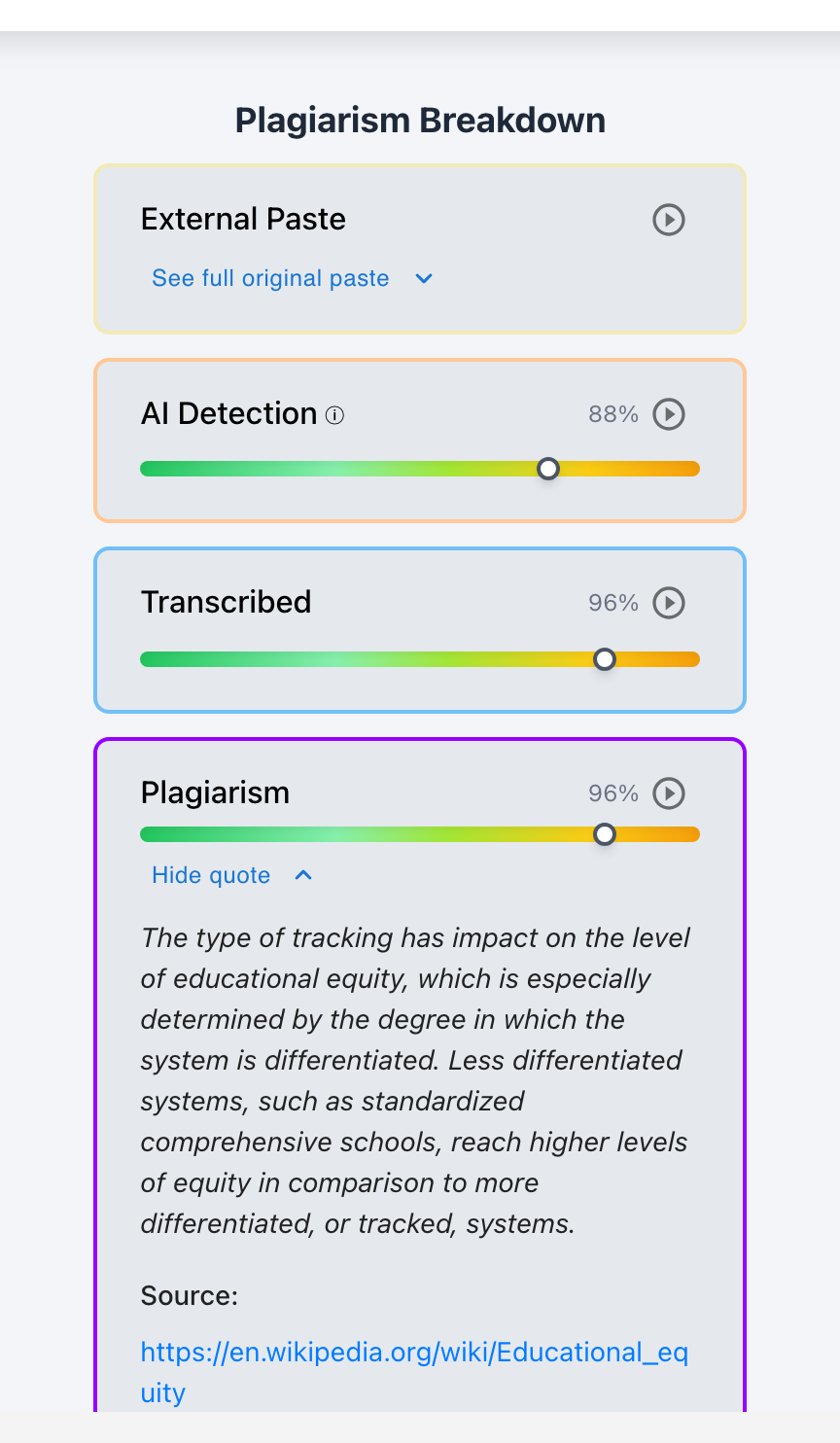
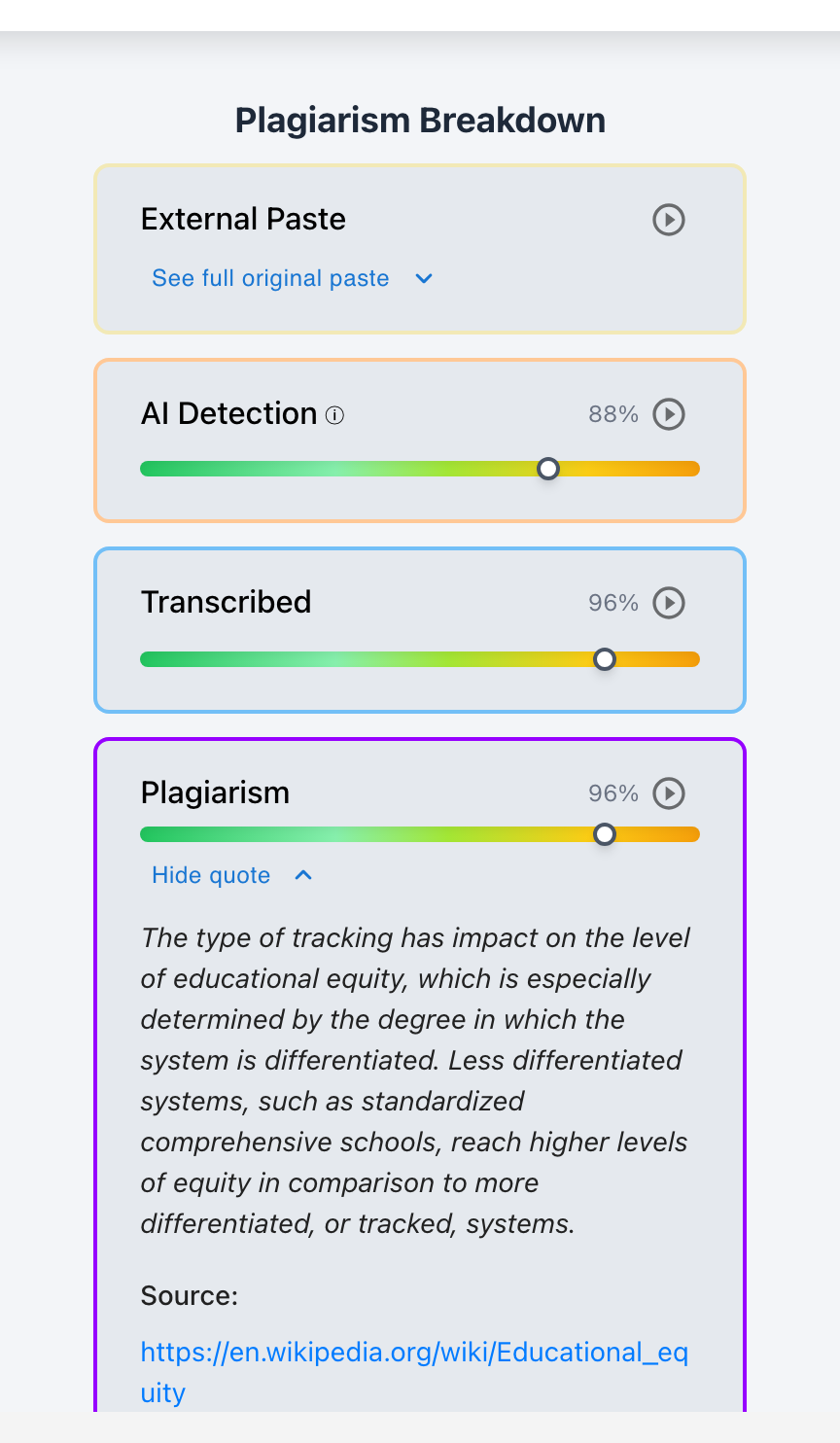
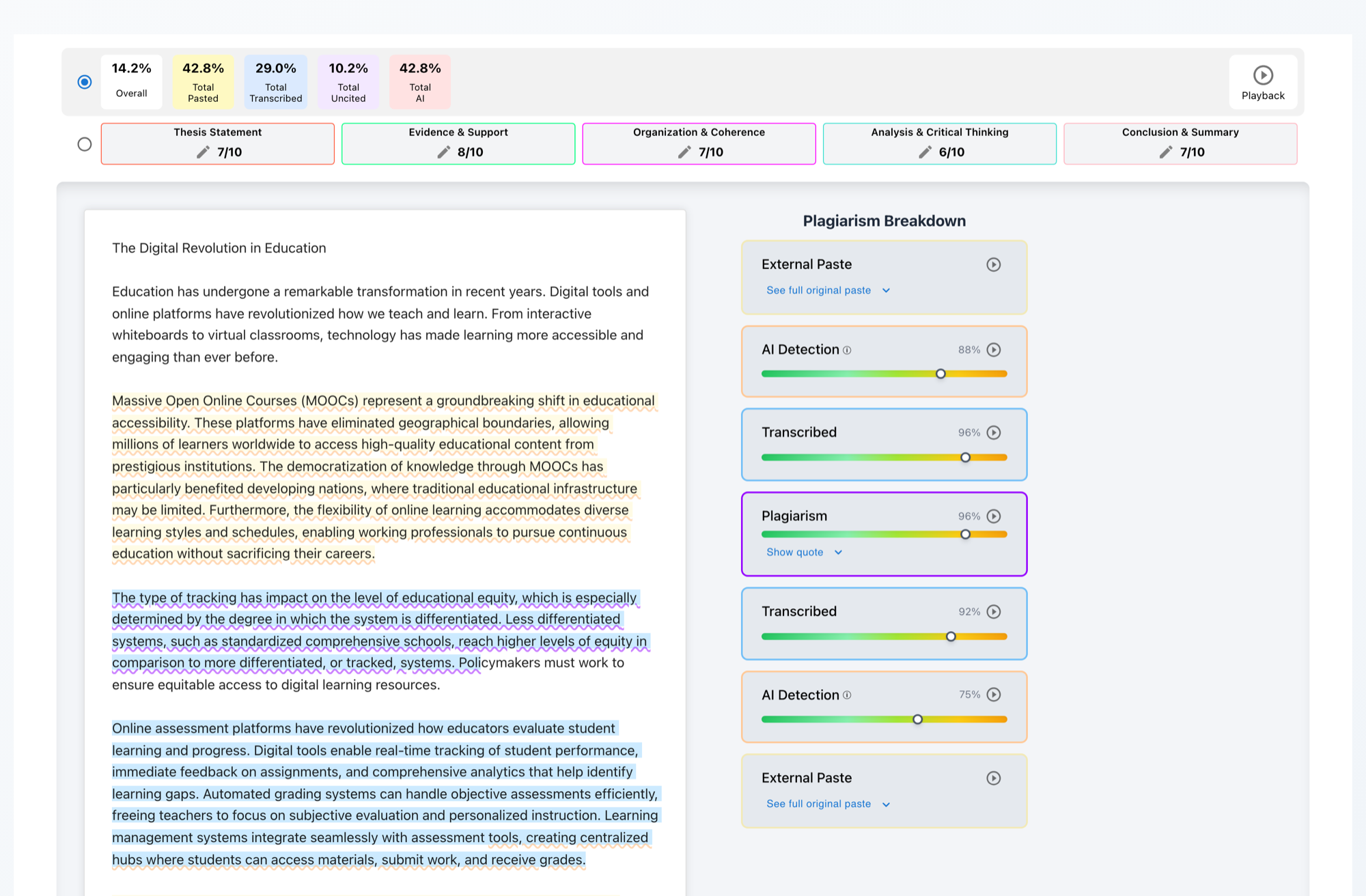
Instead of displaying an opaque percentage number, Checkmark presents a dynamic, two-pane synchronized workstation that lines up the student’s manuscript directly against the live, original external source.
According to recent scholarship, the reconstruction period represented an unprecedented, though tragically delicate, experiment in multiracial democracy across the southern states (Author, 2019).
The Four-Badge Textual Classification Typology
Checkmark’s engine analyzes every overlapping character sequence and assigns one of four unambiguous visual badges directly in the sidebar and document margin:
Text is enclosed in valid quotation marks and accompanied by a verified parenthetical citation and bibliographic entry. Recognized as rigorous scholarly evidence.
Text closely matches source syntax or vocabulary and includes an author citation, but lacks quotation marks. Signals student cognitive scaffolding rather than fraud.
Text matches an external web page, journal, or book with zero citation or author attribution anywhere in the manuscript. Requires keystroke timeline review.
Text matches another student submission within the school, district, or LMS course section. Highlighted securely without exposing student PII or external training.
Deep Live Web URL Resolution & Private District Repositories
Legacy plagiarism tools frequently display broken links, dead URLs, or generic top-level domains (e.g., wikipedia.org without the specific article path). Checkmark solves this through an advanced multi-index crawler:
- Live Dynamic URL Resolution: Checkmark crawls billions of active web pages, digital encyclopedias, open-access scholarly repositories (DOAJ, PubMed, arXiv), and news archives, resolving the exact deep link and highlighting the matched paragraph in its original web context.
- Side-by-Side HTML / PDF Rendering: For digital journal articles and scanned PDF sources, Checkmark renders the original source page layout in the right-hand pane, allowing the teacher to see surrounding context, graphs, and original footnotes.
- Private District Repositories with Zero Public Exposure: Student submissions are indexed exclusively in a siloed, encrypted district repository. When a purple Peer Cohort Match is identified, the teacher sees the matched section across class rosters without ever exposing student work to external AI training models or public databases.
5. Multi-Dimensional Evidence: Integrating Keystroke Playback, AI Detection, and Rubric Grading
A side-by-side text viewer provides spatial evidence: what does the text look like right now compared to the source? However, fully adjudicating accidental patchwriting versus deceptive fraud requires temporal and behavioral evidence: how was this text brought into existence over time?
Checkmark Plagiarism delivers this full-picture proof through its patent-pending Essay Playback™, passage-level AI detection, and rubric autograding.
Side-by-Side Engine
Synchronized two-pane alignment, 4 citation badges, live URLs, and verbatim matching.
Essay Playback™
Keystroke replay, 1x–8x scrubber, paste buffer text cache, and typing cadence telemetry.
Passage-Level AI
Sentence-level confidence sliders, perplexity scans, <150w N/A guardrails, and educator-only flags.
Rubric Autograder
Criterion-level scoring, quote-anchored justifications, teacher authority, and LMS passback.
Patent-Pending Essay Playback™: Keystroke Dynamics & Paste Telemetry
Checkmark’s Essay Playback™ reconstructs the student’s entire composing session keystroke-by-keystroke. Educators can scrub through the drafting timeline like a video at 1x, 2x, 4x, or 8x speed, observing how ideas developed in real time.
Outline Created
Drafting Para 1
Research Pause
External Paste
Revision & Polish
(Smith, 2020).1. External Paste Detection with 100% Text Preservation
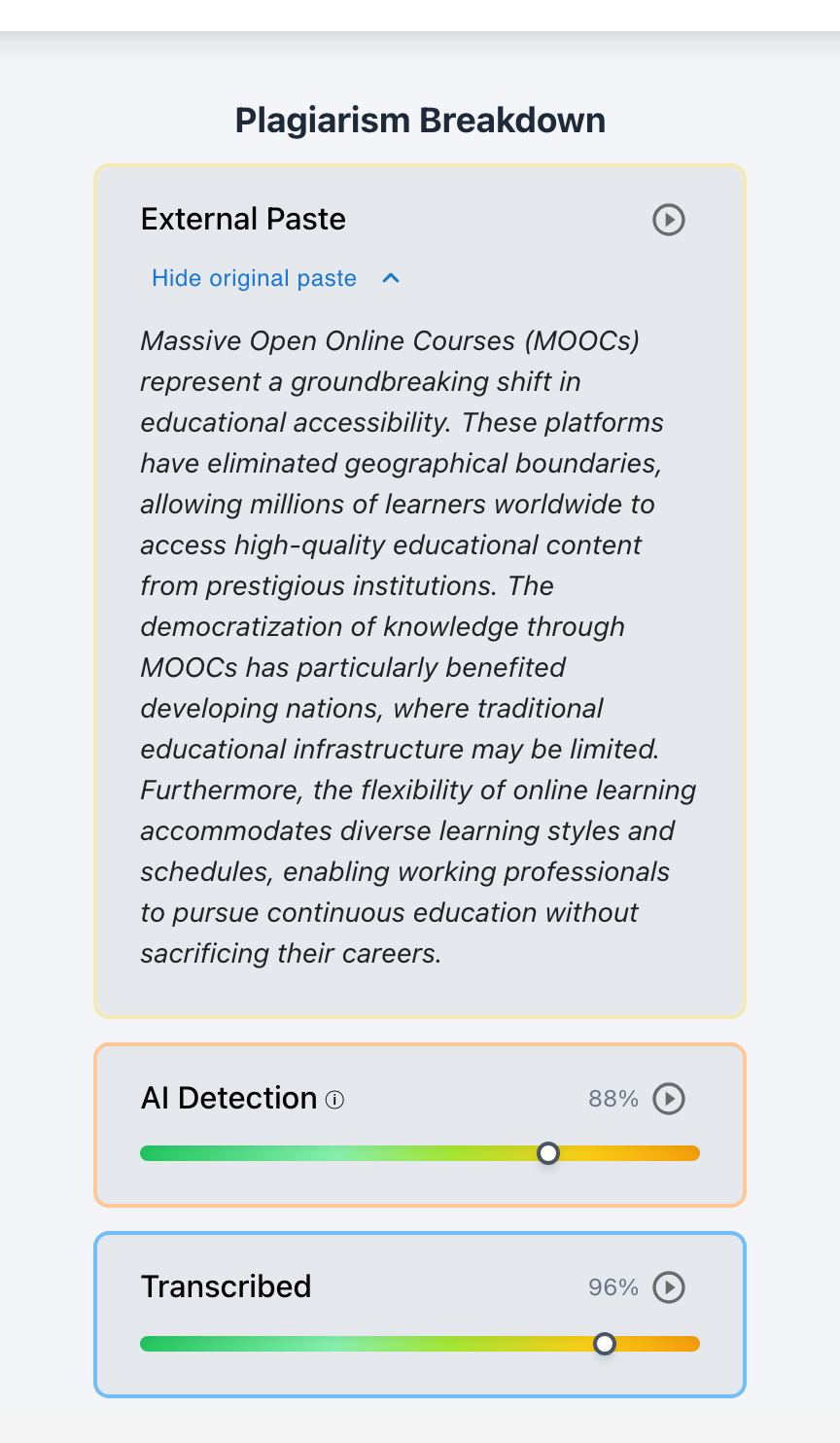
When a student copies text from a website or document and pastes it into their essay, Checkmark captures the event immediately:
- Timestamp & Character Count: Logs the exact millisecond and character length of the paste.
- 100% Original Clipboard Preservation: Checkmark records and stores the full raw text that was pasted—even if the student subsequently deletes, rewrites, or modifies every single word over the next two hours.
- Jump-to-Playback Button: Clicking the paste event in the audit log jumps the video timeline directly to the moment of insertion.
2. Transcription Detection (Second-Screen Typing)
Students attempting to circumvent paste detection sometimes open a phone, tablet, or secondary monitor and manually retype text word-for-word. Essay Playback™ exposes manual transcription through typing cadence telemetry:
Characterized by burstiness: rapid typing of 4–8 words, followed by 3–15 second pauses (cognitive processing), backspaces, cursor relocations, and syntactic deletions.
Characterized by an unnatural, steady, robotic cadence without cognitive pauses, zero developmental deletions, and linear left-to-right sentence construction while reading off a secondary device.
6. Illustrative Case Studies: Adjudicating Textual Overlap in the Classroom
To illustrate how side-by-side source viewers and multi-factor evidence resolve common academic dilemmas, let us examine three illustrative classroom scenarios.
| Case Study | Raw Legacy Score | Checkmark Multi-Factor Findings | Final Pedagogical Outcome |
|---|---|---|---|
| 1. AP US History (Secondary) | 42% Similarity (Triggered Auto-Fail) | Amber Badge (Cited but Unquoted) + 75-minute Playback natural drafting history. | Formative citation coaching; full credit awarded on revised draft. |
| 2. College First-Year Composition | 28% Similarity (Accused of Cheating) | Paste Buffer showed raw academic abstract + 22m active synonym editing & citation. | Targeted synthesis workshop; student rewritten draft validated. |
| 3. 12th Grade AP Biology Lab | 9% Similarity (Passed Undetected) | Red Badge + Steady transcription telemetry with zero backspaces or cognitive pauses. | Restorative conference; honest admission and guided rewrite. |
Context: An 11th-grade student submitted a 2,200-word research paper on The Reconstruction Amendments and the Struggle for Civil Rights.
Legacy Alert: A legacy checker returned an alarming 42% Similarity Score, triggering an automatic misconduct flag in Canvas LMS.
Checkmark Side-by-Side Analysis:
- Source Inspection: 30% of the matching text consisted of properly attributed primary source block quotes from the 14th Amendment and Congressional Globe (flagged with Green Quoted Badges).
- The Flagged Section: A 120-word paragraph discussing a cited historian showed an Amber Badge (Cited but Unquoted). The student wrote: “The reconstruction era was an unprecedented, though tragically delicate, experiment in multiracial democracy across the southern states (Author, 2019).” Live source pane showed the original sentence from the cited text (an illustrative example): “Reconstruction was an unprecedented, though tragically fragile, experiment in interracial democracy across the American South.”
- Essay Playback™ Telemetry: Scrubbing through the 75-minute timeline showed the student typed this sentence manually over 14 minutes, pausing frequently, consulting notes, and carefully adding
(Author, 2019).
Context: A freshman composition student submitted a literature review on Adolescent Mental Health and Social Media Algorithms.
Legacy Alert: The submission returned a 28% Similarity Score. The instructor suspected the student copied sections from online psychology blogs.
Checkmark Side-by-Side Analysis:
- Source Resolution: Checkmark resolved the deep URL to an open-access journal article with 78% syntactic overlap.
- External Paste Buffer: At minute 18:42, the student pasted a 310-character block directly from the journal abstract.
- Revision Telemetry: Over the next 22 minutes, the playback video showed the student reading the pasted text, using right-click synonyms, deleting two subordinate clauses, and adding
(Author et al., 2021).
Context: A senior submitted a formal laboratory report on Enzyme Kinetics and Catalase Degradation Under Variable pH Conditions.
Legacy Alert: The legacy checker showed a low 9% Similarity Score, passing well below the district threshold.
Checkmark Side-by-Side Analysis:
- Source Resolution: Checkmark flagged a single 90-word paragraph with a Red Badge (Uncited External Match) matching an uncited commercial lab supplier protocol.
- Essay Playback™ Telemetry: Playback revealed zero paste events, but the typing telemetry showed a completely flat, robotic typing speed: 65 WPM for 90 seconds straight, with zero backspaces, zero pauses, and zero cursor movements.
- Diagnosis: The student propped a smartphone next to their laptop keyboard and manually transcribed the supplier’s background section word-for-word.
7. The 4-Phase Restorative Citation Adjudication Protocol
To operationalize these insights across entire schools and departments, institutions should implement Checkmark’s 4-Phase Restorative Citation Adjudication Protocol. This framework replaces adversarial accusations with transparent, evidence-based instructional conferences.
- Examine Side-by-Side Source View (Check Green, Amber, Red, Purple Badges)
- Review Essay Playback™ (Inspect Paste Buffers & Typing Cadence)
- Check Passage-Level AI Sliders (<150w N/A Guardrails)
- Open Checkmark report collaboratively with the student
- “Walk me through how you integrated this source at minute 24:00”
- Distinguish developmental scaffolding from deliberate deception
- Complete 3-step summarizing drill (Close source, synthesize, verify)
- Correct quotation mark punctuation vs. parenthetical citations
- Resubmit draft through Checkmark for instant verification
- Autograder verifies resolved citation badges
- Teacher approves finalized rubric score and feedback commentary
- One-click grade passback to Canvas, Buzz, or Google Classroom
8. Institutional Policy & Syllabus Templates for K-12 and Higher Education
To protect both students and educators, academic institutions should codify clear distinctions between developmental patchwriting and intentional academic fraud in their syllabi and departmental handbooks.
Secondary / High School AP Syllabus Policy Template
In this course, we believe that learning to research and write is an evolving craft. Our goal is: “Stop guessing, start trusting.”
- Authentic Drafting & Process Telemetry: All major essays will be composed using our integrated writing tools with Checkmark Plagiarism. Checkmark records keystroke playback, revision timelines, and citation alignment to celebrate your authentic writing journey.
- Understanding Patchwriting vs. Plagiarism:
- Legitimate Paraphrasing: Stating another author’s ideas entirely in your own original sentence structure and vocabulary, accompanied by proper citation.
- Developmental Patchwriting (Learning Opportunity): Relying too closely on an author’s sentence structure or swapping isolated synonyms. If patchwriting is identified, you will participate in a restorative writing conference and be permitted to revise your draft for mastery credit.
- Intentional Fraud (Disciplinary Review): Submitting text copied without citation, purchasing essays, transcribing from secondary screens, or utilizing unauthorized generative AI tools to write your paper.
- Multi-Factor Review: No grade penalty will ever be based on an automated percentage score. All integrity reviews are conducted by your teacher using side-by-side evidence, keystroke playback, and personalized writing conferences.
College / University Writing Program Integrity Statement
Scholarly writing requires transparent engagement with the academic community. This department distinguishes between mechanical citation errors / developmental patchwriting and deliberate academic dishonesty.
- Developmental Patchwriting: As established by the Citation Project and writing research, novice scholars frequently mimic source syntax while learning disciplinary discourse. Patchwriting with bibliographic attribution is adjudicated as an instructional writing issue governed by rubric criteria under “Source Synthesis,” rather than an immediate honor code violation.
- Adjudication Standards: Faculty in this department utilize Checkmark Plagiarism’s multidimensional integrity reports—including side-by-side source alignment, Essay Playback™ keystroke dynamics, and passage-level analysis. Disciplinary referrals to the Academic Integrity Board require verifiable process-level evidence of intentional deception (e.g., deliberate uncredited copying, contract cheating, or unacknowledged generative AI authorship).
9. Comprehensive Comparison: Legacy Scanners vs. Checkmark Plagiarism
| Evaluation Dimension | Legacy Plagiarism Checker | Checkmark Plagiarism Engine | Pedagogical Advantage |
|---|---|---|---|
| Output Metric | Single aggregate percentage (e.g., “34% Similarity”). | Multidimensional report with 4 discrete citation badges & side-by-side source text. | Eliminates false alarms caused by cited quotes and bibliographies. |
| Patchwriting Adjudication | Flags patchwriting identically to intentional fraud. | Amber Badges distinguish cited patchwriting from uncited theft; side-by-side shows syntax mimicry. | Enables restorative coaching instead of punitive tribunals. |
| Source URL Resolution | Broken links, expired domain redirects, or generic top-level domains. | Deep live URL resolution, digital journal DOI linking, and side-by-side source rendering. | Teachers verify source context in seconds without manual web searching. |
| Drafting Process Evidence | None. Only analyzes final static PDF or Word file. | Patent-pending Essay Playback™ (1x–8x scrubbable video, keystroke dynamics, typing bursts). | Exonerates honest students falsely accused by generic scanners. |
| Paste Tracking | Binary “paste detected” flag with no preserved history. | Captures 100% of pasted clipboard text and preserves it even after student edits or rewrites it. | Captures exact provenance of external text insertions. |
| AI Writing Detection | Opaque whole-paper percentage (e.g., “72% AI”) prone to false positives on ESL writers. | Passage-level sentence underlining with calibrated confidence sliders and <150w N/A guardrails. | Surgical precision; protects non-native English writers. |
| Rubric Integration | Disconnected from grading rubrics; manual score entry. | AI Rubric Autograder with quote-anchored feedback and LMS passback (Canvas, Buzz, Classroom). | Accelerates grading while maintaining teacher final authority. |
| Student Data Privacy | Scrapes student submissions to train commercial AI models. | Zero model training on student work. FERPA & COPPA compliant private district repositories. | Protects student intellectual property and institutional privacy. |
10. Frequently Asked Questions (FAQs)
1. What is the fundamental difference between developmental patchwriting and intentional plagiarism?
Developmental patchwriting occurs when a student attempts to engage with difficult source material but lacks the specialized academic vocabulary to fully rephrase the concept in their own voice. They swap select words for synonyms while retaining the source’s grammatical structure, often including an author citation or bibliography entry. Intentional plagiarism involves deliberate deception—such as copying entire uncredited sections, stitching together text from multiple blogs while concealing sources, purchasing papers, or submitting AI-generated drafts under false claims of authorship.
2. Why do aggregate similarity percentages (like 34%) fail educators when evaluating research papers?
Aggregate similarity percentages merely calculate the mathematical ratio of matching character sequences divided by total document length. They lump together properly cited block quotes, disciplinary terminology, assignment prompt headers, Works Cited entries, developmental patchwriting, and deliberate copy-pasting into a single number. An essay with 12 properly cited historical quotations can easily trigger a 35% similarity score, leading to unfair accusations against diligent researchers.
3. How does Checkmark’s Side-by-Side Source Viewer help teachers adjudicate source overlap in seconds?
Checkmark displays the student’s essay on the left and the live, resolved external source on the right, highlighting exact verbatim strings and paraphrased structures side-by-side. Each match is tagged with one of four clear visual badges: Quoted & Cited (Green), Cited but Unquoted (Amber), Uncited External Match (Red), or Peer Cohort Match (Purple). Clicking any highlight jumps directly to the matching passage in both panes, allowing teachers to evaluate context and attribution instantly.
4. How does Essay Playback™ prove whether a student engaged in developmental patchwriting or deliberate evasion?
Essay Playback™ reconstructs the entire composing session keystroke-by-keystroke. If a student pasted a paragraph from an academic abstract and then spent 20 minutes editing words and adding an author citation, Essay Playback™ records the exact timestamp, preserves the raw pasted text, and reveals the student’s authentic developmental effort. Conversely, if a student typed an uncredited source word-for-word from a second screen without pauses or revisions, typing telemetry proves manual transcription.
5. Why do traditional similarity checkers and AI detectors disproportionately flag English Language Learners (ELL)?
English Language Learners frequently rely on formulaic syntactic frames, standard transitional phrases, and direct vocabulary scaffolding from authoritative sources to express complex ideas. Legacy similarity tools flag these common academic structures as copied text, while black-box AI detectors misinterpret the predictable grammatical patterns of non-native writers as machine-generated text. Checkmark’s passage-level confidence sliders and keystroke playback protect ELL students from false accusations.
6. Can students bypass Checkmark by rewriting pasted text or using synonym humanizers?
No. While paraphrasing tools (e.g., QuillBot) and synonym spinners manipulate surface words to evade legacy keyword matching, Checkmark captures external clipboard insertions the instant they occur. Checkmark preserves 100% of the original pasted text in its audit cache, even if the student rewrites every single word. Furthermore, Essay Playback™ exposes the absence of natural composing pauses, revisions, and typing burstiness.
7. How does Checkmark’s AI Rubric Autograder connect academic integrity to classroom grading?
Checkmark’s Rubric Autograder evaluates essays against custom or LMS-synced rubrics (Canvas LMS, Buzz LMS, Google Classroom), generating criterion-by-criterion score suggestions and quote-anchored justifications tied directly to student prose. If a student exhibits patchwriting, the autograder suggests targeted feedback under “Source Synthesis & Citation” while preserving teacher final authority to edit grades before one-click LMS gradebook passback.
11. Conclusion: Shifting Academic Integrity from Punitive Policing to Evidence-Backed Growth
The ultimate goal of academic integrity technology is not to catch students in traps or automate disciplinary referrals. It is to foster authentic writing, protect honest scholars, and give educators the transparent tools they need to teach.
When school districts and universities rely on blunt aggregate percentages, they create a culture of anxiety, criminalize the natural developmental stages of writing, and alienate the very students who need the most instructional support.
By pairing Side-by-Side Source Verification with Patent-Pending Essay Playback™, Passage-Level AI Detection, and Teacher-in-the-Loop Rubric Autograding, Checkmark Plagiarism delivers a comprehensive, multi-dimensional integrity ecosystem.
Educators no longer have to guess what an ambiguous percentage means. With Checkmark, teachers have the clear, defensible evidence they need to celebrate authentic student effort, guide novice researchers through citation mechanics, and uphold uncompromising academic standards.
Stop Guessing. Start Trusting.
Equip your faculty with patent-pending Essay Playback™, synchronized side-by-side source verification, and teacher-in-the-loop rubric autograding designed for Canvas LMS, Buzz LMS, and Google Classroom.