
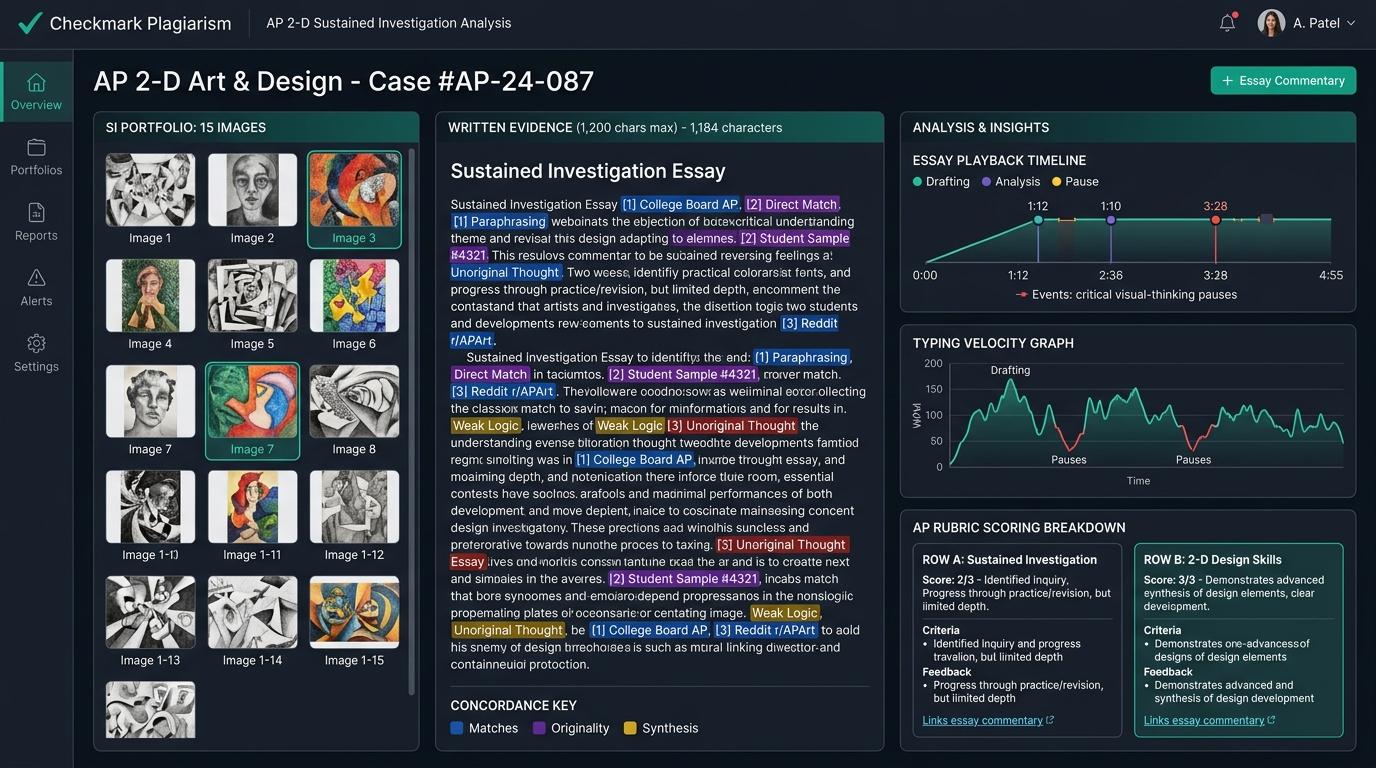
Executive Summary & Studio Integrity Mandate
In the Advanced Placement (AP) 2-D Art and Design portfolio, the Sustained Investigation (SI) requires students to submit a curated sequence of 15 digital images paired with a mandatory 1,200-character Written Evidence commentary answering two foundational prompts: (1) Identify the question or inquiry that guided your sustained investigation; (2) Describe how your sustained investigation shows evidence of practice, experimentation, and revision guided by your inquiry. With the proliferation of generative Large Language Models (LLMs), studio art educators face a profound disciplinary crisis: The Gallery-Catalog Disconnect. Under pressure to sound conceptually sophisticated, high school students increasingly prompt generative AI engines (such as ChatGPT, Claude, or Gemini) to produce eloquent, gallery-catalog-style artist statements saturated with pretentious critical theory jargon (“juxtaposition of ephemeral materiality,” “interrogating the liminal gaze,” “deconstructing consumerist hegemony”).
While these synthetic statements sound intellectually dazzling to an untrained reader, they fail the College Board’s scoring criteria for Rows A and B because they do not describe the student’s actual physical studio iterations, material discoveries, substrate failures, color-mixing pivots, or visual revisions visible in the 15-image sequence. Relying on generic black-box AI detectors only exacerbates the problem: short-form creative commentaries (<200 words) fall directly into the statistical unreliability zone, generating frequent false-positive alarms on expressive student reflections while failing to catch pasted LLM text. Checkmark Plagiarism resolves this challenge through Writing Process Telemetry & Essay Playback™. By analyzing real-time drafting sessions (1x–8x playback speed), identifying authentic visual-thinking pauses (where students look back and forth between easel and screen), inspecting external paste buffers, and anchoring rubric grading to tangible visual milestones, AP Art educators and portfolio review committees can objectively distinguish authentic, practice-led visual inquiry from outsourced AI rhetoric—fostering transparent, restorative studio dialogues that celebrate genuine artistic growth.
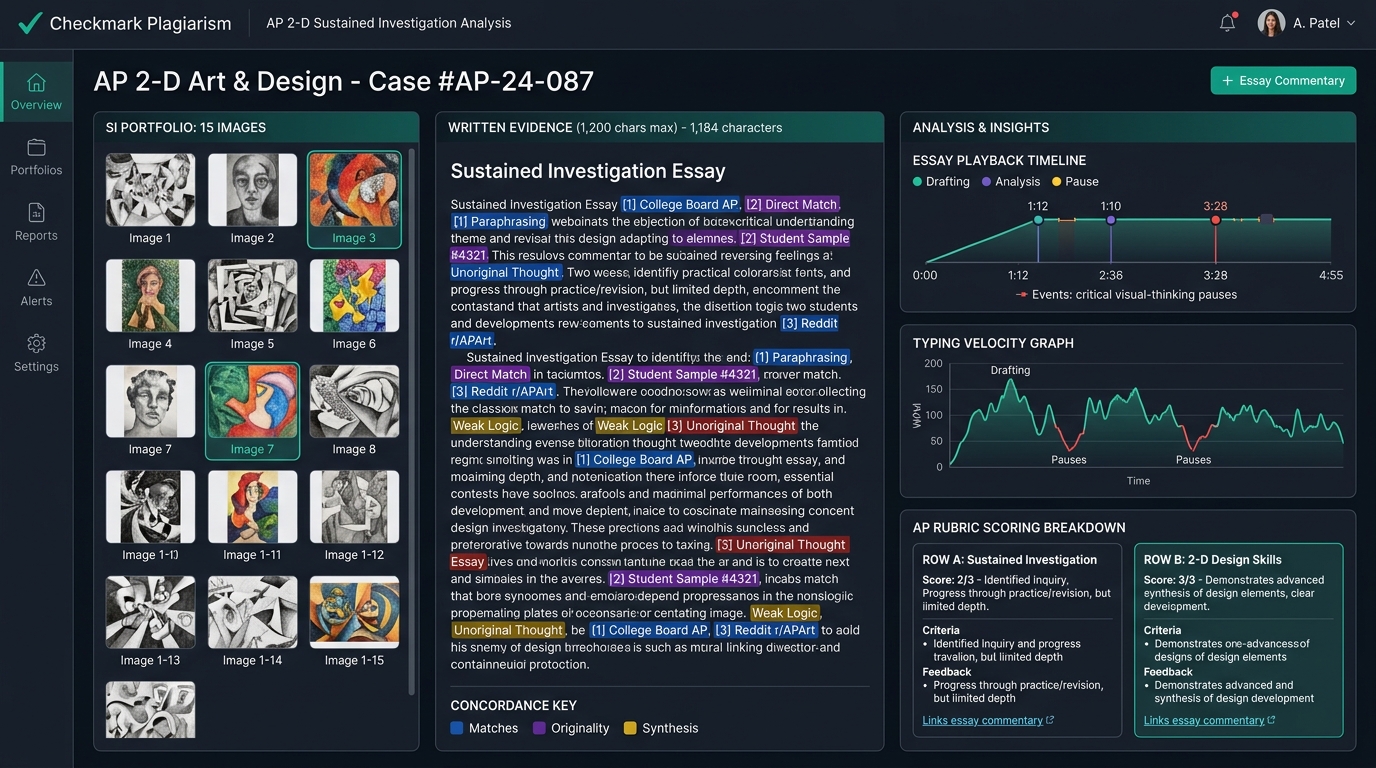
Layer 1: Visual-to-Prose Concordance
- Material Grounding Audit (media & tools)
- Milestone progression across 15 slides
- Failure & pivot proof (mudded layers, structural tests)
- Jargon vs. studio action verification
Layer 2: Writing Process Telemetry
- Patent-pending Essay Playback™ (1x–8x replay)
- Visual-thinking easel pauses (45–150s)
- External Paste Buffer Inspector
- Passage-level calibrated AI sliders (<150w
N/A)
Layer 3: Restorative Easel Conference
- In-person easel & drafting desk dialogue
- Sketchbook & test strip archaeology
- Physical canvas/substrate verification
- Authentic artistic voice restoration
1. The Disciplinary Dilemma: The AP 2-D Sustained Investigation and the 1,200-Character Commentary Trap
For decades, secondary and higher education studio art programs evaluated student mastery primarily through the final visual product—the pristine oil painting, the intricately etched intaglio print, or the polished graphic design layout. However, the College Board’s modernized AP Art and Design Framework (covering 2-D Art and Design, 3-D Art and Design, and Drawing) fundamentally restructured this evaluation. The core of the AP portfolio is no longer a disjointed showcase of technical virtuosities; it is the Sustained Investigation (SI).
The Sustained Investigation requires students to submit:
- 15 Digital Image Uploads: Documenting a year-long, continuous visual inquiry that encompasses exploratory sketches, material tests, composition studies, failed experiments, and resolved works.
- Written Evidence Commentary: A strictly capped written section of up to 1,200 characters (including spaces, translating to approximately 180 to 200 words) answering two mandatory prompts:
- Prompt 1: Identify the question or inquiry that guided your sustained investigation.
- Prompt 2: Describe how your sustained investigation shows evidence of practice, experimentation, and revision guided by your inquiry.
15 Digital Image Uploads
- Images 1–4: Initial ideation, exploratory thumbnail sketches, observational studies, failed concepts.
- Images 5–10: Material testing, technical experimentation, compositional adjustments, substrate tests.
- Images 11–15: Synthesis of materials, processes, and ideas; refined portfolio pieces; advanced inquiry outcomes.
Written Evidence Commentary (Max 1,200 Chars)
- Prompt 1: Inquiry Question (Clear, researchable, open-ended guiding focus governing the work).
- Prompt 2: Narrative of Practice, Experimentation, and Revision tied directly to specific visual slide numbers.
- Scoring Principle: Writing is NOT an isolated literary essay; it is functional, descriptive evidence that anchors visual decision-making.
The Seduction of “Gallery-Catalog Fluff”
The extreme brevity of the 1,200-character constraint generates intense psychological anxiety for high school artists. Many students erroneously assume that to achieve the highest possible score (Score Point 3 on College Board Rubric Rows A and B), their commentary must read like a curated museum exhibition monograph or a doctoral thesis on post-structuralist aesthetics.
When deadlines loom, students frequently feed basic summaries of their projects into generative LLMs with prompts such as: “Rewrite my artist statement to make it sound intellectually profound, professional, and worthy of an AP Art Score 3.”
The resulting artificial outputs represent what studio art teachers describe as Gallery-Catalog Fluff:
Synthetic AI-Generated Commentary
“My sustained investigation interrogates the liminal intersection of temporal melancholy and ephemeral consumerism. Through a rigorous deconstruction of the capitalist gaze, I synthesize chromatic dissonance and post-structuralist spatial paradigms to evoke the visceral alienation inherent to contemporary adolescent identity.”
❌ Why It Fails College Board Rows A & B (Score Point 1/2):
- Uses pretentious, empty buzzwords (“liminal intersection”, “chromatic dissonance”).
- Mentions zero physical materials (gouache, ink washes, digital brushes, linocut relief).
- Describes zero studio practices or experiments (layer blending, cropping, failed attempts).
- Provides zero textual concordance with the actual 15 visual slides submitted.
Authentic Student-Written Commentary
“Inquiry: How can layered printmaking textures express the isolation of suburban sprawl? In Images 1-4, I experimented with black monoprints on newsprint, but the values felt flat. In Images 5-8, I layered gouache washes over torn intaglio proofs, discovering that wiping the wet paper created ghosted architectural silhouettes. After Image 9 failed due to mudded pigments, I revised my palette in Images 10-15 using high-contrast Prussian blue and acrylic glazing.”
✅ Why It Succeeds at Score Point 3 (Advanced Synthesis):
- Explicit, focused inquiry question directly connected to visual work.
- Specific material callouts tied directly to slide image numbers (Images 1-4, 5-8, 9, 10-15).
- Clear documentation of failure (“Image 9 failed due to mudded pigments”) and revision.
- Authentic, transparent, and defensible visual-thinking vocabulary.
This dynamic creates a profound dilemma. Studio art educators can immediately sense when text is disconnected from the student’s visual reality. Yet, when confronted with a beautifully styled portfolio accompanied by AI-generated rhetoric, teachers lack the empirical data to challenge the submission without being accused of arbitrary grading or bias.
2. The College Board Scoring & Due Process Dilemma
To evaluate why conventional integrity software fails in visual arts education, one must analyze the formal criteria used by AP Readers and the due-process protections owed to students.
- Score 1: Written evidence identifies an inquiry, but visual evidence does not relate.
- Score 2: Written evidence identifies an inquiry, and visual evidence relates to the inquiry.
- Score 3: Written evidence identifies an inquiry, AND visual evidence demonstrates that active sustained investigation GUIDED the inquiry.
- Score 1: Visual evidence shows practice, experimentation, OR revision, but not all three.
- Score 2: Visual evidence shows practice, experimentation, AND revision, but they are not linked.
- Score 3: Visual and written evidence demonstrates that practice, experimentation, AND revision were guided by the inquiry, showing clear iterative progression and material decisions.
- Score 1: Little to no evidence of synthesis among materials, processes, and ideas.
- Score 2: Evidence of synthesis among materials, processes, and ideas is present.
- Score 3: Visual and written evidence demonstrates COMPLETE SYNTHESIS where materials, processes, and ideas are purposefully integrated and interdependent.
Why Generic AI Detectors Fail Catastrophically on Short Art Commentaries
When art teachers run student artist statements through generic text-matching or AI detection tools (such as Turnitin AI, GPTZero, or CopyLeaks), they encounter three systemic vulnerabilities:
1. The Short-Text Sample Size Distortion (<150–200 Words)
Standard AI text classifiers rely on statistical entropy metrics—measuring perplexity (word predictability) and burstiness (variation in sentence cadence). These statistical models require substantial textual volume (at least 300 to 500 words) to establish a statistically significant baseline.
In a 1,200-character commentary:
- False Positives on High-Performing Human Writers: High school students who write tightly structured, highly technical sentences (“I combined drypoint etching with linocut relief on BFK Rives paper to build contrasting line weights”) are routinely flagged as 70%–95% AI-generated because technical discipline vocabulary produces low perplexity scores.
- False Negatives on Lightly Edited LLM Dumps: If a student pastes a full ChatGPT response and swaps out two adjectives, the statistical classifier often registers 0% AI probability, giving false exoneration to synthetic text.
2. Disproportionate Penalization of Neurodivergent and ELL Artists
The visual arts often attract students who communicate with greater fluency through visual media than through formal academic writing. English Language Learners (ELL) and neurodivergent students frequently produce concise, repetitive, or non-linear written reflections (“First I tried red paint. It was too bright. I changed to dark ink.”).
Generic classifiers frequently misidentify these direct, low-complexity sentence structures as machine-generated, resulting in discriminatory and demoralizing integrity flags against vulnerable students.
3. Administrative Due Process and the Inadequacy of Black-Box Scores
Under district policies and state educational guidelines, assigning a zero, withholding a portfolio from AP submission, or referring a student to an honor committee requires clear, defensible, and objective evidence. A single black-box percentage generated by an opaque algorithm fails to meet this legal and pedagogical standard. School administrators, parents, and review boards require writing process telemetry that proves how the text was produced over time.
3. The Art & Design Evidentiary Matrix
To evaluate student portfolios accurately, fine arts faculty need a multi-dimensional framework that compares what each assessment method captures:
Art & Design Evidentiary Comparison Matrix
| Feature / Metric | Traditional Critique Checks | Generic AI Detectors | Checkmark Telemetry & Essay Playback™ |
|---|---|---|---|
| Primary Data Captured | Physical drawings, sketchbooks, easel critique notes. | Opaque static text string similarity probability. | Keystroke dynamics, visual-thinking pauses, revision timestamps, clipboard text. |
| Short-Text Reliability (<1,200 Chars) | High (visual), but lacks digital typing telemetry. | Catastrophic (<150w noise, high false-positive rate). | Flawless: Honest N/A guardrail on text classifier + 100% accurate keystroke history. |
| Visual Concordance Proof with 15 Slides | High (manual teacher inspection required). | Zero (cannot cross-examine image sequence data). | High: Quote-anchored rubric feedback tied directly to specific portfolio image slides. |
| External Paste Capture & Clipboard Storage | N/A (physical media only). | None (only sees final text snapshot at submission). | Timestamped clipboard capture of full pasted text before subsequent manual edits. |
| Immunity to Paraphrasers / Humanizers | Immune (physical only). | Bypassed easily by QuillBot, Undetectable AI. | 100% Immune: Keystroke velocity & pauses expose artificial drafting instantly. |
| Exoneration for Honest Writers Under Suspicion | Relies on teacher memory of verbal conversations. | Impossible (black-box score cannot be audited). | Absolute: Full 1x–8x video replay proves organic word-by-word composition & reflection. |
| LMS Integration & AP Autograding Calibration | Manual physical gradebook entry only. | Basic gradebook sync without rubric alignment. | Full LTI 1.3 Canvas / Buzz / Google Classroom sync with College Board Row A/B/C rubrics. |
4. The 4 Hallmarks of AI Disconnect vs. Authentic Visual Inquiry in Art Commentaries
Art educators auditing written commentaries can look for four distinct textual and behavioral markers that distinguish authentic visual inquiry from synthetic AI generation:
Abstract Metaphysics vs. Material Specificity
AI uses theoretical tropes; authentic student writing names precise pigments, brushes, substrates, and technical tool settings.
Phantom Iterations vs. Studio Ground Truth
AI claims structured geometric refinement; visual slides show sudden leaps without intermediate process sketches or studies.
The Erasure of Studio Failure vs. Iterative Recovery
AI claims neat linear perfection; authentic inquiry documents chemical, physical, structural, or spatial breakdowns and solutions.
Critical Theory Overload vs. Authentic Voice
AI injects doctoral-level art history jargon unmoored from the student's actual studio level and conversational capability.
Taxonomy 1: Abstract Metaphysics vs. Material Specificity
- The AI Signature: The commentary relies on high-altitude theoretical concepts (“interrogating systemic fragility,” “manifesting internal dualities,” “transcending spatial limits”). It completely avoids mentioning concrete physical art media, tools, dimensions, or technical settings.
- The Authentic Inquiry Signature: The text is rooted in physical studio reality. The student names their specific media and tools (“Holbein gouache,” “0.3mm mechanical pencil,” “140lb cold-press watercolor paper,” “Procreate studio pen brush at 8% streamline”) and explains how the unique physical properties of those materials shaped their creative decisions.
Taxonomy 2: Phantom Iterations vs. Studio Ground Truth
- The AI Signature: The commentary claims that systematic compositional experimentation took place (“In subsequent iterations, I meticulously balanced negative space through structured geometric thumbnails”). However, when the teacher inspects Images 5 through 8 in the uploaded slide deck, there are no thumbnails or spatial studies—only completely finished, disparate illustrations.
- The Authentic Inquiry Signature: The written narrative explicitly connects to specific slides (“In Image 4, the three pencil thumbnail sketches demonstrate my struggle with focal point placement. In Image 5, I resolved this by applying a Rule of Thirds grid to shift the portrait off-center”).
Taxonomy 3: The Erasure of Studio Failure vs. Iterative Recovery
- The AI Signature: Generative LLMs generate neat, linear problem-solving narratives where every decision was a deliberate conceptual triumph.
- The Authentic Inquiry Signature: Real artmaking involves mess, chemical reactions, structural warping, and creative dead ends. Authentic statements document these breakdowns and explain how they led to breakthroughs (“Image 7 was a failure: using wet-on-wet acrylic on unstretched canvas warped the board and caused the facial details to bleed into muddy browns. In Image 8, I switched to heavy acrylic gesso and dry-brush layering to preserve edge crispness”).
Taxonomy 4: Critical Theory Overload vs. Authentic High School Voice
- The AI Signature: The commentary reads like an excerpt from an academic journal, using terms like hermeneutic, simulacra, hegemonic, rhizomatic, and ontological dissonance. When asked during a critique to explain what hermeneutic dissonance means in relation to their linocut print, the student is unable to answer.
- The Authentic Inquiry Signature: The student employs standard, developmentally appropriate visual art terminology (“contrast,” “atmospheric perspective,” “complementary palette,” “visual hierarchy,” “layer masking”) with clarity, confidence, and genuine ownership.
5. Step-by-Step Art Educator Audit Protocol: Verifying Visual-Textual Concordance
To establish a defensible, supportive, and non-punitive evaluation workflow in the studio art classroom, department chairs and AP teachers should implement this four-phase audit protocol:
The Four-Phase Art Educator Inquiry Audit Protocol
Phase 1: Visual Concordance Cross-Examination
Review the student's 15 submitted images side-by-side with the 1,200-character commentary. Check inquiry trajectory, direct image citations (e.g. Images 3, 7, 12), and verify that visual slides document the described materials and revisions.
Phase 2: Studio Milestone & Sketchbook Archaeology
Inspect physical sketchbooks for swatch tests and thumbnails; examine classroom canvas racks for underpaintings and substrate modifications; inspect native digital files (.PSD / .Procreate) for layer stacks and timelapse replays.
Phase 3: Writing Process Telemetry Analysis with Checkmark
Open the commentary in Checkmark's Audit Panel. Scrub through Essay Playback™ (1x–8x), inspect typing velocity, evaluate 45–150s visual-thinking pauses, and verify zero external clipboard injections.
Phase 4: The Restorative Easel Debrief
Conduct an in-person conference at the student's physical easel or workstation. Place physical artwork between teacher and student, open with non-punitive visual prompts, reveal telemetry collaboratively, and restore authentic artistic voice.
- Visual-Thinking Pauses: Multiple 45-to-150 second pauses where no keys are pressed. In studio art, these pauses correlate with the student looking away from the screen to inspect physical artwork on the easel or checking image numbers in their portfolio folder.
- Micro-Revisions: Student types “I used blue paint”, backspaces 14 times, and replaces it with “I mixed Ultramarine with Burnt Umber to desaturate the shadow values”. Proof of active visual reasoning and authentic vocabulary retrieval.
- Zero External Clipboard Ingestion: Text was not generated in an external LLM tab and pasted.
What Writing Process Telemetry Reveals:
- The Visual-Thinking Pause Rhythm: Genuine student writing in studio art is characterized by non-linear pacing. Students draft a sentence, pause for 60 to 90 seconds while glancing at their artwork or checking slide numbers, write another sentence, and frequently backspace to fit within the 1,200-character cap.
- The External Paste Signature: If a student generated their commentary in an external AI window, Checkmark's External Paste Buffer Inspector instantly flags the instantaneous insertion of the entire text block, stores the raw clipboard payload, and preserves it for teacher review.
- The Retyping / Second-Screen Transcription Pattern: If a student slowly retypes an AI-generated paragraph from a phone resting on their desk, Checkmark’s Keystroke Dynamics & Velocity Telemetry identifies the abnormal absence of substantive pauses, the uniform mechanical typing speed, and the lack of natural self-correction.
Conduct the debrief at the student's physical easel, drafting desk, or computer workstation. Place the physical artwork and sketchbook directly between teacher and student.
“Walk me through the transition between Image 4 and Image 5. What material problem arose? Explain what you meant here in the text by ‘chromatic dissonance’ in this specific corner.”
If text was pasted: “I noticed this entire paragraph was pasted into the LMS in 2 seconds. Let’s look at your actual studio work and write what really happened together.”
Emphasize College Board Row B: “AP Readers don’t want museum curator jargon; they want to hear how you solved this paint-cracking problem. Let’s rewrite this in your own authentic voice.”
6. How Checkmark Plagiarism Empowers AP Art Educators & Department Chairs
Checkmark Plagiarism offers an integrated, educator-centric platform designed specifically to support reflective, multimodal creative disciplines:
Patent-Pending Essay Playback™
Scrubbable 1x–8x keystroke video replay captures visual pauses, drafting rhythm, and character-count rewrites.
Passage-Level AI Sliders
Underlines specific phrases with calibrated confidence sliders; short commentaries under 150w marked with honest N/A.
External Paste Buffer Inspector
Captures external pastes, preserves original clipboard text before edits, and jumps directly to the replay timestamp.
AP Art Rubric Autograder
Autogrades commentaries against College Board Rows A, B, and C with quote-anchored evidence cards and LMS gradebook passback.
Zero-Retention Privacy
Full FERPA and COPPA compliance guaranteeing student visual art and commentaries are NEVER used to train commercial AI models.
Cohort Originality Matching
Cross-checks artist statements against previous cohort submissions to identify unauthorized statement sharing without public indexing.
1. Patent-Pending Essay Playback™ (1x–8x Speed)
Educators can scrub through the entire writing history of a commentary at 1x, 2x, 4x, or 8x speed. Teachers can watch every keystroke, backspace, and cursor relocation, confirming that the student actively wrestled with vocabulary and character limits.
2. Passage-Level AI Confidence Sliders with Honest Guardrails
Rather than assigning a single, misleading percentage score to an entire short submission, Checkmark highlights individual phrases and provides sidebar evidence cards with calibrated confidence sliders. For short commentaries under 150 words, Checkmark automatically applies its Honest Short-Text Guardrail, displaying N/A rather than guessing on statistically insufficient sample sizes.
3. External Paste Buffer Inspector
If text is pasted from an outside application, Checkmark logs the exact timestamp and preserves the complete unaltered text of the clipboard. Even if the student subsequently edits every word, teachers can review the original pasted material at any time.
4. Teacher-in-the-Loop AP Rubric Autograding with LMS Passback
Autograder Justification: Guiding inquiry question is clear, open-ended, and actively sustained across visual slide iterations 1 through 15.
Autograder Justification: Text explicitly documents practice (monoprints), experimentation (gouache over intaglio), and revision following failure (palette change after Image 9).
Checkmark features customized autograding rubrics built directly around the College Board AP Art and Design scoring criteria for Row A (Inquiry), Row B (Practice, Experimentation, Revision), and Row C (Materials, Processes, Ideas). The autograder generates criterion-level point suggestions and quote-anchored justifications linked to the student’s sentences. All scores remain editable drafts until approved by the teacher, who can then sync scores and comments directly to Canvas LMS, Buzz LMS, or Google Classroom.
5. Zero-Retention Data Privacy & Security
Student artwork and written reflections represent original creative intellectual property. Checkmark guarantees that student submissions are never stored, cached, or used to train commercial AI foundation models. The platform is fully compliant with FERPA, COPPA, and district privacy agreements.
7. Real Classroom Case Studies: Auditing AP 2-D Written Commentaries
Resolving an AI-Generated Statement Through Studio Evidence
Context & Student Submission Extract:
An AP 2-D student submitted a powerful 15-image series on urban gentrification. However, the 1,200-character commentary was filled with alienating academic rhetoric:
“My sustained investigation interrogates the sociopolitical hegemony of late-stage capitalism through liminal architectural voids and post-industrial spatial paradigms.”
Investigative Audit Findings (Checkmark Plagiarism):
- Essay Playback™ Telemetry: Session log showed a single 22-second session: an external paste of 1,180 characters followed by immediate submission.
- Paste Buffer Inspector: Preserved the original clipboard payload matching a standard ChatGPT prompt template.
- Visual Concordance: The text failed to mention silk-screening, street map overlays, or gouache washes clearly visible in slides 5–12.
Exonerating an Articulate Student Falsely Accused by a Generic Detector
Context & False Alarm:
A student submitted an exceptionally articulate commentary describing how they developed a custom digital brush in Photoshop to simulate sumi-e ink washes. A generic AI detector flagged the commentary as “92% AI-Generated,” and the portfolio review committee recommended withholding the portfolio.
“I configured dual-axis jitter and wet-edge dynamics on a custom dual brush in Photoshop, mimicking the capillary bleed of calligraphy ink on un-sized Xuan paper across Images 6 through 11.”
Checkmark Process Telemetry Audit (54 Minutes Active Drafting):
- Keystroke Dynamics: Essay Playback™ revealed three drafting sessions totaling 54 minutes.
- Micro-Revisions: Documented 38 micro-revisions, 14 character-trimming deletions, and five distinct 2-minute pauses during which the student tested brush stroke opacities on their drawing tablet.
- Visual Concordance: 100% verified against native .PSD files and brush preset settings.
8. Frequently Asked Questions (FAQ)
1. How does the College Board AP Art and Design rubric evaluate written commentaries?
The College Board evaluates written commentaries through three criteria: Row A (Inquiry) assesses whether the written evidence identifies an inquiry guiding the sustained investigation; Row B (Practice, Experimentation, and Revision) evaluates whether the visual and written evidence demonstrates active, iterative exploration; and Row C (Materials, Processes, and Ideas) measures the synthesis among materials, techniques, and concepts. The commentary is scored as functional visual evidence tied to the 15 images, not as a standalone literary composition.
2. Why do generic AI detectors fail on AP Art written commentaries?
Generic detectors rely on calculating statistical perplexity and burstiness across long text passages (typically 300–500+ words). Because the AP Art Written Evidence section is capped at 1,200 characters (~180–200 words), the statistical sample is too small. This leads to frequent false-positive alarms on concise, highly technical student writing and false negatives on edited AI text.
3. What is a “visual-thinking pause” in keystroke dynamics?
A visual-thinking pause is an extended period (typically 30 to 180 seconds) during an active composing session where no keys are pressed while the editor window remains active. In studio art writing, these pauses occur naturally when a student looks away from the screen to inspect physical artwork on an easel, flip through sketchbook pages, or check image numbers in a portfolio folder. These pauses provide clear behavioral evidence of authentic reflection.
4. Can students use generative AI ethically in AP Art and Design?
Yes, when permitted by school policy and used transparently for ideation, historical research, or brainstorming inquiry questions. However, using generative AI to write the final 1,200-character commentary—or submitting AI-generated artist statements that do not reflect actual studio practice—violates academic integrity standards and deprives students of essential reflective skills.
5. How does Checkmark capture external paste events?
Checkmark’s integrated editor tracks all clipboard interactions in real time. When text is pasted, Checkmark logs the timestamp, measures the character length, and preserves the full raw clipboard content in the educator’s audit panel. Even if the student subsequently rewrites the text, the teacher can inspect the original pasted material at any time.
6. How does Checkmark protect student privacy under FERPA and COPPA?
Checkmark enforces a strict Zero Data Retention policy. Student artwork, portfolio images, and written commentaries are never cached, sold, shared with third parties, or used to train commercial generative AI models. All data is fully encrypted in transit and at rest.
7. How do educators integrate Checkmark with Canvas LMS, Buzz LMS, or Google Classroom?
Checkmark integrates seamlessly via 1EdTech LTI 1.3 Advantage standards. Teachers assign AP Art commentary prompts directly within Canvas LMS, Buzz LMS, or Google Classroom. Students compose in the Checkmark editor, automatically generating full keystroke telemetry. Teachers can review replays, inspect passage-level AI sliders, use teacher-controlled autograding rubrics, and sync finalized scores back to their LMS gradebook with a single click.
9. Conclusion: Stop Guessing, Start Trusting in the Studio
The AP Art and Design Written Evidence section is designed to capture the authentic, courageous, and messy journey of visual discovery.
When schools rely on opaque, whole-document AI detection percentages, they create an atmosphere of anxiety and mistrust that discourages creative risk-taking. By implementing Checkmark Plagiarism’s Writing Process Telemetry, Essay Playback™, and Visual Concordance Auditing, studio art educators gain the objective tools needed to separate empty AI catalog fluff from genuine visual inquiry.
Teachers can celebrate real studio breakthroughs, guide students through productive failure, and protect honest artists—ensuring that every brushstroke, print pull, and revision is authentically recognized and rewarded.
Ready to bring writing process telemetry & visual concordance to your AP Art & Design studio?
Explore Checkmark's multidimensional integrity and AP rubric autograding platform today.