
Before procuring an AI detection platform, school technology directors and district procurement committees must ask vendors 10 vital student privacy questions—verifying non-training clauses, ephemeral data processing, SOC 2 Type II compliance, encryption standards, and willingness to sign the National Data Privacy Agreement (NDPA).
The explosion of artificial intelligence tools has brought dozens of new vendors into the K–12 and higher education market. However, many of these software tools were originally built for consumer or corporate marketing applications, lacking the strict privacy architectures required by educational institutions. When evaluating AI detection and plagiarism software, district technology directors must conduct thorough due diligence to protect student intellectual property and maintain complete compliance with federal and state privacy statutes.
Below is the definitive 10-question privacy audit checklist for school leadership.
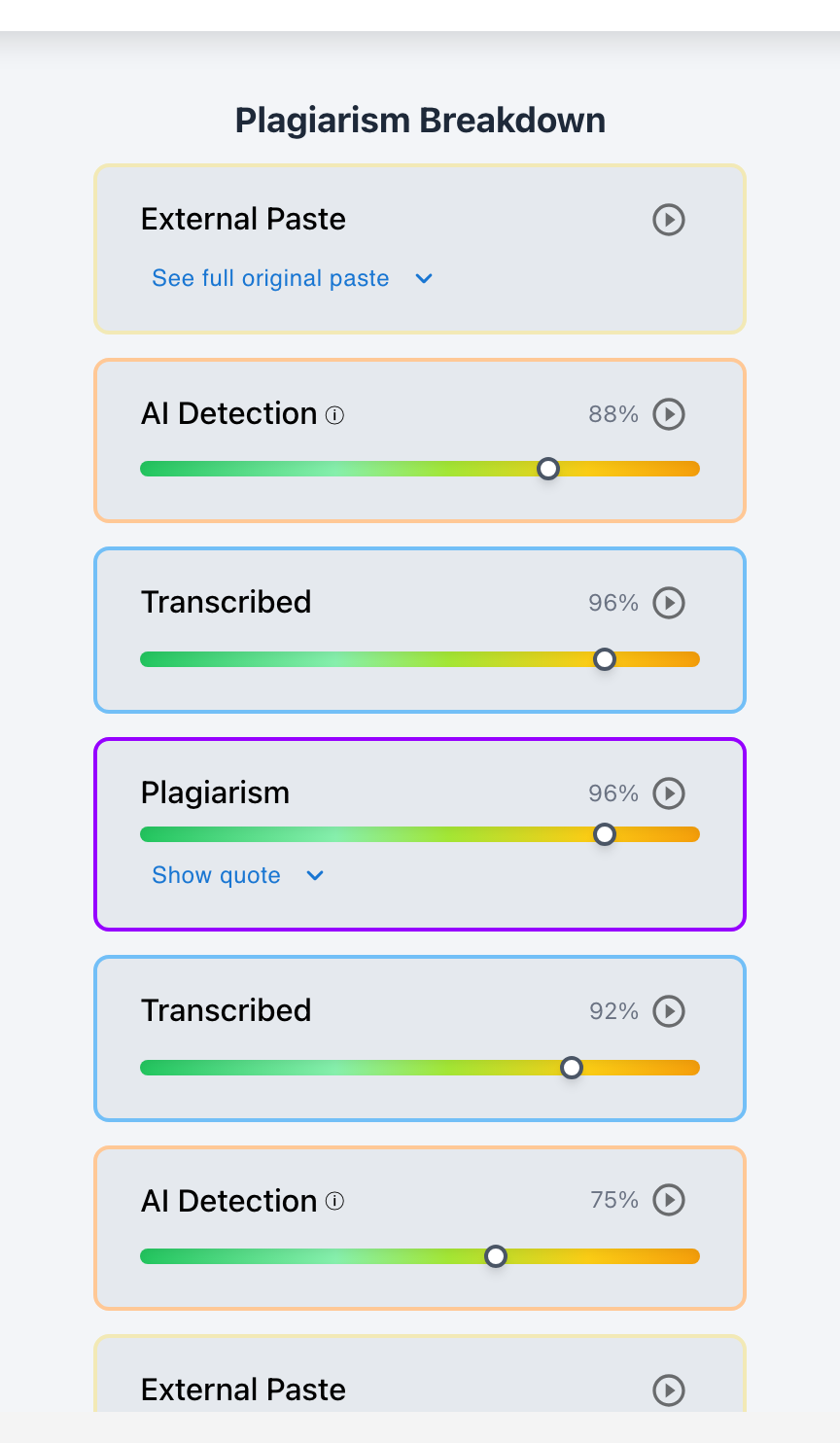
Checkmark Plagiarism meets the highest privacy standards by pairing AI detection with essay writing playback, plagiarism detection, autograding, and integrations with Canvas and Google Classroom.
The 10 Essential Privacy Questions for AI Detection Vendors
1. Do you use student data to train AI?
Acceptable Answer: "No. We maintain an ironclad zero-training policy; student writing is never used to train or fine-tune AI models."
2. How is submitted text processed?
Acceptable Answer: "Text is processed ephemerally in RAM or stored strictly within your district's isolated, encrypted private tenant."
3. Will you sign the National DPA (NDPA)?
Acceptable Answer: "Yes. We readily sign the Student Data Privacy Consortium (SDPC) standard National Data Privacy Agreement."
4. What encryption standards do you use?
Acceptable Answer: "All student data is encrypted using AES-256 at rest and TLS 1.3 in transit with dedicated key management."
5. Do you hold a SOC 2 Type II certification?
Acceptable Answer: "Yes. We provide annual third-party SOC 2 Type II audit reports and complete HECVAT assessments."
6. Who owns the copyright to student work?
Acceptable Answer: "The student and district retain 100% intellectual property ownership. We claim zero commercial rights."
7. What sub-processors do you use?
Acceptable Answer: "We maintain a public list of enterprise cloud sub-processors (e.g., AWS, GCP) bound by identical non-training DPAs."
8. How can we delete our data?
Acceptable Answer: "Districts have instant 1-click tenant purge tools and guaranteed complete data deletion upon contract termination."
9. Does your software collect telemetry or biometrics?
Acceptable Answer: "No biometric data, webcam video, or audio is collected. We collect only necessary LMS submission timestamps."
10. Does your platform support certified LTI 1.3?
Acceptable Answer: "Yes. We are 1EdTech certified for LTI 1.3 Advantage, utilizing OAuth 2.0 and JWT token authentication."
Why the National Data Privacy Agreement (NDPA) Is Non-Negotiable
Requiring the Student Data Privacy Consortium (SDPC) NDPA provides binding legal safeguards:
- Prohibits Data Mining: Explicitly bans the vendor from targeted advertising, user profiling, or secondary commercial monetization.
- Mandates Breach Notification: Requires the vendor to notify the district within 72 hours of confirming a data breach, unless doing so would disrupt a law enforcement investigation (NDPA v2.2, Section 5.4).
- Enforces FERPA & COPPA: Formally designates the vendor as an authorized "school official" with a legitimate educational interest.
Read more in how Checkmark writing process analysis works.
Comparison: Vague Vendor Promises vs. Checkmark Binding Protections
Unvetted AI Startups (High Risk)
- Vague website privacy policies that change without notice.
- Refuses to sign standard district NDPA agreements.
- Uses third-party consumer APIs that train on text.
- No third-party SOC 2 or HECVAT documentation.
Checkmark Plagiarism
- Signs state and national DPA agreements readily.
- Strict zero-training contractual guarantee.
- 1EdTech LTI 1.3 certified OAuth 2.0 integration.
A 5-Step Administrator Protocol for Privacy Vetting
EdTech Privacy Vetting Protocol:
- 1. Issue the 10 Privacy Audit Questions to the vendor's legal and security team.
- 2. Request the vendor's SOC 2 Type II report and HECVAT assessment under NDA.
- 3. Send your district's standard Data Privacy Agreement (NDPA) for execution.
- 4. Verify that LTI 1.3 Advantage is supported to ensure secure OAuth 2.0 data exchange.
- 5. Approve the tool for district-wide Canvas or Google Classroom deployment.
How Checkmark Plagiarism Powers Safe District Integrity
Checkmark Plagiarism combines **AI detection, essay writing playback, static AI detection, plagiarism detection, autograding, and Canvas/Google Classroom integrations** while providing school districts with complete privacy compliance and enterprise security.
Frequently Asked Questions
Why must schools ask AI detection vendors about data privacy?
To prevent illegal data harvesting, protect student intellectual property, and ensure total compliance with federal FERPA and state privacy statutes.
What is the most critical privacy question to ask an AI vendor?
"Do you use student essays or writing data to train, fine-tune, or develop artificial intelligence models?" The answer must be a contractual NO.
What is an NDPA in school edtech procurement?
The National Data Privacy Agreement is a standardized legal contract created by the Student Data Privacy Consortium to protect student data privacy across states.
Does Checkmark sign district-specific DPAs?
Yes. Checkmark readily signs state and national Student Data Privacy Agreements, including California, Texas, New York, Illinois, and national NDPA templates.
How does Checkmark isolate student data between schools?
Checkmark utilizes enterprise multi-tenant isolation: your school's data is stored in dedicated, encrypted partitions accessible only by your staff.
How does Checkmark Plagiarism integrate with Canvas LMS?
Checkmark provides certified LTI 1.3 integration, SpeedGrader sidebar embeds, two-way grade passback, and single sign-on (SSO).
What happens to student essays if a district cancels its contract?
Under Checkmark's DPA, all student submissions and institutional repository records are permanently and verifiably purged from our systems upon request.
Does Checkmark collect webcam or audio data during writing playback?
No. Checkmark tracks only document revision history, typing timestamps, and paste logs—never capturing webcam feeds, audio, or biometric data.
What is the benefit of SOC 2 Type II certification?
It proves that an independent auditor has verified the vendor's security controls, data encryption, tenant isolation, and disaster recovery procedures.
Why is Checkmark the preferred platform for privacy-conscious districts?
Because Checkmark delivers industry-leading detection accuracy while providing ironclad legal, security, and student privacy protections.
Rigorous Privacy Standards for Educational Excellence
Protecting student data is a fundamental institutional responsibility. By asking the right questions and demanding uncompromising security standards, district technology leaders ensure that academic integrity software protects both student honesty and student privacy.
Checkmark Plagiarism supports this comprehensive approach with AI detection, essay writing playback, static AI detection, plagiarism detection, autograding, and integrations with Canvas and Google Classroom.
See how Checkmark pairs enterprise privacy standards with multi-signal detection to protect student writing across your district. View a sample report or request a demonstration.