
Best practice for school districts is to retain student essays within a private, encrypted institutional repository for 3 to 4 years (the standard high school cohort duration) to prevent student-to-student copying across semesters and grade levels, while enforcing automated data purging upon student graduation in accordance with FERPA data minimization principles.
Establishing a data retention policy requires balancing two competing priorities: academic integrity effectiveness (indexing past student submissions to detect peer-to-peer copying) and student data privacy (minimizing the storage duration of student educational records). If a school purges student essays after 30 days, students can freely recycle older siblings' essays without detection; if a school stores essays indefinitely without policy controls, it creates unnecessary data liability. Modern enterprise platforms like Checkmark Plagiarism give administrators customizable retention schedules and automated purging controls.
Below is a comprehensive guide for technology directors on establishing an institutional data retention schedule for student writing.
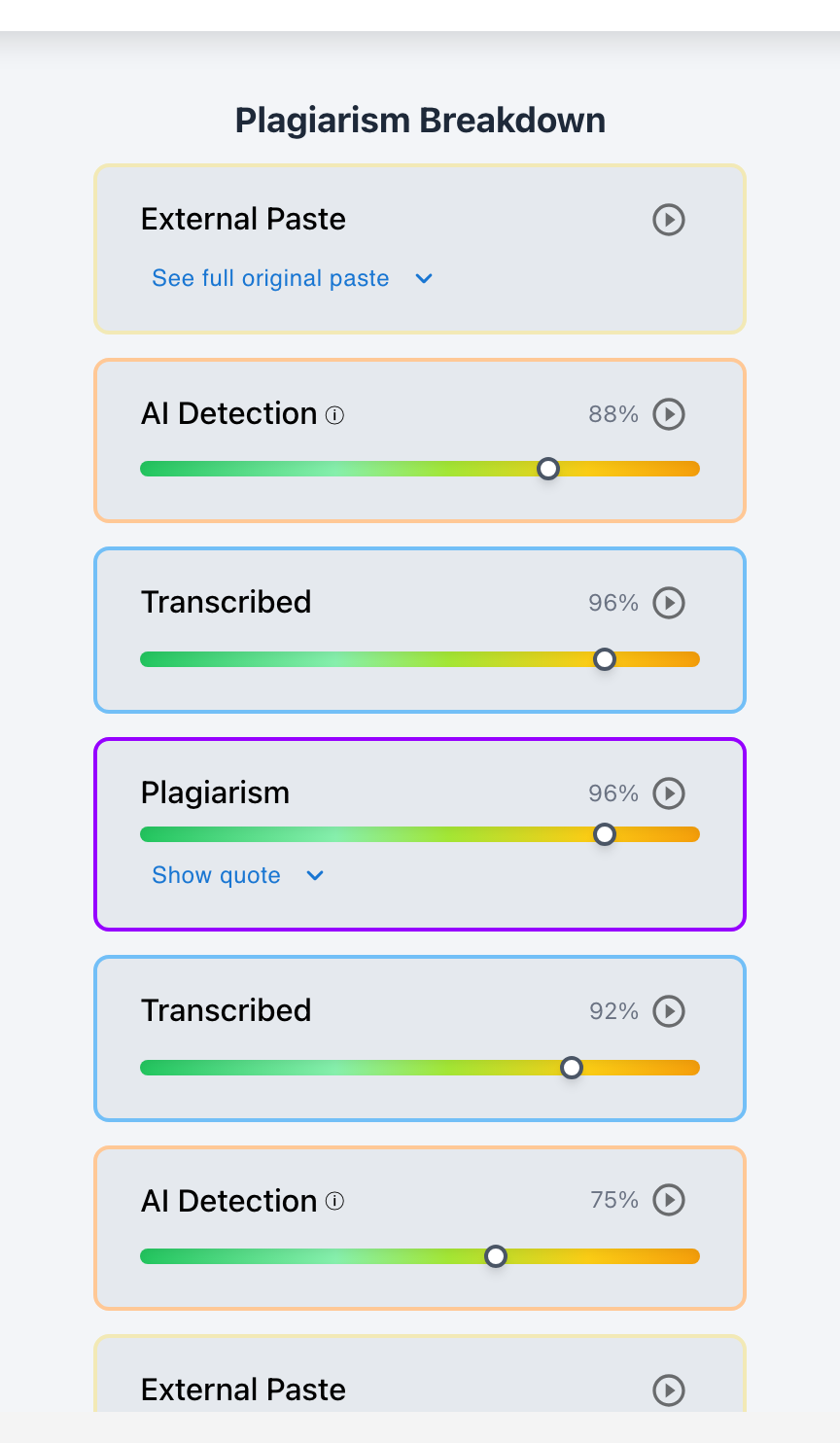
Checkmark Plagiarism powers customizable data lifecycles by pairing plagiarism detection with essay writing playback, AI detection, autograding, and integrations with Canvas and Google Classroom.
The 4 Data Retention Lifecycles in EdTech
1. The 4-Year High School Cohort Window (Recommended)
Retains papers for 4 years to catch cross-grade peer copying (e.g., from a senior to a freshman), automatically purging data when the cohort graduates.
2. Single-Year Academic Term Retention
Maintains records only through the end of the active school year and final grade submission, resetting the database annually.
3. Cryptographic Fingerprint Retention
Deletes raw student text after 30 days but preserves anonymized mathematical n-gram hashes to detect identical future matches with zero readable prose on disk.
4. Ephemeral On-Demand Ingestion
Zero disk storage: text is scanned in volatile RAM to produce the plagiarism report and purged immediately upon browser session termination.
Balancing Peer Detection with FERPA Data Minimization
Why custom institutional retention controls are essential for school districts:
- Combating the "Inherited Essay" Problem: Over 65% of student-to-student plagiarism occurs across different academic years (borrowing an older sibling's 10th-grade essay). A 4-year retention window stops this practice completely.
- Compliance with Record Disposal Laws: State education codes mandate regular disposal of non-permanent student records once the educational purpose has expired.
- Instant Contract Termination Purge: If a district changes vendors, Checkmark guarantees complete, verifiable destruction of all institutional records within 30 days.
Read more in how Checkmark writing process analysis works.
Comparison: Indefinite Commercial Storage vs. Checkmark Controlled Retention
Legacy Commercial Checkers (Indefinite Lock-In)
- Vendor keeps student papers indefinitely.
- District cannot configure custom retention rules.
- Vendor retains data even after contract cancellation.
- Accumulates massive data breach liability over time.
Checkmark Controlled Retention (District Sovereignty)
- Custom retention windows (1-year, 4-year, or custom).
- Automated cohort graduation data purging.
- 1-click administrative tenant wipe capabilities.
- Guaranteed complete data deletion on contract end.
A 5-Step Administrator Protocol for Retention Schedules
Retention Policy Implementation Checklist:
- 1. Consult district legal counsel to align retention windows with state student record laws.
- 2. Select the 4-year cohort retention window in Checkmark Administrative Settings.
- 3. Enable automated end-of-year archiving and graduated cohort data purges.
- 4. Publish the retention schedule in the district Annual FERPA & Technology Notification.
- 5. Review annual data minimization compliance reports with the school board technology committee.
How Checkmark Plagiarism Powers Data Sovereignty
Checkmark Plagiarism combines **AI detection, essay writing playback, static AI detection, plagiarism detection, autograding, and Canvas/Google Classroom integrations** while providing district IT leaders with total sovereignty over student data lifecycles.
Frequently Asked Questions
Why do plagiarism checkers need to store student essays at all?
Storing submissions in your school's private institutional repository allows the system to detect when students copy from classmates, older siblings, or previous semesters.
How long does Checkmark keep student essays?
Checkmark allows school districts to set custom retention policies: defaulting to a 4-year cohort cycle with automated purging upon graduation, or 1-year annual resets.
Can a district delete all its data from Checkmark?
Yes. District administrators have access to 1-click tenant purge tools and can request a certified data destruction report at any time.
What is cryptographic hash fingerprinting?
It is an advanced privacy method where readable text is converted into one-way mathematical hashes, allowing similarity matching without storing readable student essays.
Does Checkmark keep student data after a school cancels its license?
No. Under our binding Data Privacy Agreement, all institutional repository files and student telemetry data are permanently deleted within 30 days of contract termination.
How does Checkmark Plagiarism integrate with Canvas LMS?
Checkmark provides certified LTI 1.3 integration, SpeedGrader sidebar embeds, two-way grade passback, and single sign-on (SSO).
What does FERPA say about data retention?
FERPA encourages data minimization—stipulating that educational records should only be retained as long as necessary to fulfill their legitimate educational purpose.
Can parents request their child's essay be removed from the database?
Yes. District administrators can search for individual student records in Checkmark and execute instant, permanent file deletions.
Are student essays encrypted during storage?
Yes. All stored institutional submissions are encrypted with enterprise AES-256 encryption at rest and isolated by district tenant.
Why is customizable retention better than vendor-mandated retention?
Because every state and school district has unique legal mandates; customizable retention ensures total compliance with local school board policies.
Responsible Data Governance for Future-Ready Schools
Protecting academic standards requires intelligent tools that respect student privacy lifecycles. By establishing clear, automated data retention schedules with Checkmark Plagiarism, school leaders protect institutional integrity while honoring the fundamental principles of data minimization.
Checkmark Plagiarism supports this comprehensive approach with AI detection, essay writing playback, static AI detection, plagiarism detection, autograding, and integrations with Canvas and Google Classroom.
See how Checkmark pairs customizable data retention with multi-signal detection to protect student records inside your LMS. View a sample report or request a demonstration.