
When an educator flags a student's high-stakes essay for suspected generative AI use or unoriginal text, high school principals, assistant principals of academics, secondary academic integrity officers, and district ombudsmen face an immediate administrative and public relations flashpoint. Confronting defensive parents with an unexplainable, third-party AI detector score (e.g., “This essay is 88% AI-Generated”) or subjective teacher intuition routinely collapses into an adversarial impasse. Such encounters frequently spark accusations of bias, constitutional due process challenges under Goss v. Lopez, Family Educational Rights and Privacy Act (FERPA) records disputes, and threats of formal school board grievances.
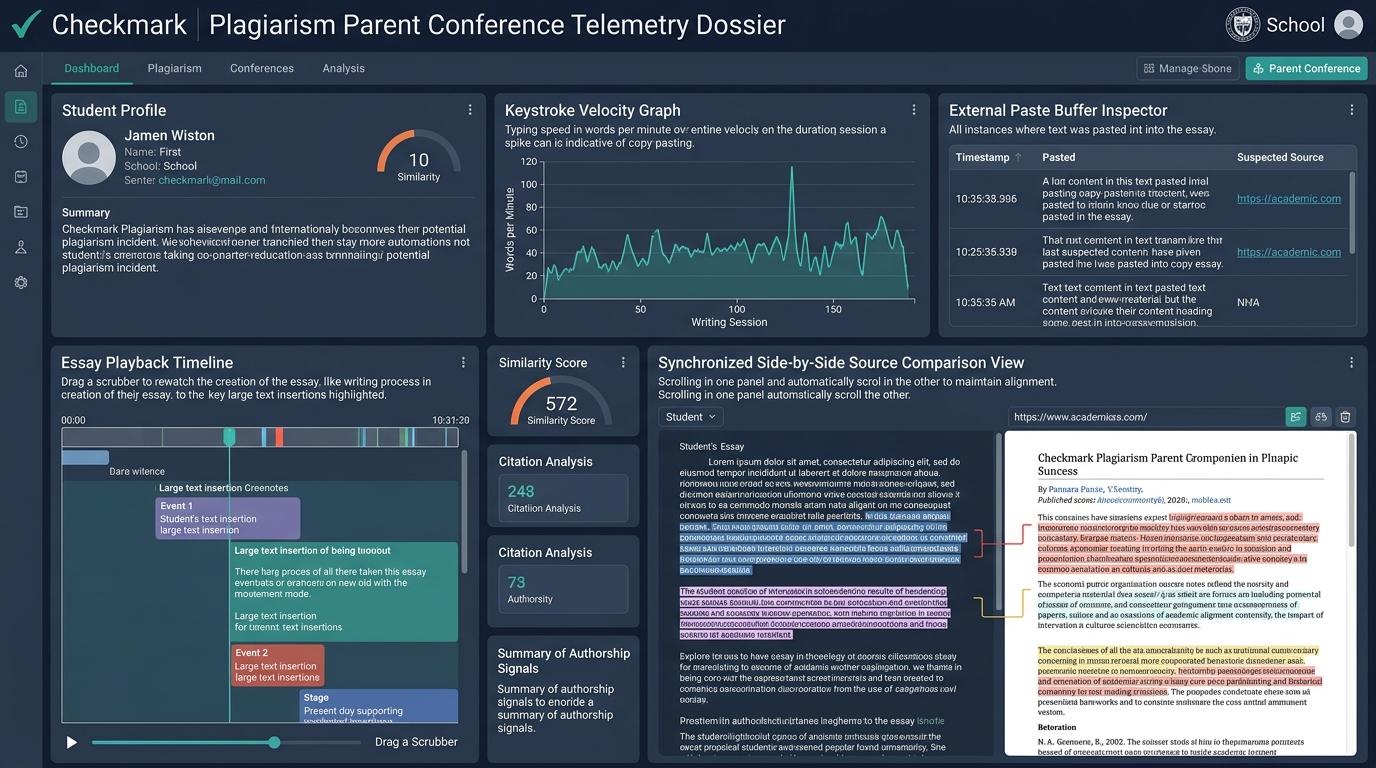
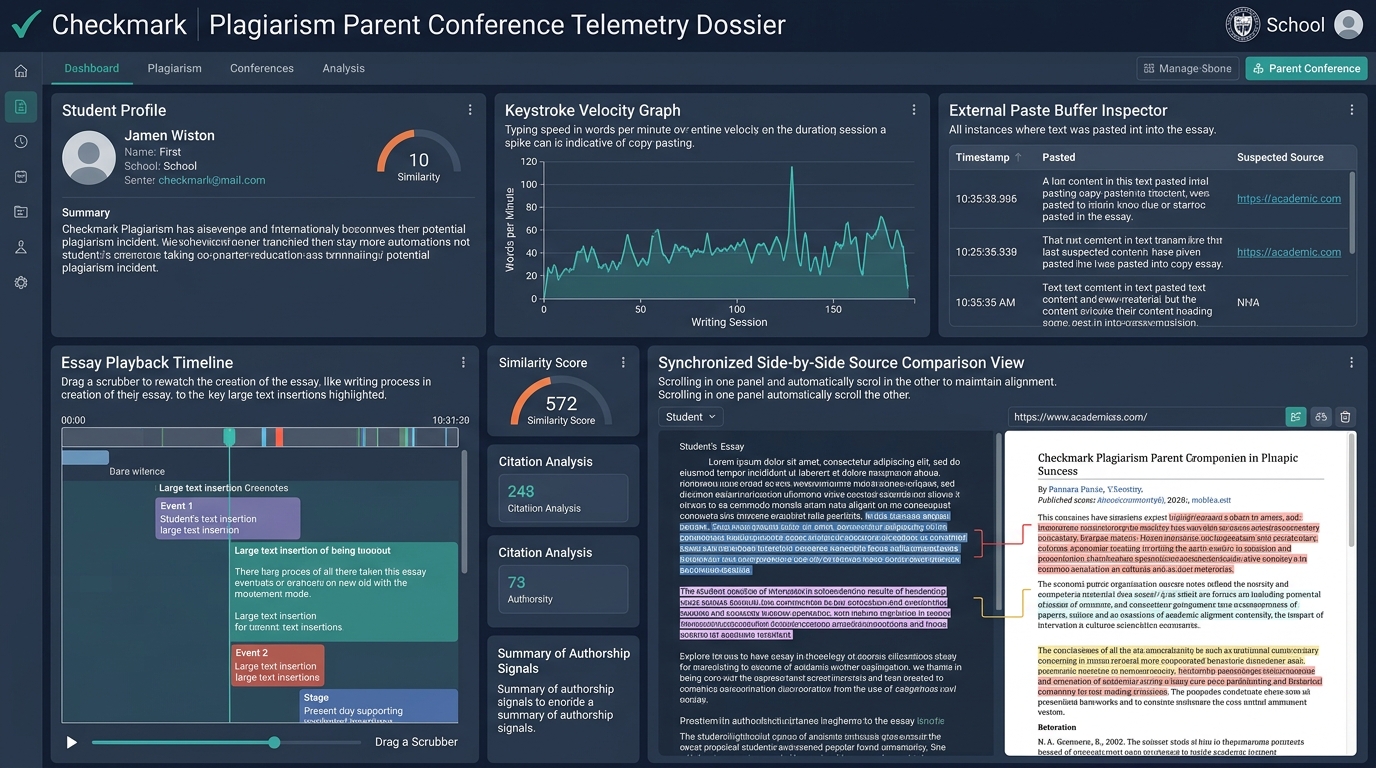
To resolve disputed academic dishonesty cases with absolute fairness and administrative authority, secondary school leaders must replace probabilistic black-box percentages with Three Incontrovertible Telemetry Receipts:
- The Drafting Journey (Temporal Replay): Patent-pending Essay Playback™ (1x–8x scrubbable video replay) capturing real-time keystroke dynamics, typing velocity (WPM), cognitive pause clustering, structural revision bursts, and organic text evolution;
- The Ingestion Record (Paste Provenance): A 100% External Paste Buffer Inspector recording timestamped captures of all external clipboard insertions, character counts, and exact preserved text—distinguishing legitimate research notes from unapproved raw Large Language Model (LLM) generation; and
- The Textual Alignment (Grounded Source Proof): Synchronized Dual-Pane Side-by-Side Comparison isolating exact verbatim or paraphrased matches anchored by a clear 4-badge citation taxonomy.
Backed by Checkmark Plagiarism's philosophy—“Stop guessing, start trusting”—and its 1-Click Multi-Evidence Parent Conference Dossier, school administrators can shift contested misconduct meetings from confrontational interrogations into collaborative, restorative co-viewing conferences that protect student due process, support classroom teachers, and restore institutional trust.
Checkmark Plagiarism equips secondary school administrators with high-resolution writing process telemetry and seamless LMS integrations across Canvas LMS, Agilix Buzz, and Google Classroom.
1. The Administrative Crisis: The Breakdown of Traditional Misconduct Conferences
Secondary school administrators stand at the front lines of an unprecedented institutional crisis. Across comprehensive public high schools, magnet academies, independent college-preparatory schools, and regional districts, building principals and academic deans are overwhelmed by contested academic integrity referrals.
The widespread availability of consumer generative AI tools (such as ChatGPT, Claude, and Gemini), AI-powered paraphrasers, and automated writing assistants has created a high-stakes clash between pedagogical integrity and parental advocacy.
Principal is forced to overturn teacher sanctions for lack of evidence, destroying faculty morale and compromising school-wide academic standards.
School faces formal board grievances, retained education attorneys, Title VI civil rights complaints, and prolonged community friction.
The Anatomy of the “Black-Box Impasse”
When a contested case reaches the building principal's desk, the traditional conference format fails almost immediately if the school relies on legacy detection tools or uncalibrated percentage scores. Administrators face four major systemic liabilities:
1. The Evidentiary Vacuum of Probabilistic Percentages
Traditional first-generation AI detectors operate as probabilistic neural classifiers. They analyze static text for statistical predictability (perplexity) and sentence structure variation (burstiness), generating a single aggregate number (e.g., 79% AI). When a parent asks: “What specific sentences were generated by AI? What prompt was used? What external tool was accessed? What is the proof that my child didn't write this?”, a whole-document percentage cannot answer. The vendor's algorithm remains a proprietary trade secret, leaving the administrator with zero empirical evidence to present across the conference table.
2. Constitutional Due Process and Legal Vulnerabilities (Goss v. Lopez)
In the landmark U.S. Supreme Court ruling Goss v. Lopez, 419 U.S. 565 (1975), the Court held that public school students facing a short disciplinary suspension have property and liberty interests in their education that the Fourteenth Amendment protects. The case concerned suspensions rather than grades, but its basic requirements are widely used as a model for fair process when a misconduct finding could affect Grade Point Averages (GPAs), class rank, National Honor Society standing, or disciplinary transcripts:
- Notice of the specific charges;
- If the student denies the charges, an explanation of the evidence supporting them; and
- A fair, meaningful opportunity for the student to present their defense.
Disciplining a student based on an unexplainable probabilistic score makes it hard to give the explanation of the evidence that fair-process standards call for. When parents retain educational attorneys, school district legal counsel may advise principals to drop sanctions supported solely by black-box AI scores, leaving teachers feeling unsupported.
3. Reported Disproportionate False Positives for Vulnerable Populations
Research from Stanford University (Liang et al., 2023, Patterns) found that popular AI text detectors were biased against non-native English writers, and educators have raised concerns that other groups of students may be affected as well:
- English Language Learners (ELL / ML): Non-native English writers naturally employ more uniform vocabulary, simpler syntactic structures, and predictable transitional phrases—the exact linguistic markers that generic AI detectors misidentify as machine-generated text.
- Neurodivergent Students (IEP / 504 / ADHD / Autism Spectrum): Educators have raised concerns that some neurodivergent learners may exhibit atypical writing patterns, such as repetitive sentence frames, highly structured logical progressions, or rapid drafting bursts following extensive offline ideation, which a detector could misread.
- Rigorous Adherence to Structured Writing Formulae: Students strictly following standard middle and high school writing frameworks (e.g., Claim-Evidence-Reasoning [CER], Schaffer 5-Paragraph models, or DBQ templates) can write with high predictability, which some legacy platforms may flag as AI-generated.
4. The Statutory Mandate of FERPA (34 CFR Part 99 § 99.10)
Under the Family Educational Rights and Privacy Act (FERPA), parents and eligible students have the right to inspect and review the student's education records, which can include digital records the school maintains that relate directly to a disciplinary or grading decision. The school must respond to an access request within a reasonable time, no more than 45 days, and must also respond to reasonable requests for explanations and interpretations of those records (34 CFR § 99.10(b) and (c)). Handing a parent an unannotated printout with an opaque percentage score makes it difficult to give that kind of explanation.
2. The Evidentiary Paradigm Shift: Moving from Guesswork to Writing Telemetry
To eliminate contentious disputes and protect both students and faculty, school districts must execute an evidentiary paradigm shift: transitioning from probabilistic text scoring to deterministic writing telemetry.
| Evidentiary Dimension | Legacy Probabilistic Paradigm | Modern Deterministic Telemetry Paradigm |
|---|---|---|
| Core Methodology | Statistical prediction of static final text via perplexity & burstiness. | Full-process dynamic telemetry capturing the entire drafting session millisecond-by-millisecond. |
| Output Granularity | Single opaque percentage score (e.g., “85% AI Probability”). | Multi-dimensional receipts: Keystroke playback, external paste buffer logs, and side-by-side source comparisons. |
| Demographic Equity | Documented false-positive bias against non-native English writers; concerns for neurodivergent & formulaic prose. | Fully demographic-agnostic; evaluates physical keystrokes, authentic pause durations, and revision history. |
| Parent Meeting Posture | Adversarial “cheat vs. innocent” interrogation; defensive impasse. | Transparent, collaborative co-viewing session focused on the student's genuine writing and research process. |
| Legal & Board Standing | Vulnerable to legal challenges, grievance appeals, & forced retractions. | Defensible, tamper-evident audit trail that withstands formal due process hearings and administrative scrutiny. |
3. The Three Incontrovertible Telemetry Receipts Principals Must Present
During a contested parent conference, administrators must anchor the conversation around objective, verifiable facts. Checkmark Plagiarism provides Three Incontrovertible Telemetry Receipts that replace subjective speculation with undeniable digital provenance.
- 1x–8x scrubbable video replay
- Typing velocity (WPM curves)
- Cognitive pause mapping
- Organic structural revisions
- 100% preserved raw clipboard
- Millisecond timestamp logs
- Character counts & source tags
- Pre-edit prompt reconstruction
- Dual-pane side-by-side view
- 4-badge citation taxonomy
- Direct clickable web/DOI URLs
- Verbatim vs paraphrased split
Receipt 1: The Drafting Journey (Temporal Replay & Keystroke Dynamics)
The first receipt is patent-pending Essay Playback™, an interactive video-like timeline that reconstructs the student's complete writing session keystroke-by-keystroke. Administrators can scrub through the entire writing session at 1x, 2x, 4x, or 8x speeds directly alongside parents.
What This Proves to Parents:
- Authentic Human Ideation vs. Instant Text Generation: An authentic 1,500-word essay requires between 90 minutes and 4+ hours of active drafting. Essay Playback™ visually demonstrates the natural cadence of writing: typing a sentence, pausing for 45 seconds to consult an outline or primary text, revising a clause, backspacing over typos, and moving paragraphs.
- Cognitive Pause Mapping: Telemetry maps where pauses occur. Human writers pause at syntactic boundaries (between sentences and paragraphs) to organize thoughts. Unnatural pause distributions (such as steady, zero-pause typing across thousands of characters) indicate external transcription or machine generation.
- Exoneration of False Positives: When a student is wrongly flagged by an uncalibrated AI detector, Essay Playback™ serves as undeniable evidence of genuine authorship, instantly putting defensive parents at ease and protecting the student's record.
Receipt 2: The Ingestion Record (External Paste Buffer Telemetry)
The second receipt is the External Paste Buffer Inspector, which records every instance where text was pasted into the document from an external source outside the active editor.
| EVENT | TIMESTAMP | CHAR COUNT | TYPE | PRESERVED CLIPBOARD CONTENT PREVIEW |
|---|---|---|---|---|
| #01 | 14:12:08 EST | 142 chars | Citation | “Madison, James. Federalist No. 10. The New York Packet, Friday, November 23, 1787.” |
| #02 | 14:38:45 EST | 2,840 chars | Unapproved Draft | “Certainly! Here is a comprehensive four-paragraph analysis of Federalist No. 10...” |
| #03 | 15:02:11 EST | 50 chars | URL | https://avalon.law.yale.edu/18th_century/fed10.asp |
“Certainly! Here is a comprehensive four-paragraph analysis of Federalist No. 10 examining how Madison's theory of extended republics controls the violence of faction...”
“In Federalist No. 10, James Madison provides a comprehensive four-paragraph analysis examining how the theory of extended republics controls the violence of faction...”
What This Proves to Parents:
- Preservation of the Original Ingestion: Students attempting to conceal AI generation frequently paste an entire LLM output and then spend 10 minutes manually editing out telltale chatbot phrasing (such as “As an AI language model...” or “Certainly, here is an essay...”). Checkmark's Paste Buffer preserves the exact raw text initially pasted, proving the true origin of the content regardless of subsequent edits.
- Distinguishing Legitimate Research Notes vs. LLM Generation: If a student claims, “I wrote my essay in my Notes app on my phone and pasted it in”, the paste buffer preserves the exact formatting, timestamps, and structure, allowing administrators to cross-examine whether the text contains authentic rough notes or synthetic output.
Receipt 3: The Textual Alignment (Grounded Source Proof & 4-Badge Taxonomy)
The third receipt is Synchronized Dual-Pane Source Proof, which pairs the student's submission directly against live internet sources, published academic databases, peer student repositories, and AI-generated reference baselines.
“The latent causes of faction are thus sown in the nature of man; and we see them everywhere brought into different degrees of activity, according to the different circumstances of civil society.”
“The latent causes of faction are thus sown in the nature of man; and we see them everywhere brought into different degrees of activity, according to the different circumstances of civil society.”
Checkmark's 4-Badge Citation Taxonomy:
Rather than treating all textual overlap as intentional plagiarism, Checkmark categorizes every passage using an objective 4-badge system:
| Badge Type | Definition & Administrative Remediation |
|---|---|
| 1. Direct Verbatim Match | Exact word-for-word string match from a published web/academic source without quotation marks or attribution. (Requires source citation). |
| 2. Paraphrased Match | Syntax and sentence structure closely mirrors a source with surface-level synonym substitution. (Requires synthesis coaching). |
| 3. Uncited Source | Factual data, distinct argument, or specialized phrasing borrowed without parenthetical credit. (Citation formatting correction). |
| 4. Legitimate Quotation | Text accurately placed within quotation marks with an appropriate bibliographic citation. (Exempt from similarity calculations). |
4. Checkmark Plagiarism's Administrative Parent Conference Suite
Checkmark Plagiarism equips secondary administrators with dedicated administrative tools specifically engineered to prepare for, conduct, and resolve contested integrity hearings.
| Administrative Tool | Function & Administrative Benefit |
|---|---|
| 1. 1-Click Multi-Evidence Parent Conference Dossier | Generates a clean, Bates-stamped, tamper-evident PDF dossier consolidating playback logs, paste records, and source views. |
| 2. External Paste Buffer Inspector | Captures and reconstructs full clipboard history, timestamps, and original formatting regardless of later text revisions. |
| 3. Calibrated Passage-Level AI Sliders with Guardrails | Isolates specific sentences with calibrated confidence sliders; displays “N/A” on short texts (<150 words). |
| 4. Teacher-in-the-Loop Rubric Autograding & Passback | Generates quote-anchored rubric feedback while keeping final grading authority with educators; direct Canvas/Buzz sync. |
| 5. Restorative Revision Workflow Architecture | Enables controlled, supervised draft revision portals to replace punitive zero grades with authentic mastery learning. |
Deep Dive: The 1-Click Multi-Evidence Parent Conference Dossier
Before entering a conference, principals should never have to manually assemble screenshots, email threads, and disparate LMS logs. With a single click, administrators generate an exportable, tamper-evident Parent Conference Dossier that contains:
- Executive Session Summary: Submission timestamp, total active composing time, total keystrokes recorded, sustained words-per-minute (WPM), and total external paste events.
- Session Timeline Visualizer: A high-level visual graph illustrating the chronological progression of the essay over time, highlighting drafting bursts, major revision periods, and paste spikes.
- Paste Provenance Ledger: A chronological table itemizing every external clipboard event, including character counts, timestamps, and full preserved text previews.
- Dual-Pane Source & Passage Highlights: High-resolution side-by-side matches with clickable URLs, verified academic metadata, and calibrated passage-level AI confidence sliders.
- Teacher Rubric Notes & Assignment Guidelines: The original prompt requirements, classroom AI usage boundaries (e.g., whether brainstorming was permitted), and the teacher's formative rubric assessment.
5. The 4-Phase Principal Parent Conference Protocol
To ensure consistent, defensible, and de-escalating meetings across all academic departments, secondary administrators should adhere to the following 4-Phase Parent Conference Protocol:
- Principal reviews 1-Click Dossier before scheduling parent meeting
- Audits active typing time, paste logs, & pause metrics against paper length
- Administrative Exoneration Gate: Dismisses false positives prior to parental contact
- Welcome parents into conference room with dual-monitor or shared projection display
- Frame meeting as collaborative drafting process review rather than disciplinary hearing
- Establish non-punitive, supportive educational tone focused on academic growth
- Scrub through Essay Playback™ timeline at 2x/4x speed alongside parents
- Review Paste Buffer Inspector events collaboratively on screen
- Invite student to narrate research, outline evolution, and drafting choices
- Execute Restorative Mastery Revision agreement with student and family
- Schedule supervised revision cycle in Writing Center with citation coaching
- Update LMS gradebook upon completed mastery submission without punitive GPA destruction
Step-by-Step Protocol Breakdown
Phase 1: Pre-Conference Telemetry Triage (Administrative Audit)
- Time Required: 10–15 minutes prior to scheduling or conducting the conference.
- Administrator Actions:
- Open the student's submission in the Checkmark Administrator Dashboard.
- Examine total active drafting time against document length (e.g., 2,000 words produced in 12 minutes is an immediate red flag; 2,000 words produced across 3.5 hours of active typing indicates authentic human drafting).
- Inspect the External Paste Buffer: Review all logged paste events. Are they citations, URLs, or complete essay blocks?
- Review passage-level AI confidence sliders: Are flags isolated to generic introductory transitions, or do they cover entire body sections?
- Administrative Exoneration Gate: If telemetry reveals authentic, continuous human keystroke drafting with natural revision cycles, the administrator dismisses the referral immediately, notifies the teacher, and updates the gradebook without subjecting the family to an unnecessary conference.
Phase 2: Co-Viewing Intake & Stage-Setting
- Physical & Digital Setup: Position a shared conference display or large monitor where the student, parents, teacher, and administrator can comfortably view the screen together.
- Opening Framing: Establish a collaborative, transparent posture. Avoid accusatory vocabulary (e.g., “cheating”, “plagiarism”, “dishonesty”). Instead, use process-oriented terminology (e.g., “drafting timeline”, “source attribution”, “paste provenance”).
Phase 3: Telemetry Walkthrough & Student Narration
- The Shared Screen Review: Open the interactive Checkmark Dossier. Scrub through the Essay Playback™ timeline starting at minute zero.
- The Student Narration Technique: Hand control of the discussion to the student by asking open, exploratory questions:
- “Marcus, walk us through what sources you were looking at right here at the 35-minute mark.”
- “We see an 800-word paste event at 14:22. Can you tell us where those notes were stored before bringing them into the document?”
- The Objective Impact: Watching the playback eliminates defensive posturing. If the student drafted authentically, the video proves it in seconds. If the student pasted unapproved AI generation, the timestamped clipboard preview shows the exact text inserted, removing any ambiguity.
Phase 4: Restorative Resolution & Mastery Agreement
- Shifting to Growth and Learning: Once the facts are established, transition immediately to educational restoration. Rather than assigning an automatic zero that destroys course GPA, establish a structured Restorative Mastery Revision Plan:
- The student agrees to complete a supervised revision cycle in the school's Writing Lab or during academic support periods.
- The student completes a mini-module on proper citation synthesis and ethical AI boundaries.
- The revised essay is autograded against the standard rubric, allowing the student to earn up to 80–85% of full credit while mastering the core academic standard.
6. Word-for-Word De-Escalation Dialogue Scripts for Administrators
Navigating parental defensiveness can be one of the most challenging aspects of academic integrity conferences. Below are sample dialogue scripts, written for illustration, designed to defuse tension and maintain administrative control.
Principal: “Good afternoon, Mr. and Mrs. Davis, thank you for coming in with Jordan. I want to be very clear about our goal today: our purpose is not to sit here in judgment or make assumptions about Jordan's character. We are here to support Jordan's academic growth. In our district, we do not rely on vague hunches or opaque computer scores. Instead, we look directly at the objective writing telemetry—the actual drafting history recorded while the essay was being written. We are going to look at that timeline together on the screen, see exactly how the paper came together, and make a fair, transparent decision as a team.”
Parent: “We know that AI detectors are completely unreliable. We read that they have high false-positive rates and discriminate against honest students. My child wrote every word of this essay, and you cannot prove otherwise!”
Principal: “You are entirely correct that standalone percentage scores from basic AI detectors can be unreliable, which is precisely why our school district does not discipline students based on detector percentages. We agree with you that an arbitrary percentage is not proof. That is why we use Checkmark's writing telemetry. Rather than guessing based on what the finished text looks like, we are going to look at the exact keystroke replay, the active typing timestamps, and the clipboard history. Let’s look at the screen together right now so you can see the exact evidence for yourselves.”
Principal: “Let’s take a look at the timeline at 7:42 PM on Tuesday evening. On the screen here, the playback shows that Jordan opened the document, typed the title, and then at 7:44 PM—two minutes into the session—a 1,200-word text block was pasted into the editor all at once. When we open our Paste Buffer Inspector, it shows the exact raw text that was on the clipboard at that second, including the initial heading: ‘Here is an analytical essay on the Great Gatsby tailored for an 11th-grade honors class.’ Jordan, can you help us understand how that text was created and where it came from before being pasted in?”
Principal: “Mr. and Mrs. Martinez, after reviewing the comprehensive telemetry report, I am pleased to tell you that Sofia’s essay is fully validated. While an initial automated filter flagged Sofia's sophisticated vocabulary, our keystroke playback shows three hours and forty minutes of authentic drafting, including 1,400 manual edits, continuous organic sentence revisions, and natural pauses where Sofia consulted primary source texts. The initial flag has been completely dismissed, Sofia's 'A' grade is recorded in Canvas, and no record of misconduct exists. Thank you for your partnership, and Sofia, exceptional work on this research paper.”
Principal: “Now that we have looked at the clipboard logs and seen that external AI generation was pasted into paragraphs three and four, our priority is ensuring Jordan masters these historical analysis standards. We do not believe in assigning a permanent zero that destroys a student's GPA and prevents learning. Instead, Jordan will participate in our Restorative Revision Workflow: two 45-minute sessions in our Writing Center to draft an original comparative analysis using proper source attribution. Upon completion, the new draft will be fully scored against the rubric. Jordan, how does that sound as a pathway forward?”
7. Turnkey Administrative Tools & Compliance Frameworks
To institutionalize these best practices, secondary administrative teams should implement the following standardized checklists and compliance safeguards.
The Turnkey Parent Conference Evidence Packet Checklist
| √ | Evidence Requirement | Verification Standard |
|---|---|---|
| [ ✓ ] | 1. Active Composing Time Audit | Minimum 45+ mins active drafting for major essays (>1,000 words); verified session active clock. |
| [ ✓ ] | 2. Keystroke Velocity & Burst Analysis | Typing speed matches human norms (20–65 WPM); natural pause clustering at clause boundaries. |
| [ ✓ ] | 3. External Paste Buffer Inspection | All clipboard events audited; full raw text captured and categorized as citations, notes, or synthetic prose. |
| [ ✓ ] | 4. Synchronized Dual-Pane Source Verification | Direct hyperlinks verified for all verbatim & paraphrased match cards with 4-badge taxonomy. |
| [ ✓ ] | 5. Passage-Level AI Confidence Calibration | Confidence sliders evaluated passage-by-passage; short-text guardrails (<150w) applied. |
| [ ✓ ] | 6. Assignment Policy Alignment | Teacher's syllabus AI usage policy and assignment rubric criteria attached to evidence dossier. |
| [ ✓ ] | 7. Bates-Stamped Dossier Generation | Clean, tamper-evident PDF exported for administrative record, FERPA compliance, & parent review. |
Legal, Due Process, and FERPA Compliance Framework (34 CFR § 99.10)
| Legal & Regulatory Mandate | Checkmark Administrative Compliance Safeguard |
|---|---|
| Fourteenth Amendment Due Process (Goss v. Lopez, 419 U.S. 565 (1975)) | Replaces arbitrary black-box scores with deterministic, empirical drafting records and reproducible telemetry logs. |
| FERPA Parental Right to Inspect (34 CFR Part 99 § 99.10) | 1-Click Multi-Evidence Dossier provides full disclosure of all raw data, telemetry logs, and assessment criteria. |
| Student Data Privacy & COPPA Compliance | Zero Model Training Guarantee: Student submissions and logs are never used to train public or commercial AI models. |
| Tamper-Evident Chain of Custody for Disciplinary Appeals | Cryptographically verified timestamps and Bates-stamped logs ensure data integrity during formal board hearings. |
8. Illustrative High School Administrative Scenarios
The following three scenarios illustrate how secondary school leaders could apply Checkmark Plagiarism's telemetry suite to resolve high-stakes misconduct disputes. They are hypothetical composites written for illustration, not reports of specific schools, students, or families, and the figures in them are examples only.
| Scenario | Initial Challenge | Telemetry Resolution |
|---|---|---|
| Scenario 1: 11th-Grade Honors English | Parent disputes AI allegation on high-stakes term paper; threatens school board grievance. | Telemetry proves a 2,200-word paste from LLM clipboard; meeting de-escalated and resolved in 12 minutes with restorative revision plan. |
| Scenario 2: Falsely Accused AP Senior | AP US History senior flagged with a 92% AI detector score; college admission at risk. | Essay Playback™ reveals 3.5 hours of genuine keystroke composition; administrator dismisses charge and completely exonerates student. |
| Scenario 3: Retained Legal Counsel Dispute | Family retains education law attorney citing due process violations over 0% grade. | Attorney reviews Bates-stamped dossier with exact prompt ingestion records; attorney formally withdraws legal grievance. |
Scenario 1: The 11th-Grade Honors English AI Dispute (De-Escalated in 12 Minutes)
- Setting: A suburban comprehensive high school (enrollment: 2,100).
- The Incident: An 11th-grade Honors English student submitted a 2,200-word comparative literature essay. The classroom teacher noted an uncharacteristic writing style and ran the paper through a legacy AI detector, which returned an 84% AI score. The teacher entered a 0% in Canvas and referred the student for disciplinary action.
- The Escalation: The student's parents—both university faculty members—sent an urgent email to the Principal and Superintendent, accusing the teacher of defamation, bias, and using unscientific tools. They demanded an immediate apology and threatened a formal school board appeal.
- The Telemetry Audit: The Assistant Principal of Academics opened Checkmark's Administrator Dashboard. The telemetry audit revealed:
- Total active typing time: 4 minutes 18 seconds.
- Keystrokes recorded: 112 keystrokes (only the title and student name).
- Paste Buffer Inspector: At 9:14 PM, a single paste event inserted 2,188 words containing telltale structural syntax from an LLM prompt response.
- The Conference Outcome: The Assistant Principal convened the meeting, projected the Checkmark Dossier, and scrubbed through the 4-minute playback. When the parents saw the timestamped clipboard capture preserving the raw prompt output, all hostility evaporated. The conference shifted immediately from conflict to support. The student admitted to feeling overwhelmed by multiple deadlines, signed a Restorative Mastery Agreement, and completed a supervised rewrite during study hall. Total meeting time: 12 minutes.
Scenario 2: The Falsely Accused AP US History Senior (Exonerated via Keystroke Dynamics)
- Setting: A competitive public magnet high school.
- The Incident: An AP US History senior submitted an extensive research paper on Cold War foreign policy. Because the student strictly followed a complex primary source synthesis template, a generic commercial detector flagged the paper as 92% AI-Generated. The student faced loss of National Honor Society leadership and suspension.
- The Administrative Review: Rather than issuing a disciplinary notice, the Principal executed a pre-conference telemetry audit using Checkmark Plagiarism.
- The Telemetry Evidence:
- Active Drafting Time: 3 hours 44 minutes across four discrete drafting sessions.
- Keystroke Metrics: 9,812 individual keystrokes, sustained typing speed of 38 WPM, with 1,280 manual deletions, backspaces, and clause re-orderings.
- Source Attribution: Dual-pane source viewer confirmed 14 legitimate primary source quotations, each correctly enclosed in quotation marks and mapped to National Archives documents.
- The Resolution: The Principal recognized that the legacy detector had produced a false positive due to the student's disciplined, formulaic syntax. The Principal dismissed the disciplinary referral prior to any formal meeting, emailed the parents to commend the student's scholarly diligence, and conducted a professional development briefing for the social studies department on the importance of telemetry verification.
Scenario 3: The Retained Legal Counsel Withdrawal (Due Process Defense)
- Setting: An independent college-preparatory academy.
- The Incident: A senior was assigned a failing grade for submitting an AI-generated economics policy brief. The family hired a prominent education law attorney who sent a formal legal demand letter to the Head of School and District Board, alleging breach of contract, lack of evidentiary due process, and arbitrary grading based on unvalidated software.
- The Administrative Response: The school’s legal counsel and Academic Dean compiled a Checkmark 1-Click Multi-Evidence Parent Conference Dossier and sent it directly to the family's attorney. The dossier included:
- Cryptographically verified timestamps showing a 1,600-word paste from an external clipboard at 11:42 PM;
- The preserved paste buffer text displaying the unedited LLM prompt header;
- Synchronized dual-pane matches revealing three non-existent, hallucinated economic journal citations generated by the AI; and
- The complete keystroke playback showing zero organic drafting prior to the paste event.
- The Legal Outcome: Upon reviewing the indisputable, Bates-stamped telemetry dossier, the attorney contacted the family and advised that the school’s evidence was bulletproof under judicial standards of review. The attorney formally withdrew the grievance letter within 24 hours, and the student completed the school's standard honor revision protocol.
9. Frequently Asked Questions (FAQ) for High School Administrators
Q1: How do I handle a parent who brings printouts of studies proving AI detectors have high false-positive rates?
Answer: Agree with them immediately and validate their concern. State clearly: “Mr. and Mrs. Smith, we completely agree with those studies. Standalone percentage scores from basic AI detectors are probabilistic and unreliable, which is why our school district does not discipline students based on detector scores. Today, we are not looking at a detector percentage; we are reviewing objective writing telemetry—the actual keystroke replay and clipboard records captured while the paper was being written.” This immediately disarms their primary defense and redirects attention to the empirical evidence on screen.
Q2: What if a student claims they drafted the entire essay offline in a personal application (e.g., Apple Notes or Microsoft Word) and pasted it into the LMS editor?
Answer: Checkmark's ecosystem captures telemetry across major native environments (including Google Docs, Canvas LMS embedded editors, Buzz LMS, and Microsoft Word via Checkmark editor tooling). If a student pastes text from an external unmonitored application, Checkmark's External Paste Buffer Inspector captures the full raw text, timestamp, and character count. Administrators can ask the student to open their personal device and show the incremental version history in that external app. If the external app also displays an instantaneous creation timestamp without revision history, it confirms external generation rather than human drafting.
Q3: How does Checkmark protect neurodivergent students (ADHD, Autism) whose writing patterns differ from neurotypical norms?
Answer: Educators have raised concerns that generic AI detectors may misclassify some neurodivergent writing, because these students may utilize hyper-structured sentence formats or engage in long offline processing followed by rapid typing bursts. Checkmark avoids relying on text patterns alone because Essay Playback™ evaluates the physical existence of keystrokes, manual corrections, backspaces, and natural cognitive pause patterns. Even if a student types in rapid bursts, their organic edits, typo corrections, and sentence re-orderings prove authentic human authorship beyond question.
Q4: Is sharing writing telemetry and keystroke replays with parents fully FERPA compliant under federal privacy statutes?
Answer: Yes, 100%. Under FERPA (34 CFR Part 99 § 99.10), parents have the legal right to inspect and review the education records a school maintains about their child. Furthermore, Checkmark maintains a strict Zero Model Training Architecture: student submissions, telemetry logs, and keystroke records are encrypted at rest and in transit and are never used to train public or commercial AI models, ensuring full compliance with FERPA, COPPA, and state student privacy laws.
Q5: How should a principal respond when a student claims a massive paste event was simply their own pre-written research notes?
Answer: Open the External Paste Buffer Inspector in the Checkmark Dossier and examine the preserved text together. Legitimate student research notes contain bullet points, fragmented thoughts, URLs, typographical errors, and informal outlines. In contrast, AI-generated pastes feature polished syntax, complex compound-complex sentence structures, synthetic transition markers (e.g., “Furthermore”, “In conclusion”), and thematic topic sentences. Comparing the pasted text against the student's known writing baseline makes the true nature of the text immediately clear.
Q6: Can Essay Playback™ differentiate between speech-to-text dictation tools and pasted AI generation?
Answer: Yes. Speech-to-text dictation software inserts text in continuous acoustic bursts of 3 to 12 words per spoken phrase, punctuated by frequent phonetic transcription errors, manual punctuation insertions, and voice-command pauses. Conversely, generative AI pasting appears as an instantaneous block insertion of hundreds or thousands of characters in a single millisecond. Checkmark’s telemetry engine distinctly visualizes dictation rhythms versus external clipboard events.
Q7: What specific role should the classroom teacher play during a formal administrative parent conference?
Answer: The classroom teacher should participate as the subject-matter and curriculum expert rather than an adversary. The administrator should lead the technical walkthrough of the Checkmark Dossier, allowing the teacher to focus on curricular standards, assignment learning objectives, and the pedagogical steps of the Restorative Mastery Revision Plan. This shields the teacher from direct parental hostility while reinforcing professional grading authority.
10. Conclusion: Institutionalizing Trust Through Objective Telemetry
The era of adjudicating academic misconduct through subjective teacher suspicion, adversarial interrogations, and opaque commercial AI detector percentages has come to an end. Secondary school leaders can no longer afford the administrative paralysis, legal vulnerabilities, and community friction generated by unprovable allegations.
By adopting Checkmark Plagiarism's philosophy—“Stop guessing, start trusting”—high school principals, assistant principals, and academic deans transform contentious disciplinary hearings into transparent, defensible, and restorative learning conferences. Armed with the Three Incontrovertible Telemetry Receipts—Essay Playback™, External Paste Buffer logs, and Synchronized Dual-Pane Source Proof—school administrators can protect student due process, support instructional staff, and build a school culture grounded in enduring academic integrity.
Empower Your School Leadership Team with Checkmark Telemetry
Equip your building administrators, academic deans, and English departments with patent-pending Essay Playback™, 1-Click Parent Conference Dossiers, and LMS-integrated rubric autograding.