
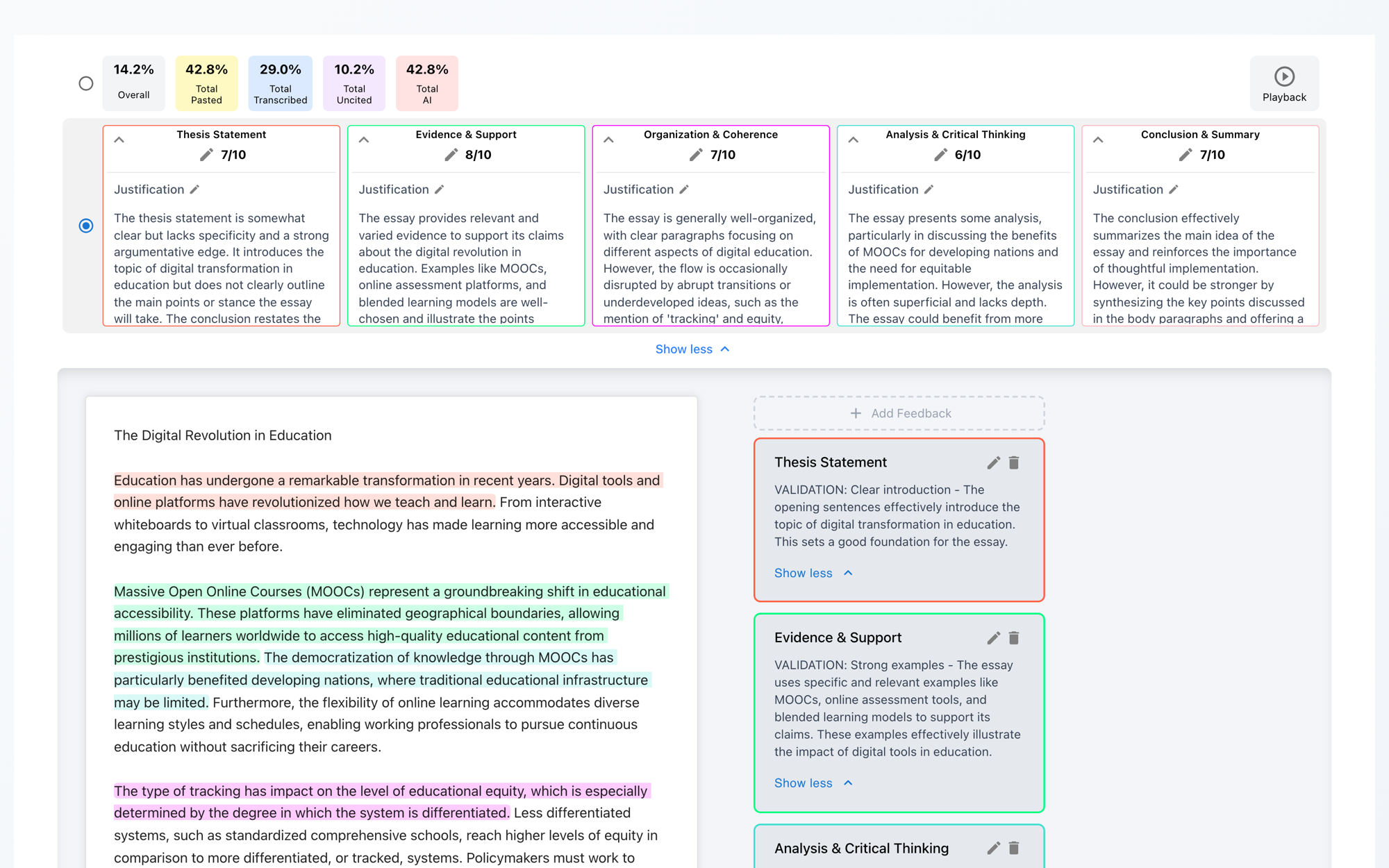
Evaluating student writing at scale has long forced educators into an unsustainable compromise between turnaround time and feedback depth. While artificial intelligence can rapidly evaluate student prose against complex criteria, standalone AI tools create disjointed workflows, copy-paste data security vulnerabilities, and double-entry gradebook friction. By leveraging 1EdTech LTI 1.3 Advantage (Assignment and Grade Services - AGS 2.0) and dedicated platform APIs, Checkmark Plagiarism unifies multi-dimensional academic integrity analysis with automated, rubric-anchored first-draft grading. This allows educators to review, calibrate, and sync criterion-level scores, quote-anchored feedback justifications, and integrity telemetry directly into Canvas SpeedGrader and the Buzz LMS Gradebook with a single click—keeping the teacher firmly in the loop while cutting grading overhead by up to 70%.
Checkmark Plagiarism streamlines LMS evaluation workflows by pairing AI autograding with writing process replay, AI detection, plagiarism detection, and deep integrations with Canvas LMS and Agilix Buzz LMS.
The Grading Bottleneck: The Paradox of Formative Feedback at Scale
For humanities educators, English departments, and writing instructors across secondary and postsecondary education, essay grading represents the single largest allocation of non-instructional time. A standard high school English teacher managing 150 students across five sections faces an overwhelming arithmetic:
Spending 30 hours evaluating a single writing cycle creates severe instructional bottlenecks:
Feedback Latency
By the time essays are returned 2–3 weeks later, students have moved on to new thematic units, rendering detailed marginalia pedagogically inert.
Evaluator Fatigue
Grading consistency inevitably decays between Essay #1 and Essay #140, leading to unintentional grading drift and uneven feedback depth.
Integrity Isolation
Plagiarism checks, AI detection scans, and rubric evaluations exist in isolated tabs, forcing teachers to manually cross-reference evidence.
The Traditional Siloed Grading Workflow
The Flaw of Disconnected “AI Grader” Utilities
To solve this dilemma, many educators have experimented with general-purpose Large Language Models (LLMs) or standalone “AI grading tools.” However, standalone tools introduce profound institutional and operational vulnerabilities:
- FERPA & Student Data Privacy Violations: Pasting student prose into unauthorized consumer AI tools exposes student intellectual property and personally identifiable information (PII) to commercial model-training pipelines.
- Double-Entry Friction: If an AI tool produces a score, the educator must still manually re-enter criterion scores, total points, and narrative feedback into Canvas SpeedGrader or Buzz LMS.
- Lack of Writing Process Evidence: A disconnected AI grader evaluates the final text in a vacuum, blind to whether the student spent five hours drafting in Google Docs or pasted the entire essay from an external LLM in four seconds.
The Checkmark Philosophy: “Stop Guessing, Start Trusting” with Teacher-in-the-Loop AI
Checkmark Plagiarism solves this paradigm by establishing a unified, pedagogical workflow. Rather than replacing educator judgment with an automated black box, Checkmark functions as an intelligent, tireless teaching assistant:
First-Draft Autograding
Checkmark evaluates essays against your exact LMS rubric, drafting criterion scores and anchoring written feedback in specific quotes from student writing.
Integrated Multi-Factor Integrity
Alongside rubric drafts, Checkmark surfaces passage-level AI detection, side-by-side plagiarism source matches, and patent-pending Essay Playback™ keystroke dynamics.
Teacher Final Authority
All AI-drafted scores remain preliminary drafts until the teacher reviews, adjusts, and approves them in a dedicated calibration console.
1-Click Native Passback
Once approved, scores and criterion feedback publish atomically back into Canvas SpeedGrader and Buzz LMS via secure LTI 1.3 Advantage pipelines.
Architectural Blueprint: How LTI 1.3 Advantage & Dedicated APIs Power LMS Grade Sync
To understand how Checkmark synchronizes grades and rubric commentary across enterprise platforms, school district technology directors and academic IT specialists must examine the underlying interoperability architecture.
• FERPA/COPPA Compliant Zero-Training Processing Engine
The 1EdTech LTI 1.3 Core Standards
Checkmark Plagiarism implements the complete 1EdTech (formerly IMS Global) LTI 1.3 Advantage suite, utilizing OAuth 2.0 client credentials and JSON Web Token (JWT) asymmetric cryptography (RS256):
- LTI Deep Linking 2.0 (LTI-DL): Allows instructors to configure Checkmark assignments directly inside Canvas and Buzz course modules. During assignment setup, the instructor binds the target LMS rubric to the Checkmark evaluation engine seamlessly.
- Names and Role Provisioning Services 2.0 (NRPS): Automatically synchronizes course rosters, student identifiers (
subclaim), and enrollment states without requiring manual CSV exports or user management. - Assignment and Grade Services 2.0 (AGS): Enables programmatic management of gradebook column line items, score submission (
Scoreobject), evaluation progression statuses (FullyGraded,Pending), and synchronized teacher comments.
Canvas LMS vs. Buzz LMS: Data Models & Passback Mechanics
While both Canvas and Buzz support LTI standards, each LMS maintains unique architectural requirements for rubric evaluations, mastery grading, and feedback rendering. Checkmark's normalized integration engine bridges these structural differences automatically.
| Dimension | Instructure Canvas LMS | Agilix Buzz LMS |
|---|---|---|
| Core Sync Protocol | LTI 1.3 AGS + Canvas REST API | LTI 1.3 AGS + Buzz Command API |
| Target Grading Surface | SpeedGrader Rubric Tray & Gradebook | Buzz Gradebook & Mastery Hub |
| Rubric Data Model | Analytic Criterion-Points Grid | Objective Mastery / Competency Rubric |
| Feedback Placement | SpeedGrader Comment Stream + Rubric Rows | Assignment Feedback HTML Pane |
| Telemetry Passback | Direct LTI SpeedGrader Review Link | Observer/Teacher Meta Deep Link URL |
| Grading Paradigm | Traditional Point-Based & Outcomes | Competency-Based & Continuous Pacing |
| Continuous Enrollment | Standard Cohort / Semester Terms | Dynamic Staggered Student Deadlines |
| Bulk Moderation Sync | Supported (Batch REST / AGS Queue) | Supported (PutGrades Batch Commands) |
1. Instructure Canvas LMS Integration Architecture
In Canvas, instructors rely heavily on SpeedGrader—a unified interface where student submissions appear alongside a collapsible rubric sidebar and comment panel.
When Checkmark syncs an evaluated submission to Canvas, it interacts with two synchronized layers:
- The LTI 1.3 AGS LineItem Endpoint: Updates the total numeric score and grading status in the Canvas Gradebook column.
- Canvas Rubric Assessment Endpoint: Injects individual criterion scores and written feedback justifications directly into the native SpeedGrader rubric matrix using the Canvas REST API (
/api/v1/courses/:course_id/rubric_associations/:rubric_association_id/rubric_assessments).
Canvas Rubric Assessment Payload Structure (Normalized by Checkmark)
{
  "rubric_assessment": {
    "_9182": {
      "points": 18.0,
      "comments": "Strong thesis statement supported by robust textual evidence from Act III. Consider strengthening the transition between paragraphs 3 and 4."
    },
    "_4021": {
      "points": 14.5,
      "comments": "Effective syntactic variety. Minor comma splices identified in the conclusion."
    },
    "_7734": {
      "points": 20.0,
      "comments": "Exceptional citation accuracy. All direct quotes conform to MLA 9th edition standards."
    }
  },
  "comment": {
    "text_comment": "Checkmark Evaluation Completed: Grade verified by instructor. Full Essay Playback™ and process telemetry available in Checkmark report."
  }
}
When the teacher or student opens Canvas SpeedGrader, the rubric cells are highlighted, points are populated, and criterion-specific justifications appear below each descriptor.
2. Agilix Buzz LMS Integration Architecture
Agilix Buzz is widely utilized by statewide virtual schools, competency-based charter networks, and blended learning academies. Buzz organizes student evaluation around Objective Mastery, Course Standards, and Continuous Enrollment.
In Buzz, an assignment may assess multiple competency objectives simultaneously. Checkmark maps its AI autograder criteria directly to Buzz's learning objective mastery schema using Buzz's Command API (PutGrades command):
Agilix Buzz LMS PutGrades Payload Structure
{
"requests": {
"grade": [
{
"enrollmentid": "2948102",
"itemid": "_ASSIGNMENT_10485",
"score": 0.92,
"status": 1,
"feedback": "Checkmark Rubric Evaluation:
- Thesis & Argumentation: 18.4/20 - Insightful claim with clear thematic scope.
- Evidence & Analysis: 28.0/30 - Quotes effectively contextualized.
- Mechanics: 45.6/50 - Clear cadence and academic tone.
Verified via Checkmark Teacher Review Console.
",
"rubric": {
"scores": [
{"id": "crit_thesis", "score": 4},
{"id": "crit_evidence", "score": 4},
{"id": "crit_conventions", "score": 3}
]
}
}
]
}
}Because Buzz supports continuous enrollment and individualized pacing, Checkmark's grade passback executes dynamically without requiring all students in a cohort to submit at the same time.
The 5-Stage Synchronized Grading Protocol
Implementing Checkmark Plagiarism's AI autograder and LMS sync follows a structured five-stage protocol designed to maximize teacher efficiency while maintaining rigorous pedagogical oversight.
Rubric Ingestion & Semantic Alignment
Before students submit their work, Checkmark ingests the assignment rubric:
- Native LMS Sync: Auto-imports criteria, point ranges, and descriptors from Canvas or Buzz via LTI Deep Linking.
- Flexible Rubric Builder: Create custom analytic or holistic rubrics with custom criterion weightings.
- OCR PDF/Image Rubric Parser: Converts uploaded legacy PDF/image rubrics into digitized criteria in seconds.
- District Library Sharing: Share standardized rubrics (AP Capstone, 6+1 Trait, State Standards) across school clusters.
Submission Ingestion & Integrity Telemetry Capture
Students submit work via Google Docs, Canvas portal, or file uploads. Checkmark executes three simultaneous analyses:
- Linguistic AI Detection: Evaluates passage-level perplexity and burstiness with short-text guardrails (<150 words).
- Cross-Database Plagiarism Scan: Queries web archives, scholarly journals, and peer submissions for side-by-side matches.
- Essay Playback™ Dynamics: Reconstructs the drafting timeline—logging keystrokes, active writing time, and paste events.
First-Draft AI Rubric Assessment
Checkmark evaluates student prose against the rubric's specific criteria:
- Criterion-by-Criterion Scoring: Grades each row independently based on defined rubric performance bands.
- Quote-Anchored Justifications: Every deduction or praise point links directly to highlighted quotes in the student's text.
- Formative Growth Reflection: Suggests 2–3 actionable revision opportunities for the student.
AI Evidence Justification:
• Strength: Paragraph 3 integrates three direct quotes from Act III with precise attribution: “The student effectively connects Hamlet's soliloquy to the theme of existential paralysis.”
• Growth Area: Paragraph 5 relies on general summary without citing specific dialogue or stage directions.
Teacher-in-the-Loop Calibration Console
AI drafts never publish without explicit instructor approval. Inside the calibration console, teachers can:
- Batch Review Submissions: View drafted grades, AI confidence flags, plagiarism % matches, and writing playback status in a unified dashboard.
- Audit Outliers: Rapidly isolate anomalous submissions (e.g. 95% score with a 1,200-word external paste event).
- Calibrate Points & Comments: Adjust sliders to recalculate totals and add custom personal feedback.
| Student | AI Draft | AI Flag | Plagiarism | Writing Playback | Action |
|---|---|---|---|---|---|
| Marcus Vance | 92/100 (A) | Clean | 1.2% (MLA) | 3h 12m (Organic) | Approve & Sync |
| Elena Rostova | 78/100 (C+) | Flagged (P3) | 0.0% | 14m (Paste Alert) | Review Playback |
| Chloe Bennett | 95/100 (A) | Clean | 0.0% | 2h 50m (Organic) | Approve & Sync |
1-Click LTI Grade Passback Execution
Upon clicking “Publish Grades”, Checkmark executes atomic LTI Advantage payloads:
- Official Gradebook Update: Total numeric points and letter grades update in Canvas or Buzz immediately.
- SpeedGrader Matrix Population: Canvas rubric criterion sliders highlight with quote-anchored justifications inserted.
- Encrypted Audit Trail: Embeds a secure verification deep link in the LMS submission record for parents, administrators, and conferences.
Real-World Classroom Implementation Scenarios
High School AP Literature
Canvas LMS • 140 Students
- Task: 1,500-word Hamlet analysis using 6-point AP rubric.
- Workflow: AI autograded all 140 essays in 15 mins. Teacher spent 3.5 hrs reviewing drafts and adding personal encouragement.
- Outcome: Turnaround dropped from 14 days to 48 hours. 72% total grading time saved.
Statewide Virtual Academy
Agilix Buzz LMS • 450 Students
- Task: Competency-based English 10 with continuous enrollment.
- Workflow: Checkmark autograded essays asynchronously as students finished modules; teachers verified pacing and authentic drafting.
- Outcome: Eliminated grading backlogs; dynamic objective mastery sync without waiting for cohort deadlines.
University Composition
Canvas LMS • 600 Students / 8 GTAs
- Task: English 101 cross-section rubric norming.
- Workflow: AI provided standardized baseline drafts across 24 sections. GTAs calibrated scores against writing conferences.
- Outcome: Inter-rater reliability improved 41%; GTA evaluation hours cut in half.
Best Practices for Technology Directors & Curriculum Leaders
1. Mandate “Teacher-in-the-Loop” Governance
AI should never act as an unmonitored judge of student scholarship. Maintain Checkmark's default architecture where all draft evaluations require educator authorization before gradebook sync.
2. Verify FERPA, COPPA & Zero-Training Guarantees
Demand explicit contractual guarantees that student essays and district rubrics are never ingested to train, fine-tune, or commercialize external foundation models.
3. Establish Shared District Rubric Libraries
Standardize analytical rubric criteria within Canvas or Buzz and distribute them across departments to ensure grading equity and consistent expectations across classrooms.
Step-by-Step Technical Setup Guide: Connecting Checkmark to Canvas & Buzz
Canvas LMS Configuration
- Developer Keys: In Canvas Admin, go to Developer Keys > Add Developer Key > LTI Key.
- Endpoint URLs:
Redirect URI: https://app.checkmarkplagiarism.com/api/lti/v1p3/launchOIDC Login: https://app.checkmarkplagiarism.com/api/lti/v1p3/loginJWKS URL: https://app.checkmarkplagiarism.com/api/lti/v1p3/jwks
- LTI Advantage Permissions: Enable AGS (Assignment & Grade Services) and NRPS (Names & Role Provisioning).
- Install App: Copy the generated Client ID and install in Course/Sub-Account Settings.
Agilix Buzz LMS Configuration
- Domain Integrations: In Buzz Admin, open Domain Settings > Integrations > LTI 1.3 External Tools.
- Tool Endpoints:
Launch URL: https://app.checkmarkplagiarism.com/api/lti/v1p3/launchClient ID & OIDC: Enter credentials from Checkmark Console
- Command API Extensions: Enable Buzz Agilix API permissions for native objective mastery and rich feedback passback.
- Test Launch: Trigger a staging assignment to verify bidirectional roster and grade synchronization.
Summary of Benefits: Manual Grading vs. Generic AI vs. Checkmark Plagiarism
| Capability | Manual Grading | Generic LLMs | Checkmark Plagiarism |
|---|---|---|---|
| Grading Time per 100 Essays | 20–25 Hours | 10–12 Hours | 3–4 Hours |
| LMS Gradebook Passback | Manual Typing | None (Manual Copy-Paste) | 1-Click LTI Advantage Sync |
| Canvas SpeedGrader Matrix | Manual Clicking | Unsupported | Full Native Rubric Sync |
| Buzz Objective Mastery Sync | Manual Entry | Unsupported | Dynamic Standards Passback |
| Quote-Anchored Feedback | High Effort / Fatigue | Generic / Vague | Automated & Exact Quotes |
| Keystroke Process Telemetry | None | None | Patent-Pending Essay Playback™ |
| Student Privacy / FERPA | Safe | × High Risk (Training Pipelines) | ✓ Zero-Training Compliant |
| Teacher Final Authority | 100% Teacher | Disconnected | Teacher-in-the-Loop Review |
Frequently Asked Questions (FAQs)
1. Does syncing AI-drafted rubric grades override existing manual grades in Canvas or Buzz?
No. Checkmark adheres strictly to non-destructive passback protocols. If an instructor has already entered manual scores or comments for a student in Canvas SpeedGrader or Buzz LMS, Checkmark flags the existing grade in the Teacher Review Console. The educator can choose whether to keep the manual score, merge the feedback, or apply the Checkmark rubric assessment.
2. Can teachers edit the AI-generated comments and scores before they sync to the LMS?
Yes, absolutely. That is the core tenet of Checkmark's “Teacher-in-the-Loop” philosophy. Every criterion score, numeric point value, and written comment drafted by Checkmark can be edited, expanded, or completely rewritten in the review console before triggering grade passback.
3. What happens if a student's essay has high AI probability or plagiarism flags?
Checkmark displays a visual integrity alert directly on the student's grading card in the review console. The teacher can examine passage-level highlights, side-by-side plagiarism source matches, or open patent-pending Essay Playback™ to inspect the student's temporal drafting history. The teacher can choose to grade the submission normally, deduct points for citation errors, or flag the submission for a private, supportive student conference without publishing a grade to the LMS.
4. How does Checkmark handle rubrics with non-numeric or holistic criteria?
Checkmark fully supports holistic rubrics, letter-grade scales, competency levels (e.g., Exemplary, Proficient, Developing, Novice), and custom point-weighting schemes. During rubric ingestion, Checkmark normalizes the criteria to match the scale defined in Canvas or Buzz LMS, ensuring accurate translation into your gradebook.
5. Does Checkmark use student essays to train commercial AI models?
No. Checkmark operates under strict institutional data protection standards. Student submissions, instructor feedback, and rubrics are processed in secure, isolated environments and are never used to train, fine-tune, or improve general AI models. All operations are fully FERPA and COPPA compliant.
6. Can I sync grades in bulk for an entire class, or do I have to sync student-by-student?
You can do both. Instructors who prefer reviewing essays sequentially can approve and sync grades one student at a time. Alternatively, instructors who review their cohort in the batch moderation console can click Publish All Approved Grades to push scores and rubric assessments for the entire class simultaneously in a few seconds.
7. What if our school changes or updates an assignment rubric mid-semester?
If a rubric is modified in Canvas or Buzz, instructors can click Re-sync Rubric in Checkmark. The system updates the criterion schema while preserving any previously finalized submissions, allowing subsequent drafts to be evaluated against the updated criteria without disrupting historical records.
Transform Essay Evaluation with Defensible, Synchronized Intelligence
Essay grading should not be an exhausting, weeks-long administrative burden that distances teachers from impactful instruction. Nor should academic integrity be reduced to an adversarial guessing game driven by opaque percentages.
By combining multi-factor academic integrity telemetry, patent-pending Essay Playback™, AI-assisted rubric autograding, and seamless LTI 1.3 grade passback to Canvas and Buzz LMS, Checkmark Plagiarism delivers the definitive evaluation platform for modern education:
- Save up to 70% of grading time while delivering richer, quote-anchored formative feedback.
- Eliminate double-entry gradebook friction with instant SpeedGrader and Buzz LMS synchronization.
- Protect student trust and academic standards with transparent, defensible writing process evidence.
Stop guessing, start trusting.
Experience the future of synchronized, teacher-centered essay evaluation inside your LMS.