
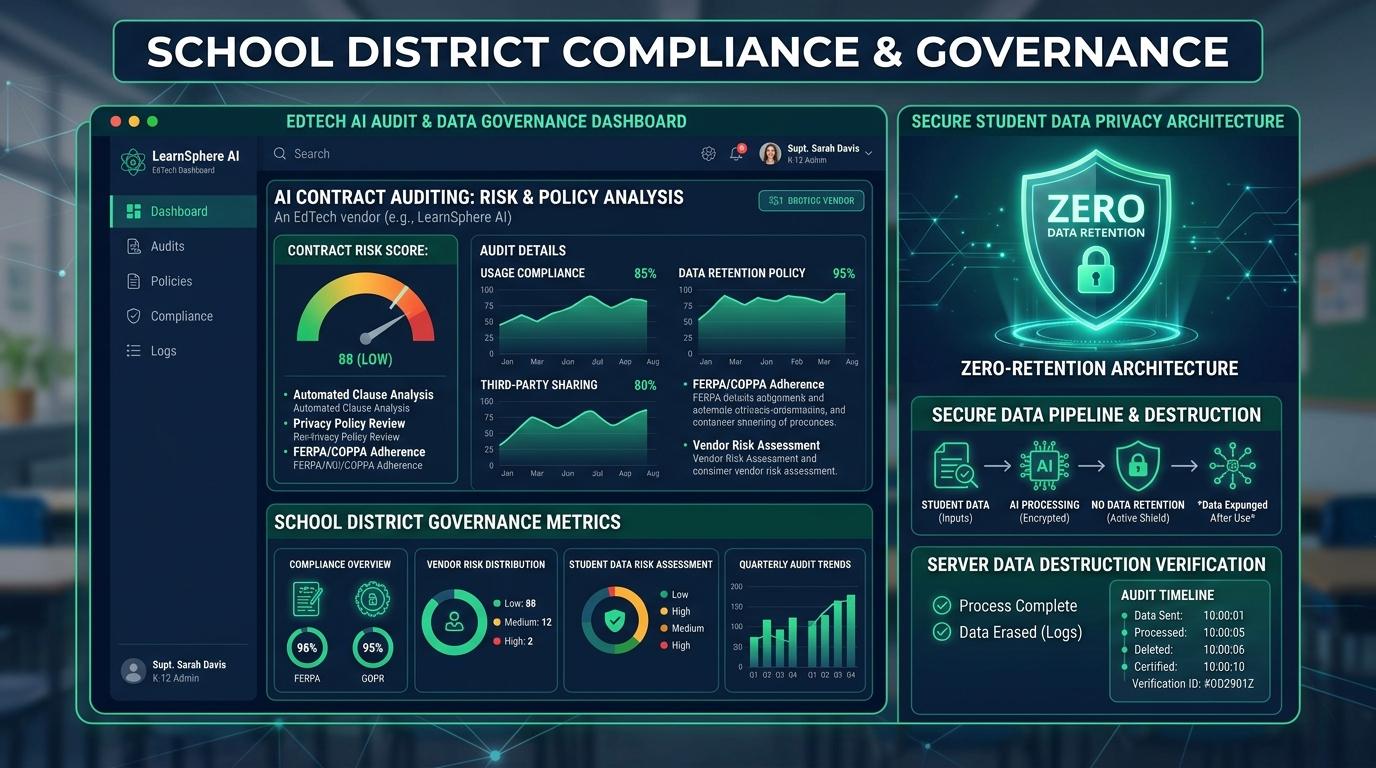
As school districts accelerate the adoption of generative AI writing assistants, automated grading engines, and academic integrity platforms, school boards face an unprecedented governance challenge: protecting student data sovereignty in an era of data-hungry neural networks. Standard vendor assurances such as “We are FERPA compliant” or “We offer a model training opt-out” are no longer sufficient. Consumer-grade AI architectures frequently cache student essays, log keystroke telemetry, and expose sensitive intellectual property to third-party sub-processor pipelines. To maintain statutory compliance and safeguard student trust, school boards, superintendents, and district technology directors must transition from passive policy acceptance to active architectural auditing. This guide establishes a rigorous procurement evaluation framework—contrasting flawed “opt-out” checkboxes with True Zero-Retention (Ephemeral Processing), providing contract redlining clauses, and highlighting how Checkmark Plagiarism delivers enterprise-grade academic integrity, autograding, and patent-pending Essay Playback™ within an uncompromising zero-training, school-isolated security perimeter.
Checkmark Plagiarism empowers school boards, superintendents, and IT leadership to implement defensible writing governance by unifying passage-level AI detection, side-by-side plagiarism verification, rubric-based autograding, and patent-pending Essay Playback™ writing process telemetry within a strict zero-retention, FERPA-compliant infrastructure integrated with Canvas LMS and Agilix Buzz LMS.
The High-Stakes Shift: Why AI Contracts Break Traditional EdTech Privacy Frameworks
For nearly two decades, educational technology procurement followed a well-understood legal playbook. When a school district licensed a cloud-hosted Student Information System (SIS), Learning Management System (LMS), or digital textbook platform, data privacy focused primarily on access control:
- Who has access to the student database?
- Is data encrypted in transit (TLS 1.3) and at rest (AES-256)?
- Does the vendor promise not to sell student Personally Identifiable Information (PII) to behavioral advertisers?
Under standard cloud agreements, student data was stored in relational databases, served back to authorized educators upon request, and remained isolated within tenant silos.
The Generative AI Paradigm Shift
The rapid rollout of Large Language Models (LLMs), natural language processing (NLP) detectors, and algorithmic autograders has fundamentally shattered this traditional paradigm. AI systems are not passive storage lockers; they are computational engines that require massive, continuous corpuses of textual data to train, fine-tune, evaluate, and calibrate parameters.
| Architectural Dimension | Traditional SaaS EdTech (SIS, LMS) | Generative AI & Black-Box EdTech |
|---|---|---|
| Data Storage Mode | Relational database records | Massive token ingestion & parameter updating |
| Data at Rest | Static encrypted disk storage (AES-256) | Latent representation embedded in model weights |
| Retrieval Mechanism | Deterministic SQL query | Probabilistic generative output & vector search |
| Data Deletion | Straightforward row-level SQL purge | Irreversible memorization across neural weights |
| Supply Chain | Direct vendor-to-district hosting | Multi-tier sub-processor API pipelines (OpenAI, AWS, Anthropic) |
When a student submits an original 1,500-word personal narrative, a reflective humanities essay, or a timed history paper into an AI-powered educational platform, that document contains far more than academic prose. It contains:
Biographical Markers
Family background, political perspectives, emotional reflections, and unique authorial voice that can easily identify a minor.
Student Intellectual Property
Original thesis arguments, creative compositions, and preliminary research hypotheses owned by the student.
Temporal Biometric Telemetry
Keystroke timing, writing cadence, deletion frequency, and pause durations reflecting cognitive drafting patterns.
If an EdTech vendor captures, retains, or repurposes this data—even under the guise of “product improvement” or “algorithmic training”—the district faces profound legal liabilities under federal and state statutes, violates student privacy rights, and compromises community trust.
The Illusion of Compliance: Deconstructing Marketing Buzzwords vs. Technical Reality
When school board members and district technology directors review vendor proposals, they frequently encounter boilerplate marketing claims. Understanding the legal and technical reality behind these slogans is the first step toward effective oversight.
| What Vendor Proposals Claim | What Legal & Technical Audits Reveal |
|---|---|
| “We are 100% FERPA Compliant” | Relies on broad “School Official” exceptions while retaining student essays for internal AI tuning and algorithm refinement. |
| “We Never Sell Student Data” | Commercializes student data indirectly by utilizing student text to train proprietary commercial AI models that are sold to other clients. |
| “All Data is Anonymized / De-Identified” | Strips student names but feeds full-text prose containing personal details and stylometric signatures into cloud LLM pipelines. |
| “We Offer a Model Opt-Out Toggle” | Opt-out applies only to future model training; 30-to-90-day server logging, prompt caching, and human moderation caches remain active. |
| “Enterprise Cloud Encryption (AES-256)” | Data is encrypted in the primary database, but transmitted in cleartext payloads to third-party AI sub-processor APIs. |
1. “FERPA Compliant” and the “School Official” Exception Trap
The Family Educational Rights and Privacy Act (FERPA, 34 CFR Part 99) strictly prohibits educational institutions from disclosing education records containing Personally Identifiable Information (PII) without prior written parental consent.
To operate in public schools, EdTech vendors routinely invoke the “School Official Exception” (34 CFR § 99.31(a)(1)(i)(B)). Under this provision, an outside contractor may receive student records without parental consent only if the contractor:
- Performs an institutional service for which the school would otherwise use employees;
- Operates under the direct control of the school or district regarding the use and maintenance of education records;
- Adheres to strict redisclosure and secondary-use limitations (34 CFR § 99.33(a)).
If an EdTech AI vendor uses student submissions, writing process telemetry, or autograding interactions to train, retrain, or improve its commercial machine learning algorithms, the vendor is not operating under the direct control of the district for a sole educational purpose. The moment student data is fed into a model-training pipeline, the “School Official” exception is violated, placing the school district in direct non-compliance with federal law.
2. The “De-Identified” and “Anonymized Data” Myth in Generative AI
Under traditional privacy regulations, vendors could legally aggregate and analyze “de-identified” student records by stripping direct identifiers such as names, student ID numbers, and email addresses. In the era of generative AI, textual “de-identification” is virtually impossible:
- Contextual Re-Identification: An English essay detailing a student's experience moving from a specific town, mentioning a sibling's rare medical condition, or describing a specific local community event can easily be re-identified when processed by modern LLMs.
- Stylometric Fingerprinting: Advanced linguistic models can match authorial voice, syntactic tendencies, and vocabulary distribution across disparate datasets with high statistical certainty.
- Vector Embeddings: Converting student writing into high-dimensional mathematical representations (embeddings) creates persistent semantic fingerprints that can be reverse-engineered or queried to reveal sensitive underlying content.
School boards must ensure that district contracts explicitly reject standard “anonymized data aggregation” carve-outs when dealing with student writing and AI analysis.
3. The Sub-Processor & Third-Party API Supply Chain Blindspot
Many EdTech startups and legacy plagiarism vendors do not host their own proprietary foundation models. Instead, they act as application wrappers, routing student text to third-party foundational AI providers (such as OpenAI, Anthropic, Google Cloud Vertex AI, or Amazon Bedrock) via Application Programming Interfaces (APIs).
• Risk: Potential model retraining if commercial API tier is misconfigured.
• Massive attack surface for data breaches and secondary commercial exploitation.
A vendor's privacy policy is only as robust as its weakest sub-processor agreement. If a vendor signs a compliant district Data Privacy Agreement (DPA) but routes student essays through a third-party commercial API that retains data for 30 days for “abuse monitoring” or model fine-tuning, the district's student data remains exposed.
Technical Deep Dive: Model Training Opt-Outs vs. True Zero-Retention Architecture
When evaluating AI contracts, the central technical distinction school boards must understand is the difference between an administrative model training opt-out and a structurally enforced Zero-Retention Architecture.
| Architectural Dimension | Model Training Opt-Out | True Zero-Retention (ZDR) |
|---|---|---|
| Data Ingestion Mechanism | Ingested, logged, and stored on server disk | Volatile RAM processing only |
| Persistent Storage Duration | 30 to 90 days (server & abuse logs) | 0 seconds (Immediate Memory Purge) |
| Vector Database Indexing | Permanent across multi-tenant clusters | Scoped ephemeral in-memory cache |
| Human Moderation Logs | Enabled for safety sampling | Explicitly disabled via enterprise ZDR |
| Model Retraining Exposure | High risk of pipeline leakage / bugs | Structurally impossible |
| Peer Plagiarism Matching | Stores full raw essays in shared archive | One-way cryptographic hash vaults |
| Verification & Defensibility | Vendor verbal promise (“trust me”) | Verifiable API logs |
Why “Model Training Opt-Outs” Fail District Audits
Many software vendors provide administrative “opt-out” checkboxes in their settings console or data addendums. While this sounds reassuring to non-technical committees, opt-out mechanisms suffer from critical structural weaknesses:
- Default-to-Ingest Pipelines: In opt-out models, the software architecture is inherently built to capture, ingest, and store raw payloads. The opt-out functions as an application-level filter rather than an architectural barrier. A single code deployment bug, database schema update, or administrative misconfiguration can silently re-enable data ingestion across thousands of student accounts.
- Server-Side Abuse Monitoring Caches: Standard commercial LLM endpoints retain full-text prompt and response logs on their servers for 30 to 90 days to monitor for Terms of Service violations. Even if data is not used for long-term model training, student essays sit unencrypted in multi-tenant log stores during that retention window, creating a massive attack surface for data breaches.
- The Machine Unlearning Dilemma: Once a deep neural network is trained on a dataset, that data cannot be selectively deleted. Machine learning models do not store documents as discrete files; information is distributed across billions of numeric weights (parameters). True “unlearning” (machine unlearning) remains an unsolved computer science challenge. If a vendor inadvertently trains an AI model on student essays before an opt-out is processed, the only remedy is destroying the entire model weights—an action no vendor will voluntarily undertake.
✓ 1-Click Deterministic Deletion: File and record permanently purged from database tables and backup cycles.
× Impossible to Selectively Purge: Student prose is permanently embedded across billions of neural parameters.
The Gold Standard: True Zero-Retention Architecture (Ephemeral Processing)
To eliminate legal risk and guarantee absolute student privacy, school boards must mandate True Zero-Retention Architecture (Zero Data Retention - ZDR) for all generative AI, autograding, and detection tools.
In a True Zero-Retention architecture:
- Volatile Memory (RAM) Execution: The student submission is received over an encrypted TLS 1.3 pipeline, loaded into volatile memory, analyzed against linguistic models or rubric criteria, and the generated evaluation report is returned directly to the LMS.
- Immediate Payload Purge: The moment the response payload is transmitted, the raw text is immediately deallocated and wiped from system RAM. No temporary disk caches, no prompt logs, and no debugging archives are created.
- Enterprise Zero-Retention Endpoints: All external model interactions utilize enterprise-grade Zero Data Retention agreements with foundation model providers, ensuring that third-party servers bypass standard 30-day abuse monitoring caches entirely.
- Isolated Cryptographic Peer Fingerprinting: For student-to-student plagiarism detection across classrooms or district cohorts, the platform generates irreversible cryptographic hashes and n-gram shingles rather than storing raw, readable text in a shared cloud database. These mathematical hashes allow exact-match detection within the district's private silo without exposing student prose to external repositories.
Perplexity & burstiness modeling
Quote-anchored feedback drafts
Keystroke dynamics & paste capture
The EdTech AI Procurement Audit Matrix: A 10-Point Technical Checklist
When school boards, district technology committees, and legal counsels review vendor contracts, they should require vendors to complete the following 10-Point Technical Audit Matrix. Every requirement must be backed by legally binding contract language rather than verbal or marketing assurances.
| # | Procurement Dimension | Red Flag / Non-Compliant | Compliant / Gold Standard |
|---|---|---|---|
| 1 | Model Training & Tuning | Vendor uses student essays to train public or internal AI models. | Explicit 0% training guarantee in master DPA contract. |
| 2 | Retention Window | Indefinite storage or 30-to-90-day prompt server logging. | 0-day retention; volatile RAM execution only. |
| 3 | Sub-Processor Contracts | Third-party LLM APIs retain data for abuse monitoring caches. | Enforced Zero Data Retention (ZDR) on all external APIs. |
| 4 | De-Identification Terms | Vendor claims ownership of “anonymized / derived” data. | District retains 100% ownership of all data and derivatives. |
| 5 | Peer Plagiarism Archive | Submissions uploaded to a global, multi-school commercial pool. | District-scoped, one-way cryptographic hash vaults. |
| 6 | Biometric / Telemetry Data | Keystroke logs commercialized or shared with third parties. | Keystroke telemetry scoped strictly to educator review console. |
| 7 | State Privacy Compliance | Generic terms of service; refuses standard state DPAs. | Signs state DPAs (SDPC NDPA Exhibit E, NY 2-d, SOPIPA, SOPPA). |
| 8 | Termination Data Purge | Data remains in model weights or unverified backup archives. | Complete, verified NIST 800-88 data purge within 30 days. |
| 9 | Security Verification | Self-attested compliance questionnaires without audits. | Independent SOC 2 Type II audit report & district audit rights. |
| 10 | Due Process & Visibility | Opaque black-box AI score; punitive flags shown to students. | Transparent receipts, educator-only visibility, teacher authority. |
Contract Redlining Guide: Red Flag Clauses vs. Gold Standard Contract Language
School district legal counsels, Chief Information Officers, and procurement officers should utilize this side-by-side redlining guide to identify predatory or negligent contract clauses in vendor Master Service Agreements (MSAs) and End User License Agreements (EULAs).
Clause 1: Intellectual Property & Data Ownership
“Customer grants Vendor a worldwide, royalty-free, perpetual, irrevocable license to use, host, store, reproduce, modify, and create derivative works from Customer Data, including student submissions, solely for the purposes of operating, maintaining, developing, and improving Vendor's current and future products, algorithms, and machine learning services.”
“As between District and Vendor, District retains all right, title, and interest, including all intellectual property and proprietary rights, in and to all Customer Data and Student Work. Vendor is granted only a limited, non-exclusive, revocable license to process Student Work solely for the explicit purpose of delivering the contracted educational services to the District. Under no circumstances shall Vendor or its sub-processors use Student Work, writing telemetry, or derived metadata to train, retrain, fine-tune, or validate any artificial intelligence, machine learning model, or algorithmic scoring system.”
Clause 2: Data Retention & Zero-Retention Mandate
“Vendor may retain Customer Data, logs, and user activity records for a commercially reasonable period to ensure system stability, prevent abuse, and enhance service reliability. Anonymized data may be retained indefinitely.”
“Vendor shall implement a Zero Data Retention (ZDR) architecture for all generative AI and automated assessment modules. Student submissions and associated writing telemetry shall be processed strictly in volatile memory (RAM) and purged immediately upon transmission of evaluation results back to the District's Learning Management System. No unencrypted server logs, prompt caches, or temporary disk archives containing Student Work shall be retained beyond the active execution session. All third-party sub-processor API pipelines utilized by Vendor must operate under binding zero-data retention agreements with logging explicitly disabled.”
Clause 3: Plagiarism Repositories & Cross-Institutional Matching
“To provide comprehensive plagiarism and collusion detection, all submitted student essays will be indexed into Vendor's global institutional repository and cross-matched against submissions from other educational institutions.”
“Vendor shall not upload, pool, or cross-match District Student Work into any public or global repository accessible by third-party institutions. Any peer-match plagiarism or collusion detection must be strictly isolated to the District's private, dedicated institutional silo. Peer-matching algorithms shall utilize one-way, irreversible cryptographic hashing or shingling techniques, ensuring that cleartext student prose is never stored, exposed, or readable across tenant boundaries.”
Clause 4: Contract Termination & Certified Data Destruction
“Upon termination of this Agreement, Vendor will deactivate Customer accounts. Backups will be overwritten in the normal course of business.”
“Within thirty (30) calendar days of contract expiration or written termination notice, Vendor shall securely and permanently destroy all District Data, student records, cryptographic hashes, and backup archives in accordance with NIST Special Publication 800-88 Revision 1 (Guidelines for Media Sanitization). Vendor shall deliver a signed, legally binding Certificate of Destruction executed by an authorized corporate officer confirming complete data eradication.”
Real-World District Scenarios & Procurement Case Studies
To understand how data retention vulnerabilities manifest in practice, examine three realistic district procurement pathways.
The “Free AI Assistant” Shadow IT
Suburban District • 14,000 Students
- Context: High school teachers recommended a “free” online grammar and AI checker.
- Vulnerability: Under consumer terms, essays were ingested into a commercial training corpus.
- Impact: Verbatim excerpts of a student's personal admissions essay surfaced in public chatbot queries. Massive parental FERPA complaints.
The Sub-Processor Latent Data Breach
Unified School District • 32,000 Students
- Context: District licensed an AI autograder with a signed state DPA.
- Vulnerability: Vendor utilized a commercial API tier that cached prompts for 90 days.
- Impact: Sub-processor cloud breach exposed 45,000 student essays with teacher comments, triggering state regulatory penalties.
Proactive Governance with Checkmark
Public School System • 28,000 Students
- Context: District mandated architectural audit before deploying AI integrity tools.
- Solution: Deployed Checkmark with 0-day retention, isolated hash vaults, and Canvas/Buzz sync.
- Impact: 100% student data sovereignty and false AI accusation disputes dropped to near zero.
Checkmark Plagiarism’s Enterprise Security & Zero-Retention Blueprint
Checkmark Plagiarism was engineered from the ground up to solve the dual challenges of the AI era: empowering educators with deep, defensible writing insights while providing absolute, uncompromised student data protection.
Zero Model Training Guarantee
Student work is never used to train, calibrate, or tune commercial or internal AI models. Guaranteed in legally binding master DPAs.
Ephemeral In-Memory Execution
Essays and telemetry are processed in volatile RAM (0-Day retention) and purged immediately upon report transmission back to the LMS.
District-Isolated Vaults
Peer-match plagiarism detection uses one-way cryptographic hashes isolated strictly to your school or district silo.
Patent-Pending Essay Playback™
Verifies authentic composition through non-invasive keystroke dynamics, revision pauses, and external paste tracking.
Educator-Only Safeguards
AI probability highlights are strictly educator-facing to prevent arbitrary, punitive automated accusations against students.
Full Regulatory Compliance
100% FERPA, COPPA, CSPC, SOPIPA, SOPPA, and NY Education Law § 2-d compliant; ready to execute SDPC National DPAs.
Multi-Factor Integrity: Moving Beyond Opaque Percentages
Traditional AI detectors output an arbitrary, whole-document percentage (e.g., “87% AI”), leaving teachers with no actionable evidence and exposing districts to contentious parent disputes. Checkmark replaces black-box guessing with multi-dimensional receipts:
- Passage-Level Granularity: Highlights specific sentences with calibrated confidence sliders, allowing teachers to distinguish between AI-generated paragraphs and organic human prose.
- Side-by-Side Plagiarism Comparisons: Matches text against billions of live web sources and digital archives with direct, clickable source links.
- Patent-Pending Essay Playback™: Reconstructs the student's entire writing session keystroke-by-keystroke at 1x to 8x speed. Teachers can inspect drafting pauses, real-time revisions, transcription cadence, and exact external paste timestamps—providing undeniable proof that clears honest students and clarifies unauthorized shortcuts.
- Educator-in-the-Loop Autograding: Evaluates essays against your exact district rubrics, drafting criterion scores and quote-anchored justifications while leaving final grade authority with the instructor.
Actionable Toolkit: Model Board Policy Resolution & District DPA Addendum
School boards seeking to establish immediate governance over AI procurement can adapt the following model resolution and standard contract addendum.
BOARD RESOLUTION NO. [______]
ADOPTION OF DISTRICT STANDARDS FOR ARTIFICIAL INTELLIGENCE & STUDENT DATA RETENTION
WHEREAS, the [District Name] Board of Education is committed to protecting the privacy, intellectual property, and civil rights of all students; and
WHEREAS, emerging artificial intelligence technologies present unique data privacy risks, including unauthorized data retention, model training on student prose, and latent data exposure;
NOW, THEREFORE, BE IT RESOLVED, that the Board of Education establishes the following mandatory procurement standards for all EdTech software incorporating generative AI, natural language processing, automated grading, or writing analytics:
- ZERO MODEL TRAINING MANDATE: No software shall be licensed or approved that utilizes District student data, student submissions, or writing telemetry to train, retrain, or fine-tune public or proprietary AI models.
- EPHEMERAL DATA RETENTION: All AI evaluation engines must operate under verified Zero Data Retention (ZDR) architectures, purging raw student text from system memory immediately upon delivery of results.
- DISTRICT-SCOPED DATA SILOS: Plagiarism repositories must remain private to the District and utilize irreversible cryptographic hashing.
- HUMAN-IN-THE-LOOP REQUIREMENT: Automated AI systems shall not be utilized to assign final punitive grades or academic misconduct penalties without mandatory, verified educator review and transparent evidentiary receipts.
PASSED AND ADOPTED this [____] day of [Month], 2026.
Frequently Asked Questions (FAQ)
1. Does FERPA allow AI vendors to use de-identified student essays to train their models?
No. Under the FERPA “School Official” exception (34 CFR § 99.31), an outside vendor may access student education records only to perform an outsourced institutional service on behalf of the district and under its direct control. Repurposing student essays—even without direct names—to build, train, or refine a commercial machine learning product constitutes an unauthorized commercial secondary use, violating federal law. Furthermore, full-text student essays cannot be reliably de-identified due to unique contextual, biographical, and stylistic markers.
2. What is the difference between a “Model Training Opt-Out” and “Zero-Retention Architecture”?
An opt-out is an administrative setting where the vendor's software still ingests and stores student data on servers, relying on software filters to exclude that data from future training cycles. This leaves data vulnerable to 30-to-90-day server logging, cloud breaches, and accidental leaks. Zero-Retention Architecture (ZDR) is a hardware- and API-level design where student text is processed exclusively in volatile system RAM and destroyed immediately after analysis, leaving zero stored data on disk or third-party servers.
3. How does Checkmark Plagiarism detect peer plagiarism without storing cleartext essays in a shared cloud database?
Checkmark utilizes isolated cryptographic hashing and n-gram shingling. When an essay is submitted, the system converts the text into irreversible, one-way mathematical hash signatures stored strictly within your district's private repository. When another student submits an essay, their text is hashed and compared mathematically against the district vault. This allows exact and near-match similarity detection without ever storing, exposing, or sharing readable student prose across institutional boundaries.
4. Are keystroke dynamics and writing playback considered biometric data under state privacy laws?
Under state student data privacy laws (such as California's SOPIPA, New York's Ed Law 2-d, and Illinois' SOPPA), behavioral and telemetry data collected from students must be protected with the same stringent security standards as traditional PII. Checkmark treats Essay Playback™ telemetry as confidential, district-owned educational records. Keystroke timing and revision metadata are strictly educator-facing, encrypted with AES-256 at rest, and never shared, monetized, or used for behavioral profiling.
5. What should a district do if an existing vendor refuses to sign a Zero-Retention DPA?
If a vendor refuses to commit to zero model training and zero data retention in a legally binding Data Privacy Agreement (such as the SDPC National Data Privacy Agreement), the district should pause procurement or terminate the contract. Continuing to send student work to an unverified AI vendor exposes the district, school board members, and administrators to severe regulatory penalties, breach liability, and community distrust.
6. Can an AI detector's percentage score be used as the sole basis for an academic integrity penalty?
Never. Statistical AI detection percentages are probabilistic estimates based on perplexity and burstiness; they are not infallible proof. Punitive disciplinary action based solely on an opaque score violates fundamental principles of academic due process. Checkmark Plagiarism provides a multi-dimensional evidence suite—combining passage-level AI confidence sliders, side-by-side plagiarism source quotes, and patent-pending Essay Playback™ writing process timelines—enabling educators to base conversations on transparent, undeniable evidence (“receipts”) rather than black-box algorithms.
7. How does Checkmark integrate with our existing Canvas or Buzz LMS environment?
Checkmark integrates seamlessly via 1EdTech LTI 1.3 Advantage protocols (Assignment and Grade Services 2.0, Deep Linking 2.0, and Names and Role Provisioning Services). It supports single sign-on (SSO) via Google and Microsoft, synchronizes course rosters automatically, and allows teachers to review AI autograder drafts and launch Essay Playback™ directly within Canvas SpeedGrader or the Buzz LMS Gradebook without double-entry friction.
Conclusion: Lead with Clarity, Protect with Confidence
As artificial intelligence becomes an integral component of the 21st-century educational landscape, school boards hold the ultimate responsibility for ensuring that technological progress does not come at the expense of student privacy and intellectual sovereignty.
By enforcing strict procurement auditing, rejecting ambiguous opt-out clauses, mandating True Zero-Retention architectures, and partnering with transparent, educator-first platforms like Checkmark Plagiarism, district leaders can foster an academic environment built on defensibility, equity, and trust.
Ready to Bring Defensible Academic Integrity & Zero-Retention AI Governance to Your District?
Schedule an architectural security review with our educational technology specialists to audit your district's AI contracts and explore Checkmark's enterprise LMS integration.