
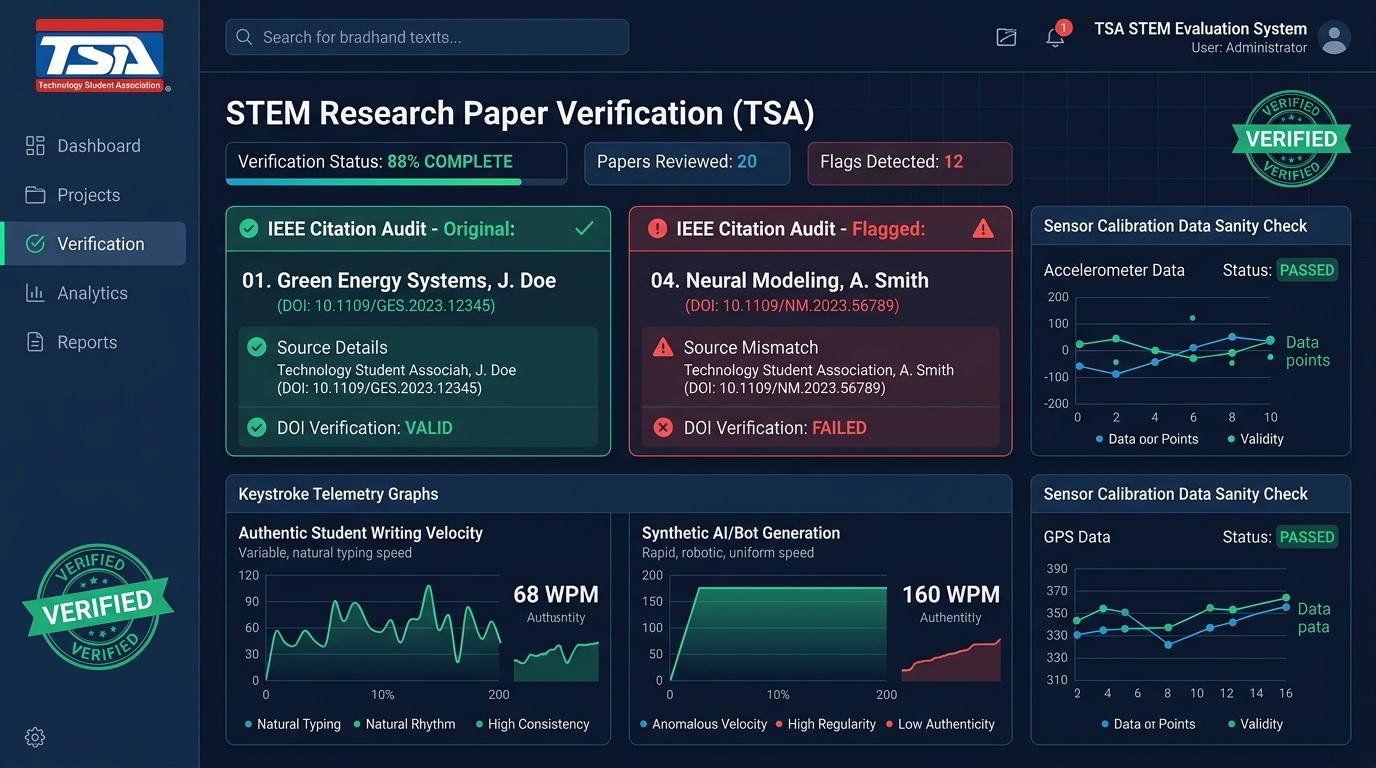
In secondary Career and Technical Education (CTE) engineering and STEM pathways, the STEM research white paper written by students in Technology Student Association (TSA) chapters and CTE pathways represents a high point of high school technical scholarship. Students are challenged to author a rigorous academic manuscript investigating cutting-edge subtopics—such as decentralized microgrid power routing, solid-state electrolyte interfaces, CRISPR-Cas agricultural therapeutics, or carbon nanotube composites—formatted according to IEEE or APA 7th edition referencing standards.
However, high school TSA chapter advisers, CTE department chairs, and competitive event judges face an acute academic integrity dilemma: as regional, state, and national submission deadlines converge with heavy student academic loads, competitors increasingly prompt generative Large Language Models (LLMs) to draft technical literature reviews and experimental summaries. Generative models effortlessly fabricate convincing scientific prose that hallucinates non-existent IEEE and Nature DOI citations, confabulates fake academic researchers and university lab affiliations, smooths out messy laboratory noise to invent impossible 99.8% energy conversion efficiencies, and generates generic technical jargon detached from physical bench experimentation in the school maker lab. Compounding this crisis, generic commercial AI percentage detectors fail catastrophically in STEM—flagging standardized engineering syntax, LaTeX equations, chemical formulas, and IEEE numerical reference brackets [1] as “AI-generated” while completely missing sophisticated, paraphrased AI-generated research papers. Checkmark Plagiarism provides high school TSA advisers with an integrated, defensible verification suite: pairing passage-level AI confidence sliders and side-by-side DOI and source quotation viewers with patent-pending Essay Playback™ writing telemetry (1x–8x replay), external clipboard paste buffer inspection, and quote-anchored rubric autograding synced directly into Canvas LMS, Agilix Buzz, and Google Classroom.
Checkmark Plagiarism empowers STEM educators and TSA chapter advisers through an integrated suite of writing process playback, passage-level AI detection, side-by-side source verification, rubric autograding, and native LMS integrations.
1. The Disciplinary Architecture of TSA Research-Based Events
The Technology Student Association (TSA) is the premier national Career and Technical Student Organization (CTSO) dedicated to students enrolled in STEM and CTE pathways. TSA publishes a High School Competitive Events Guide, and its research-based events, such as Biotechnology Design, Engineering Design, and Future Technology Teacher, ask students to document research and connect it to an applied engineering, biotechnology, or classroom solution. A student STEM research white paper extends that same expectation, bridging theoretical scientific literature with empirical engineering application.
Unlike general humanities essays, a STEM research white paper is a formal, peer-review-style technical manuscript. Students are evaluated on their ability to conduct primary and secondary scientific research, synthesize complex peer-reviewed literature, document controlled experimental methodologies, analyze empirical quantitative datasets with statistical significance testing, and format technical citations with absolute professional fidelity.
| TSA Competitive Event | Format & Scope | Disciplinary Focus & Integrity Vulnerability |
|---|---|---|
| Data Science and Analytics |
Documentation & Poster Digital Scientific Poster • Semifinal Onsite Challenge |
Societal issue investigated with data collected or compiled from various sources; findings documented.
⚠️ Vulnerability: Fabricated datasets, hallucinated sources & ungrounded literature reviews.
|
| Biotechnology Design |
Documentation & Display Optional Model • Multimedia Presentation |
Contemporary biotechnology problem tied to the annual theme; documented research and a developed solution.
⚠️ Vulnerability: AI-generated trial logs, synthetic enzyme kinetics & bio-assays.
|
| Engineering Design |
Documentation Portfolio Display • Model/Prototype |
Solution to an annual theme based on a National Academy of Engineering grand challenge; documentation portfolio, display, and model/prototype.
⚠️ Vulnerability: Retrofitted shop fabrication logs & AI-drafted failure analyses.
|
| Future Technology Teacher |
Research & Lesson Plan Classroom Video • Standards Alignment |
Research on a developing technology; lesson plan connected to the Standards for Technological and Engineering Literacy (STEL).
⚠️ Vulnerability: AI-generated pedagogical theory & synthetic learning objectives.
|
| Debating Technological Issues |
Summary of References Research-Backed Debate |
Research on the annual topic and subtopics; teams submit a summary of references and use their research to support an assigned pro or con position.
⚠️ Vulnerability: Hallucinated references in the summary of references & unverified supporting claims.
|
The Typical Structural Anatomy of a STEM Research White Paper
A well-formed STEM research white paper typically follows a standard scientific structure:
A concise synthesis of the research hypothesis, experimental parameters, primary analytical methodology, and quantitative findings formatted to the assignment or competition specifications.
Articulation of the assigned topic or challenge (e.g., Sustainable Decentralized Microgrids in Arctic Climates or Solid-State Electrolyte Dendrite Suppression), defining the scientific gap and engineering constraints.
Synthesis of existing peer-reviewed literature, establishing prior art and technological baselines using standard academic indexing (IEEE or APA 7th Edition).
Detailed, reproducible documentation of laboratory apparatus, sensor calibration protocols, breadboard or bench circuitry, chemical reagent purity, software simulation parameters (e.g., MATLAB, ANSYS, Simulink), and safety matrices.
Presentation of raw and processed quantitative data, including high-resolution tables, scatter plots with regression curves (R²), error bars representing standard deviation (σ) or 95% confidence intervals, and hypothesis significance testing (paired t-tests, two-way ANOVA with p-values).
Critical interpretation of experimental anomalies, sensor measurement tolerances, hardware failure modes, thermal dissipation bottlenecks, and trade-off analyses.
Concrete engineering recommendations for physical implementation, economic feasibility, and future iterations.
Strict IEEE numerical bracket indexing ([1], [2]) or APA 7th edition author-date format with authentic, verifiable Digital Object Identifiers (DOIs) and direct URLs.
| Evaluation Dimension | Illustrative Weight | Key Rubric Indicators |
|---|---|---|
| 1. Problem Definition & Relevance | 15–20% | Originality of inquiry, alignment with annual theme, depth of technological context, societal and industrial impact. |
| 2. Literature Synthesis & Citation Authenticity | 20–25% | Credibility of scholarly sources, integration of peer-reviewed journals, absence of uncited claims or hallucinated DOIs. |
| 3. Experimental Design & Empirical Data | 20–25% | Methodological reproducibility, apparatus precision, valid statistical analysis (p < 0.05), error bars, and calibration bounds. |
| 4. Technical Analysis & Engineering Logic | 20–25% | Insightful discussion of failure modes, trade-offs, realistic efficiency constraints, and future scalability. |
| 5. Structural Format & Technical Style | 10–15% | Strict IEEE/APA formatting, manuscript layout, precision of scientific terminology, clear mathematical notation. |
2. The High-Stakes Deadline Dilemma & The Anatomy of Synthetic STEM Hallucinations
High school TSA chapter advisers—who are typically Career and Technical Education (CTE) engineering instructors, physics teachers, or computer science educators—manage chapter rosters of 30 to 80 student competitors across 15 to 30 diverse competitive events.
As regional and state TSA leadership conferences approach (typically between February and April), high school competitors experience intense deadline compression. Students balance rigorous high school schedules, AP coursework, varsity athletics, and hands-on shop fabrication for events like Engineering Design or Robotics. When the submission deadline for a formal research paper arrives, students who spent weeks building physical test fixtures often find themselves with only 48 hours to complete a 6-page formal academic manuscript.
Under this extreme time pressure, students turn to consumer generative AI tools (ChatGPT-4o, Claude 3.5 Sonnet, Google Gemini) to draft large sections of their white papers. Because LLMs are probabilistic autoregressive models trained to predict the next most likely token rather than retrieve verified empirical facts, prompting an LLM to “write a literature review on solid-state battery electrolytes with IEEE citations” creates four dangerous categories of academic fabrication:
LLMs synthesize believable paper titles, invent real-sounding author teams, and generate syntactically valid DOI strings (e.g., 10.1109/TSTE.2023.8741920, an invented example that does not resolve) that lead to 404 dead ends or completely unrelated papers.
Generative models invent synthetic trial datasets with zero experimental variance (e.g., 99.8% solar inverter efficiency or perfectly linear R² = 0.9999 curves with no thermal or sensor noise).
The manuscript uses advanced postgraduate vocabulary (e.g., synchrotron X-ray diffraction, operando Raman spectroscopy) that the high school student cannot explain and never conducted in the school maker lab.
Students paste abstracts from paywalled IEEE/Elsevier articles into AI rewriters (QuillBot, Undetectable AI) to evade basic plagiarism detectors without reading or comprehending the underlying research study.
Technical Teardown: Authentic Student Writing vs. Synthetic LLM Hallucination
To understand how synthetic research manifests in student white paper submissions, compare these two technical write-ups evaluating solid-state lithium-metal battery interfaces:
[1] H. Vance, K. Thorne, and M. Chen, ‘Elimination of Dendritic Growth in Solid-State Lithium Batteries via Garnet Electrolyte Doping,’ IEEE Transactions on Sustainable Energy, vol. 14, no. 3, pp. 1422-1431, Mar. 2024. https://doi.org/10.1109/TSTE.2024.0984112”
3. TSA Competition Integrity Rules and Why Generic AI Detectors Fail
TSA publishes High School General Rules and event-specific guidelines, and advisers should read the current text of both before deciding on any integrity penalty:
The exact language on original work, plagiarism, AI-generated text, and disqualification, along with any disclosure requirements for AI-assisted brainstorming or editing. Rules can change from year to year and can differ by event, so cite the current General Rules and your event's guidelines rather than a summary.
When chapter advisers or conference event coordinators suspect a submitted white paper of containing synthetic text or fabricated citations, traditional review methods create immense friction:
| Audit Method | Inherent Vulnerability in High School STEM Environments |
|---|---|
| Manual Google Search of Citations & DOIs | Extremely slow for advisers reviewing 15–20 papers (each with 15–30 citations). Does not capture rewritten or paraphrased AI synthesis. |
| Generic Whole-Document AI Detectors (e.g., Turnitin, GPTZero) | Produces a single opaque percentage (e.g., “78% AI”) with zero evidentiary proof. Flags legitimate scientific equations, chemical nomenclature, and IEEE references as “AI” (false positives). |
| Standard Google Docs Version History | Collapses complex drafting into coarse 30-minute revision snapshots. Cannot prove whether an external paste was original student notes or a raw payload from an external LLM session. |
Why Generic AI Percentage Detectors Trigger False Alarms in STEM White Papers
Generic AI detectors analyze text through statistical measures of perplexity (word choice predictability) and burstiness (sentence length variation). In humanities writing, humans write with high burstiness (mixing short, punchy sentences with long, complex clauses) and high perplexity.
In high-level STEM writing, however, the disciplinary conventions of scientific prose force human authors to write with low perplexity and low burstiness:
- Standardized Technical Nomenclature: Terms like pulse-width modulation (PWM), proportional-integral-derivative (PID) controller, poly(methyl methacrylate), and thermogravimetric analysis are highly predictable mathematically. When a student correctly uses industry-standard terms, generic AI detectors calculate low perplexity and falsely classify the passage as AI-generated.
- Mathematical & LaTeX Formulations: Equations such as:
η = Pout / Pin = (Vload × Iload) / (G × Acell)follow strict, invariant syntax. Generic scanners frequently flag mathematical derivations and equation descriptions as machine-generated text.
- Structured IEEE Reference Brackets: Numerical citation syntax (e.g.,
...as demonstrated in recent solid-state trials [4], [7]-[9].) is highly uniform. Generic tools heavily penalize standard bibliographic framing.
Disqualifying an honest student based on an opaque “84% AI Score” from a generic detector destroys student morale, damages the TSA chapter's reputation, and invites fierce parent appeals. Advisers must never rely on black-box percentage scores. Defensible verification requires transparent, multi-dimensional evidence: verified source matching, DOI concordance checks, and keystroke-level writing telemetry.
4. The High School STEM Evidentiary Matrix
To evaluate student STEM white papers objectively, TSA advisers, CTE directors, and competitive event judges must utilize an integrated evidentiary framework that separates surface formatting from cognitive authorship:
| Evidentiary Dimension | Paper Lab Notes | Generic AI Detect | Google Docs Revisions | Checkmark Plagiarism |
|---|---|---|---|---|
| 1. IEEE/APA DOI Concordance Verification | Manual cross-check required | ❌ Ignored | ❌ None | ✅ Live 2-Way Link & Source Matching |
| 2. Keystroke-Level Process Telemetry (1x–8x Replay) | ❌ Only static snapshots | ❌ None (analyzes final text) | ⚠️ Coarse 30-minute version chunks | ✅ Patent-Pending Essay Playback™ |
| 3. External Paste Buffer Payload Preservation | ❌ None | ❌ None | ⚠️ Shows paste size only; no history | ✅ Full Timestamped Clipboard Capture |
| 4. Granular Passage Sliders (No Black-Box Scores) | ❌ None | ❌ Whole-document opaque % score | ❌ None | ✅ Passage-Level Calibrated Cards |
| 5. False Positive Protection on STEM Syntax & Equations | ❌ N/A | ❌ Heavy false positives | ❌ N/A | ✅ Context-Aware STEM Guardrails |
| 6. Quote-Anchored Rubric Evaluation & LMS Passback | ❌ Manual rubric scoring | ❌ None | ❌ None | ✅ Quote-Anchored Rubric Autograde |
| 7. FERPA/COPPA Zero Student Data Model Training | ✅ Fully private | ⚠️ Varies; many train on data | ⚠️ Google Workspace enterprise terms | ✅ 100% Zero-Model Training Guarantee |
5. Step-by-Step TSA Adviser Audit Protocol for STEM White Papers
Before certifying student submissions for competition, chapter advisers should implement a systematic, 5-phase verification protocol using Checkmark Plagiarism.
10.1109 (IEEE), 10.1038 (Nature), 10.1016 (Elsevier), 10.1021 (ACS).Phase 1: DOI & IEEE Xplore Database Concordance Audit
The most definitive signature of generative AI text in STEM research is the presence of hallucinated citations. Because LLMs predict text based on statistical co-occurrence rather than querying structured relational databases, they generate plausible-sounding titles, real author names, and fake DOIs.
[4] R. K. Sterling and J. M. Alvarez, “Optimization of Solid-State Electrolyte Conductivity via Zirconia Nanoparticle Dispersion,” IEEE Transactions on Nanotechnology, vol. 22, pp. 312–319, 2023. DOI: 10.1109/TNANO.2023.3184920
10.1109/TNANO.2023.3184920 returns HTTP 404 Not Found on dx.doi.org.Phase 2: Empirical Data & Statistical Sanity Checks
Advisers should scrutinize the reported experimental findings for physical plausibility. Generative AI tools lack physical intuition and frequently invent impossible experimental conditions:
- Sensor Resolution Limits: High school student microcontrollers (Arduino Uno, ESP32, Raspberry Pi Pico) utilize 10-bit or 12-bit Analog-to-Digital Converters (ADCs). An authentic reading from a 10-bit ADC has a discrete step resolution of:
ΔV = 5.0 V / 1024 ≈ 4.88 mVIf a student paper presents voltage measurements with 8 decimal places of continuous precision (e.g.,
3.41892041 V) without specialized benchtop multimeters, the data was fabricated by an AI or spreadsheet formula. - Thermodynamic & Efficiency Bounds: Watch for impossible conversion efficiencies (e.g., a student-built Peltier thermoelectric generator claiming 42% thermal efficiency when real-world bismuth telluride modules peak at 5–8%, or solar micro-inverters claiming 99.8% efficiency).
- Absence of Experimental Noise: Genuine laboratory trials contain standard error, sensor drift, and thermal fluctuations. If five consecutive trial runs report identical values (σ = 0.000), the data was fabricated.
| Hardware / Component | Typical High School Benchmark Range | Red Flag AI Fabrication Claim |
|---|---|---|
| 1. Solar Photovoltaic Panels | 14% – 21% cell efficiency; natural dust & thermal derating | “The custom solar concentrator achieved 94.6% optical-to-electrical efficiency.” |
| 2. Thermoelectric Peltier Generators (TEG) | 3% – 7% Carnot efficiency; rapid thermal saturation | “Peltier module maintained 38.4% energy harvesting efficiency across 40°C ΔT.” |
| 3. DIY Lithium Battery Test Pouch Cells | 150 – 350 cycles before significant capacity fade | “Constructed prototype achieved 5,000 cycles with 0.00% capacity degradation.” |
| 4. Breadboard Circuit Noise (5V Rail) | Baseline ripple voltage: 20 mV – 100 mV peak-to-peak | “Microcontroller rail recorded zero ripple voltage (0.000000 V variance).” |
Phase 3: Writing Telemetry & Keystroke Replay with Essay Playback™
The most rigorous defense against AI ghostwriting is observing the chronological composition process. Through Checkmark's patent-pending Essay Playback™, advisers can scrub through a student's entire drafting session at 1x to 8x speed.
Evidentiary Signature: Natural typing cadence (45–70 WPM), frequent backspaces, cognitive pauses during mathematical derivations, and iterative sentence restructuring.
Evidentiary Signature: Unnatural, constant typing speed across dense technical terminology, zero cognitive hesitation pauses during complex calculations, and near-zero error correction.
Phase 4: External Paste Buffer & Payload Inspection
When a student copies text from ChatGPT or Claude into Google Docs, standard Google Docs revision history merely records that text was added.
Checkmark's External Paste Inspector captures the exact timestamp, character count, and complete original clipboard payload—even if the student subsequently spent two hours editing, rewriting, or paraphrasing every single sentence.
“Section 3.2: Electrochemical Impedance Modeling. The equivalent circuit model consisting of bulk electrolyte resistance (Rb) in series with a constant phase element (CPE1) was analyzed using the Randles cell configuration...”
Phase 5: The Restorative STEM Research Debrief
When telemetry and source audits reveal ungrounded AI generation or hallucinated citations, advisers should initiate a Restorative STEM Research Debrief. The goal is not punitive humiliation, but coaching the student in academic integrity and scientific accountability:
| Debrief Step | Specific Scripting & Adviser Action |
|---|---|
| 1. Ground the Meeting in Objective Data | “Let's review your white paper draft together using our Checkmark Playback timeline and citation matching report.” |
| 2. Investigate Problem Citations Directly | “I noticed in Section 2 that Reference [4] cites a 2023 paper on zirconia electrolytes. Can you pull up that article in IEEE Xplore?” |
| 3. Explore Drafting Telemetry Together | Open Checkmark Essay Playback. “Notice here where this 700-word block was pasted at 11:42 PM. Walk me through how you drafted that section.” |
| 4. Establish a Revision Contract | Provide a 48-hour revision window to purge synthetic citations, rerun physical laboratory measurements, and re-author the literature review from authentic primary sources before competition freeze. |
6. How Checkmark Plagiarism Empowers STEM Educators and TSA Chapter Advisers
Checkmark Plagiarism is engineered specifically to meet the high evidentiary standards of secondary STEM classrooms, CTE pathways, and CTSO competitive events:
Highlights individual sentences with calibrated confidence sliders (Human Style vs Typical AI Pattern) without generating arbitrary whole-paper percentages that penalize STEM equations.
Compares student literature reviews against billions of live academic web pages, IEEE articles, and indexed encyclopedias with direct two-way linked cards.
Reconstructs the complete keystroke timeline at 1x to 8x speed, showing authentic calculation pauses vs mechanical typing.
Captures and preserves complete external clipboard payloads, linking directly into the playback scrub timeline.
Automatically autogrades papers against the rubric you set, generating evidence cards synced to Canvas, Buzz, and Classroom.
Full FERPA and COPPA compliance; student research manuscripts are never ingested or cached to train commercial AI models.
7. Illustrative High School Case Studies in Competitive STEM Integrity
The two scenarios below are illustrative examples, not reports of specific schools. The DOIs shown in Scenario 1 are examples of non-existent identifiers.
Case Study 1: 11th Grade TSA Biotechnology Design Team — Resolving Hallucinated CRISPR Citations
• Checkmark's Plagiarism Breakdown highlighted three citations in Section 2 (Literature Review) as unverified external sources.
• Clicking the two-way linked cards revealed that DOIs
10.1038/s41587-023-01892-x and 10.1128/msystems.00412-23 did not exist in Nature Biotechnology or mSystems databases.
• The team spent two days in the school media center accessing the JSTOR and PubMed Central databases, replacing the fake citations with genuine peer-reviewed studies on maize genetics.
• The team went on to place 2nd at the State Leadership Conference with fully verified sources.
Case Study 2: 12th Grade Engineering Competitor — Defending Authentic Mathematical Derivations
• Checkmark's passage-level confidence sliders revealed that the generic detector had triggered on the student's 14 mathematical derivations of magnetic flux linkage and LC resonance formulas formatted in LaTeX.
• Checkmark's Essay Playback™ demonstrated 6 hours of continuous, authentic human typing: 42 backspaces while balancing mutual inductance equations, 12-minute pauses while calculating coil geometry on scrap graph paper, and zero external paste buffer events.
• The false accusation was dismissed immediately, and the student's submission was certified for the National TSA Conference.
8. Frequently Asked Questions (FAQ) for TSA Advisers & STEM Judges
Answer: It depends on the event and the year, so check the current TSA High School General Rules and the guidelines for your specific event. AI rules can differ by event and change over time; TSA even offers an Artificial Intelligence event in which semifinalists use a generative AI tool. Whatever the rules allow, submitting AI-generated prose as original student writing is an integrity problem, and any permitted AI use, such as brainstorming or grammar checking, should be disclosed to the adviser and judges.
Answer: Generic AI detectors evaluate text predictability (perplexity). Mathematical derivations (e.g., Maxwell's equations, Ohm's law, statistical ANOVA formulas) and standardized LaTeX markup follow rigid syntactic structures with virtually zero stylistic variation. Generic scanners misinterpret this high predictability as machine-generated text. Checkmark Plagiarism eliminates this vulnerability by utilizing disciplinary-aware guardrails that isolate narrative analysis from standardized mathematical formulas.
Answer: Checkmark seamlessly integrates across Google Docs (via Google Workspace LTI integrations), Canvas LMS, Agilix Buzz, Microsoft Word, and standard web submissions. Regardless of whether a student types on a school Chromebook or a personal home workstation, Checkmark captures complete keystroke telemetry, time-stamped drafting sessions, and external paste events, providing advisers with complete visibility into the writing process.
Answer: First, rule out accidental typographical errors by searching the article title in Google Scholar or CrossRef. If the title and authors do not exist in any indexed academic database, the citation is almost certainly an ungrounded LLM hallucination. The adviser should hold a restorative debrief, show the student the Checkmark verification report, and require the student to replace the fabricated reference with a verified primary source before competition registration closes.
Answer: Checkmark's External Paste Inspector captures the complete text of every clipboard event. When a student pastes authentic lab notes, the payload typically contains rough bullet points, raw numerical measurements, or informal observations from a spreadsheet. When a student pastes an LLM response, the payload contains polished, multi-paragraph academic prose with synthetic transitions and pre-formatted bibliographies.
Answer: No. While paraphrasing tools alter word choice to evade basic vocabulary-matching algorithms, they cannot fabricate an authentic, multi-hour keystroke timeline. If a student generates text in an LLM and runs it through a humanizer, Checkmark detects the sudden external paste drop and the total absence of organic composing, pause intervals, and sentence-level revisions in Essay Playback™.
Answer: Unlike public AI detection tools that store student submissions in public repositories to train future foundation models, Checkmark provides a strict Zero-Data Model Training Guarantee. Student white papers, experimental designs, and patentable engineering innovations remain 100% confidential, encrypted at rest and in transit, in full compliance with FERPA and COPPA statutory standards.