
Competitive high school speech and debate (Policy [CX], Lincoln-Douglas [LD], Public Forum [PF], and Congressional Debate) has reached an acute evidence integrity inflection point. Under intense tournament pressure, competitors routinely “cut” hundreds of evidence cards from academic journals, think tank reports, and government white papers. However, traditional manual source verification—hunting down 50+ citations, paywalled PDFs, and 80-page briefs between 45-minute tournament rounds—has become practically impossible for coaching staffs. Compounding this challenge is the rise of unethical evidence manipulation: card clipping (oral truncation during rapid delivery), context stripping (omitting vital qualifiers like “unlikely” or “contingent upon”), bracket distortion (inserting claims absent from original scholarship), and generative AI citation hallucination.
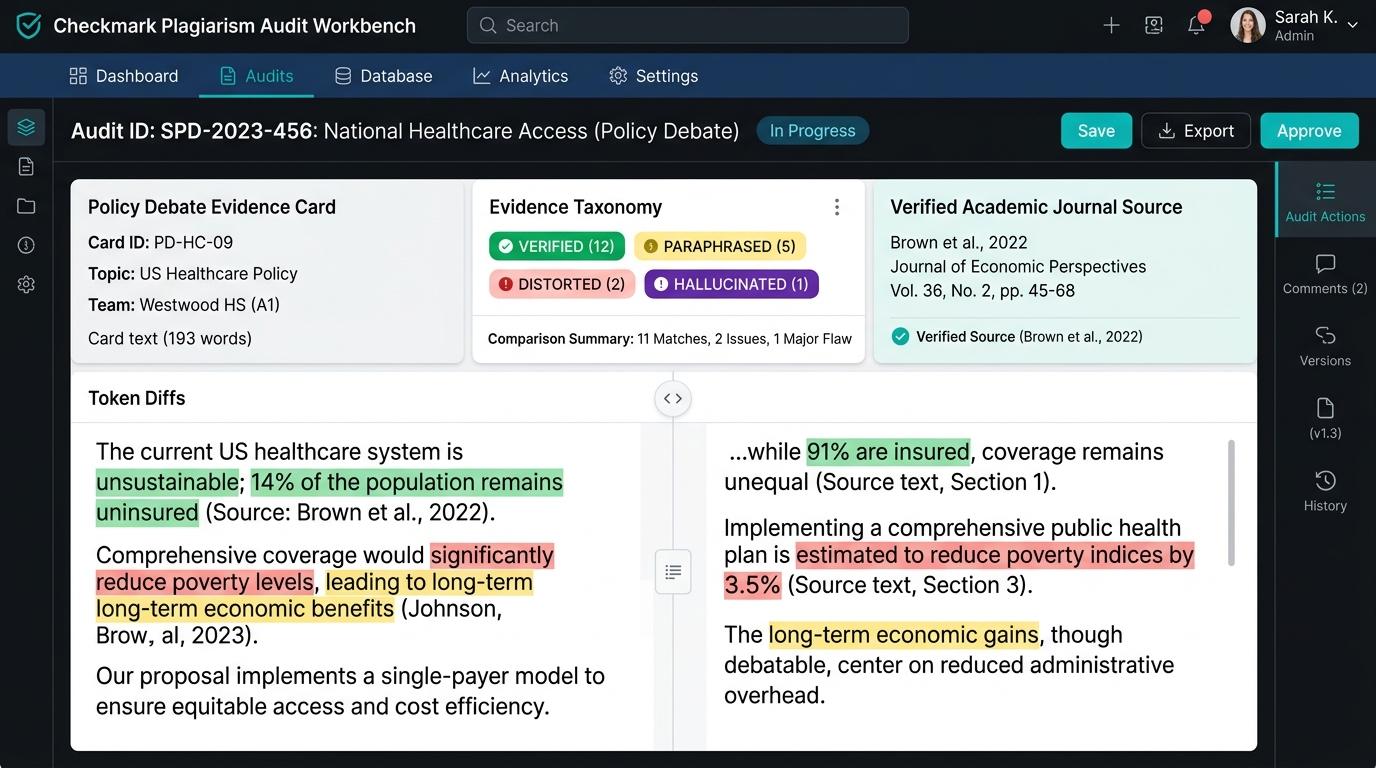
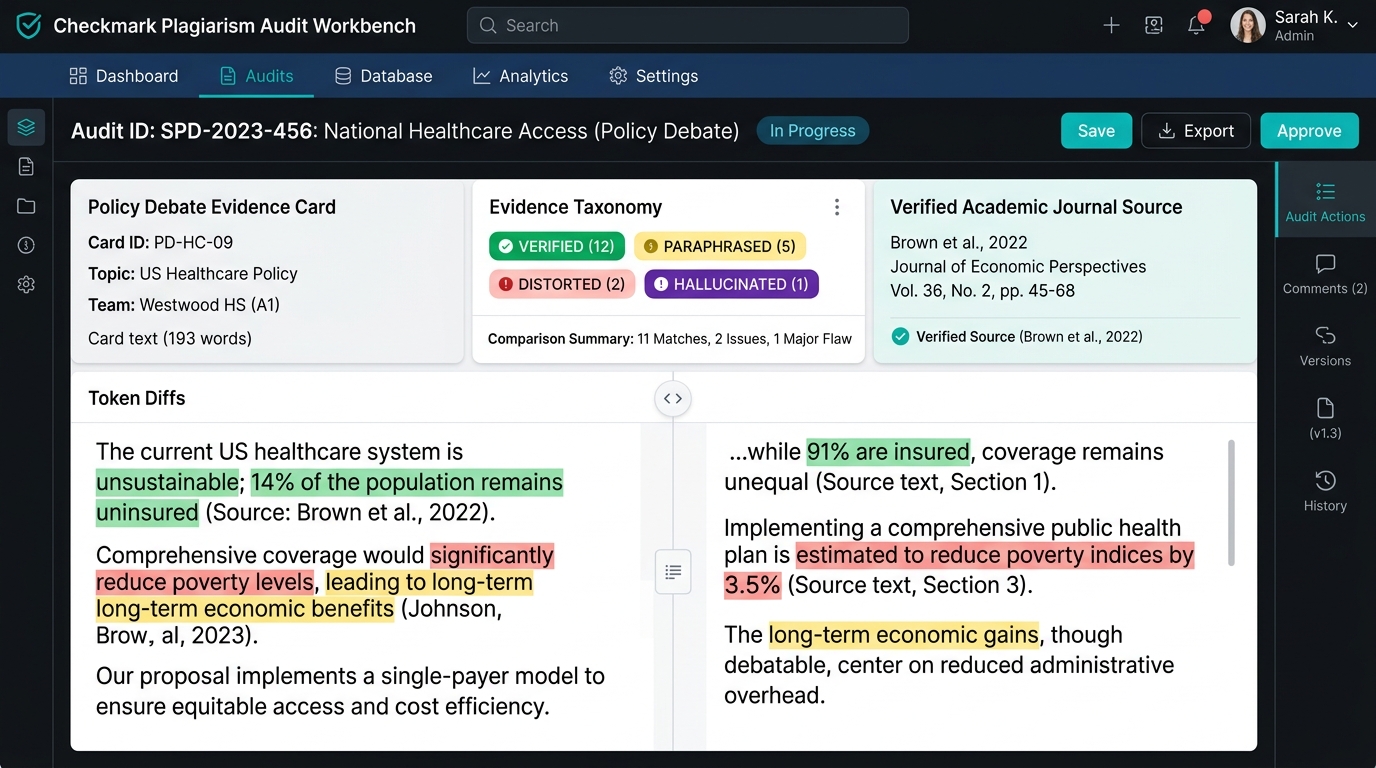
Traditional black-box plagiarism scanners fail completely because competitive debate cards legitimately quote original scholarship verbatim, while generic AI detectors misidentify technical academic prose. Checkmark Plagiarism resolves this crisis with the Side-by-Side Source Proof & Debate Card Audit Workbench. By pairing synchronized dual-pane source comparison (mapping cut cards directly against original web and scholarly publications with token-level lexical highlighting), a 4-badge evidence taxonomy (🟢 Quoted & Contextually Verified, 🟡 Paraphrased with Source, 🔴 Distorted / Out-of-Context Clipping, 🟣 Unverified / Hallucinated Citation Alert), patent-pending Essay Playback™ writing telemetry (1x–8x scrubbable keystroke replay with 100% paste buffer preservation), and teacher-in-the-loop rubric autograding, coaches and adjudicators can audit evidence cards in seconds, protect honest debaters from false accusations, and shift forensic pedagogy from adversarial confrontation to restorative research mastery.
Checkmark Plagiarism equips forensics directors, debate coaches, and tournament tab rooms with cutting-edge evidentiary auditing by integrating side-by-side source proof, patent-pending Essay Playback™ writing telemetry, passage-level AI detection, and teacher-in-the-loop rubric autograding into seamless Canvas LMS and Agilix Buzz LMS workflows.
1. The Evidence Crisis in Competitive Speech & Debate
Competitive interscholastic forensics—encompassing Policy Debate (Cross-Examination / CX), Lincoln-Douglas Debate (LD), Public Forum Debate (PF), Congressional Debate (Student Congress), and Extemporaneous Speaking (EXTEMP)—is widely recognized as one of the most intellectually rigorous co-curricular activities in secondary education. Student debaters analyze complex public policy, macroeconomics, international relations, constitutional law, and moral philosophy.
At the core of every debate round lies the evidence card (the primary unit of forensic argumentation). A properly prepared evidence card consists of four standardized elements:
A concise, high-impact claim written by the debater summarizing the card's offensive warrant.
Author qualification, author name, institutional affiliation, date, title, journal/publication, and verified DOI or stable URL.
A complete, unedited excerpt from the original scholarly work preserving surrounding context, non-emphasized prose, and governing qualifiers.
Specific words and phrases bolded, underlined, and enlarged that the debater will read aloud within strict 4-minute or 8-minute speech time limits.
When prepared with integrity, card cutting is a sophisticated pedagogical exercise in synthesis, critical reading, and evidentiary precision. However, as competitive stakes have escalated—with national circuit travel, state championships, college scholarship offers, and National Speech & Debate Association (NSDA) National Tournament qualification on the line—the pressure to produce definitive, hyper-offensive evidence has fueled a systemic integrity crisis.
The Forensics of Debate Evidence Violations
Debate evidence violations do not typically resemble simple classroom plagiarism (submitting someone else's paper as one's own). Instead, forensic violations represent subtle, deliberate, or negligent distortions of authority, text, and context. Forensic league adjudicators and coaches classify these violations into four distinct archetypes:
1. Card Clipping & Oral Truncation
NSDA Rule 7.2.CMechanism: In Policy (CX) and Lincoln-Douglas debate, competitors utilize rapid delivery (spreading, exceeding 350+ words per minute). A debater marks 150 words of underlined text but stops reading at word 80 when the speech timer expires—failing to mark their oral stopping point on the shared speech document (speech drop / email chain).
Violation Impact: The team extends the unread back-half of the card in rebuttal speeches, claiming an offensive warrant that was never officially read into the round record.
2. Context Stripping & Qualifier Omission
NSDA Rule 7.2.AMechanism: To manufacture absolute terminal impacts (e.g., claiming a tariff will “guarantee nuclear war” or “cause economic collapse”), students selectively highlight words while deleting adjacent conditional clauses (such as “unlikely,” “in theory only,” or “contingent upon”).
Violation Impact: Inverts author intent, transforming a scholarly refutation of an outcome into purported proof of its inevitability.
3. Bracket & Punctuation Manipulation
NSDA Rule 7.2.AMechanism: While brackets [...] are strictly reserved for grammatical clarifiers (e.g., substituting “[the European Union]” for “they”), unethical card cutters insert substantive argumentative warrants that the author never penned, or strip question marks to convert exploratory inquiries into absolute claims.
Violation Impact: Misattributes claims to prestigious scholars and creates artificial certainty from exploratory papers.
4. AI-Generated Phantom Citations (The LLM Wave)
Synthetic FraudMechanism: Under late-night prep pressure, students prompt LLMs to “find a card proving modular nuclear reactors stop grid failure with a 2025 citation.” Generative AI invents plausible-sounding titles, fabricated author credentials (e.g., “Dr. Marcus Sterling, MIT”), and synthetic statistics.
Violation Impact: Fabricated evidence enters official tournament rounds, completely undetectable by human memory alone.
The NSDA Unified Manual & Evidence Rules 7.1 to 7.5
The National Speech & Debate Association (NSDA) regulates evidence integrity under Rules 7.1 through 7.5, Evidence Rules for Policy, Public Forum, Lincoln-Douglas, and Big Questions Debate, in the High School Event Rules section of the High School Unified Manual (2026-2027 edition). Congressional Debate has its own parallel evidence rules in the same manual. The provisions most relevant to card auditing are summarized below:
| NSDA Rule Provision | Regulatory Mandate | Violation Consequence |
|---|---|---|
| Rules 7.1.B and 7.1.C Citation Integrity |
Oral and Written Citation: Debaters orally give the primary author's last name and year of publication, and must provide the full written citation (author, date, source, title, URL, author qualifications, page numbers) if an opponent or judge requests it. | Judge's discretion: may disregard the evidence, diminish its credibility, weigh the violation in the decision, or take no action (Rule 7.4.A). |
| Rule 7.2.A Distortion (Contextual Non-Distortion) |
Evidence must not contain added or deleted words that significantly alter the author's conclusion, and any added words must be bracketed. | Loss of the debate and disqualification from the tournament (Rule 7.4.C). |
| Rules 7.2.C and 7.1.G Clipping |
Card Clipping: A debater may not claim to have read the complete text of highlighted or underlined evidence while skipping portions of it, and the written text must clearly mark the portions read. | Loss for the offending debater(s) and zero speaker points (Rule 7.4.B); the national office may also impose Code of Honor consequences (Rule 7.4.D). |
| Rule 7.3 Challenge Procedure |
Formal Evidence Allegation: A formal in-round allegation of distortion, non-existent evidence, or clipping stops the round so the judge can examine the evidence. Allegations first made after the round go to the tabulation committee. | Binary ruling: If the allegation is legitimate, the team that committed the violation takes the loss; if it is not, the team making the allegation takes the loss (Rule 7.3.C). |
While NSDA rules establish a strict regulatory baseline, enforcement on the ground has historically suffered from high procedural friction. Formal in-round evidence allegations under Rule 7.3 are high-stakes gambles, because an allegation that fails costs the challenger the round, and they can devolve into hostile arguments, groundless accusations, and tournament delays. High school coaches desperately need a proactive, automated, and instructional mechanism to audit evidence before their debaters step foot into competition.
2. The Limitations of Manual Source Checking & Generic Detectors
Why has debate evidence auditing remained broken for decades? The answer lies in the insurmountable logistical math of manual coaching and the profound architectural mismatch of generic software tools.
- • 16 Policy & PF Teams (32 Active Debaters)
- • 48 Total Evidence Briefs & Topic Files
- • 640 Unique Cut Evidence Cards
- • Sources: JSTOR, Brookings, CSIS, CBO, HeinOnline
- • Locating, downloading & scanning 1 PDF: 4–8 min
- • Total time needed for 640 cards: 42.6 to 85.3 HOURS
- • Available Thursday prep window: 4 Hours (240 min)
- • Realistic coach review limit: 30–45 cards (~5%)
Over 95% of team evidence enters weekend competition completely unverified, leaving programs vulnerable to accidental clipping, citation hallucinations, and devastating tournament forfeits.
Why Generic Software Tools Fail on Debate Cards
When school districts attempt to force traditional plagiarism checkers or generic AI detectors onto speech and debate squads, the results are disastrous:
| Software Category | Behavior on Debate Cards | The Practical Failure | Checkmark Advantage |
|---|---|---|---|
| Traditional Plagiarism Scanners (Turnitin, Copyleaks, Unicheck) |
Flags cut cards as “High Plagiarism” because cards quote original text verbatim. | Useless false positives. Debaters ARE supposed to quote source text verbatim! | Distinguishes ethical quotation from context stripping and clipping. |
| Black-Box AI Detectors (GPTZero, ZeroGPT, generic tools) |
Generates opaque 0–100% whole-document scores; misidentifies dense academic syntax as AI-generated. | False accusations against honest debaters citing complex legal/scientific scholarship. | Passage-level sliders with honest short-text (<150w) suppression guardrails. |
| Generic Text Diff Tools (Raw character diffs) |
Performs raw character comparison only; lacks automated source retrieval or citation auditing. | No semantic understanding of author intent, qualifiers, or NSDA evidence rules. | 4-badge evidence taxonomy calibrated for forensic rules and restorative coaching. |
Debate requires a specialized evidentiary architecture—one that understands that verbatim quotation is the goal, but that contextual fidelity, qualifier preservation, and authentic research history are the governing integrity benchmarks.
3. Checkmark Plagiarism’s Side-by-Side Source Proof & Card Audit Workbench
Checkmark Plagiarism delivers an enterprise-grade, educator-first auditing suite designed specifically for secondary and collegiate forensics programs, AP Seminar/Research classrooms, and academic integrity committees.
“...targeted carbon pricing [will] prevent regional grid failure by stabilizing peak load capacity across Midwest interconnects.”
“...targeted carbon pricing may prevent grid failure by stabilizing peak load capacity, though this effect is contingent upon federal transmission infrastructure subsidies.”
[will] replaces tentative modal may. Mandatory subsidy condition omitted from card.1. Synchronized Dual-Pane Source Comparison
When a coach or judge opens a debate brief or Google Doc in Checkmark, the platform parses each individual card—separating the Tag, Cite, Body, and Underlined segments. Checkmark's search engine queries billions of indexed scholarly articles, JSTOR publications, think tank repositories, and government databases to retrieve the unedited source text.
The system then displays the student's cut card on the left pane and the authentic source document on the right pane. As the coach scrolls through the debate brief, the source pane automatically scrolls in real-time synchronization, highlighting the exact corresponding paragraph, surrounding sentences, and footnotes.

2. The 4-Badge Evidence Source Taxonomy
Rather than delivering an ambiguous percentage, Checkmark classifies every cut card against a 4-badge evidentiary taxonomy calibrated for academic and forensic standards:
🟢 Quoted & Contextually Verified
- Verbatim excerpt faithfully capturing author's governing thesis.
- Essential qualifiers, scope limits, and conditions remain intact.
- Citations, credentials, and DOIs are 100% active and authentic.
- Status: Approved for immediate competitive tournament use.
🟡 Paraphrased with Source
- Accurately summarizes source material without direct quotes.
- Factual alignment with zero distortion of empirical data.
- Standard for Congressional Debate speeches and Extemp outlines.
- Status: Verified for non-card public address events.
🔴 Distorted / Out-of-Context Clipping
- Underlined text strips vital caveats (“unlikely,” “may”).
- Author thesis inverted (e.g., opponent objection cited as conclusion).
- Unethical bracket insertion
[...]altering core warrants. - Status: BLOCKED: Pre-competition repair clinic required.
🟣 Unverified / Hallucinated Citation Alert
- Citation metadata (DOI, author, journal volume) does not exist.
- High linguistic markers of generative AI hallucination.
- Source absent across global scholarly and web repositories.
- Status: CRITICAL INTEGRITY ALERT: Immediate audit required.
3. Patent-Pending Essay Playback™ for Forensics Preparation
For original speech events (Original Oratory, Informative Speaking) and debate brief construction, Checkmark provides patent-pending Essay Playback™—a keystroke-by-keystroke video replay engine. Coaches can scrub through the entire drafting timeline at 1x, 2x, 4x, or 8x speed to watch how arguments were assembled:
- 100% External Clipboard Paste Buffer Preservation: When a student pastes research into their brief, Checkmark captures the raw, original clipboard content and timestamps the event. Even if the student subsequently edits, rewords, or truncates every single sentence over the next three hours, the coach can click the “Jump to Paste” button to view the original unedited text.
- Transcription Detection: If a student retypes an AI-generated brief or purchased case from a second monitor or mobile phone, Checkmark's keystroke telemetry identifies the mechanical, burstless typing velocity (constant typing cadence with zero natural composing pauses or structural reorganizations).
- Protection for Diligent Researchers: When an opposing team falsely accuses a student of using AI or stealing a case, the student's authentic Essay Playback timeline—revealing hours of messy outlining, organic pauses, Thesaurus lookups, and progressive card cutting—provides immutable, irrefutable proof of original scholarship.

4. Teacher-in-the-Loop Rubric Autograding with Quote-Anchored Justifications
When coaches evaluate debate briefs, practice round speech transcripts, or Lincoln-Douglas philosophical framework cases, Checkmark's AI Autograder generates formative evaluations tied to official NSDA, state forensic, or AP Capstone rubrics. Every criterion score (e.g., Warrant Quality, Evidentiary Context, Impact Calculus, Synthesis Rigor) is anchored directly to verbatim quotations from the student's submission, providing transparent justifications that coaches can review, edit, or override before publishing.

4. Real-World Forensics Case Studies
To understand how Checkmark's Side-by-Side Source Proof transforms coaching practice, examine three illustrative case studies modeled on high school competitive debate. The sources and quotations in them are fictional and are not excerpts from any real publication.
| Event & Topic | The Evidentiary Distortion | Checkmark Investigation & Resolution |
|---|---|---|
| Policy Debate (CX) Global Health Topic |
Biosecurity impact card deleted “extraordinarily improbable” safety caveat. | Side-by-side viewer highlighted deleted qualifier in red diff; 🔴 Distorted Badge fired; coach recalibrated tag in practice. |
| Public Forum (PF) Federal Tax Policy |
Government economic-report card substituted “[will]” for original tentative “could”. | Dual-pane comparison exposed bracketed “[will]” and stripped conditions; resolved in 90 seconds during tournament challenge. |
| Lincoln-Douglas (LD) Rawlsian Justice Framework |
Author's refutation of an opponent's objection was cut as their own positive philosophy. | Synchronized alignment revealed card was cut from “Objections” section; restorative coaching conference repaired student brief. |
Case Study 1: National Circuit Policy Debate (CX) — Biosecurity Qualifier Omission
Debater’s Cut Card: “Under current trajectories, unregulated dual-use gain-of-function experiments heighten escape vectors, creating runaway biosafety failure. [DELETED QUALIFIER] Such an escape triggers catastrophic mortality and global extinction cascades across vulnerable populations.”
“Under current trajectories, unregulated dual-use gain-of-function experiments heighten escape vectors, creating runaway biosafety failure. However, while mathematically conceivable in extreme unconstrained zero-containment models, such an outcome is extraordinarily improbable under current Biosafety Level 4 (BSL-4) multi-redundant filtration protocols. Such an escape triggers catastrophic mortality and global extinction cascades only if all tertiary airlocks and thermal incinerators fail simultaneously—a scenario with near-zero empirical probability.”
Coaching Resolution: During after-school prep, the coach projected the dual-pane diff. Rather than issuing a suspension, the coach guided debaters to re-tag the card accurately: “Unregulated biotechnology increases low-probability catastrophic risk vectors, justifying precautionary BSL-4 oversight.” Students learned that defensible, nuanced probability holds up far better in cross-examination than hyper-inflated claims.
Case Study 2: Public Forum (PF) — Economic Tax Policy & Budget Report Distortion
Affirmative Cut Card: “Federal budget models demonstrate that a $40/ton carbon fee [will] stimulate $180 billion in domestic clean energy private equity investment over five fiscal years.”
“Federal budget models demonstrate that a $40/ton carbon fee could stimulate $180 billion in domestic clean energy private equity investment over five fiscal years, but only in the event that global fossil fuel export prices remain above baseline projections and all border adjustment tariffs are waived.”
Adjudication Outcome: The tournament tab director opened Checkmark's tournament console and reviewed the side-by-side report in 90 seconds. Because the bracketed “[will]” and the stripped conditions met the NSDA Rule 7.2.A definition of distortion, the allegation was upheld, the penalties in Rule 7.4.C applied, and the tournament schedule continued without delay.
Case Study 3: Lincoln-Douglas (LD) — Philosophical Warrant Inversion
Student’s Cut Card: “The Difference Principle fails to respect individual agency, requiring a complete retreat toward unconditional libertarian property rights.”
“Section 4: Examining Libertarian Critiques of Justice as Fairness. Opponents of redistributive justice famously assert that ‘the Difference Principle fails to respect individual agency, requiring a complete retreat toward unconditional libertarian property rights.’ However, this critique collapses upon closer inspection because Rawlsian primary goods are prerequisites for meaningful moral agency, not its antithesis.”
Coaching Resolution: The student had searched for “Difference Principle fails” and copied the first match, failing to notice they were quoting the author's summary of an objection being dismantled. During a restorative conference, the coach walked through the section headings, helping the student recut the card to accurately represent the author's defense of Rawls.
5. The 4-Phase Debate Evidence Calibration Protocol
To operationalize automated evidence verification across a competitive speech and debate program, coaches and team directors can implement Checkmark's standardized 4-Phase Protocol:
• Ingest team Google Docs, Word tubs, & Canvas LMS.
• Automated crawl of citations & DOIs.
• Team Evidence Dashboard.
• Review 🔴 and 🟣 flagged badges.
• Token-level highlight & diff audit.
• Pre-competition card lock.
• NSDA Rule 7.3 dispute triage.
• Instant 1-Page PDF diff receipt.
• Rulings executed in <2 min.
• Weekly 15-min Source Repair Clinics.
• Contextual evidence logs.
• Research literacy mastery.
Phase 1: Pre-Tournament Ingestion & Batch Auditing
- LMS & Cloud Drive Synchronization: Debaters submit their topic briefs, negative block files, and affirmative cases through Google Drive, Microsoft OneDrive, Canvas LMS, or Buzz LMS.
- Automated Batch Indexing: Checkmark automatically extracts all cut cards, parsing tags, bibliographic citations, DOIs, and underlined text.
- Evidence Health Dashboard: The head coach receives a centralized squad overview displaying the percentage of verified cards (🟢), paraphrased sections (🟡), contextual distortions (🔴), and unindexed/hallucinated citations (🟣).
Phase 2: Dual-Pane Contextual Verification & Discrepancy Flagging
- Pre-Flight Inspection: The coaching staff filters the squad dashboard to review only 🔴 and 🟣 flags.
- Token-Level Highlight Review: Clicking on any flagged card opens the synchronized dual-pane viewer, immediately highlighting omitted qualifiers, altered bracket text, or missing DOIs.
- Pre-Competition Resolution: Debaters whose cards are flagged must either re-cut the card with complete contextual fidelity or replace the source before the team departs for the tournament.
Phase 3: In-Round & Post-Round Adjudication (NSDA Rule 7.3)
- Frictionless In-Round Verification: If an opponent questions an evidence card during a round, the coach or adjudicator opens Checkmark's tablet-optimized verification console.
- Instant Visual Evidence Dossier: Checkmark generates a 1-page PDF “Evidence Receipt” displaying the cut card side-by-side with the original scholarly paragraph, highlighting all lexical variances.
- Defensible Adjudication: Tournament directors make evidence rulings backed by indisputable, transparent data—eliminating subjective he-said-she-said arguments and avoiding unnecessary forfeits.
Phase 4: Restorative Evidence Coaching & Source Repair Clinics
- Non-Punitive Pedagogy: Academic integrity is an educational journey, not a policing regime. Checkmark's philosophy emphasizes “Stop guessing, start trusting.”
- Weekly Source Repair Clinics: During regular after-school practices, coaches host 15-minute repair sessions. Debaters whose cards triggered flags review the original academic articles, analyze why the initial cut was misleading, and write comprehensive contextual summaries.
- Research Portfolios: Students maintain an authenticated evidence repository, building high-level research competencies that prepare them for collegiate research, law school, and professional policy analysis.
6. Turnkey Tournament Evidence Audit Checklist & Restorative Coaching Scripts
Turnkey Tournament Evidence Audit Checklist
- Author full name, institutional affiliation, and scholarly credentials clearly stated in cite.
- Publication name, date of release, journal volume/issue, and page numbers fully disclosed.
- Active DOI, stable JSTOR link, or direct working web URL included.
- Zero AI hallucination flags (author, paper title, and publication independently indexed).
- Governing author thesis faithfully represented in the debater's argument tag.
- Critical qualifiers (“unlikely,” “may,” “contingent upon”) retained in underlined text.
- Methodological limitations, sample sizes, and temporal constraints preserved in body text.
- Author's review of opponent counterarguments NOT cited as the author's own conclusion.
- Brackets
[...]strictly limited to grammatical clarifiers (e.g., proper nouns for pronouns). - Zero substantive argumentative warrants inserted within bracketed phrases.
- Question marks, conditional hyphens, and ellipses accurately reflect original punctuation.
- Highlighted text in speech documents matches verbatim what the debater reads aloud in round.
- Clear oral stopping points marked on shared files when timer expires mid-card.
- Unread card segments NOT extended in subsequent rebuttal speeches.
- Original written speeches (Original Oratory/Informative) show organic Essay Playback™ history.
- External clipboard pastes accounted for with preserved source buffer logs.
- Zero mechanical retyping / transcription anomalies from external unauthorized devices.
Restorative Coaching Scripts
Coach: “Let's pull up your biosecurity card on Checkmark's side-by-side viewer. Look at this right pane where the original source is displayed. Notice how the sentence right before your highlight states that extinction is ‘extraordinarily improbable under BSL-4 containment’? When you cut that out, your tag claims the author proves extinction is guaranteed. That meets the NSDA Rule 7.2.A definition of distortion. I know you wanted a high-impact warrant, but how does stripping that caveat actually leave you vulnerable if an opponent reads the full paragraph in cross-examination?”
Student: “They'd catch me on author intent and blow up my credibility with the judge.”
Coach: “Exactly. Strong debaters win by defending nuanced, realistic probability, not exaggerated distortions. Let's recut this card together to defend the actual risk factor.”
Coach: “Checkmark's audit flagged this card on clean energy tax credits with a purple Hallucinated Alert. The author ‘Dr. Sterling’ and this specific MIT journal volume don't exist in any academic database. Walk me through how you found this source during prep.”
Student: “I was running out of time before the deadline, so I asked ChatGPT to find me a card with a statistic proving clean energy creates jobs, and it gave me that text.”
Coach: “I appreciate your honesty. Here is why that is dangerous: LLMs predict words, not facts. When you ask an AI for evidence, it invents citations that sound real but are completely fabricated. In a tournament, reading that card would result in an immediate forfeit. Let's log into Brookings and CBO right now and find real empirical data that you can stand behind with 100% confidence.”
Coach: “I understand your team has raised an NSDA Rule 7.3 challenge regarding our economic impact card. Rather than having an adversarial dispute, let's open Checkmark's side-by-side audit receipt for this card right now. You can see the full source text in the right pane, our debater's exact highlights on the left, and the token diff. The author's qualifiers are fully preserved in the body text. Let's review the diff together so the judge and tab room can make a swift, objective determination.”
7. Enterprise Security, FERPA Zero-Training Compliance & LMS Integration
Secondary school speech and debate programs handle proprietary research briefs, intellectual property, and student manuscript drafts. Checkmark Plagiarism guarantees rigorous data privacy and enterprise infrastructure:
Student debate cases, affirmative briefs, and original oratory drafts are NEVER used to train, fine-tune, or calibrate public or commercial AI models.
Proprietary squad strategies remain 100% confidential within your private school account.
Full compliance with the Family Educational Rights and Privacy Act (FERPA) and COPPA.
Enterprise-grade encryption: AES-256 at rest, TLS 1.3 in transit. Zero third-party data monetization.
Native Single Sign-On (SSO) via Google Workspace, Microsoft 365, Canvas LMS, and Agilix Buzz LMS.
Direct rubric synchronization and grade passback into Canvas SpeedGrader and Buzz gradebooks.
8. Frequently Asked Questions (7 Targeted FAQs)
1. How does Checkmark differentiate between legitimate debate card highlighting (“cutting”) and unethical evidence distortion?
Unlike traditional plagiarism checkers that view any selective excerpting as suspicious, Checkmark is purpose-built for debate forensics. The platform evaluates whether the student's highlighted text preserves the author's governing thesis, methodology, and scope. If non-emphasized text simply provides background detail while the highlighted text accurately reflects the author's argument, the card receives a 🟢 Quoted & Contextually Verified Badge. A 🔴 Distorted Badge is triggered only when essential qualifiers (e.g., “unlikely”, “hypothetically”), negative conditions, or contradictory conclusions are stripped or syntactically altered.
2. What happens when a debater cites a paywalled journal or book behind a university database login?
Checkmark indexes millions of open-access publications, government white papers, and think tank archives. For paywalled scholarly repositories (such as JSTOR, Elsevier, SpringerLink, and HeinOnline), Checkmark utilizes secure academic metadata resolvers and DOI cross-referencing. If a specialized print book or subscription archive cannot be retrieved via public web crawlers, coaches and debaters can upload the source PDF or scan directly into Checkmark's Card Workbench to generate an instant synchronized comparison.
3. How does Checkmark handle AI-hallucinated citations vs. real academic sources that have moved URLs?
When a URL returns a 404 error, Checkmark performs a multidimensional bibliographic search across author registries, DOI resolvers, CrossRef, and semantic scholar indexes. If the paper exists, Checkmark automatically repairs the citation link. However, if the author, title, publication, and DOI fail all academic indexing checks simultaneously while displaying linguistic patterns typical of LLM generation, Checkmark issues a 🟣 Unverified / Hallucinated Citation Alert with a detailed diagnostic report.
4. Can Essay Playback™ be used to verify that a debater wrote their own Original Oratory or Congressional Debate bill?
Yes. For original written events (Original Oratory, Informative Speaking, Congressional legislation, and AP Research papers), Essay Playback™ provides a complete keystroke-by-keystroke time-lapse video of the composition process. Coaches can observe how the student brainstormed, deleted sentences, restructured paragraphs, and integrated research over time. Furthermore, Checkmark's paste buffer preservation logs every external paste, ensuring that borrowed quotes are properly attributed.
5. How does Checkmark assist tournament tab rooms during live NSDA Rule 7.3 formal evidence allegations?
When an evidence challenge is filed, tournament adjudicators do not need to pause tournament rounds for 45 minutes to track down obscure citations. The tab room can generate a 1-Page Side-by-Side Evidence Dossier from Checkmark in under 90 seconds. This report displays the debater's cut card side-by-side with the verified source, highlighting any omitted qualifiers, bracket insertions, or citation discrepancies in clean visual diff format. Adjudicators make rapid, objective, and defensible rulings.
6. Will uploading our team's proprietary debate cases and negative blocks expose them to competing high schools?
No. Checkmark maintains strict tenant data isolation. Your team's research briefs, affirmative cases, counterplan solvency files, and speech manuscripts are encrypted and stored in your private school repository. Student work is never shared across school accounts, never published publicly, and never used to train commercial AI models.
7. How does Checkmark integrate with Canvas SpeedGrader or Buzz LMS for high school speech and debate elective classes?
Checkmark connects seamlessly via 1EdTech LTI 1.3 Advantage. When students submit speech manuscripts, debate briefs, or AP Seminar essays in Canvas LMS, Agilix Buzz LMS, or Google Classroom, Checkmark automatically processes the files and embeds the Side-by-Side Audit Workbench and Essay Playback timeline directly inside the teacher's grading interface. Rubric scores, quote-anchored justifications, and coach feedback sync straight back to the LMS gradebook with a single click.
9. Conclusion: Moving from Adversarial Disqualification to Restorative Research Mastery
The goal of interscholastic speech and debate is not to catch students in gotcha violations or impose punitive disqualifications. Its mission is to develop articulate, ethical, and intellectually rigorous leaders who understand how to analyze complex information, evaluate authoritative sources, and construct defensible arguments.
When high school debate programs rely on outdated manual checks or opaque black-box detectors, evidence integrity becomes a source of anxiety, suspicion, and toxic round challenges.
By implementing Checkmark Plagiarism's Side-by-Side Source Proof, 4-Badge Evidence Taxonomy, and Patent-Pending Essay Playback™, coaches and tournament directors replace guesswork with transparent, objective proof. Educators save dozens of hours each week, honest debaters are protected against false accusations, and students master the gold standard of ethical research—fostering a culture of integrity that endures long after the final tournament gavel falls.