
The National History Day (NHD) Historical Paper category represents the pinnacle of secondary historical inquiry, requiring high school students (Grades 9–12) to produce an authoritative 1,500 to 2,500-word historical paper, a 500-word Process Paper, and a rigorous Annotated Bibliography divided strictly into primary and secondary sources. However, as regional, affiliate, and national deadlines approach, overburdened students facing immense competition pressure frequently turn to generative Large Language Models (LLMs) to synthesize complex historical arguments.
This reliance produces three catastrophic academic integrity hazards: synthetic archival citations that invent non-existent call numbers at the Library of Congress (LOC) or National Archives (NARA), confabulated primary sources (e.g., phantom letters between historical figures), and sophisticated AI patchwriting that paraphrases Wikipedia or scholarly monographs without genuine historical comprehension. Traditional similarity checkers fail because synthetic prose has 0% web match, while blunt whole-document AI detectors trigger rampant false positives on archaic primary quotes and standardized Chicago/Turabian footnotes. Guided by Checkmark Plagiarism’s core philosophy—“Stop guessing, start trusting”—this guide equips high school history educators, AP U.S./Euro/World History teachers, NHD chapter advisers, and contest judges with an actionable, 5-phase archival audit framework. By uniting digital repository permalink verification, semantic anachronism checks, patent-pending Essay Playback™ keystroke telemetry, external paste payload analysis, and restorative historiographical conferences, educators can verify authentic student scholarship, protect honest competitors, and preserve the integrity of historical research.
Checkmark Plagiarism delivers enterprise-grade academic integrity and feedback infrastructure designed specifically for secondary humanities educators, uniting synchronized side-by-side source matching with patent-pending keystroke process playback, passage-level AI confidence sliders, quote-anchored rubric autograding, and direct gradebook integrations for Canvas LMS and Agilix Buzz LMS.

1. The High Stakes of National History Day (NHD) Historical Papers
For over half a century, National History Day (NHD) has served as the gold standard of project-based historical inquiry for middle and high school students across the United States and international affiliates. In the Senior Division (Grades 9–12), the Historical Paper category stands apart from exhibits, documentaries, performances, and websites as the sole individual-only category demanding exhaustive textual scholarship, historiographical contextualization, and formal academic documentation.
The three core student deliverables grounded in primary archival inquiry
- Thesis-driven historical narrative.
- Strict Chicago / Turabian footnotes.
- Deep primary source quote integration, contextualization, & causal analysis.
- Four-section reflective essay.
- Details topic selection & theme fit.
- Explains archival search pathway & historical argument synthesis.
- Strict Primary vs. Secondary separation.
- 2–3 sentence annotations per entry.
- Explains source discovery, historical utility, and point of view.
Library of Congress (LOC Chronicling America) • National Archives & Records Administration (NARA) • Founders Online • Presidential Libraries • Special Collections
The Mandatory Deliverables Under NHD Contest Rules
To advance through school, regional, affiliate (state), and national contests at the University of Maryland, College Park, student submissions must strictly adhere to the NHD Contest Rule Book:
- The Historical Paper (1,500–2,500 Words): The text must build a thesis-driven historical argument, situating the topic within broad historical context, analyzing multiple historical perspectives, evaluating cause-and-effect relationships, and proving historical significance over time. The word count strictly includes student-composed text, captions, and internal quotes, while excluding the title page, process paper, footnotes/endnotes, and annotated bibliography.
- The Process Paper (≤ 500 Words): A four-section reflective essay detailing:
- How the student chose their topic and its relation to the annual theme.
- How the student conducted their historical research across repositories.
- How the student created their project and structured their argument.
- The historical argument (thesis) and why the topic is historically significant.
- The Annotated Bibliography: Separated into two distinct sections: Primary Sources and Secondary Sources. Each citation must follow the Chicago Manual of Style (Notes and Bibliography format) or Kate L. Turabian’s A Manual for Writers of Research Papers, Theses, and Dissertations. Each entry must feature a mandatory annotation (typically 2–3 sentences) explaining how the student used the source and how it informed their historical perspective.
- Footnotes and Endnotes: Every direct quotation, specific piece of statistical data, paraphrased argument, or controversial historical assertion must be attributed via Chicago-style footnotes or endnotes.
Official competition judging weighting for the Historical Paper category
- Historical Argument: Clear, thesis-driven, and insightful.
- Wide Research & Primary Sources: Extensive use of verified primary records.
- Historical Context: Deep understanding of political/social factors.
- Multiple Perspectives: Balanced analysis of contemporaneous views.
- Historical Accuracy: Factually unassailable chronologies.
- Significance in History: Short- and long-term impact analysis.
- Logical paragraph flow and essay organization.
- Professional academic prose and disciplined historical tone.
- Clear transitions between contextual narrative and analytical claims.
- Grammatical rigor and mechanical precision.
- Strict adherence to 1,500–2,500 word limit.
- Process paper compliance (≤ 500 words).
- Flawless Chicago/Turabian footnote formatting.
- Clear, sustained connection to annual NHD theme.
The Primary Archival Research Burden
Unlike standard 5-paragraph classroom essays or AP document-based questions (DBQs) where students analyze a pre-curated packet of 7 documents, NHD papers require authentic, self-directed archival discovery. High school historians are expected to scour digital and physical archival repositories:
- The Library of Congress (LOC): Chronicling America historic newspapers, American Memory digitized collections, Prints and Photographs Division, and Manuscript Reading Room collections.
- The National Archives and Records Administration (NARA): Record Groups (RGs), presidential records, military service logs, treaties, and congressional acts.
- Founders Online & Presidential Libraries: Unfiltered correspondence of early American statesmen, executive orders, and White House tape transcripts.
- State Historical Societies, University Special Collections, and Oral History Archives: Local town registers, diaries, broadsides, immigrant letters, and recorded interviews.
Synthesizing dozens of archaic 18th, 19th, or early 20th-century primary sources into a cohesive 2,500-word historiographical narrative is intellectually demanding. When high school competitors are balancing 4–5 AP courses, extracurriculars, and looming NHD submission deadlines, the temptation to take shortcuts via generative AI becomes acute.
2. The Modern Integrity Crisis in High School Archival Research
The introduction of commercial Large Language Models (LLMs) has fundamentally transformed the nature of academic misconduct in secondary history research. While traditional plagiarism involved copying text from published websites, AI-assisted misconduct produces deceptive synthetic scholarship that mimics advanced historiographical prose while distorting historical facts.
How generative AI confabulates archival scholarship in secondary research papers
LLMs hallucinate realistic archival metadata (e.g., “NARA Record Group 59, Box 412, Folder 8”) and confabulate non-existent letters, diary entries, or diplomatic cables that appear structurally authentic but physically do not exist.
Students paste secondary monograph or Wikipedia excerpts into LLMs with prompts like “Rewrite this with higher vocabulary and Chicago footnotes.” Surface syntax changes, but the student demonstrates zero cognitive synthesis or primary source analysis.
LLMs generate synthetic 2–3 sentence annotations containing generic historical buzzwords (“This source provided vital insight into economic conditions”) without the student ever opening the digitized archival manuscript or reading the microfilm roll.
The Hallucination Mechanism in Historical Context
Large Language Models do not consult an indexed database of verified historical records when generating text; they operate on probabilistic token prediction. In academic history papers, the model calculates the most probable sequence of words following formal bibliographic conventions:
When an LLM is prompted to “Write a section on Thomas Jefferson’s private reservations regarding the Louisiana Purchase with primary source footnotes,” it does not search Founders Online or the National Archives catalog. Instead, it generates a syntactically convincing footnote referencing a non-existent letter:
| COMPONENT | HISTORICAL AUDIT VERDICT |
|---|---|
| Historical Figures | REAL: Jefferson and Rush were frequent correspondents. |
| Target Repository | REAL: Library of Congress holds the Thomas Jefferson Papers. |
| Collection Series | REAL: Series 1 exists (General Correspondence, 1651–1827). |
| Reel / Box / Folder | FABRICATED: Jefferson Papers are organized by microfilm reel numbers (Reels 1–65), not “Box 42, Folder 11”. |
| Date & Content Check | PHANTOM: Jefferson wrote no letter to Rush on 14 November 1803. |
| Quoted Historical Text | SYNTHETIC: The quoted prose was generated token-by-token by the LLM in pseudo-19th-century epistolary syntax. |
The Patchwriting Trap in Historical Papers
Patchwriting—defined as restating a source’s ideas while copying its sentence structure and substituting synonyms—is particularly pernicious in secondary history research. In NHD research, students frequently encounter dense, 40-page academic journal articles from The Journal of American History or The William and Mary Quarterly.
Instead of reading, digesting, and extracting specific primary evidence to build their own causal claims, struggling students paste scholarly paragraphs into an AI tool:
How generative paraphrasing launders scholarly analysis without cognitive synthesis
“The Pullman strike collapsed primarily because Attorney General Richard Olney secured a federal court injunction under the Sherman Antitrust Act, thereby weaponizing military power against organized labor under the legal pretext of protecting the transit of United States mail.”
“The downfall of the Pullman boycott was catalyzed when Attorney General Richard Olney obtained a sweeping federal judicial order through the Sherman Antitrust Act, which effectively mobilized federal armed forces against striking railway workers under the constitutional justification of maintaining mail delivery.”
In this example, the student has not synthesized historical evidence; they have merely laundered another historian’s historiographical analysis through an AI thesaurus engine. Traditional plagiarism checkers often flag this with low similarity (under 15%), while the student receives unearned credit for advanced historical analysis.
3. The NHD Contest Rule Book & The Flaws of Generic AI Detectors
When high school history teachers and NHD advisers suspect that a research paper contains synthetic text, fabricated citations, or AI patchwriting, turning to generic, whole-document AI percentage detectors (e.g., tools that output “78% AI Generated”) introduces severe pedagogical and ethical hazards.
Critical weaknesses of black-box percentage scores when auditing secondary historical research
Authentic archaic prose (Federalist Papers, abolitionist pamphlets, presidential proclamations) features formal vocabulary and low perplexity that trigger false AI flags.
Highly structured bibliographic strings (Author, “Title,” Place: Publisher, Year, Page) are mechanically uniform, causing generic detectors to label real citations as AI.
Generic detectors look for global statistical uniformity. When students prompt LLMs to “add natural typos” or use text humanizers, detectors return a false “100% Human.”
NHD Rule 15 and Rule 16 require clear, objective evidence of misconduct before disqualifying a student. An opaque, proprietary percentage score is easily overturned on appeal.
The NHD Contest Rule Book on Academic Integrity
The official National History Day Contest Rule Book outlines clear standards for student authorship and academic integrity:
- Rule 15 | Plagiarism: “Plagiarism is presenting the work, ideas, or words of another person as your own, without credit... Turning in a paper written by someone else (or generated by artificial intelligence) is plagiarism.”
- Rule 16 | Disqualification and Rule Infractions: Disqualification is a severe penalty reserved for verified academic dishonesty (plagiarism, fabricating evidence, submitting work created by an external party or AI). Infractions that do not involve intentional dishonesty (such as formatting errors or minor word count overages) result in scoring deductions rather than disqualification.
To uphold Rule 15 and Rule 16 fairly, history educators and NHD contest coordinators cannot rely on black-box percentage scores. Accusing a dedicated high school student of fabricating primary sources based solely on an uncalibrated detector score damages student trust and exposes the school to contentious parent disputes.
Checkmark’s Core Pillar: “Stop Guessing, Start Trusting”
Checkmark Plagiarism replaces subjective speculation with objective, multi-dimensional evidentiary dossiers. Rather than generating a single opaque percentage, Checkmark integrates:
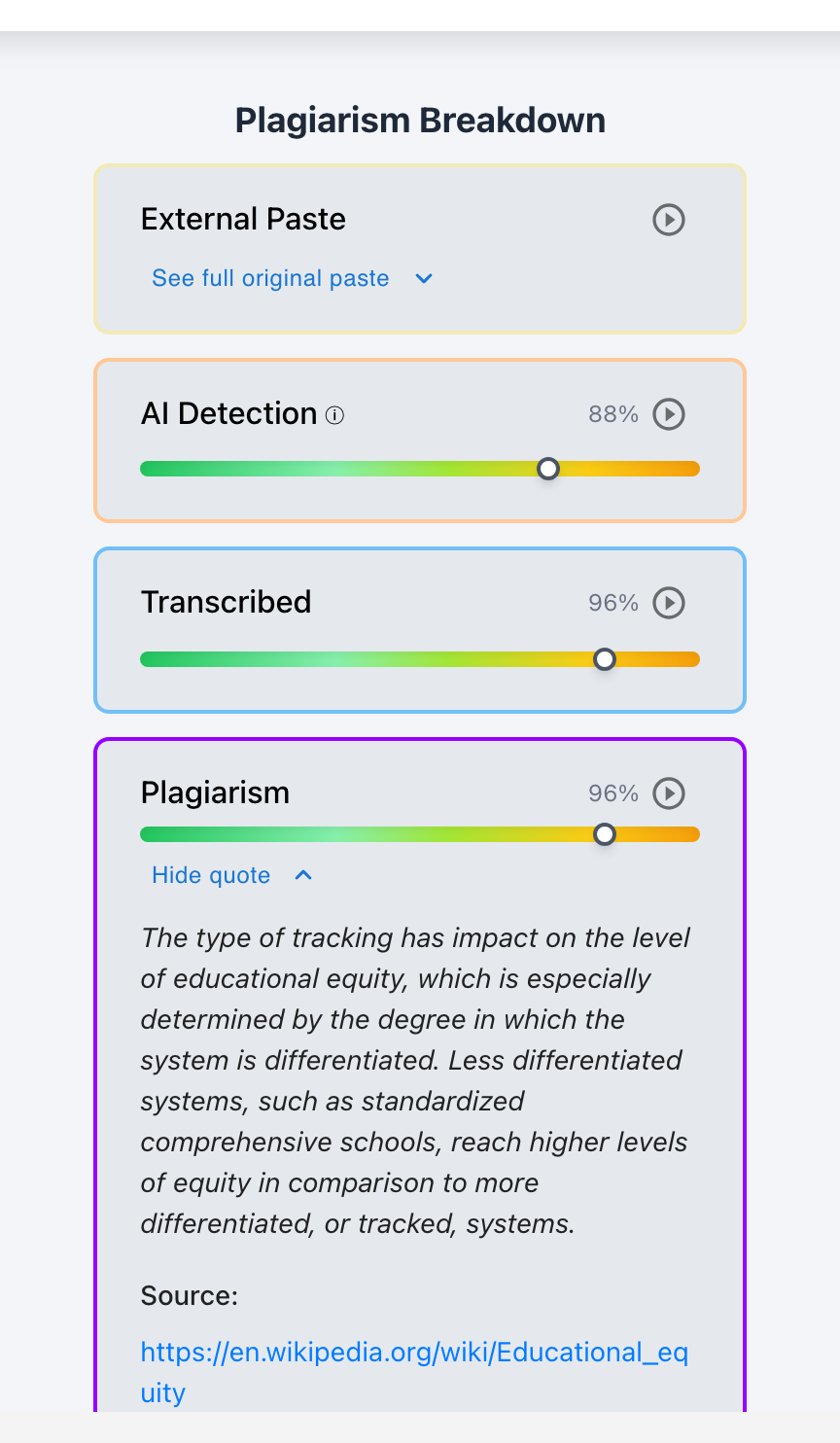
- Passage-Level AI Confidence Sliders: Underlines specific suspect sentences alongside calibrated linguistic markers (burstiness, perplexity predictability) while ignoring formal Chicago footnotes and quoted archaic text.
- Side-by-Side Web & Academic Repository Matching: Scans live archives and scholarly indices to expose uncited patchwriting and direct text overlap.
- Patent-Pending Essay Playback™ (Writing Process Telemetry): Scrubs through the student’s keystroke-by-keystroke writing session to observe authentic drafting, primary source transcription pauses, and real-time revisions.
- External Paste Payload Preservation: Captures the complete, unedited text of any external clipboard insertion—even if the student subsequently rewrote every word.
4. The High School History Evidentiary Matrix
To audit an NHD historical paper effectively, educators need to understand how different verification methods perform across the unique demands of historical research:
| Verification Dimension | Paper Logs & Index Cards | Generic AI Detectors | Checkmark Suite & Essay Playback™ |
|---|---|---|---|
| Primary Source Verification (LOC/NARA Concordance) | Manual, time-intensive check | ❌ Cannot verify; flags real quotes as AI | ✅ Side-by-side matching + passage confidence |
| Hallucinated Citation Detection (Non-existent Box/Folders) | Catches obvious errors if checked | ❌ Completely blind to fake citations | ✅ Permalink audit + keystroke trace analysis |
| AI Patchwriting Identification (Monograph theft) | Misses synonym-swapped text | ❌ Blind to rewritten AI passages | ✅ Two-way linked source cards + paste inspection |
| Writing Process Verification (Keystroke & Drafting) | None (evaluates only final product) | ❌ None (evaluates static snapshot) | ✅ 1x–8x keystroke replay of entire drafting flow |
| Chicago Footnote Handling (Formatting vs Integrity) | Manual audit required | ❌ Triggers false positive flags | ✅ Smart filter isolates citations from prose |
| Exoneration of Honest Students (Defending against flags) | Relies on teacher memory | ❌ Fails; black-box score creates doubt | ✅ Full revision history provides irrefutable proof |
| LMS Integration & Grade Passback (150+ students) | None | ❌ Standalone portal only | ✅ Direct Canvas, Buzz, & Google Classroom sync |
5. Step-by-Step History Teacher & NHD Adviser Audit Protocol
When evaluating senior division NHD research papers, history educators and competition judges should implement this rigorous, 5-phase audit protocol before certifying papers for regional or affiliate contests.
A standardized, evidence-grounded verification workflow for high school history educators
Phase 1: Digital Permalink & Call Number Audit
High school history teachers should begin by auditing the Annotated Bibliography and Footnotes for digital repository concordance:
- Test Persistent Identifiers (PURLs) and Archival Permalinks:
- For Library of Congress (LOC) items, verify standard LOC URI syntax (e.g.,
https://www.loc.gov/item/[id]/orhttps://chroniclingamerica.loc.gov/lccn/...). - For National Archives (NARA) items, check the National Archives Identifier (NAID) in the NARA Online Catalog (
https://catalog.archives.gov/id/[NAID]). - For Founders Online, confirm the document URL corresponds to the actual NHPRC database (
https://founders.archives.gov/documents/...).
- For Library of Congress (LOC) items, verify standard LOC URI syntax (e.g.,
- Audit Physical Archival Hierarchy Strings: Check whether the repository hierarchy makes organizational sense. For example, if a footnote cites “National Archives, Record Group 59 (Department of State), Box 12, Folder 4,” confirm whether Record Group 59 actually holds the relevant topic (e.g., foreign policy dispatches vs. naval records, which would be RG 45 or RG 24).
- Cross-Check Microfilm Reel vs. Box/Folder Designations: Major digitized collections (such as the George Washington or Alexander Hamilton papers at the Library of Congress) are cataloged by Series and Reel Number, not modern office “Box/Folder” numbers. A citation listing “Box 4” for a collection organized exclusively by microfilm reels is a classic LLM hallucination hallmark.
Phase 2: Historiographical Consistency & Anachronism Sanity Checks
Large Language Models frequently introduce subtle semantic anachronisms when synthesizing historical primary sources:
| ANACHRONISM TYPE | HALLUCINATED AI SYNTAX EXAMPLE | HISTORICAL REALITY |
|---|---|---|
| Conceptual Anachronism | “In his 1862 diary, the soldier noted his severe PTSD from Antietam.” | The psychological concept of PTSD was not formulated until 1980 (DSM-III). In 1862, terms were “soldier’s heart” or “exhaustion.” |
| Geopolitical Anachronism | “The 1845 dispatch referenced diplomatic tensions in Germany.” | The region was officially the German Confederation until German unification under Bismarck in 1871. |
| Bibliographic Anachronism | “As documented in the 1920 journal article in Foreign Affairs...” | Foreign Affairs was founded in September 1922 by the Council on Foreign Relations. |
Teachers should review suspect primary source quotations:
- Does the vocabulary match contemporaneous 18th/19th-century usage, or does it sound like a modern 21st-century essayist using an antique filter?
- Are historical actors expressing motivations or referencing events that occurred months or years after the purported date of the document?
Phase 3: Writing Telemetry & Keystroke Dynamics with Essay Playback™
When evaluating student submissions in Google Docs, Canvas LMS, or Buzz LMS, static text examination cannot reveal how the paper was composed. With Checkmark’s Essay Playback™, history teachers can scrub through the entire writing session at 1x to 8x speed to observe authentic historical scholarship in action.

How writing velocity, burstiness, and pauses reveal genuine primary source synthesis
- High variance in typing speed, natural cognitive pauses (30–120s).
- Organic line editing and iterative argument restructuring.
- Zero source reading pauses; instantaneous block insertions.
- Clipboard preservation captures original external prompt payload.
Key Telemetry Indicators in Historical Writing:
- Source Synthesis Pauses: Genuine historical synthesis is characterized by extended pauses (30 to 120 seconds) between typing bursts as the student switches tabs, reads a digitized manuscript on Chronicling America, and formulates their own analytical claim.
- In-Line Transcription Rhythms: When a student transcribes a 3-line primary source quote from a historical letter, typing speed naturally slows down, accompanied by brief pauses as their eyes move between the original manuscript scan and the typing document.
- Mechanical Typing Anomalies: If a student types a complex 4-paragraph historiographical argument at a relentless 90 words per minute without a single backspace, deletion, or organizational restructuring, this indicates manual transcription from a secondary screen, phone, or generative AI prompt.
Phase 4: External Paste Buffer Payload & Clipboard Forensic Inspection
One of the most powerful capabilities within Checkmark’s patent-pending suite is the External Paste Inspector.
“Furthermore, the radical faction of the abolitionist movement, spearheaded by William Lloyd Garrison, rejected the political incrementalism of the Liberty Party. In the 1844 Liberator editorial (Vol. 14, No. 22), Garrison asserted that the United States Constitution was ‘a covenant with death and an agreement with hell,’ demanding immediate, uncompensated emancipation without regard to constitutional technicalities...”
Even if a student uses an AI humanizer or manually rewrites every sentence after pasting, Checkmark preserves the exact raw payload copied from the external application. Teachers can immediately identify whether the pasted text originated from an uncredited digital encyclopedia, a scholarly PDF, or a generative chatbot session.
Phase 5: The Restorative Historiographical Conference Protocol
When an audit reveals hallucinated citations, extensive patchwriting, or unverified bulk pastes, educators should initiate a supportive, restorative conference. In alignment with Checkmark’s philosophy, the objective is not punitive confrontation, but intellectual growth, historical rigor, and academic restoration.
6. How Checkmark Empowers History Educators & NHD Advisers
Checkmark Plagiarism delivers an enterprise-grade academic integrity and feedback suite designed specifically for secondary humanities educators, AP history teachers, and NHD coordinators.
Comprehensive verification, playback, and rubric evaluation infrastructure for history departments
- Calibrated sliders per sentence & paragraph.
- Honest short-text guardrails (<150 words = N/A).
- Protects archaic primary quotes from false flags.
- 1x to 8x video-style replay of full typing session.
- Tracks pauses, deletions, rewrites, & transcriptions.
- External paste inspector with clipboard preservation.
- Pre-configured for NHD Criteria (60/20/20).
- Generates criterion-tied feedback cards.
- Anchored directly to student prose with teacher override.

1. Calibrated Passage-Level AI Sliders
Unlike blunt whole-paper percentage scores, Checkmark analyzes text sentence-by-sentence. When an NHD paper includes long block quotes from 19th-century speeches (e.g., Abraham Lincoln’s Cooper Union address or Frederick Douglass’s What to the Slave Is the Fourth of July?), Checkmark’s intelligent parsing recognizes the primary quote syntax and isolates it from the student’s analytical commentary, preventing false-positive alarms.
2. Side-by-Side Source Matching for Uncited Patchwriting
Checkmark scans billions of live web pages, historical databases, open-access university repositories, and digital archives. When a student patchwrites from an uncited secondary article, Checkmark highlights the source text side-by-side with the student’s submission, providing clickable links to the original repository.
3. Quote-Anchored Rubric Autograding Aligned to NHD Criteria
Grading stacks of 2,500-word historical papers across 130+ students is an overwhelming weekend burden for high school history teachers. Checkmark’s AI Autograder generates draft rubric scores directly aligned with the official NHD judging matrix:
- Historical Quality (60%): Evaluates thesis strength, historical context, primary source utilization, historical accuracy, and impact over time.
- Clarity of Presentation (20%): Evaluates organization, writing quality, and grammatical clarity.
- Rule Compliance (20%): Evaluates word counts, citation formatting, and annotated bibliography completeness.
Every suggested score is accompanied by a quote-anchored feedback card linking directly to specific sentences in the student’s essay. The teacher maintains complete authority to edit, override, or approve feedback before syncing finalized grades back to Canvas, Google Classroom, or Buzz LMS with a single click.
7. Realistic Classroom Case Studies
- NARA catalog search revealed Box 88 covers 1912 antitrust files, not 1894 strike records.
- Essay Playback™ showed a 350-word block pasted at minute 42.
- External Paste Inspector preserved the prompt: “Write a primary source quote from Richard Olney supporting federal troops.”
8. Frequently Asked Questions (FAQ)
1. How does Checkmark differentiate between authentic archaic primary source quotes and AI-generated text?
Generic AI detectors analyze text globally, calculating statistical perplexity across the entire document. Because formal 18th- and 19th-century prose features archaic vocabulary and highly structured syntax, generic tools frequently misidentify historical documents as AI. Checkmark’s multi-factor engine utilizes passage-level granularity and smart quotation parsing, isolating quoted material from student-composed prose to eliminate false-positive flags on historical texts.
2. Can a student bypass detection by retyping AI-generated text manually from a phone or second monitor?
No. Checkmark’s Essay Playback™ analyzes keystroke dynamics, typing velocity, and pause distribution. Authentic historical writing involves non-linear composition: pausing to interpret primary sources, backspacing, reordering clauses, and revising arguments. When a student manually transcribes text from a secondary device, they exhibit a distinct mechanical typing cadence characterized by rapid, constant-speed keystrokes with zero organic drafting pauses or analytical revisions.
3. What should a history teacher do if an NHD paper contains a broken or dead archival link?
A broken link is not automatic proof of intentional dishonesty; digital repository URLs can change over time. Teachers should first perform a manual search of the target repository (such as the Library of Congress or National Archives catalog) using the author, title, and date. If the document exists, coach the student on updating the link to a persistent identifier (PURL) or official stable URL. If the document cannot be located and the metadata matches known hallucination patterns, review the student’s Essay Playback™ timeline to examine how the citation was composed.
4. How does Checkmark handle Chicago/Turabian style footnotes and annotated bibliographies?
Standard citation strings and annotated bibliographies follow rigid, formulaic formatting rules that often trigger false positives in basic AI detectors. Checkmark applies dedicated bibliographic filtering that separates footnotes, endnotes, and bibliography entries from the main argumentative prose, evaluating each component with appropriate context-aware integrity checks.
5. Does Checkmark store or use student NHD research papers to train commercial AI models?
Never. Checkmark is built with strict enterprise-grade data privacy protections and full compliance with FERPA and COPPA. Student submissions are securely processed in encrypted environments and are never used to train public or private commercial AI models. High school districts and NHD affiliate organizations maintain 100% data ownership.
6. How does Checkmark’s AI Autograder align with the official National History Day judging rubric?
Checkmark’s AI Autograder features pre-configured rubric templates mirroring the official NHD Senior Division judging criteria: Historical Quality (60%), Clarity of Presentation (20%), and Theme/Rule Compliance (20%). It generates initial draft scores, written justifications, and quote-anchored evidence cards for each criterion. The classroom teacher retains final grading authority, with full ability to modify scores and feedback before syncing with Canvas, Buzz, or Google Classroom.
7. How can NHD chapter advisers use Checkmark during the formative drafting process before contest deadlines?
Advisers can establish formative milestone checkpoints in Checkmark (e.g., Topic Proposal, Annotated Bibliography Draft, Primary Source Synthesis Draft, and Final Paper). By reviewing Essay Playback™ and citation concordance at each milestone, advisers can catch patchwriting and citation confabulation weeks before contest submission deadlines, transforming potential honor code crises into valuable historiographical learning opportunities.
9. Conclusion: Preserving Historical Truth Through Transparent Integrity
The mission of National History Day is to cultivate critical thinking, rigorous inquiry, and a deep appreciation for the complex human narratives preserved in historical archives. When high school students engage with primary sources—grappling with 19th-century cursive, analyzing conflicting eyewitness accounts, and synthesizing historical context—they develop analytical skills that serve them for a lifetime.
Generative AI tools cannot replicate the cognitive journey of authentic historical research. By replacing opaque, punitive detection tools with Checkmark’s transparent suite—combining passage-level AI confidence sliders, side-by-side repository matching, patent-pending Essay Playback™, and quote-anchored rubric feedback—history educators can confidently uphold the integrity of the historical discipline.
Stop guessing, start trusting. Equip your social studies department and NHD chapter with the objective evidence needed to verify authentic scholarship, support student growth, and celebrate genuine historical excellence.
Equip Your NHD Chapter & History Department with Checkmark
Discover how keystroke process playback, side-by-side archival verification, and quote-anchored rubric grading safeguard authentic historical inquiry across your school or district.
Schedule a Department Demo