
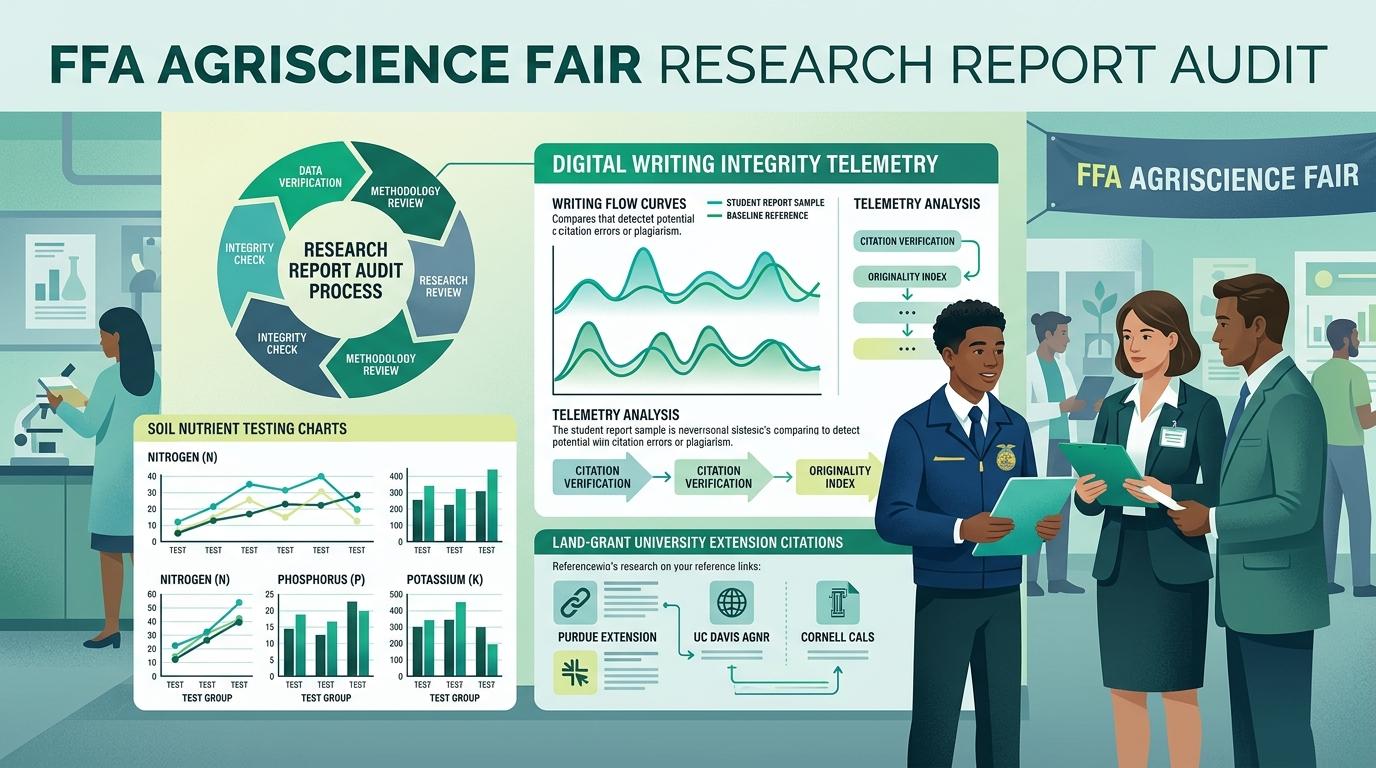
The National FFA Agriscience Fair represents the pinnacle of secondary agricultural inquiry, challenging Grades 7–12 agricultural education students across six divisions and six scientific categories to conduct rigorous empirical research—ranging from soil nitrogen-phosphorus-potassium (N-P-K) leaching kinetics, cover crop dry biomass accumulation, and mycorrhizal fungi root colonization assays to soil pH buffering dynamics and hydroponic electrical conductivity (EC) equilibria. However, severe regional, state, and national convention submission deadlines, coupled with the widespread accessibility of generative Large Language Models (LLMs), have triggered an unprecedented academic integrity dilemma in secondary Career and Technical Education (CTE): high school FFA members facing project deadlines are increasingly tempted to prompt AI tools to synthesize entire agriscience fair research reports.
This synthetic generation introduces confabulated Land-Grant Extension citations (e.g., non-existent Texas A&M AgriLife, Iowa State Extension, Purdue Extension, or UC ANR circulars), fabricated USDA Agricultural Research Service (ARS) bulletin numbers, mathematically impossible soil cation-exchange equilibria, and unnaturally smoothed crop yield curves with zero biological variance. Simultaneously, generic commercial AI percentage detectors fail agriscience educators by generating rampant false positives on standardized agricultural taxonomy (Zea mays, Bradyrhizobium japonicum), USDA NRCS soil series classifications (Typic Hapludolls), standard extraction protocols (Mehlich-3, Bray-1), and APA extension citation formats while failing to detect copy-pasted LLM experimental datasets. Checkmark Plagiarism resolves this investigative bottleneck by pairing passage-level AI confidence sliders with patent-pending Essay Playback™ writing process telemetry (1x–8x replay), raw spreadsheet clipboard inspection, cross-chapter peer matching, and quote-anchored rubric autograding aligned with official National FFA Agriscience Fair scorecards. Integrated directly into Canvas LMS, Agilix Buzz, and Google Classroom, Checkmark equips FFA advisers and contest judging committees to verify empirical data concordance, uphold the National FFA Agriscience Fair's research integrity expectations, and conduct supportive, restorative research conferences that protect student growth and collegiate research readiness.
Checkmark Plagiarism empowers agricultural educators and FFA advisers through an integrated suite of writing process playback, passage-level AI detection, side-by-side source verification, rubric autograding, and native LMS integrations.
1. The National FFA Agriscience Fair Architecture: Divisions, Categories, and Disciplinary Standards
The National FFA Agriscience Fair recognizes middle and high school agricultural education students who engage in authentic scientific inquiry and emerging agricultural technology research. Governed by the handbook and rubrics published by the National FFA Organization, the competition demands that students transition from passive classroom learners into practicing agricultural researchers.
| Division | Grade Levels | Participation | Disciplinary Scope & Methodological Rigor |
|---|---|---|---|
| Division 1 | Grades 7–8 (Middle School) | Individual | Foundational scientific method, controlled variables, basic descriptive statistics, and primary logbook logging. |
| Division 2 | Grades 7–8 (Middle School) | Team | Collaborative foundational inquiry, shared greenhouse bench or animal trials, and dual-member logbook documentation. |
| Division 3 | Grades 9–10 (Secondary Underclass) | Individual | Intermediate experimental design, two-sample t-tests, standard error calculations, and APA literature reviews. |
| Division 4 | Grades 9–10 (Secondary Underclass) | Team | Intermediate collaborative multi-plot agronomic trials, randomized block designs, and joint manuscript drafting. |
| Division 5 | Grades 11–12 (Secondary Upperclass) | Individual | Advanced collegiate-level inquiry: One-way/Two-way ANOVA, regression modeling (R²), and primary extension synthesis. |
| Division 6 | Grades 11–12 (Secondary Upperclass) | Team | Advanced multi-variable team field trials, bio-assays, spectrophotometry, and multi-enterprise statistical models. |
The division descriptions above are a summary for orientation, so confirm the current grade bands and team rules in the Agriscience Fair Handbook. Within these six divisions, student research is categorized into six specialized agricultural disciplines:
Agronomy, genetics, crop physiology, and soil-plant interactions. Typical trials evaluate nitrogen-use efficiency in hybrid corn, biochar amendment rates in sandy loam, cover crop biomass accumulation (cereal rye vs. hairy vetch), or mycorrhizal root colonization under varying tillage intensities.
Biogeochemical cycles, soil conservation, water quality, and ecological sustainability. Projects quantify nitrate-nitrogen (NO₃-N) and orthophosphate (PO₄³⁻) leaching in drainage lysimeters, macroinvertebrate biotic indices (FBI) in stream runoff, or heavy metal phytoextraction.
Food safety, post-harvest biochemistry, preservation, and value-added processing. Investigations explore lipid oxidation kinetics in grass-fed vs. grain-finished beef, antimicrobial efficacy of plant essential oils against E. coli, or thermal pasteurization curves.
Livestock nutrition, physiology, reproduction, and welfare. Trials evaluate feed conversion ratios (FCR) in market broilers, probiotic supplementation on equine cecal pH, ruminal buffering in dairy calves, or internal parasite fecal egg counts (FEC) under rotational grazing.
Agricultural mechanics, precision ag, robotics, and thermodynamics. Projects evaluate automated variable-rate drip irrigation algorithms, multispectral drone NDVI ground-truthing, solar drying facility efficiencies, or tractor hydraulic flow dynamics.
Agricultural economics, consumer perceptions, and policy adoption. Studies analyze consumer willingness-to-pay for organic vs. conventional labeling, farmer adoption barriers for precision nitrogen sensors, or the efficacy of youth agricultural literacy campaigns.
2. The LLM Temptation in Secondary Agriscience: Anatomy of Synthetic Reports
High school agriculture students manage extraordinarily demanding co-curricular schedules. A typical active FFA member balances an intensive Supervised Agricultural Experience (SAE) project (raising livestock, managing greenhouse crops, or working on an agribusiness placement), rigorous preparation for Career Development Events (CDEs) or Leadership Development Events (LDEs), chapter officer meetings, livestock show exhibition schedules, and full academic course loads.
When the hard submission deadline for District, Sectional, State, or National Agriscience Fair judging arrives—frequently coinciding with spring regional conventions and AP testing—students who have encountered experimental failures (e.g., greenhouse aphids killing crop replicates, frozen irrigation lines, or delayed soil testing lab turnaround) face an acute temptation: prompting a generative LLM (such as ChatGPT, Claude, or Gemini) to write their research report or invent missing data points.
Anatomy of Hallucinated Agricultural Citations
Large Language Models operate via statistical next-token prediction across vast text corpora; they do not query live USDA Agricultural Research Service repositories or Land-Grant Extension publishing databases unless explicitly integrated with specialized live-retrieval tools. When prompted for agricultural literature, LLMs routinely generate hallucinated citations that mimic academic phrasing with deceptive plausibility.
| Citation Component | Genuine Peer-Reviewed / Extension Source | AI-Hallucinated Citation Signature |
|---|---|---|
| Author Affiliation | Real, verifiable faculty/specialist at cited Land-Grant university (e.g., TAMU Soil Sciences). | Real agronomy professor paired with a completely fabricated paper title. |
| Extension Circular Code | Matches official university publication series (e.g., Purdue AY-318-W, Iowa State PM 1688). | Synthesizes plausible-sounding series codes (e.g., an invented code such as “TAMU Ext. Bul. EB-4491”). |
| Digital Object ID (DOI) | Resolves directly via https://doi.org to authentic manuscript record and volume/issue. | Invented 10.xxxx/xxx string that returns HTTP 404 Not Found or unrelated article. |
| Publication Scope | Cites specific soil series, localized rainfall, geographic microclimates, and regional cultivars. | Vague, sweeping generalizations with no regional soil series or climatic bounds. |
“Smith, J. A., & Brown, T. L. (2021). Nitrate-nitrogen leaching dynamics under no-till cover crop rotations in silt loam soils (Publication No. AGR-1882). University of Kentucky Cooperative Extension Service. https://doi.org/10.1016/j.agwat.2021.106721”
https://doi.org/10.1016/j.agwat.2021.106721 returns a “DOI Not Found” error. The 10.1016 prefix belongs to Elsevier, which makes the string look credible, but no record exists for this suffix, so the citation cannot be traced to any paper.Anatomy of Fabricated Soil Trial Data and Agronomic Inconsistencies
When agricultural students face missing lab readings or greenhouse failures, they may prompt an LLM to generate “a complete raw data table for a 6-week soil trial comparing 0, 5, 10, and 15 tons/acre biochar on soil pH, Mehlich-3 extractable phosphorus, cation-exchange capacity, and nitrate leaching.”
While the generated numbers look impressive on a PDF submission, they routinely violate foundational laws of soil chemistry, thermodynamics, and biological growth kinetics:
| Soil Trial Parameter | Authentic Empirical Laboratory Dynamics | AI-Fabricated Data Artifacts |
|---|---|---|
| Nitrate Leaching (NO₃⁻ mg/L in leachate) | High replicate variance due to preferential macropore flow and column soil compaction variations. | Perfect linear stepwise reductions (R² > 0.995) across all replicates with near-zero standard deviations (s < 0.05). |
| Cation-Exchange Capacity (CEC meq/100g) | CEC = ∑(Ca²⁺ + Mg²⁺ + K⁺ + Na⁺ + Al³⁺ + H⁺) balances stoichiometrically with soil texture. | Individual base cations sum to 45 meq, while total CEC is listed as 18.2 meq/100g (stoichiometric failure). |
| Soil pH Buffering | Sigmoidal buffering response; soil clay/humus mineralogy resists rapid pH swings. | Unbuffered linear 0.5 pH unit jumps per amendment unit regardless of soil buffer index. |
| Hydroponic EC vs. Total Dissolved Solids (TDS) | Direct physical correlation: TDS (ppm) ≈ EC (mS/cm) × 640. | EC and TDS move in opposite directions, or TDS deviates wildly from standard conversion factors. |
| Mycorrhizal Root Colonization (% VAM) | Clustered percentage values based on gridline intersect counts (e.g., 42%, 47%, 51%). | Decimal values reported to 4 decimal places (45.3218%), impossible on 100-root segment counts. |
In authentic soil testing using standard extraction protocols (such as Mehlich-3, Ammonium Acetate pH 7.0, or Bray-1), Soil Cation-Exchange Capacity (CEC) represents the total capacity of a soil to hold exchangeable cations:
When an LLM synthesizes a soil chemistry dataset, it almost always outputs random values for calcium, magnesium, and potassium without balancing the stoichiometric sum. An adviser auditing the student's submission will find that the base cations exceed 200% of the soil's stated CEC—an impossible condition in terrestrial soils that instantly proves data fabrication.
3. National FFA Research Integrity Expectations, Disqualification Risks, and the Generic Detector Failure
The National FFA Organization expects Agriscience Fair projects to be the authentic, original research of the students named on the entry. Advisers should confirm the exact wording of the originality, research integrity, and sanctions requirements in the current Agriscience Fair Handbook and Rubrics published on the National FFA website and in their state association's rules. The principles below summarize what advisers should be prepared to uphold. They are not quotations from the handbook, and the consequence ladder that follows is illustrative:
- Originality of Entry: Every project should be the original, empirical work of the student(s) named on the entry application.
- Avoiding Scientific Misconduct: Plagiarism, data fabrication, data falsification, unauthorized ghostwriting, manipulation of agricultural logbooks, or misrepresentation of secondary sources as primary data are forms of scientific misconduct.
- Sanctions: Consequences for an integrity violation are set by the fair's governing rules and your state association, and can range from a course-level penalty to disqualification. Check the current handbook for the sanctions that apply at each level of competition.
Why Generic AI Detectors Fail High School Agriculture Advisers
Faced with mounting pressure to enforce research integrity, many high school agriculture departments turn to generic, commercial AI percentage detectors. However, generic detectors create severe pedagogical crises in agricultural science classrooms:
- Standard Agronomic Terminology: Flags scientific binomials (Glycine max, Bradyrhizobium japonicum) due to low linguistic perplexity.
- USDA NRCS Soil Taxonomy: Classifications (Typic Argiudolls, fine-loamy, mixed) can trigger inflated “AI probability” scores.
- Standardized Extension Citation Syntax: APA reference entries for Land-Grant circulars trigger formulaic pattern flags, falsely accusing honest students.
- Blind to Numerical Tables: Generic detectors parse only continuous prose; they cannot evaluate numerical data tables or soil chemistry balance equations.
- Defeated by Paraphrasing: Light paraphrasing tools drop detector scores to 0% while preserving completely fabricated citations and synthetic soil data.
- Zero Process Evidence: An arbitrary whole-paper score (e.g., “74% AI”) offers no defensible proof during contentious parent conferences.
Agriculture teachers managing five to six class periods and 120–160 students cannot rely on opaque probability scores. They need transparent, reproducible, and legally defensible writing telemetry.
4. The High School Agriscience Evidentiary Matrix
To reliably audit written research reports and safeguard student rights, FFA advisers must apply a multidimensional evidentiary standard. The matrix below outlines how traditional auditing, generic AI detectors, and Checkmark Plagiarism compare across critical verification parameters.
| Evidentiary Dimension | Traditional Paper Logbook & Manual Audit | Generic AI Detector (Single Black-Box %) | Checkmark Agricultural Source & Essay Playback™ |
|---|---|---|---|
| Core Verification Mechanism | Visual inspection of manual handwriting and physical greenhouse bench pots. | Probabilistic token distribution algorithms (perplexity/burstiness). | Patent-pending keystroke dynamics, temporal replay, and live Land-Grant source mapping. |
| Land-Grant Extension Source Authentication | Adviser must manually search each publication code online. | Completely blind; flags APA syntax as “formulaic AI.” | Live two-way linked web cards; checks university repositories and DOI registries. |
| Soil Trial Data Concordance Tracking | Compares final report to handwritten ink log pages. | Cannot parse numerical data tables or spreadsheets. | External paste inspector audits raw clipboard data entry pacing and spreadsheet formulas. |
| Writing Process Replay (1x–8x Speed) | None (only sees final printed manuscript). | None (evaluates static text snapshot after submission). | Full 1x–8x timeline playback; reveals drafting velocity, pauses, and revisions. |
| External Clipboard Provenance Inspection | None (cannot verify digital text creation history). | None (cannot detect copy-paste actions or sources). | Timestamped capture of external pastes with full text preservation. |
| Cross-Chapter Cohort Peer Match | Limited to adviser's own memory across class periods. | None (evaluates submission in complete isolation). | Detects text & dataset sharing across regional chapter cohorts. |
| Defensibility in Contested Integrity Conferences | Subjective; vulnerable to parental dispute & appeals. | High risk of false flags; legally indefensible. | Objective keystroke telemetry provides unassailable process receipts. |
5. Step-by-Step FFA Adviser Audit Protocol for Agriscience Submissions
High school agriculture instructors can execute the following five-step protocol to systematically audit written agriscience reports before submitting entries to District, State, or National judging committees.
Step 1: Primary Logbook & Raw Spreadsheet Concordance Audit
Before analyzing narrative style, the adviser must verify that the empirical foundation of the report exists in physical reality:
- Physical Logbook Authentication: Confirm that the student maintains a bound, handwritten primary research logbook. Entries must include specific dates, clock times, environmental conditions (greenhouse ambient temperature, relative humidity), and raw instrument readings (spectrophotometer optical density at 600 nm, EC in µS/cm). Genuine logbooks feature physical artifacts: ink smudges, crossed-out erroneous readings with corrected notations, and chronological gaps reflecting weekends.
- Spreadsheet Formula Audit: Open the student’s raw Google Sheet or Excel workbook. Verify that summary statistics (x̄, standard deviation s, standard error SEM, and ANOVA F-values) are generated using dynamic spreadsheet formulas (
=AVERAGE(),=STDEV.S(),=ANOVA()) rather than static, hard-coded numbers typed into cells.
Step 2: Agricultural Extension & USDA DOI Source Verification
The literature review must be audited to ensure that all cited Land-Grant Extension publications and USDA research bulletins correspond to genuine, published agronomic studies:
https://doi.org. Verify resolving title and journal.Step 3: Writing Process Telemetry & Keystroke Replay with Essay Playback™
When students compose their research reports in Google Docs on school-issued Chromebooks or within LMS text editors (Canvas LMS, Agilix Buzz), Checkmark Plagiarism's Essay Playback™ reconstructs the complete drafting session. Advisers can scrub through the entire writing process at 1x, 2x, 4x, or 8x speed to observe how the paper was assembled.
Step 4: External Paste Inspection & Clipboard Provenance
Checkmark’s External Paste Inspector captures every text snippet pasted into the document from outside sources, preserving the complete original clipboard content even if the student subsequently edits, rewrites, or deletes the pasted text.
Small snippets (10–50 characters) containing raw numerical columns from Google Sheets, spectrophotometer model numbers, or direct quoted APA definitions.
Formatted bibliographic entries pasted directly from university library databases or citation managers (e.g., Zotero, Purdue OWL).
Large blocks (500–2,500 words) containing full sections, markdown headers (###), bulleted conclusions, and confabulated extension citations pasted in a single timestamped event.
Step 5: Conducting Supportive Restorative Agriscience Research Debriefs
When an audit reveals confabulated citations, impossible soil chemistry figures, or bulk external paste events, the agriculture teacher’s response must remain pedagogical, restorative, and supportive. The philosophy of Checkmark is “Stop guessing, start trusting.” Academic integrity tools should provide transparent, defensible evidence (“receipts”) to foster fair conversations and student growth—not arbitrary, punitive black-box scores.
6. How Checkmark Plagiarism Powers High School Agriscience Advisers & Judging Committees
Checkmark Plagiarism provides a purpose-built academic integrity and rubric evaluation suite engineered specifically for secondary Career and Technical Education environments.
LMS Integration Workflow: Canvas LMS, Agilix Buzz, and Google Classroom
Whether an FFA adviser is grading 150 introductory agriscience semester reports or screening state fair submissions, Checkmark embeds directly into secondary LMS workflows via LTI 1.3 Advantage.
7. Illustrative High School Agriscience Case Scenarios
Topic: Pyrolyzed oak biochar mitigating soil nitrate leaching in sandy loam soils.
Submission: 14-page report citing 7 Texas A&M AgriLife and USDA-ARS bulletins.
Resolution: Student admitted using LLM after aphids killed greenhouse plants. Adviser guided student to re-run column leaching trials with authentic controls.
Topic: Macroinvertebrate family biotic index (FBI) in agricultural runoff streams.
The False Positive: Generic detector flagged paper as “89% AI” due to soil taxonomy (Typic Udifluvents) and EPA protocols.
Resolution: Writing telemetry completely exonerated student; paper cleared for State FFA Agriscience Fair entry.
Topic: Black soldier fly larvae meal vs. soybean meal on broiler chick feed conversion ratios.
Submission: Significant FCR (p = 0.0021) and uniform weight gains across 40 birds.
Resolution: Students admitted missing weighing days 14–21 during basketball tournament. Adviser coached team to report data gaps as limitations and recalculate on verified dates.
8. Frequently Asked Questions (FAQs) for FFA Advisers, CTE Leaders, and Agriscience Judges
1. Where is the boundary between allowed grammar tools and prohibited generative AI in Agriscience Fair reports?
Check the current National FFA Agriscience Fair Handbook and your state association's rules for the exact language on AI tools, because those documents take precedence over general guidance here. As a practical standard, basic assistive tools such as spell-checkers or standard grammar polishers are widely accepted, while using generative LLMs to compose the research narrative, invent experimental datasets, or hallucinate citations undermines the originality and data integrity expected of every entry and can put it at risk of disqualification.
2. Why do generic AI detectors flag legitimate agricultural taxonomy as AI-generated?
Generic detectors rely on linguistic perplexity and burstiness. Highly standardized agronomic phrases (e.g., Bradyrhizobium japonicum, cation-exchange capacity, Mehlich-3 extraction) are statistically formulaic, causing generic tools to falsely brand authentic scientific writing as machine-generated. Checkmark uses calibrated passage-level confidence sliders paired with Essay Playback™ to eliminate false accusations.
3. Can Essay Playback™ audit collaborative team projects (Divisions 2, 4, and 6)?
Yes. Essay Playback™ color-codes and separates keystroke telemetry by individual student Google or LMS accounts, allowing advisers and judges to verify that both team members contributed equitably to the experimental narrative, data synthesis, and literature review.
4. How does Checkmark verify Land-Grant Extension publications?
Checkmark's Plagiarism Breakdown engine cross-references billions of live web pages, university repositories (e.g., Texas A&M AgriLife, Purdue, Iowa State, UC ANR, UF/IFAS), and DOI registries, providing side-by-side quote viewers with active hyperlinks for instant verification.
5. Does Checkmark store student agriscience reports to train public AI models?
Absolutely not. Checkmark enforces a strict Zero-Model Training policy. Student agriscience reports remain 100% private, FERPA/COPPA compliant, and are never used to train public or proprietary LLMs, safeguarding student intellectual property and proprietary agricultural research.
6. How does quote-anchored rubric autograding help FFA advisers grade heavy stacks of agriscience reports?
Checkmark autogrades first-draft submissions against custom rubrics mapped directly to official National FFA Agriscience Fair scorecards. It generates criterion scores anchored to specific quotes in the student report, which advisers can review, adjust, and sync directly to Canvas, Agilix Buzz, or Google Classroom gradebooks in one click.
Conclusion: Fostering Authentic Inquiry and Scientific Leadership in Agricultural Education
Agricultural education has always been rooted in real-world, hands-on experiential learning—from the greenhouse bench and the soil testing lab to the livestock barn and the agricultural mechanics shop. The National FFA Agriscience Fair serves as a premier pipeline connecting high school students to high-demand careers in agronomy, veterinary medicine, agricultural engineering, and environmental resource management.
By replacing opaque, punitive black-box AI detectors with Checkmark Plagiarism's transparent evidentiary ecosystem—combining passage-level AI confidence sliders, side-by-side Land-Grant source proof, patent-pending Essay Playback™ writing process telemetry, and quote-anchored rubric autograding—agriculture teachers and FFA advisers can stop guessing and start trusting. With defensible process receipts in hand, educators can uphold National FFA research integrity expectations, protect honest students from false accusations, and empower the next generation of agricultural leaders to conduct authentic, impactful scientific inquiry.