
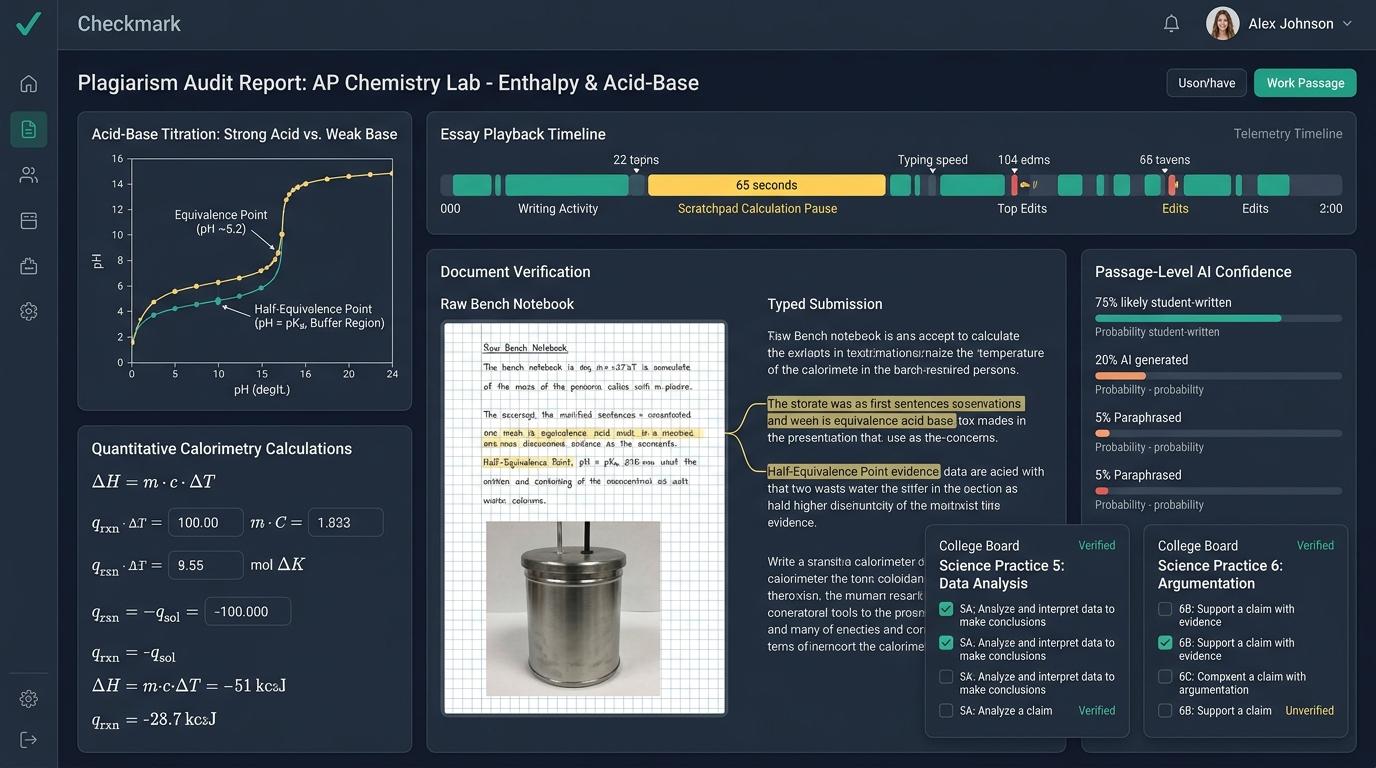
Executive Summary & Scientific Integrity Mandate
In secondary Advanced Placement (AP) Chemistry classrooms, rigorous inquiry-based wet labs constitute over 25% of instructional time—demanding that students translate empirical bench observations into quantitative thermodynamic derivations, logarithmic acid-base equilibria curves, and formal Claim-Evidence-Reasoning (CER) lab writeups under College Board Science Practices 5 and 6. However, the ubiquity of Large Language Models (LLMs) has sparked a widespread data integrity crisis: students under intense AP grade pressure frequently prompt AI tools to synthesize “perfect” post-lab calculations, generating fabricated titration curves, hallucinated buffer capacities, and confabulated enthalpy values (q = mcΔT, ΔH_rxn = -q_cal / n) unmoored from their actual bench notebooks.
Simultaneously, generic commercial AI detectors fail science faculty by flagging standard chemical formulas, equilibrium expressions, and structured CER templates as “AI-generated” while letting synthesized data pass undetected. Checkmark Plagiarism resolves this challenge by pairing passage-level AI confidence sliders with patent-pending Essay Playback™ writing process telemetry (1x–8x replay), external paste inspection with full text preservation, and quote-anchored AP science rubric autograding. Integrated directly into Canvas SpeedGrader, Agilix Buzz, and Google Classroom, Checkmark enables high school chemistry teachers to audit empirical concordance, verify authentic mathematical drafting pauses, and conduct restorative lab conferences that celebrate genuine scientific inquiry over fabricated perfection.
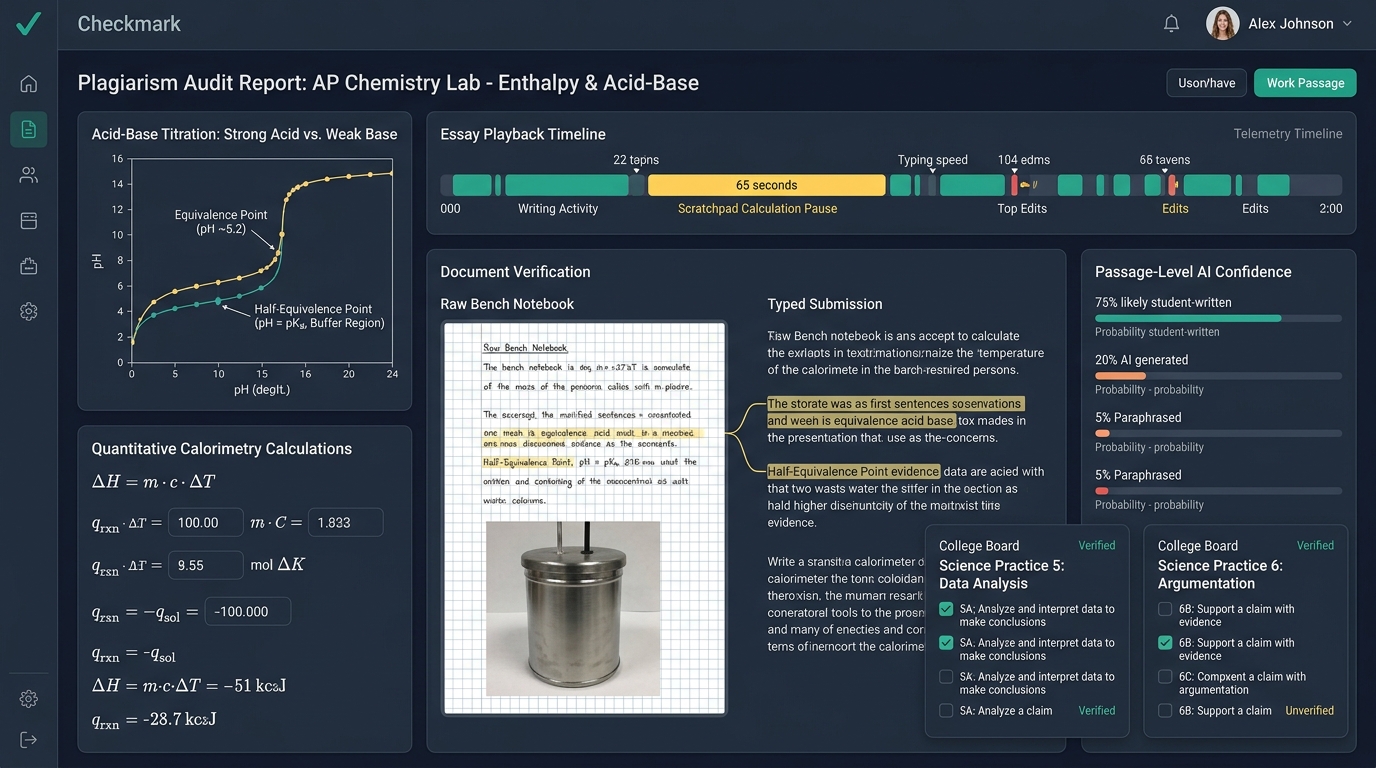
Layer 1: Empirical Bench Concordance
- Stamped paper lab notebook cross-verification
- Physical measurement variance (±0.02 mL buret)
- Expected calorimeter heat loss (~10%–25% lower)
- Indicator overshoot & meniscus parallax reality
Layer 2: Writing Process Telemetry
- Patent-pending Essay Playback™ (1x–8x replay)
- TI-84 / scratchpad calculation pauses (45–90s)
- External Paste Inspector (preserves raw buffer)
- Passage-level calibrated AI confidence sliders
Layer 3: Restorative Lab Conference
- Evidence-based dialogue on physical error analysis
- College Board SP 5 (Math) & SP 6 (CER) alignment
- Safe environment celebrating genuine bench trials
- Revision opportunities replacing zero-tolerance penalties
1. The Disciplinary Anatomy of AP Chemistry Quantitative Lab Inquiries
In the modern College Board AP Chemistry curriculum, laboratory investigations are not merely illustrative demonstrations; they are open-inquiry assessments designed to cultivate collegiate-level scientific reasoning. Science Practice 5 (Mathematical Routines) and Science Practice 6 (Argumentation) require students to capture raw, imperfect physical measurements, perform multi-step stoichiometric and thermodynamic transformations, and defend empirical claims using precise biochemical and chemical logic.
| Science Practice | Disciplinary Core Competency in Quantitative Wet Labs | Primary Lab Evidence Types |
|---|---|---|
| Practice 1 (SP 1) | Models & Representations: Describe models and particulate drawings. | Submicroscopic particle diagrams (hydrated ions, buffer pairs). |
| Practice 2 (SP 2) | Question & Method: Formulate scientific questions and experimental procedures. | Gravimetric, volumetric, and spectroscopic assay design. |
| Practice 3 (SP 3) | Representing Data: Construct and interpret graphical representations. | Titration curves, Beer’s law calibration plots, heating curves, integrated rate laws. |
| Practice 4 (SP 4) | Model Analysis: Analyze and evaluate thermodynamic and kinetic models. | Macroscopic, particulate, and mathematical model evaluations. |
| Practice 5 (SP 5) | Mathematical Routines: Solve quantitative stoichiometry and thermodynamics problems. | Calorimetry (q = mcΔT), molar enthalpy, equilibrium expressions, pH/pKa. |
| Practice 6 (SP 6) | Argumentation: Develop and justify scientific claims using empirical evidence. | Formal Claim-Evidence-Reasoning (CER) writeups with error analysis. |
When 10th, 11th, and 12th-grade chemistry students execute core AP inquiry labs—such as Investigation 12: Hand Warmer Design (Calorimetry & Hess’s Law), Investigation 14: Acid-Base Titrations & Buffer Capacity, or Investigation 2: Spectrophotometric Beer’s Law Analysis—they must synthesize complex empirical data into formal written reports.
Core Quantitative Benchmark 1: Calorimetry, Specific Heat, and Hess’s Law
Calorimetry investigations require students to isolate an aqueous reaction system within a nested polystyrene (coffee-cup) calorimeter, measure transient temperature shifts (ΔT = T_final - T_initial), and derive molar enthalpy changes (ΔH_rxn).
Where m is total aqueous mass (assuming ρ = 1.00 g/mL), c = 4.184 J/(g·°C), and ΔT = T_f - T_i.
Accounting for heat capacity of nested polystyrene cups and thermometer immersion stem.
Expressed in kJ/mol. For exothermic reactions, ΔT > 0 ⇒ q_aq > 0 ⇒ ΔH < 0.
Summing intermediate laboratory reactions (e.g., solid vs aqueous dissolution steps) to confirm path independence.
Exothermic Reaction (ΔH < 0)
- Chemical system releases thermal energy:
q_rxn < 0 - Aqueous solution absorbs heat:
q_soln > 0 - Observed thermometer rise:
ΔT > 0 (T_f > T_i) - Physical Bench Reality: Uninsulated cup lids and thermometer glass dissipate heat to ambient air. Observed |ΔH_exp| is 10% to 25% lower than theoretical literature values.
Endothermic Reaction (ΔH > 0)
- Chemical system absorbs thermal energy:
q_rxn > 0 - Aqueous solution loses heat:
q_soln < 0 - Observed thermometer drop:
ΔT < 0 (T_f < T_i) - Physical Bench Reality: Heat flows inward from ambient surroundings into cold cup, preventing temperature from dropping to its ideal minimum.
Core Quantitative Benchmark 2: Acid-Base Titration Curves & Buffer Equilibrium
In acid-base volumetric titrations, high school students standardize an unknown weak or strong acid by delivering calibrated aliquots of standard titrant (typically 0.1000 M NaOH) from a 50.00 mL buret, recording pH via digital sensor or buret meniscus readings.
| Titration Stage | Strong Acid / Strong Base (HCl + NaOH) | Weak Acid / Strong Base (CH3COOH + NaOH) |
|---|---|---|
| Initial pH (V_b = 0) | pH = -log10[H+] (Sharp low initial pH, ~1.00) |
[H+] = √(Ka × Ca) ⇒ pH = -log10√(Ka × Ca) (Moderate initial pH, ~2.88) |
| Half-Equivalence Point (V_b = 0.5 V_e) | Unbuffered dilution zone; rapid pH transition begins. |
Optimal Buffer Zone: [HA] = [A-] [H+] = Ka ⇒ pH = pKa Minimal slope (dpH/dV) on curve |
| Equivalence Point (V_b = V_e) | Neutral Salt: [H+] = [OH-] = 1.0×10^-7 pH = 7.00 (at 25°C) |
Basic Salt Hydrolysis: A- + H2O ⇔ HA + OH- pH > 7.00 (~8.72 for 0.10M acetate) |
| Post-Equivalence (V_b > V_e) | [OH-] = n_excess / V_total pH = 14.00 - pOH |
[OH-] = n_excess / V_total pH = 14.00 - pOH |
Henderson-Hasselbalch Buffer Mechanics
In authentic student lab data, the buffer region displays a flat plateau. When students prompt LLMs to synthesize tables, AI engines frequently confabulate linear steps between V_b = 0 and V_b = V_e, completely violating the logarithmic buffering capacity.
Indicator Transition & Overshoot Dynamics
- Phenolphthalein (pK_In ≈ 9.3): Colorless in acid (pH < 8.2), faint pale pink at endpoint (pH 8.2–9.2), dark fuchsia magenta in excess base. Perfect for weak acid titrations (pH_e ≈ 8.7).
- High School Overshoot Reality: Novice students routinely add 1–2 extra drops past endpoint, shifting the observed color to deep purple and adding +0.05 to +0.10 mL of systematic volumetric error.
Core Quantitative Benchmark 3: Spectrophotometry & Beer-Lambert Law
In AP Chemistry Investigation 2 (Spectroscopic Determination of Food Dye or Cu2+ Concentration), students measure the attenuation of monochromatic light transmitted through an aqueous cuvette:
Where A is unitless absorbance (optimal linear range: 0.100 ≤ A ≤ 1.000), ε is the molar absorptivity constant (L·mol-1·cm-1) at λmax, b = 1.00 cm is cuvette path length, and c is molar concentration.
Secondary Bench Realities vs. LLM Confabulation Artifacts
The defining challenge of grading high school chemistry lab reports in the age of generative AI lies in the stark contrast between physical wet-bench realities and the idealized mathematical outputs synthesized by Large Language Models:
| Laboratory Dimension | Authentic Secondary Bench Data | LLM-Generated Fabrication |
|---|---|---|
| Calorimetry Heat Loss | Always Present (10% to 25% error): Heat dissipates through cup lid and air gap; ΔH_exp is consistently lower in magnitude than literature values. | Ignored / Perfect 0.0% Error: Assumes a closed adiabatic system and yields textbook theoretical values (-55.8 kJ/mol) with zero physical loss. |
| Buret Meniscus Readings | Random Parallax Uncertainty: Read to ±0.02 mL (e.g., 14.38 mL, 28.71 mL) with authentic human estimation dispersion across trials. | Idealized Round Numbers: Reports exactly 25.00 mL or perfectly computed fractional steps matching nominal stoichiometry with zero noise. |
| Titration Endpoint Quality | Frequent Overshoot: Students routinely add 1 extra drop, turning solution dark fuchsia (+0.05 to +0.50 mL over equivalence point). | Instantaneous Exact Stop: Reports equivalence at precisely V_e with zero indicator overshoot or color tint discrepancy (pH 7.00 or 8.72 flat). |
| Air Bubble Trapping | Erratic Volume Jumps: Air bubbles under buret stopcock dislodge mid-titration, creating a 0.3 to 0.8 mL step artifact in raw data table. | Continuous Sigmoidal Curve: Generates perfectly smooth, mathematically idealized logistic curves without a single empirical outlier. |
| Cuvette Cleanliness | Baseline Drift & Smudges: Micro-scratches or lint on cuvette faces create minor baseline offsets and absorbance scatter. | R² = 1.0000 Calibration: Hallucinates perfectly collinear absorbance points with zero stray light or instrumental noise. |
| Stoichiometric Calculations | Linked to Measured Mass: Calculations propagate measured analytical balance readings (2.041 g ⇒ 0.0510 mol used consistently). | Detached Formula Confabulation: Derives enthalpy from standard reference tables (-285.8 kJ/mol) while completely ignoring the student’s own recorded mass! |
2. The AP Grading & Disciplinary Dilemma: Why Generic AI Detectors Fail Science Faculty
High school AP Chemistry teachers manage 120 to 160 students across 5 to 6 class periods. Grading a multi-page quantitative lab report with full error analysis takes 10 to 15 minutes per student—demanding entire weekends of teacher time. When generative AI entered the classroom, many science departments turned to generic commercial AI detectors in an effort to screen lab writeups automatically.
However, black-box AI detectors have proven disastrously unsuited for secondary STEM evaluation.
The False-Positive Trap (Honest Prose Flagged)
- Chemical equations (
HCl(aq) + NaOH(aq) → NaCl(aq) + H2O(l)) - Standard unit strings (
kJ/mol,J/(g·°C)) - Rigid AP CER template framing (“The claim is supported by evidence that...”)
- Disciplinary equilibrium phrases with low token perplexity
The False-Negative Blindspot (Fabricated Data Slips Through)
- Completely fabricated calorimetry data tables
- Hallucinated titration buret volumes and buffer capacities
- Polished AI calculations matching textbooks rather than bench measurements
- Informal student prompting that bypasses statistical burstiness filters
1. The False-Positive Trap in Structured Scientific Prose
High school chemistry students are explicitly trained to use structured, standardized academic syntax. When writing the Reasoning section of a CER lab report, teachers require students to write sentences such as:
“Because acetic acid (CH3COOH) is a weak monoprotic acid, its conjugate base (CH3COO-) undergoes hydrolysis at the equivalence point according to the equation CH3COO-(aq) + H2O(l) ⇔ CH3COOH(aq) + OH-(aq), resulting in an equivalence pH strictly greater than 7.00.”
To a statistical token-predictability model (measuring perplexity and burstiness), this sentence looks virtually identical to an LLM completion because scientific vocabulary is inherently regular, highly structured, and low in perplexity. Consequently, generic detectors routinely assign 80%–95% AI confidence scores to rigorous, authentic student science writing.
2. The False-Negative Blindspot: Data Fabrication Without Textual Flags
Conversely, when a student enters their prompt into ChatGPT—“Here is my AP Chem lab on enthalpy of neutralization. I forgot to record my temperatures. Generate a plausible data table for 50 mL 1.0 M HCl + 50 mL 1.0 M NaOH and write out the full q=mcΔT calculation and CER discussion in a casual student voice”—the resulting writeup passes generic detectors effortlessly.
The text exhibits high burstiness and informal syntax, but the underlying scientific data is completely fabricated. The student never touched a buret or coffee cup, yet the generic AI detector assigns a “Clean / Human” score.
3. The AP Chemistry Evidentiary Matrix
To evaluate student lab authenticity without adversarial accusations, high school science educators require multi-dimensional evidentiary telemetry. The following matrix illustrates the structural differences between traditional audit methods and Checkmark’s scientific writing telemetry:
| Forensic Capability | Paper Lab Notebook Alone | Generic AI Detectors | Standard Google Docs History | Checkmark Scientific Writing Telemetry |
|---|---|---|---|---|
| Raw Bench Data Verification | High (if initialed in pen) | Zero (text-only scan) | Low (shows typed table state) | High (side-by-side notebook audit) |
| Calculation Pause Detection (Scratchpad) | Zero | Zero | Very Low (periodic snapshots) | High (quantifies 45–90s calc pauses) |
| External Clipboard / Paste Preservation | Zero | Zero | Low (marks bulk text insertions) | High (preserves full pasted text & source) |
| Passage-Level Granularity vs Whole-Paper Score | N/A | Zero (opaque 0–100% number) | N/A | High (sentence-by-sentence sliders) |
| Transcription from Device (Mechanical Retyping) | Zero | Zero | Low (appears as regular typing) | High (identifies 0-pause drafting streams) |
| Quote-Anchored Rubric Scoring (SP 5 & SP 6) | Zero (manual grading required) | Zero | Zero | High (instant AP CER passback to LMS) |
The Cognitive Drafting Lifecycle of Authentic Chemistry Writing
Authentic scientific writing possesses a distinct temporal and behavioral fingerprint. A student actively working through an AP Chemistry lab writeup moves through three distinct cognitive phases:
When a student uses an LLM to generate their report, this authentic cognitive rhythm vanishes entirely. Instead of 45-to-90-second calculation pauses interspersed with active dimension typing, the telemetry reveals either:
- The Instantaneous Paste Drop: A 4-second session where 1,200 words of complex dimensional analysis and CER prose are pasted simultaneously into an empty document.
- The Mechanical Transcription Stream: Continuous, robotic typing at 65 words per minute with zero backspaces, zero calculation pauses, and zero corrections as the student copies generated text from a secondary phone screen.
4. Step-by-Step High School Chemistry Teacher Audit Protocol
To protect academic integrity while fostering a supportive learning environment, AP Chemistry teachers and science department chairs should implement this structured 5-step audit protocol.
Bench Notebook Check
Cross-verify typed report with stamped bench ink data.
Sanity Checks
Verify ΔH signs (<0), heat loss percent error, buffer pH.
Essay Playback™
Inspect 1x–8x replay for 45–90s calculator pauses.
Paste Inspector
Review raw clipboard drops in Checkmark paste viewer.
Restorative Debrief
Conduct coaching focused on scientific truth & error analysis.
Step 1: Raw Bench Notebook vs. Typed Report Concordance Check
Before reviewing the narrative discussion, require students to submit a high-resolution photograph or scan of their raw lab notebook page alongside their typed report in Canvas, Buzz, or Google Classroom.
- The Initial Check: Verify that the lab notebook page contains the teacher’s physical stamp or signature from the lab period.
- Data Cross-Check: Compare initial and final buret volumes, calorimeter temperatures (
T_i, T_f), and reagent masses recorded in ink against the data table in the typed report. - The Red Flag: If the typed report features initial temperatures of
21.5°CandT_f = 28.0°Cwhile the raw notebook recordsT_i = 22.1°CandT_f = 27.4°C, the student has discarded their physical bench data in favor of an AI-generated calculation.
Step 2: Thermodynamic & Stoichiometric Sanity Checks
Review the quantitative conclusions for physical plausibility under high school lab conditions:
| Quantitative Check | Expected Physical Reality | Suspicious AI Artifact |
|---|---|---|
| Enthalpy Sign Consistency | Exothermic neutralization must yield ΔH < 0. q_aq > 0 ⇒ q_rxn < 0. |
Positive ΔH with confabulated reasoning claiming “solution gained heat, so reaction is positive.” |
| Calorimeter Error Directionality | Measured |ΔH_exp| is 5%–20% LOWER than theoretical due to cup and lid heat dissipation. |
Reports exactly -55.8 kJ/mol (0.0% error) or cites standard literature values without error discussion. |
| Equivalence Point pH Realism | Weak acid titration (CH3COOH) yields basic equivalence (pH 8.5–9.0) due to acetate conjugate base hydrolysis. | Reports pH = 7.00 for weak acid, or generates perfectly smooth data with no experimental buret drop dispersion. |
| Half-Equivalence Buffer Concordance | Experimental pH at half-V_e closely approximates literature pKa (4.74 for acetic acid). | pH at half-V_e does not match reported pKa because the LLM hallucinated linear steps across the table. |
| Significant Figure Integrity | Precision constrained by buret (±0.02 mL) and balance (0.001 g) to 3 or 4 sig figs. | Fabricates 6 decimal places (2.719648 kJ) or drops trailing zeroes (25 mL instead of 25.00 mL). |
Step 3: Writing Telemetry & Calculation Pause Analysis with Essay Playback™
When an AP Chemistry writeup displays suspicious data or generic AI flags, open the submission in Checkmark Plagiarism and launch Essay Playback™.
Step 4: External Paste & Clipboard Source Inspection
If a student copy-pastes text from ChatGPT, Claude, or a shared document, Checkmark’s External Paste Inspector captures the exact timestamp, character count, and preserved raw text:
Forensic Analysis:
- Text was inserted into document in a single 0.2-second event.
- Student subsequently deleted “flawless bench technique” and replaced with “minimal error”.
- Checkmark preserves original unedited clipboard text, defeating post-paste cosmetic edits.
Step 5: Facilitating Supportive, Restorative Lab Conferences
When audit evidence reveals fabricated data or AI generation, the teacher’s response should be pedagogical and restorative rather than purely punitive. High school students often fabricate data out of anxiety—fearing that an “imperfect” lab result or broken beaker will ruin their AP grade.
| Conference Phase | Teacher Dialogue & Evidence Protocol |
|---|---|
| 1. Set the Scientific Tone | “Marcus, thank you for meeting with me. In AP Chemistry, real science is about understanding experimental error, not getting ‘perfect’ numbers. Let’s look at your lab report and your bench notebook together.” |
| 2. Review Raw Concordance | “Your bench notebook shows your calorimeter temperature rose by 4.8°C, but your typed report uses 6.5°C and reports an enthalpy of -55.8 kJ/mol. Walk me through where that 6.5°C came from.” |
| 3. Review Essay Playback Replay | “When we look at your Essay Playback timeline, we see that the entire calculation section and CER discussion were pasted in at 11:42 PM in a single paste. Can you show me how you calculated these values on paper?” |
| 4. Focus on Real Scientific Error | “A 4.8°C rise gives an enthalpy of -40.2 kJ/mol, which represents a 28% error due to heat loss to the room. In AP Chemistry, explaining that heat loss earns FULL credit on the AP Exam! Fabricating perfect data actually loses points.” |
| 5. Restorative Remediation | Allow the student to re-write the calculations and CER discussion using their actual raw bench data for revised credit, reinforcing that scientific integrity and rigorous error analysis are paramount. |
5. How Checkmark Empowers Secondary Chemistry & STEM Departments
Checkmark Plagiarism provides a purpose-built academic integrity and autograding platform designed specifically for the demands of secondary science classrooms.
1. Passage-Level AI Confidence Sliders
Instead of assigning an arbitrary, punitive whole-document percentage (e.g., “78% AI”), Checkmark underlines specific sentences and provides calibrated confidence cards in the sidebar. Standard chemical equations, thermodynamic definitions, and structured CER framing phrases are recognized as standard scientific vocabulary, while ungrounded, synthetic narrative paragraphs are flagged with precision.
2. Essay Playback™ (1x–8x Replay)
Teachers can watch the entire drafting process unfold in real time or accelerated speed. Playback highlights drafting bursts, backspaces, formula edits, and cognitive calculation pauses, providing undeniable empirical proof of authentic authorship.
3. External Paste Inspector with Text Preservation
Checkmark records every external paste event, timestamping the insertion and preserving the exact text originally copied from external LLMs, web resources, or peer documents—protecting educators against subtle post-paste tweaking.
4. Quote-Anchored Rubric Autograding
Checkmark's teacher-in-the-loop autograder evaluates student writeups against custom AP Chemistry rubrics (or synced rubrics from Canvas, Buzz, and Google Classroom). It verifies mathematical steps, checks significant figures, assesses CER argumentation quality, and generates formative feedback cards anchored directly to quotes in the student's prose—saving high school science teachers 15+ hours of grading per lab unit.
6. Frequently Asked Questions (FAQ)
1. Why do generic AI detectors flag standard AP Chemistry equations and CER templates as AI-generated?
Generic AI detectors operate by calculating token perplexity (word choice unpredictability) and burstiness (sentence structure variation). High school chemistry writing requires standardized, low-perplexity phrasing (e.g., “The reaction is exothermic because the temperature of the calorimeter increased...”, chemical formulas like CH3COOH, and standard units like kJ/mol). Because these formal constructions follow rigid conventions, generic detectors falsely categorize authentic student work as machine-generated. Checkmark eliminates this problem through passage-level confidence scoring and keystroke writing telemetry.
2. What is the most common mathematical sign error in student enthalpy calculations?
The most frequent error is confusing the sign of heat exchanged by the solution (q_aq) with the enthalpy of reaction (ΔH_rxn). In an exothermic neutralization reaction, temperature rises (ΔT > 0), meaning the aqueous solution absorbs heat (q_aq > 0). However, because energy is released by the chemical system, q_rxn = -q_aq, making ΔH_rxn strictly negative (ΔH < 0). Generic LLMs frequently make logical errors here, writing that ΔH is positive because ΔT was positive.
3. How does Checkmark differentiate between typing notes from a phone screen versus authentic composing?
When a student types while reading from a phone or second monitor (transcription), their keystroke velocity is unnaturally steady (typically 50–70 WPM without pause), with near-zero backspaces, no restructuring of sentences, and no 45–90 second arithmetic calculation pauses. In contrast, authentic student drafting exhibits variable burst velocity, frequent backspaces to fix chemical formulas and units, and clear pauses where the student stopped typing to perform calculations on a handheld calculator.
4. How should an AP Chemistry teacher handle a lab writeup with 0.0% error?
In secondary high school calorimetry or titration labs, a reported 0.0% percent error is a massive red flag for data fabrication. Uninsulated coffee cups lose 10%–25% of their heat to the environment, buret readings possess ±0.02 mL parallax uncertainty, and phenolphthalein endpoints are easily overshot by 1–2 drops. When a report claims perfect theoretical values, cross-check the typed table against the student's stamped bench notebook and review the Essay Playback telemetry for synthetic paste events.
5. Can students bypass Essay Playback by typing in Google Docs on Chromebooks?
No. Checkmark captures rich writing telemetry across 1:1 Chromebook Google Docs environments, Microsoft Word, and LMS embedded essay editors (Canvas SpeedGrader and Agilix Buzz). All keystrokes, pauses, deletions, and paste events are logged natively and rendered seamlessly in the playback viewer.
6. How does Checkmark support restorative grading for honest lab errors?
Checkmark's philosophy is “Stop guessing, start trusting.” In AP Chemistry, students often fabricate data because they mistakenly believe that experimental error results in a lower grade. Checkmark's quote-anchored rubric autograder allows teachers to reward rigorous error analysis and honest bench data over synthetic perfection, providing students with actionable feedback and opportunities to revise their reasoning.
7. Does Checkmark store or train AI models on student lab data?
No. Checkmark adheres to strict zero-retention and zero-model-training policies. Student submissions and lab writeups are processed securely in FERPA- and COPPA-compliant cloud infrastructure and are never added to public training corpora or used to train general AI models.
Transform Your AP Chemistry & STEM Lab Assessment
Empower your science department with patent-pending Essay Playback™ writing telemetry, passage-level AI detection, and quote-anchored AP science rubric autograding. Protect empirical bench integrity while saving 15+ hours of grading per lab unit.