
Executive Summary
On the Advanced Placement (AP) U.S. History, European History, and World History exams, the Short Answer Question (SAQ) section challenges students to execute rapid-fire historical analysis under extreme time pressure: 3 questions, each containing 3 discrete sub-parts (Parts A, B, and C), completed within 40 minutes (~13.3 minutes per question, or ~4.5 minutes per sub-part). To achieve the 9 available points (representing 20% of the composite AP score), high school social studies educators systematically train students in the rigid, formulaic ACE Method (Answer the prompt with an analytical claim, Cite specific non-stimulus historical evidence, and Explain the historical causal mechanism).
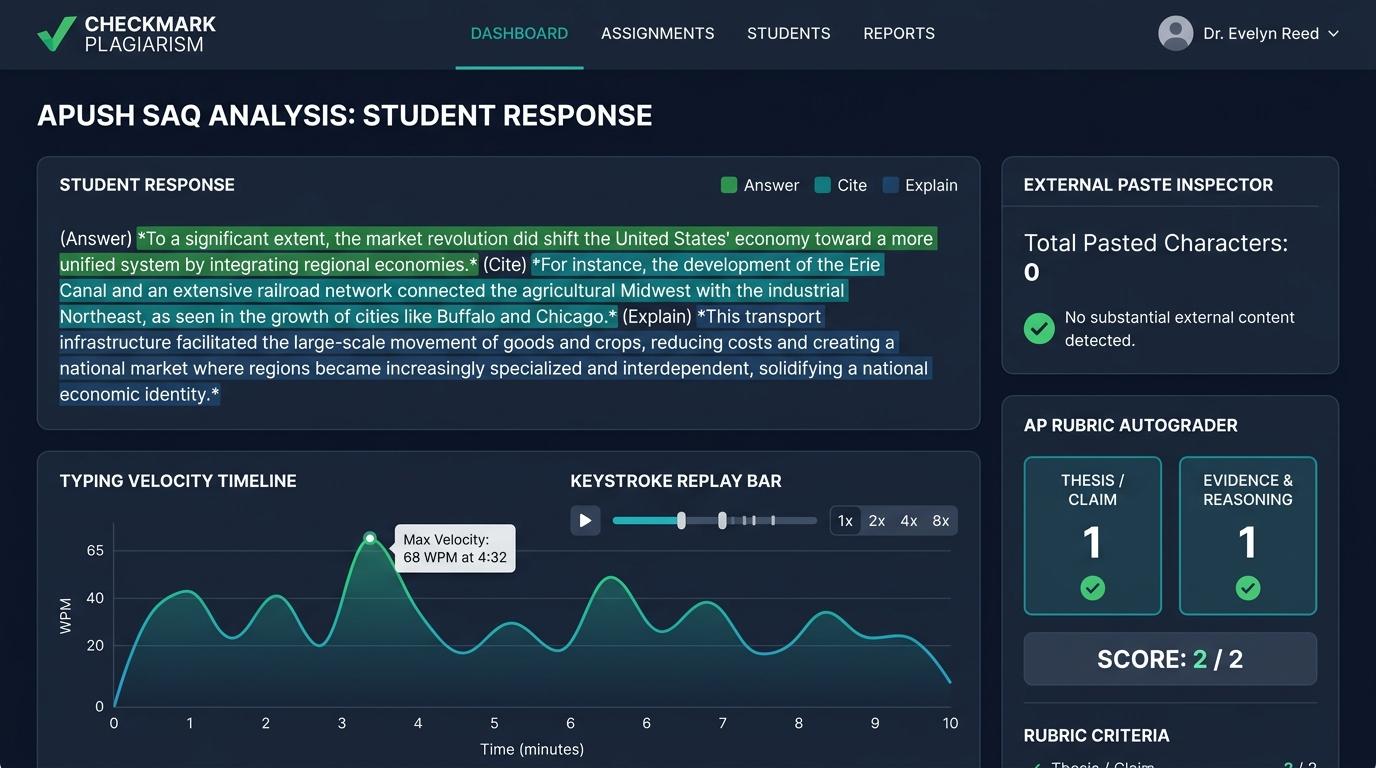
However, the widespread transition to 1:1 Chromebooks, Google Docs, Canvas LMS Quizzes, and Buzz LMS for timed classroom unit exams has introduced a profound integrity dilemma. Dishonest students exploit 15-second large language model (LLM) paste shortcuts or unmonitored second-screen smartphone transcriptions, while generic whole-document AI percentage detectors trigger aggressive false-positive alarms on earnest students precisely because their formulaic ACE sentence stems mimic low-perplexity AI prose. Checkmark Plagiarism resolves this systemic crisis through Writing Process Telemetry and patent-pending Essay Playback™ (1x–8x replay). By capturing temporal keystroke dynamics, typing velocity curves, inter-key pause distributions, and external paste buffers with complete original text preservation, Checkmark provides secondary history educators with transparent, defensible forensic evidence (“receipts”) to verify authentic historical recall, protect honest students during parent-teacher conferences, and streamline rubric grading.
1. Deconstructing the AP History SAQ: Structure, Cognitive Demand, and the ACE Writing Model
To understand why verifying authentic student authorship on timed historical writing is so uniquely challenging in secondary education, one must first analyze the rigorous structural and cognitive constraints of the College Board’s Short Answer Question format.
2 Competing Historian Interpretations (e.g., Bernard Bailyn vs. Howard Zinn; Gordon Wood vs. Gary Nash).
1 Primary text excerpt, historical map, political cartoon, or quantitative chart/data table.
Direct thematic prompt requiring free recall without text stimulus. Q3 (Periods 1–5) or Q4 (Periods 6–9).
On AP U.S. History (APUSH), AP European History, and AP World History: Modern exams, the SAQ section (Section I, Part B) accounts for exactly 20% of the student’s total exam score. Unlike the expansive 60-minute Document-Based Question (DBQ) or 40-minute Long Essay Question (LEQ), which require multi-paragraph thesis generation, document sourcing, and complex line-of-reasoning synthesis, the SAQ is an exercise in extreme historical precision, rapid factual retrieval, and concision.
The Tripartite Sub-Question Architecture
Every SAQ is divided into three distinct, lettered sub-prompts:
- Part A (1 Point): Typically requires the student to identify a core argument or explain a primary cause/effect or similarity/difference related to a provided stimulus.
- Part B (1 Point): Demands that the student provide one piece of specific historical evidence not found in the text that supports the argument, perspective, or trend established in Part A.
- Part C (1 Point): Requires the student to explain how an alternative historical perspective, counter-evidence, or subsequent historical development modifies or challenges the premise (or supports a competing historian’s interpretation).
The College Board evaluates each sub-part on a strict binary scale: 0 points or 1 point. There is no partial credit within a sub-question. To earn the point, the student must deliver a complete, historically accurate, and analytically sound claim supported by concrete factual evidence.
The Historical Reasoning Processes (HRP)
Every SAQ prompt is explicitly constructed around one of three College Board Historical Reasoning Processes:
- Comparison: Analyzing similarities and differences between historical events, regional developments, ideological movements, or competing historiographical interpretations (e.g., contrasting the First Great Awakening with the Second Great Awakening, or comparing Bernard Bailyn’s ideological thesis on the American Revolution with Howard Zinn’s economic class conflict thesis).
- Causation: Identifying and explaining both proximate (short-term) and systemic (long-term) causes and consequences of historical developments (e.g., explaining how the Seven Years’ War directly led to the collapse of imperial-colonial relations between 1763 and 1776).
- Continuity and Change Over Time (CCOT): Analyzing what patterns remained stable versus what structural transformations occurred across historical eras (e.g., evaluating shifts in federal power and economic intervention from the Gilded Age through the New Deal).
Take a definitive analytical stance using the prompt’s historical reasoning stem. Never restate the prompt verbatim; articulate a precise historical claim.
Name concrete, non-stimulus historical proper nouns (Acts, Treaties, Court Cases, Organizations, Rebellions, Publications).
Articulate the causal mechanism connecting the evidence to the prompt claim, demonstrating why this fact validates the historical argument.
A fully realized ACE paragraph is typically 3 to 5 sentences (50 to 90 words). Over an entire 3-question SAQ exam, a student produces roughly 450 to 750 words across 9 discrete ACE paragraphs.
The Cognitive Friction of Authentic Timed Writing
In an authentic testing environment, composing an SAQ paragraph imposes heavy cognitive friction on a 10th or 11th-grade high schooler:
- Stimulus Deconstruction (60–90 seconds): Reading and mentally mapping dense primary or secondary text (e.g., an excerpt from Alexander Hamilton’s Report on Manufactures vs. Thomas Jefferson’s agrarian writings).
- Mental Fact Retrieval (30–60 seconds): Searching working memory for non-stimulus historical proper nouns (e.g., the National Bank controversy, the Whiskey Rebellion, the 1793 Proclamation of Neutrality).
- Sentence Construction & Lexical Hesitation (120–180 seconds): Drafting the ACE sentences on the Chromebook keyboard, pausing between clauses to refine historical precision, deleting inaccurate dates or names, and restructuring explanations to ensure the causal mechanism is explicit.
When executed honestly, this cognitive sequence leaves an unmistakable temporal, kinetic fingerprint on the digital document. When short-circuited via artificial intelligence or unmonitored digital copying, that fingerprint disappears entirely.
2. The Timed Exam Integrity Crisis in 1:1 High School Classrooms
Over 85% of high schools in the United States operate in 1:1 computing environments, primarily deploying Google Chromebooks. Furthermore, the College Board has transitioned AP exams—including APUSH, AP Euro, and AP World—to digital testing platforms. To prepare students for this reality, secondary social studies departments conduct weekly or bi-weekly timed SAQ writing assessments using learning management systems such as Canvas LMS Quizzes, Google Docs in Google Classroom, Buzz LMS, and Schoology.
However, administering timed free-response writing on connected digital devices without physical separation or continuous writing telemetry has introduced four primary vectors of academic dishonesty.
Instant LLM Paste Injection
Student copies the SAQ prompt → Pastes into ChatGPT/Claude via split-screen or browser extension → Receives perfect 3-part ACE response → Pastes 250 words into the test box in under 400 milliseconds.
Second-Screen Phone Transcription
Student props smartphone against Chromebook bezel below teacher’s line of sight → Queries AI or Discord → Retypes output manually at continuous flatline typing speed (75–90 WPM) with zero conceptual pauses.
Digital “Crib Sheet” Split-Screening
Student keeps a digital review book (AMSCO, Heimler study guide) or shared doc open → Copies pre-written historical summaries directly into exam box, bypassing factual memory retrieval.
Cross-Period Asynchronous Collusion
Period 1 students leak SAQ prompt topics to group chats → Period 4/6 students pre-generate complete ACE responses during lunch and reproduce them without engaging in real-time historical synthesis.
The Inadequacy of Legacy Lockdown Browsers
Many districts attempt to solve these integrity issues by deploying lockdown browser applications. However, high school teachers and instructional technology coaches report severe limitations:
- Blind to Second Screens: Lockdown browsers restrict the laptop screen but have zero awareness of an iPhone propped on a student’s knee or a smartwatch on their wrist.
- Technical Fragility: Lockdown software frequently crashes on low-spec school Chromebooks, drops Wi-Fi connections mid-exam, and corrupts student draft state, causing immense disruption during timed testing windows.
- Zero Pedagogical Diagnostic Value: Lockdown tools do not record how a student writes. They treat testing as a binary surveillance challenge rather than an educational process, failing to provide teachers with formative insights into student writing stamina or drafting habits.
3. Why Generic AI Detectors Fail Catastrophically on AP SAQs
When high school teachers suspect that a timed SAQ submission was generated by AI, their first instinct is often to paste the student’s text into a commercial, whole-document AI detection tool. However, applying generic statistical AI detectors to AP History SAQ responses produces disastrous results: massive false-positive rates on honest, high-achieving students, and complete false-negative blind spots on paraphrased or transcribed AI text.
“Write formulaic, predictable stems with zero conversational fluff.”
- “One major historical difference...”
- “This difference arose because...”
- “For example, the Embargo Act of 1807...”
- “This evidence demonstrates that...”
“Predictable sentence sequences = Low Perplexity = AI Generated.”
- Token sequence is highly predictable
- Uniform sentence length (~18 tokens)
- Low burstiness score across paragraph
- Output: 85%–95% AI-Generated Alarm
The Sub-150-Word Statistical Instability
A single AP SAQ sub-part (Part A, B, or C) typically consists of only 50 to 80 words. Even an entire 3-part SAQ rarely exceeds 200 words. From a mathematical and natural language processing perspective, statistical n-gram analysis and transformer probability scoring are notoriously unstable on sample sizes below 150 to 250 words. In short texts, a single domain-specific proper noun or standardized transition word can swing the aggregate probability calculation from 10% to 90%.
Checkmark’s Honest Short-Text Guardrail
Recognizing the mathematical invalidity of statistical AI scoring on micro-texts, Checkmark Plagiarism enforces an explicit short-text guardrail: below ~150 words (such as an isolated SAQ sub-prompt or daily bellringer), Checkmark displays N/A for statistical AI confidence rather than guessing on an insufficient sample size. Instead of relying on unreliable probabilistic scores, Checkmark evaluates authenticity using immutable, empirical Writing Process Telemetry and Essay Playback™.
The Inability to Detect Second-Screen Retyping
Static AI detectors evaluate only the final artifact of text. They have zero temporal awareness. A paragraph of 70 words generated by Claude and manually retyped by a student looking at an iPhone produces the exact same text string as a paragraph generated by a student looking at their Chromebook screen. Static detectors cannot tell the teacher whether those 70 words were typed in 45 seconds at a flatline 85 words per minute or drafted over 4 minutes with authentic cognitive pauses and self-corrections.
4. The High School AP History Evidentiary Matrix: Comparative Analysis
To evaluate how different assessment monitoring and integrity methods perform in a secondary social studies environment, consider the following comprehensive comparison matrix:
| Integrity Dimension | Paper Blue Books | Generic AI Detectors | Google Docs Version History | Canvas LMS Access Logs | Checkmark Telemetry & Playback™ |
|---|---|---|---|---|---|
| Keystroke-Level Granularity | ✗ None (Static ink) | ✗ None (Final text only) | ∼ Coarse snapshots (15s–3min) | ✗ Page load/submit only | ✓ Full Fidelity (ms resolution) |
| External Paste Inspection | N/A | ✗ None | ∼ Shows sudden text; loses overwritten pastes | ✗ None | ✓ Captures raw paste buffer even if later rewritten |
| Second-Screen Detection | ∼ Physical proctoring only | ✗ Blind to transcription | ✗ Cannot calculate typing speed | ✗ Cannot capture velocity | ✓ Identifies flatline WPM & zero lexical pauses |
| False Positives on ACE Stems | ✓ Zero | ✗ Extremely High (Flags formulaic stems) | ✓ Zero | ✓ Zero | ✓ Zero (Validates drafting timeline) |
| Sub-150-Word Micro-Texts | N/A | ✗ Unstable / Hallucinates scores | ∼ Coarse | ✗ No text analysis | ✓ Enforces Honest Guardrail (N/A + Telemetry) |
| Defensibility in Conferences | ✓ High (Handwriting sample) | ✗ Low (Opaque percentage) | ∼ Moderate (Confusing snapshot UI) | ✗ Very Low (Vague server logs) | ✓ Supreme (Interactive video replay of drafting) |
| Rubric Autograding & LMS Sync | ✗ Exhausting manual grading | ✗ None | ✗ None | ∼ Basic quiz points | ✓ Quote-anchored AP rubric autograder; 1-click sync |
| FERPA / COPPA Compliance | ✓ Compliant | ∼ Vendors may train models on data | ✓ Compliant | ✓ Compliant | ✓ Zero model training on student work |
5. Writing Process Telemetry: The Science of Kinetic and Cognitive Drafting
Writing Process Telemetry is the empirical capture and mathematical analysis of the temporal, kinetic, and linguistic behaviors of a writer during active digital composition.
When a student writes an authentic historical response, their brain does not function like a high-speed printer. Authentic writing is an iterative, cognitively demanding process characterized by distinct temporal phases: planning, lexical retrieval, keyboard motor execution, visual evaluation, and recursive editing.
Features distinct motor bursts (15–25 characters on familiar words), micro-pauses (2–6s before proper nouns like “Embargo Act” or “John Dickinson”), and frequent backspaces (10–25 edits) as the student refines historical reasoning.
Features unnaturally constant velocity without deceleration. The student reads off a secondary device and retypes character-by-character. Zero lexical pauses before complex historical terms and near-zero recursive backspaces.
A sudden vertical spike inserting 200+ words in a single millisecond event. Checkmark preserves the complete raw external paste buffer in memory even if the student subsequently edits the words.
The Biometrics of Historical Composition
Checkmark’s telemetry engine tracks four fundamental data streams to reconstruct the student’s authentic cognitive workflow:
1. Inter-Key Intervals (IKIs) and Velocity Curves
An Inter-Key Interval (IKI) is the exact time elapsed in milliseconds between consecutive keystrokes (tk - tk-1). While an authentic student may type common words (such as “the”, “because”, or “similarity”) in rapid motor bursts of 55–65 WPM, their overall velocity fluctuates dynamically as they formulate historical concepts. When transcribing from a phone, velocity remains fixed at maximum copying speed (70–95+ WPM) without natural cognitive deceleration.
2. Cognitive Pause Distributions
Where and for how long a writer pauses reveals their underlying mental operations:
- Macro-Planning Pauses (10–45s): Authentic writers pause before starting to read the stimulus, analyze author perspective, and outline their thesis.
- Syntactic Boundary Pauses (2–6s): Pauses between the Answer, Cite, and Explain sentences indicate active logical transition planning.
- Lexical Retrieval Pauses (800–2,500ms): Crucially, before typing a specific historical proper noun (e.g., “Marbury v. Madison”, “Alien and Sedition Acts”), authentic writers display a micro-pause while accessing semantic memory. Second-screen copiers show zero lexical hesitation.
3. Edit-Distance Ratios & Recursive Revision
In an authentic 70-word SAQ sub-part, a high schooler typically executes 8 to 25 edit operations (correcting typos, replacing chronologically inaccurate dates, and restructuring clauses). Conversely, an LLM transcription exhibits an edit-distance ratio approaching zero—the text flows monotonically onto the screen from start to finish without a single reconsidered thought.
4. External Paste Preservation & Text-Offset Mapping
When a paste occurs, Checkmark does not merely flag that a paste took place. Checkmark creates an immutable snapshot of the entire raw string of pasted text, recording the exact timestamp, word count, original clipboard buffer, and a synchronized “Jump to Playback” anchor.
6. Step-by-Step History Teacher SAQ Audit Protocol
When secondary social studies teachers must evaluate a batch of 120 to 160 timed SAQ submissions across five class periods, they cannot afford to spend 20 minutes manually auditing every student. They need a systematic, highly efficient 5-phase audit protocol.
Sync submissions directly from Canvas LMS Quizzes, Buzz LMS, or Google Classroom. Scan the cohort dashboard for instant paste alerts (🔴), velocity anomalies >70 WPM (🟡), or paragraph-level AI flags.
Open flagged submission and scrub the interactive timeline at 2x to 8x speed. Visually confirm: Did the student pause to plan? Did they stumble and backspace on proper nouns? Did they revise causal sentences?
Click highlighted paste cards to inspect raw source text. Differentiate uncited primary stimulus quotes (🟡 Uncited Source) from external AI generation (🔴 External Paste) with complete clipboard text preservation.
Review AI-drafted 0/1 point evaluations anchored directly to student sentences for Part A, Part B, and Part C. Teacher retains full final authority to adjust scores, edit feedback, and push to Canvas gradebook.
Conduct transparent conferences using Essay Playback as an objective mirror. Ask Socratic check questions to assess real understanding, and assign structured retakes focused on authentic historical thinking.
One major difference between the First Great Awakening and the Second Great Awakening was that the Second Great Awakening placed a heavy emphasis on societal reform movements. [Pause: 3.2s] In particular, preachers like Charles Finney urged converts to achieve moral perfection by eradicating social sins.
For example, during the Second Great Awakening in the 1830s, religious fervor directly spawned the American Temperance Society and energized the abolitionist movement led by William Lloyd Garrison. [Backspace x8: deleted “early Quaker pamphlets”]
This evidence shows that whereas the First Great Awakening focused primarily on individual theological conversion within established churches, the Second Great Awakening transformed religious zeal into organized civic activism aimed at reforming American institutions.
Identifies clear historical difference regarding societal reform movements.
Names non-stimulus proper noun evidence (American Temperance Society, William Lloyd Garrison).
Articulates causal mechanism connecting religious zeal to civic institution reform.
7. Three Real-World High School AP History Case Studies
To see how writing process telemetry functions in practice, consider these three representative secondary classroom scenarios.
The Instant Historiographical Synthesis (11th Grade APUSH)
Assignment & Submission: A timed 13-minute classroom SAQ analyzing competing historical interpretations of the American Revolution. The student submitted a 215-word response contrasting ideological constitutionalism with economic class conflict.
Telemetry Audit: Total document time was 1 minute 34 seconds. At timestamp 01:12, Checkmark captured a Vertical Paste Event inserting 215 words in 380 milliseconds. Checkmark’s External Paste Inspector revealed the raw clipboard prompt prefix: “Write a 3-part APUSH SAQ using the ACE method answering the following prompt...”
Restorative Resolution: During a supportive conference, the student admitted to using an AI browser tab due to panic. The student completed a proctored, handwritten retake and attended after-school review sessions on historical source evaluation.
The False-Positive Exoneration on Containment (11th Grade APUSH)
The Conflict: An earnest, high-achieving student received a 91% AI-Generated score from a generic commercial detector because their ACE sentences followed standard rhetorical formulas.
Telemetry Exoneration: The teacher opened Checkmark’s Essay Playback™. The recording showed 11 minutes 45 seconds of continuous composing: a 70-second initial planning pause, 28 WPM average typing, a 4.2-second pause before typing “Truman Doctrine,” 14 backspaces to replace “financial support” with “economic and military containment,” and 24 total recursive edits.
Resolution: The telemetry provided ironclad proof of authentic student authorship. The false accusation was completely dismissed, transforming a tense parent meeting into an opportunity to praise the student’s disciplined writing habits.
The Second-Screen Phone Transcription (10th Grade AP Euro / APUSH)
Assignment & Submission: A timed SAQ on federal intervention in the 1894 Pullman Strike. A student submitted a 190-word response. Traditional paste detectors reported 0 pasted characters.
Telemetry Audit: Checkmark flagged a Velocity Anomaly: the student typed 190 words in 2 minutes 15 seconds at a flatline 84 WPM. The Inter-Key Interval distribution showed zero pauses >400ms—even before complex proper nouns like “Attorney General Richard Olney” and “In re Debs.” Total backspaces across the entire submission: 0.
Restorative Resolution: In conference, the teacher demonstrated that authentic memory retrieval requires pauses before specific historical legal precedents. The student admitted to reading an AI response off their phone and was placed on a guided time-management contract.
8. Pedagogical Best Practices: Building Authentic Historical Thinking
Integrating writing process telemetry into high school history classrooms is not merely about policing exams; it is about cultivating deep, authentic historical reasoning. Social studies departments should implement the following pedagogical practices:
Demarcate authorized study support (generating flashcards, glossing 18th-century syntax) from prohibited exam generation (timed SAQs and DBQs).
Show students their own Essay Playback™ timelines. Teach them that cognitive pausing and recursive editing are signs of sophisticated historical thought.
Leverage quote-anchored autograding to deliver rapid, formative feedback before the next unit exam, preventing recurring structural errors.
9. Frequently Asked Questions (FAQ)
1. How does writing process telemetry accommodate students with 504 Plans or IEPs (e.g., extra time or dysgraphia)?
Writing process telemetry evaluates individual cognitive drafting dynamics, not arbitrary speed benchmarks. For students with 504 Plans or IEP accommodations granting 1.5x or 2.0x extended time, Checkmark’s engine evaluates their natural writing cadence across their individualized testing window. The system looks for authentic cognitive pauses, organic bursts, and revision operations—which are present regardless of whether a student writes at 20 WPM or 50 WPM. Furthermore, for students who use approved assistive technology (such as speech-to-text), Checkmark supports specialized dictation telemetry profiles.
2. What if a student is naturally a fast typist (e.g., 90+ WPM)? Will they be falsely flagged for transcription?
No. An accomplished typist who composes authentically will type common words at high speeds, but their velocity curve will still exhibit natural deceleration and cognitive pauses when retrieving historical facts from memory (such as dates, acts, and treaties) or when planning sentence transitions. Furthermore, authentic fast typists make frequent mechanical typos and recursive edits (backspacing and retyping). A student engaged in second-screen transcription types with flatline uniformity and zero structural backspacing. Telemetry analyzes the full multidimensional kinetic signature, not raw speed alone.
3. Why isn’t Google Docs’ built-in “Version History” sufficient for auditing timed SAQs?
Google Docs Version History captures periodic, coarse snapshots (often every 15 seconds to several minutes). If a student pastes a block of text, rapidly retypes a few words, or deletes something between snapshots, Google Docs collapses the intermediate events into a single static diff. It cannot display real-time millisecond keystroke velocity, measure inter-key intervals, track exact pause locations, or preserve the full original text of overwritten clipboard pastes. Checkmark’s patent-pending Essay Playback™ captures the entire kinetic writing session with full millisecond fidelity.
4. Does Checkmark store student essays or train AI models on student work?
No. Checkmark Plagiarism operates under a strict Zero Model Training Policy. Student submissions are never used to train, fine-tune, or improve general AI models. All data is processed in enterprise-grade, encrypted environments that are fully compliant with the Family Educational Rights and Privacy Act (FERPA) and the Children’s Online Privacy Protection Act (COPPA).
5. Can Checkmark integrate directly with Canvas LMS Quizzes and SpeedGrader?
Yes. Checkmark offers deep, seamless LTI integrations with Canvas LMS, Buzz LMS, Schoology, and Google Classroom. Teachers can launch Essay Playback™ and review quote-anchored rubric feedback directly within their existing grading workflows, and sync finalized grades back to their gradebook with a single click.
6. What should a teacher do if a student admits they used an LLM on their phone during a timed SAQ?
Social studies departments should follow a restorative, developmental protocol. Use the confession as an opportunity to diagnose why the student resorted to cheating (e.g., test anxiety, poor time management, or feeling behind on content). Require the student to complete an alternative proctored assessment to demonstrate mastery, provide targeted study resources, and record the conference in Checkmark’s private educator notes to track growth over time.
7. How does quote-anchored rubric autograding save AP history teachers time while grading 150+ SAQ sets?
Grading 150 students on a 3-part SAQ requires evaluating 450 distinct ACE paragraphs—a process that typically takes 8 to 12 hours of weekend grading. Checkmark’s AI Autograder instantly evaluates each sub-part against the binary 0/1 College Board criteria, highlights the exact student sentence fulfilling each requirement, and generates a pre-drafted feedback card. The teacher simply scans, confirms or adjusts the score, and publishes—reducing grading time by over 70% while providing richer, quote-anchored feedback to every student.
Conclusion: Moving from Guesswork to Pedagogical Trust
The objective of Advanced Placement History is not merely to prepare high school students for a national exam score, but to cultivate disciplined, evidence-based critical thinking and historical empathy. When artificial intelligence shortcuts the authentic writing process, students miss the essential intellectual struggle of historical synthesis.
By combining Writing Process Telemetry, patent-pending Essay Playback™, and quote-anchored AP rubric autograding, Checkmark Plagiarism empowers secondary social studies educators to eliminate false accusations, detect unmonitored second-screen copying, cut grading time by 70%, and restore authentic historical inquiry in the digital classroom.
Stop guessing, start trusting. Discover how Checkmark Plagiarism transforms high school history education at checkmarkplagiarism.com.