
Executive Summary & AP Physics Integrity Mandate
In secondary Advanced Placement (AP) Physics 1 classrooms, rotational dynamics represents one of the most conceptually demanding and mathematically rigorous units in the high school science curriculum. Under College Board AP Science Practices 1, 2, 5, and 6, students must synthesize empirical lab data into formal Claim-Evidence-Reasoning (CER) frameworks, derive multi-step algebraic relationships (∑τ = Iα, mgh = ½mvcm2 + ½Iω2, L = Iω), and execute complex Quantitative-Qualitative Translations (QQT) explaining how physical variables govern rotational behavior.
However, the widespread availability of generative Large Language Models (LLMs) has introduced a serious academic integrity challenge: high school students struggling with rotational concepts routinely prompt AI chatbots to compose their lab conclusions. This produces LLM physics confabulation—eloquent, textbook-sounding prose riddled with physical contradictions, such as treating static friction as dissipative kinetic friction, asserting that mass alters rolling speed down an incline, or generating qualitative justifications that directly contradict their own derived equations (“Schrödinger’s Mass”). Simultaneously, generic commercial AI percentage detectors fail physics teachers by flagging standard LaTeX formulas and formulaic physics nomenclature as “AI-generated” while missing copy-pasted LLM text. Checkmark Plagiarism resolves this dilemma by pairing passage-level AI confidence sliders with patent-pending Essay Playback™ writing process telemetry (1x–8x replay), external paste inspection with complete clipboard preservation, and quote-anchored AP science rubric autograding. Seamlessly integrated with Canvas SpeedGrader, Agilix Buzz, and Google Classroom, Checkmark equips secondary physics teachers to audit mathematical scratchpad pauses, verify equation-to-prose concordance, and conduct restorative whiteboard debriefs that cultivate authentic scientific literacy.

Layer 1: QQT & Derivation Concordance
- Cross-check qualitative claims against derived algebra
- Boundary limit analysis (M → ∞, R → 0, c → 1)
- Static friction role (torque generator vs non-dissipative)
- Physical sensor inertia accounting (Ipulley ≈ 1.5×10⁻⁶ kg·m2)
Layer 2: Writing Process Telemetry
- Patent-pending Essay Playback™ (1x–8x replay)
- TI-84 / Nspire scratchpad pauses (2–5 minutes)
- External Paste Inspector (preserves clipboard buffer)
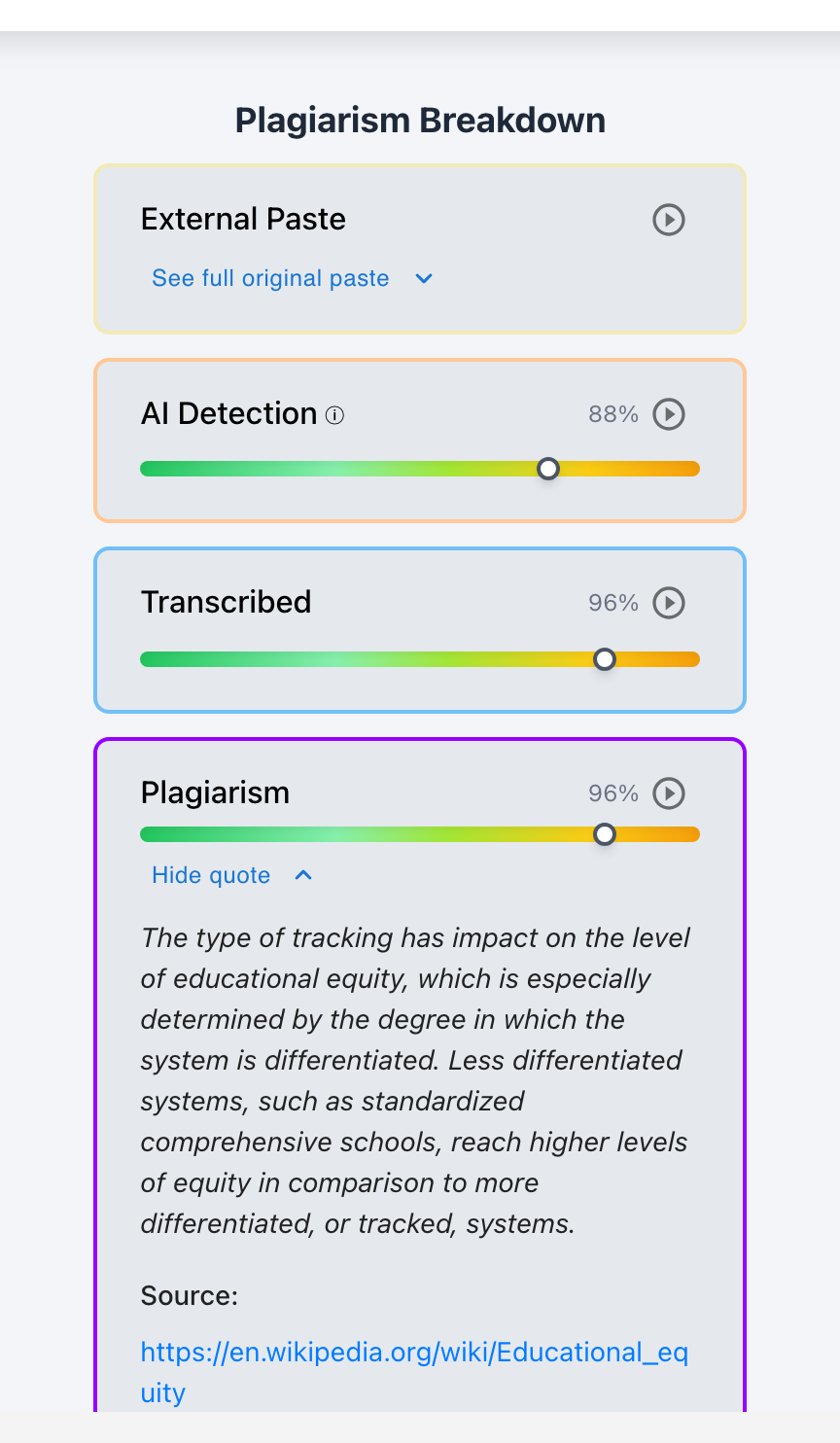
- Passage-level calibrated AI confidence sliders
Layer 3: Restorative Whiteboard Debrief
- Student re-derives key energy steps on whiteboard
- Review Essay Playback timeline together collaboratively
- Identify genuine misconceptions vs intentional evasion
- Growth-oriented lab revision pathways for mastery credit
1. The Disciplinary Anatomy of AP Physics 1 Rotational Dynamics & Quantitative-Qualitative Translation (QQT)
In the modern College Board AP Physics 1 curriculum, scientific mastery extends far beyond plugging numerical values into algebraic formulas. The course framework places paramount emphasis on conceptual understanding, representational translation, and experimental validation. Rotational dynamics (Unit 7) serves as the ultimate testing ground for these competencies, requiring students to bridge linear kinematics with rotational analogs, model distributed mass systems, and analyze energy partitioning.
| Science Practice | Disciplinary Core Competency in Physics Inquiry | Rotational Lab Application |
|---|---|---|
| Practice 1 (SP 1) | Modeling: Create and use visual, mathematical, and graphical representations. | Extended Free-Body Diagrams with force contact points and lever arms. |
| Practice 2 (SP 2) | Mathematical Routines: Derive symbolic equations and perform calculations from first principles. | Deriving ∑τ = Iα, rolling energy conservation, Parallel Axis Theorem. |
| Practice 3 (SP 3) | Scientific Questioning: Formulate testable experimental questions. | Investigating how geometric mass distribution governs rolling velocity down an incline. |
| Practice 4 (SP 4) | Experimental Design: Plan and execute data collection strategies. | Setting up rotary motion sensors, photogate arrays, and video motion analysis. |
| Practice 5 (SP 5) | Data Analysis: Perform linearizations, calculate slopes, evaluate measurement uncertainty. | Plotting τ vs α to extract experimental I, accounting for sensor pulley inertia. |
| Practice 6 (SP 6) | Argumentation & Explanation: Develop scientific arguments justifying physical behavior. | Formal Claim-Evidence-Reasoning (CER) and Quantitative-Qualitative Translation (QQT). |
When 10th, 11th, and 12th-grade students conduct cornerstone rotational dynamics investigations—such as determining the moment of inertia of irregular objects, measuring torque and angular acceleration with rotary motion sensors, investigating the “Race of the Rolling Shapes” down an incline, or analyzing conservation of angular momentum during inelastic rotational collisions—they must translate empirical sensor data and video analysis into formal written argumentation.
Foundational Principles of Rotational Mechanics
To distinguish authentic student analysis from AI-generated confabulation, educators must first establish the precise theoretical architecture of secondary rotational mechanics.
| Physical Concept | Linear / Translational Form | Rotational / Angular Form | Connecting Kinematic Constraint |
|---|---|---|---|
| Position / Displacement | x, Δx (meters, m) | θ, Δθ (radians, rad) | Δx = Δθ · R |
| Velocity / Rate of Change | v = dx/dt (m/s) | ω = dθ/dt (rad/s) | vcm = ω · R |
| Acceleration | a = dv/dt (m/s²) | α = dω/dt (rad/s²) | acm = α · R |
| Inertia / Resistance | Mass M (kg) | Moment of Inertia I (kg·m²) | I = ∑ mi ri² = cMR² |
| Cause of Acceleration | Net Force ∑F (N) | Net Torque ∑τ (N·m) | τ = r F sinθ = r⊥ F |
| Newton’s Second Law | ∑F = M a | ∑τ = I α | ∑τext = dL/dt |
| Kinetic Energy | Ktrans = ½ M v² | Krot = ½ I ω² | Ktotal = ½Mv² + ½Iω² |
| Momentum | p = M v (kg·m/s) | L = I ω (kg·m²/s) | L = r × p = Iω |
Shape Factor: c = 0.40
Mass concentrated near center.
Shape Factor: c = 0.50
Uniform circular mass density.
Shape Factor: c ≈ 0.67
Mass on spherical shell boundary.
Shape Factor: c = 1.00
All mass at maximum radius R.
The Mechanics of Rolling Without Slipping
When a round object rolls down an incline without slipping, its motion is a superposition of pure translation of the center of mass and pure rotation about the center of mass.
Kinematic Coupling & Static Friction
Instantaneous Stationary Contact: The point of contact between the rolling cylinder and the ramp is instantaneously at rest relative to the incline surface (vcontact = 0).
- Torque Generation: Static friction exerts torque about the center of mass (τ = fs R) to produce angular acceleration α.
- Zero Non-Conservative Work: Because the contact point does not slip, static friction does no work (Wnc = 0). Total mechanical energy is conserved!
Energy Conservation Derivation
Crucial College Board Insight: Mass (M) and Radius (R) completely cancel out. Final velocity depends strictly on the dimensionless shape factor c.
| Finish Rank | Object Geometry | Shape Factor (c) | Final Velocity at Bottom (vcm) | Linear Acceleration (acm) |
|---|---|---|---|---|
| 🥇 1st Place | Solid Sphere | c = 0.40 (⅖) | v = √(2gh / 1.4) ≈ 1.195 √(gh) | a = &frac57; g sinθ ≈ 0.714 g sinθ |
| 🥈 2nd Place | Solid Disk / Cylinder | c = 0.50 (½) | v = √(2gh / 1.5) ≈ 1.155 √(gh) | a = ⅔ g sinθ ≈ 0.667 g sinθ |
| 🥉 3rd Place | Hollow Spherical Shell | c ≈ 0.67 (⅔) | v = √(2gh / 1.67) ≈ 1.095 √(gh) | a = ⅗ g sinθ ≈ 0.600 g sinθ |
| 4th Place | Thin Hoop / Ring | c = 1.00 | v = √(2gh / 2.0) = 1.000 √(gh) | a = ½ g sinθ = 0.500 g sinθ |
The College Board Quantitative-Qualitative Translation (QQT) Paradigm
The Quantitative-Qualitative Translation (QQT) question format is a signature Free Response Question (FRQ) type on the AP Physics 1 exam. It is specifically designed to assess whether students can seamlessly connect mathematical equations to conceptual prose explanations without relying on rote numerical calculations.
Make a conceptual claim about how changing a parameter (e.g., doubling ramp height, substituting a hollow cylinder for a solid disk, or shifting mass closer to the pivot) affects angular acceleration or final speed.
Derive a symbolic algebraic expression for the target physical variable from fundamental principles (∑τ = Iα or ∑Ei = ∑Ef) in terms of specified constants.
Explain how the derived algebraic equation supports the initial qualitative reasoning by analyzing limiting cases (M → ∞, R → 0, c → 1) and energy partitioning mechanisms.
2. The LLM Disconnect: How Generative AI Fails Rotational Mechanics & QQT Reasoning
When high school students face the steep cognitive hurdles of rotational dynamics lab write-ups—calculating percentage uncertainties in photogate velocities, calculating rotary sensor friction corrections, and translating multi-step derivations into qualitative prose—many resort to prompting generative Large Language Models (LLMs) such as ChatGPT, Claude, or Google Gemini.
However, LLMs do not possess physical intuition, causal reasoning models, or spatial awareness. They operate via statistical token probability, predicting sequences of words and mathematical symbols that frequently co-occur in online physics textbooks and forums. In rotational mechanics, this structural limitation results in predictable, catastrophic physics confabulations.
Failure Mode 1: Equation-Prose Discordance (“Schrödinger’s Mass” Syndrome)
v = √[2gh / (1 + c)] — Correctly cancels mass M from both sides of the energy conservation equation.
“Because Object A has a larger mass (0.45 kg vs 0.18 kg), it experiences greater gravitational force, accelerating faster down the ramp and winning the race.”
The Forensic Flaw: The qualitative explanation relies on intuitive Aristotelian misconceptions that directly contradict the student's own derived equation right above it!
Failure Mode 2: Friction Amnesia & Dissipation Misconceptions
- The Frictionless Roll Fallacy: The AI asserts that the sphere rolls down the incline because “gravity acts without any friction opposing its motion” (ignoring that zero friction produces pure sliding without rotation).
- The Dissipative Static Friction Hallucination: The AI claims “mechanical energy was lost because static friction did work (W = -fsd) on the rolling cylinder” (in pure rolling, static friction does zero non-conservative work).
Failure Mode 3: Rotational Inertia Geometry Hallucinations & Coefficient Swaps
LLMs regularly scramble rotational inertia coefficients when asked to compare novel or compound geometries: asserting that a solid disk has I = ⅖MR², confabulating fictitious geometric factors such as I = ¾MR², or botching the Parallel Axis Theorem by writing I = Icm - Md² or I = Icm + Md.
Failure Mode 4: Mixing Angular and Linear Quantities (Dimensional Incoherence)
Because LLMs generate tokens based on text proximity, they frequently produce dimensionally nonsensical expressions: writing kinetic energy as K = ½Mv² + ½I v² (substituting linear velocity v for angular velocity ω), formulating torque as τ = F · α, or expressing rolling angular acceleration as α = acm · R instead of α = acm / R.
Failure Mode 5: Ignoring Non-Zero Apparatus Overhead (Rotary Motion Sensors & Pulley Inertia)
In authentic high school AP Physics 1 lab write-ups (e.g., PASCO or Vernier rotary motion sensors), experimental linear acceleration is consistently 5%–12% lower than point-mass predictions due to sensor pulley inertia (Ipulley ≈ 1.5×10⁻⁶ kg·m2). Authentic student writing explains this discrepancy, whereas AI writeups either report a fabricated 0.0% error rate or invent generic excuses like “air resistance on the rolling sphere.”
Students submitted formal CER lab reports investigating rolling velocities of a Solid Brass Cylinder (M=0.45 kg, R=2.5 cm), Hollow Aluminum Pipe (M=0.18 kg, R=2.5 cm), and Solid Steel Sphere (M=0.22 kg, R=1.2 cm) down a 1.2 m ramp angled at 15°.
“Part B: Quantitative Derivation: v = √[ 2gh / (1 + c) ].
Part C: Qualitative Reasoning: The solid brass cylinder arrived before the hollow pipe because the brass cylinder has greater mass (0.45 kg vs 0.18 kg), generating more gravitational force along the ramp. Static friction dissipated energy along the track.”
- Equation-Prose Discordance: Mathematical derivation cancels mass M, while qualitative prose attributes the speed advantage to mass M.
- Physical Misconception: Erroneously claims static friction dissipated mechanical energy during pure rolling.
- Writing Telemetry (Essay Playback™): Both Part B and Part C appeared in a single 450-word external clipboard paste at 11:42 PM with zero intermediate calculator pauses.
3. The AP Physics Grading Dilemma: Why Generic AI Detectors Fail Science Teachers
Secondary physics teachers, department chairs, and STEM coordinators face a unique disciplinary crisis when attempting to use generic, commercial AI detection tools (such as Turnitin AI Score, GPTZero, or CopyLeaks) to evaluate quantitative lab reports.
Generic detectors analyze perplexity and burstiness across generic prose. Standardized LaTeX equations (∑τ = Iα), College Board formula sheet definitions, and formulaic physics nomenclature are flagged as 85%–100% “AI-generated” on honest students!
If a student prompts an LLM to generate flawed qualitative reasoning and lightly paraphrases 2–3 words, generic detectors score the passage as 0% AI—completely missing the copied, confabulated physical logic and data fabrication.
Furthermore, high school physics teachers typically manage 130 to 160 students across multiple class periods. Grading a single batch of 150 rotational dynamics lab reports demands 25 to 35 hours of intensive grading. Without automated rubric assistance and objective writing process evidence, teachers are forced to choose between skimming lab reports without catching AI shortcuts or sacrificing entire weekends to manual grading.
4. The AP Physics Evidentiary Matrix: Comparative Analysis of Verification Methods
To evaluate academic integrity effectively in secondary STEM classrooms, educators must compare available verification methodologies across their core pedagogical and technical dimensions:
| Evaluative Dimension | Paper Lab Notebooks (Only) | Generic Black-Box AI Detectors | Google Docs Version History | Checkmark Writing Telemetry & Replay |
|---|---|---|---|---|
| Equation-to-Prose Concordance Check | High (Manual Teacher Review) | None (Opaque percentage score) | None (Static text diffs only) | Automated Quote-Anchored Rubric |
| Protection Against LaTeX False Positives | High (Handwritten Authenticity) | Zero (Severe False Positives) | Moderate (Timestamped) | 100% Immune (Process Replay) |
| External Clipboard & Paste Preservation | N/A (Manual Paper Copying) | None (Analyzes Final Text Only) | Coarse Chunk Snapshots Only | Exact Original Text Captured |
| Mathematical Drafting Pause Telemetry | Static Ink (No Temporal Data) | None | Incomplete (No Pause Data) | Granular Keystroke Dynamics (1x–8x) |
| LMS SpeedGrader & Gradebook Passback | None (Manual Grade Entry) | Third-Party Tab (No Autograde) | None (Separate Drive Tab) | 1-Click Native Passback (Canvas/Buzz) |
| Restorative Whiteboard Conference Utility | High (Notebook Review) | Low (Hostile Accusation Risk) | Moderate (Clunky Snapshot History) | Exceptional Video Playback |
5. Step-by-Step High School Physics Teacher Audit Protocol
When evaluating rotational dynamics lab write-ups, AP Physics educators should execute a structured, non-punitive audit protocol designed to verify physical understanding while fostering restorative student growth.
Stage 1: Equation-to-Prose Concordance Audit (The QQT Double-Check)
Examine the student's final derived symbolic expression (e.g., vcm = √[2gh / (1 + c)] or α = τ / I).
Ask: What happens to vcm if mass M doubles? Check qualitative prose: Did the student claim heavier objects roll faster? If yes, Equation-Prose Discordance is confirmed.
Stage 2: Rotational Mechanics Sanity Checks & Apparatus Overhead Audits
Verify that the student correctly identifies static friction as the torque generator (τ = fs R) and flag any claims that static friction “did non-conservative work to remove mechanical energy.”
Cross-check claimed torque values with raw PASCO Capstone or Vernier Graphical Analysis files, looking for genuine discussion of rotary motion sensor pulley inertia (Ipulley ≈ 1.5×10⁻⁶ kg·m2).
Stage 3: Writing Telemetry & Keystroke Dynamics Analysis via Essay Playback™ (1x–8x)
Natural 2–5 minute pauses between derivation lines for calculator computations and scratchpad sketching, along with character-by-character backspaces to fix indices or signs.
Instantaneous block pastes appearing in under 1 second, or mechanical 65 WPM typing without any calculation pauses, indicating transcription from a secondary screen.
Stage 4: Conducting the Restorative Whiteboard Physics Debrief
1. Non-Confrontational Opening: “Your lab writeup has some interesting derivations, but I noticed some contradictions between your energy formula and your qualitative explanation. Let's head to the whiteboard and work through the physical system together.”
2. Guided Whiteboard Re-Derivation: Ask the student to draw the extended free-body diagram for the rolling sphere, locate the contact point for static friction, and partition the kinetic energy modes.
3. Collaborative Telemetry Review: Open Checkmark Essay Playback™ alongside the student: “I noticed this derivation block was pasted in at 11:45 PM without drafting pauses. Walk me through where your scratch work came from.”
4. Growth-Oriented Revision Pathway: Allow the student to complete a guided lab revision for mastery credit, reinforcing authentic problem-solving over punitive zeroes.
6. How Checkmark Empowers Secondary STEM Educators & Academic Integrity Committees
Checkmark Plagiarism provides high school physics teachers, science department chairs, and STEM coordinators with a comprehensive, transparent, and pedagogy-first integrity suite designed specifically for secondary classrooms.
1. Multi-Factor Passage-Level AI Confidence Sliders
Unlike blunt whole-paper percentage scores that falsely flag formulaic physics nomenclature, Checkmark evaluates essays at the granular passage level. Standard LaTeX derivations and formula statements display calibrated confidence sliders reflecting human scientific style, while short responses under 150 words display an honest N/A guardrail.
2. Patent-Pending Essay Playback™ (1x–8x Replay)
Captures authentic writing telemetry from 1:1 Chromebooks, Google Docs, Canvas, and Buzz LMS editors. Teachers can scrub through writing timelines at 1x, 2x, 4x, or 8x speed to observe calculator pauses, equation editing, and scratchpad intervals.
3. External Paste Inspector with Raw Text Buffer
When text is pasted from an external window (e.g., ChatGPT, Claude, Discord, or Chegg), Checkmark records the exact timestamp, character count, and preserves the full original pasted clipboard content—even if the student later edits or paraphrases every sentence.
4. Quote-Anchored AP Science Rubric Autograding
Evaluates student CER and QQT lab write-ups against customized College Board AP Physics 1 rubrics. Generates point breakdowns accompanied by quote-anchored justifications citing specific sentences in the student's lab report before 1-click grade passback.
Privacy, Ethics & Enterprise Security
- Zero Student Model Training: Student lab submissions and calculations are never stored to train public or commercial AI models.
- FERPA & COPPA Compliant: Full enterprise data encryption in transit and at rest with strict zero-retention privacy standards.
- LTI 1.3 Certified: Direct native launch inside Canvas SpeedGrader, Agilix Buzz, and Google Classroom.
7. Frequently Asked Questions (FAQ) for High School Physics Educators and Department Chairs
1. Why do generic AI detectors flag honest physics lab derivations as 90%+ AI?
Generic commercial AI detectors rely on statistical language metrics—specifically perplexity (word choice predictability) and burstiness (sentence length variation). Mathematical derivations in physics (∑τ = Iα, mgh = ½mv² + ½Iω²) and formal scientific definitions (“moment of inertia represents resistance to rotational acceleration”) are inherently predictable and follow standardized syntax. Generic detectors misinterpret this low perplexity as machine generation. Checkmark avoids this flaw by combining passage-level linguistic analysis with patent-pending Essay Playback™ writing telemetry, allowing teachers to verify authentic drafting pauses.
2. How can I tell if a student used an AI paraphraser (e.g., QuillBot) on their QQT reasoning?
While text humanizers and paraphrasers alter surface-level vocabulary to evade linguistic detectors, they cannot fabricate authentic temporal writing telemetry. In Checkmark’s Essay Playback™, a paraphrased AI passage appears as a single massive paste event or a mechanical, steady transcription without natural pauses for mathematical scratchpad calculations. Furthermore, paraphrasers frequently introduce severe physics errors—such as replacing “moment of inertia” with “instant of laziness” or “static friction” with “immobile rubbing.”
3. What should I do if a student claims they derived their equations offline on paper?
In authentic offline drafting, a student typing their finished derivation into a document still exhibits natural formatting pauses, corrections of LaTeX syntax, and organic sentence construction. If a student claims offline drafting but pasted a 500-word formatted lab writeup in a single second, Checkmark’s external paste inspector displays the exact pasted text. The teacher can then conduct a brief restorative whiteboard debrief (Stage 4), asking the student to recreate their derivation steps on the classroom whiteboard.
4. How does Checkmark handle short physics warm-ups or 2-sentence concept checks under 150 words?
Checkmark includes an honest short-text guardrail: submissions below approximately 150 words display an N/A flag rather than guessing on insufficient sample sizes. For short assignments, teachers rely on Essay Playback™ to observe typing velocity and paste events without risking statistical false positives.
5. How can department chairs use Checkmark to calibrate grading across physics sections?
High school science department chairs can upload standardized AP Physics 1 rubrics into Checkmark’s shared departmental library. The AI Rubric Assistant generates initial draft scores with quote-anchored evidence across all sections, allowing teachers to review calibrated baseline scores and ensure consistent grading rigor across multiple instructors.
6. Does Checkmark integrate directly with Canvas SpeedGrader and Agilix Buzz?
Yes. Checkmark is built with native LTI 1.3 architecture. Teachers can launch Checkmark reports directly within Canvas SpeedGrader, Agilix Buzz, and Google Classroom. Finalized rubric scores and written feedback pass back into the LMS gradebook with a single click, saving teachers hours of administrative data entry.
7. Can Essay Playback™ differentiate between speech-to-text dictation and AI pasting?
Yes. Speech-to-text assistive technology inputs text in rapid phrase-level acoustic bursts with characteristic conversational cadence and phonetic transcription corrections, whereas unauthorized AI pasting appears as an instantaneous single-frame insertion of pre-formatted, fully punctuated prose.
8. How does restorative conferencing with writing telemetry prevent parent pushback?
Traditional parent confrontations occur when schools present an opaque “85% AI score” from a black-box detector that parents and students rightly dispute. Checkmark replaces adversarial accusations with objective, indisputable process evidence: parents and students can watch the Essay Playback™ timeline together, see exact timestamps and paste events, and participate in a transparent, growth-oriented discussion focused on physical understanding and academic mastery.