
Executive Summary & AP CSP Integrity Mandate
The College Board’s AP Computer Science Principles (AP CSP) Create Performance Task (Create PT) requires high school students to develop a functional software application (in Python, JavaScript, Code.org App Lab, Snap!, or Scratch) and author rigorous, technically precise Written Responses explaining their program’s purpose, data abstractions, list-based storage with iteration, and parameterized algorithmic procedures. However, the ubiquity of generative Large Language Models (LLMs) has introduced an acute classroom integrity dilemma: students frequently develop or adapt working code and then feed their scripts into ChatGPT or Claude to auto-generate the required written explanations.
These AI-generated responses often present slick, grammatically pristine prose that confabulates parameters, invents non-existent algorithmic logic, or introduces college-level paradigms completely disconnected from the student’s actual codebase. Simultaneously, generic commercial AI detectors trigger catastrophic rates of false positives by flagging mandatory Computer Science vocabulary (e.g., iteration, Boolean expression, traversal, abstraction) and standard College Board sentence stems as machine-generated text, while failing entirely to evaluate whether the student’s commentary matches their code.
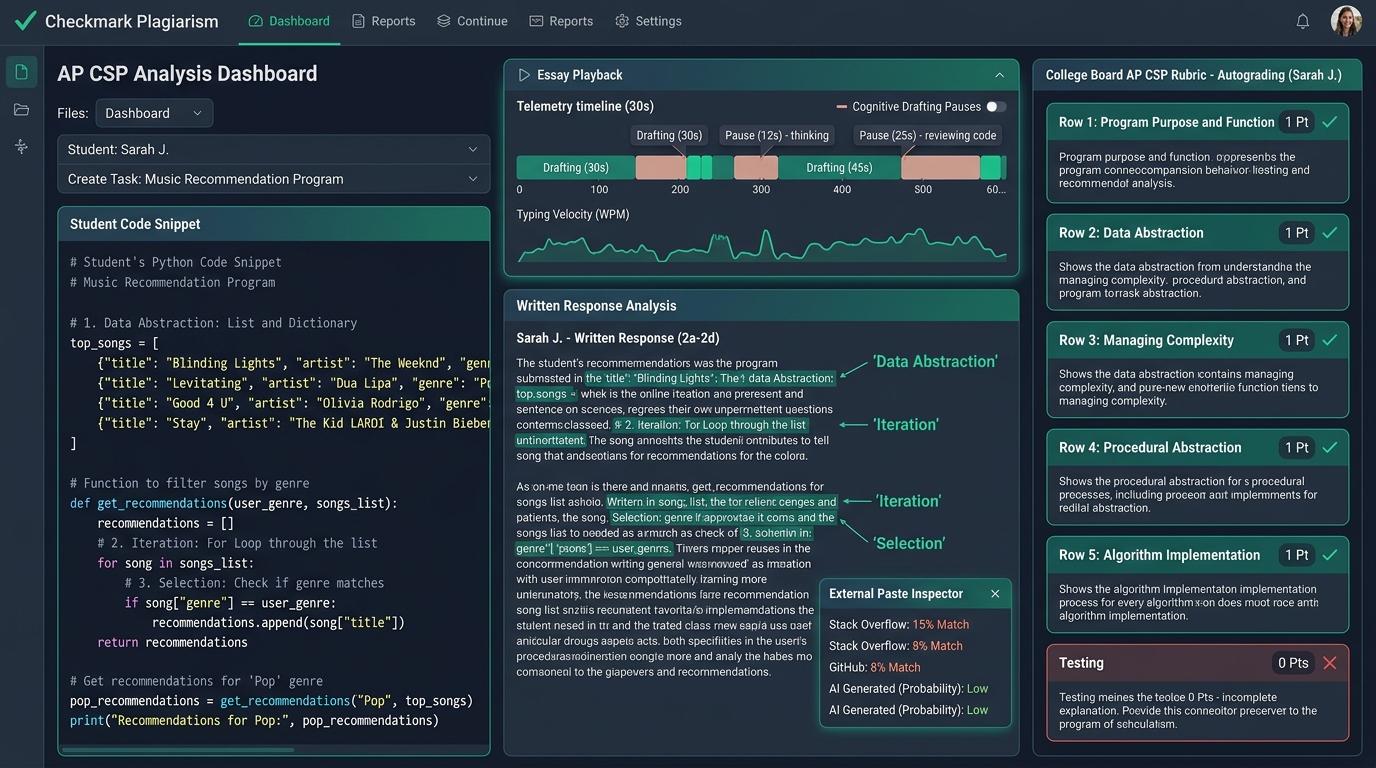
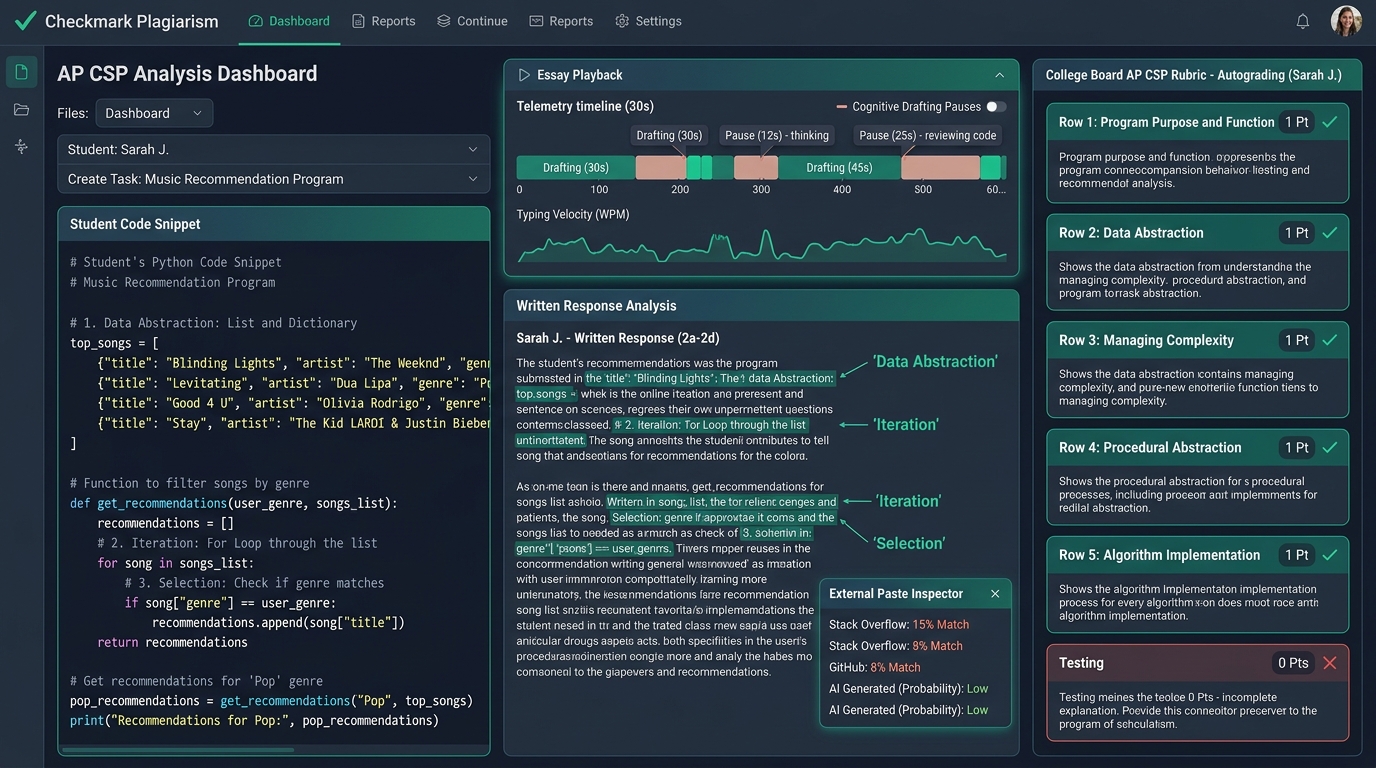
Checkmark Plagiarism resolves this dilemma by pairing passage-level AI confidence sliders with patent-pending Essay Playback™ writing process telemetry (1x–8x replay), external paste tracking with full text preservation, and quote-anchored AP CSP rubric autograding. Integrated directly into Canvas SpeedGrader, Agilix Buzz, and Google Classroom, Checkmark equips secondary CS educators to verify empirical code-to-commentary concordance, audit authentic drafting rhythms, and lead constructive, restorative code tracing conferences that uphold academic integrity while fostering deep computational literacy.
1. The Disciplinary Architecture of the AP CSP Create Performance Task
In secondary computer science education, the College Board’s Advanced Placement Computer Science Principles (AP CSP) curriculum serves as a foundational gateway into computational thinking, algorithmic problem solving, and software engineering. Unlike traditional programming assessments that evaluate solely whether source code compiles, satisfies unit tests, or matches a reference implementation, the AP CSP Create Performance Task (Create PT) places equal, if not greater, weight on the student’s capacity to articulate, document, and defend their computational artifacts in formal technical writing.
Component 1: Program Code
Complete, student-developed program code submitted as a clean PDF file. Developed in block-based (Scratch, Snap!, App Inventor) or text-based languages (Python, JavaScript/App Lab, Swift, Java).
Component 2: Video Demo
A 1-minute video (.mp4, .wmv, .mov, max 30MB) demonstrating program functionality: user input, programmatic execution, and resulting output.
Component 3: Written Responses
Four structured technical responses (or Personalized Project Reference [PPR] exam responses) analyzing program purpose, data abstraction, complexity management, iteration, and parameterized algorithms.
For 9th through 12th-grade computer science teachers managing 120 to 160 students across five or six class periods, evaluating the Create PT presents a unique pedagogical challenge. Students spend at least 12 in-class hours designing games, simulation engines, quiz apps, or utility tools. Yet, the final AP score hinges decisively on the clarity, accuracy, and depth of the Written Responses.
The Anatomy of the Four Written Response Prompts
To earn full credit across the College Board’s analytical scoring criteria, students must respond to four highly structured prompts, each targeting a specific computational concept and rubric row:
WR 1: Program Function & Purpose
Row 1 (1 Pt)- State the broader program purpose (the user problem solved).
- Describe the overall functionality.
- Detail user input, internal processing, and resulting output.
WR 2: Data Abstraction & Complexity
Rows 2 & 3 (2 Pts)- Identify a named list/array and explain what data it stores.
- Defend how the list manages complexity.
- Contrast with a hypothetical non-list implementation.
questionList stores string questions. It manages complexity because without it, I would need 30 separate scalar variables and 30 nested if blocks to select questions.”
WR 3: Storage & Processing (Iteration)
Row 5 Integration- Identify where the list is processed using iteration (loops).
- Explain how each element is accessed, evaluated, or aggregated.
- Trace data flow through each iteration cycle.
for loop traverses scoreHistory from index 0 to length - 1, summing all values into totalPoints to compute the player average.”
WR 4: Procedural Abstraction & Algorithms
Rows 4, 5, 6 (3 Pts)- Present a student-developed procedure with at least one parameter.
- Show sequencing, selection, and iteration.
- Provide step-by-step trace and two distinct testing calls.
calcGrade takes parameter rawScore. It contains an if-else tree to assign a letter grade. Calling it with 85 returns 'B', while calling with 45 returns 'F'.”
Language Neutrality Across Text-Based and Block-Based Environments
A defining strength of the AP CSP course is its language neutrality. High school classrooms across the United States implement the curriculum using diverse developmental platforms:
- Block-Based Environments: Code.org App Lab, MIT App Inventor, Scratch (MIT Media Lab), Snap! (UC Berkeley), and Microsoft MakeCode.
- Text-Based Environments: Python (via Replit, IDLE, or VS Code), JavaScript (via Code.org App Lab or HTML5 Canvas), Swift, and Java.
Regardless of the platform, the written response demands are identical. A student building a block-based turtle-graphics game in Snap! must explain data abstraction with the exact same conceptual precision as a student developing a text-based inventory management system in Python.
# Authentic Student Python Example: Algorithmic Procedure with Iteration & Selection
def filter_high_scorers(score_list, minimum_threshold):
    """Traverses score_list, filters scores above threshold, returns count."""
    qualifying_count = 0
    # Iteration: Traverses each element in the list
    for score in score_list:
        # Selection: Evaluates score against parameter threshold
        if score >= minimum_threshold:
            qualifying_count += 1
            print(f"Qualifying score found: {score}")
        else:
            print(f"Score below cutoff: {score}")
    return qualifying_count

# Procedure Call 1: minimum_threshold = 80 -> Executes 'if' branch 3 times
result_a = filter_high_scorers([95, 82, 74, 88, 60], 80)

# Procedure Call 2: minimum_threshold = 100 -> Executes 'else' branch for all elements
result_b = filter_high_scorers([95, 82, 74, 88, 60], 100)1. User-Defined Procedure: Explicit parameters (score_list, minimum_threshold).
2. Algorithmic Complexity: Combines sequencing, selection (if-else), and iteration (for loop).
3. Distinct Execution Paths: Call 1 produces result_a = 3; Call 2 produces result_b = 0.
The Acute Classroom Dilemma: Working Code, Outsourced Explanations
The primary integrity vulnerability in high school AP CSP classrooms is not simply whole-program plagiarism. Rather, it is a nuanced, hybrid form of academic fraud: code-commentary dissociation.
A student successfully builds a working arcade game in Code.org App Lab or a text-based inventory tool in Python. However, when faced with drafting the dense, rubric-governed written responses—intimidated by College Board criteria or pressed for time—the student copies their 80 lines of working code into ChatGPT or Claude and prompts:
“Here is my JavaScript code for an AP CSP project. Write my Written Responses for WR 1, WR 2, WR 3, and WR 4 so I get all 6 rubric points on the College Board rubric.”
The Large Language Model instantly produces a response that sounds authoritative, sophisticated, and grammatically flawless. However, upon close inspection by an experienced computer science educator, these AI-generated commentaries exhibit three glaring structural defects:
Disconnected Conceptual Inflation
The LLM introduces advanced paradigms—such as dynamic memory allocation, asynchronous promises, object-oriented polymorphism, or MVC architectural separation—into a simple 40-line procedural block script where no such concepts exist.
Parameter & Variable Confabulation
The LLM misidentifies global state variables as procedure parameters, invents loops that do not exist in the code, or claims a return value is generated by a void function that only updates UI labels.
The Generic Complexity Boilerplate Mirage
The LLM generates vague, textbook boilerplate (“The list enhances modularity, readability, and algorithmic efficiency”) without articulating the concrete code failure that would occur in this specific program if the list were removed.
2. College Board Policies, Rubric Rows, and Why Generic AI Detectors Fail CS Teachers
To address the surge of generative AI, the College Board updated its official AP Computer Science Principles policy regarding Artificial Intelligence and plagiarism. Understanding the exact boundaries of this policy is essential for high school educators, department chairs, and AP coordinators.
The AP CSP Scoring Rubric Matrix (Rows 1–6)
Every high school AP CSP teacher must evaluate classroom drafts against the College Board’s six analytic rubric criteria:
Identifies the broader purpose (user problem solved) AND describes functionality. Specifies user input, processing, and resulting program output.
Includes two distinct code segments: (1) creation/storage of data in a named list/array, and (2) usage of data from that same list. Identifies list name and contents.
Explains specifically how the list manages program complexity. Must explain why the program would be difficult or impossible to write without using the list abstraction.
Includes a student-developed procedure with at least one explicit parameter that affects procedure execution. Identifies procedure name and return type/behavior.
Procedure includes sequencing, selection (if/else), and iteration (loop). Provides step-by-step algorithmic trace of how the code executes in detail.
Describes two distinct calls to the procedure: Call 1 passes arguments executing one branch; Call 2 passes arguments executing a different branch. States exact results of both.
Why Generic Commercial AI Detectors Fail High School CS Teachers
Faced with grading stacks of 150 Create PT submissions, many high school teachers and districts have turned to generic commercial AI detectors (such as Turnitin AI detector, GPTZero, or CopyLeaks). In secondary computer science classrooms, these tools fail catastrophically for three technical reasons:
1. The Domain Lexicon Trap (High False Positives)
Standard CS terminology (iteration, traversal, Boolean expression, conditional, parameter, abstraction, argument) has naturally low lexical perplexity. When an honest 10th grader uses proper technical terms, generic detectors flag the text as “85% AI-generated.”
2. Mandatory Sentence Stem Penalization
High school teachers explicitly teach College Board sentence frames (“The list named... manages complexity because...”). Because these stems are uniform across thousands of student essays, generic detectors classify them as machine text.
3. The Code-Commentary Gap (Blind to True Fraud)
Commercial detectors evaluate written text in isolation. They cannot inspect the student’s code to determine whether the prose accurately reflects actual code logic or describes hallucinated parameters and non-existent loops.
When a generic detector assigns a “70% AI Probability” to an honest student’s explanation of a Python for loop, the teacher is left in an impossible position: either accuse the student based on an opaque, unexplainable probability score, or ignore the alert entirely. To achieve defensible academic integrity, computer science educators need transparent, process-based evidentiary telemetry.
3. The High School Computer Science Evidentiary Matrix
To evaluate student authorship objectively without relying on arbitrary black-box scores, high school computer science departments require a comprehensive evidentiary framework. The matrix below compares the four primary methodologies available to secondary educators:
High School Computer Science Evidentiary Matrix
| Evidentiary Dimension | 1. Manual 1-on-1 Oral Code Debrief | 2. Generic AI Detectors (Turnitin) | 3. Git / IDE Version Control | 4. Checkmark Suite & Essay Playback™ |
|---|---|---|---|---|
| Code-to-Prose Concordance | EXCELLENT: Teacher asks student to live-trace code logic. | ZERO: Detector evaluates text in isolation; blind to code logic. | POOR: Version history tracks code commits but ignores written responses. | EXCELLENT: Highlights specific code-commentary ties with quote anchors. |
| Keystroke Dynamics & Process Replay | ZERO: Provides no temporal record of writing session. | ZERO: Analyzes static final text string; no temporal data. | MODERATE: Shows snapshot commits; lacks sub-second keystroke granularity. | EXCELLENT: 1x–8x replay of every keystroke, backspace, and pause. |
| External Paste & Clipboard Inspector | ZERO: Relies solely on verbal student memory recall. | ZERO: Cannot verify clipboard source or paste events. | POOR: Large diffs show as commit blocks without clipboard preservation. | EXCELLENT: Timestamped paste capture with full original text stored. |
| False Positive Resistance on Jargon | HIGH: Teacher knows student voice and vocabulary level. | DISASTROUS: Flags standard CS terms and prompt stems as AI. | NOT APPLICABLE: Does not evaluate written prose text quality. | IMMUNE: Calibrated passage sliders prevent domain jargon penalties. |
| AP CSP Rubric Autograding & LMS Passback | MANUAL: Teacher hand-grades against 6 analytic rows. | ZERO: Provides no rubric alignment or grade passback. | ZERO: No pedagogical scoring or LMS gradebook synchronization. | AUTOMATED: Generates quote-anchored rubric drafts for Canvas/Buzz. |
| Teacher Time Economy (150+ Students) | UNSUSTAINABLE: 15–20 min per student = 40+ hours grading. | FAST BUT UNRELIABLE: Generates scores but causes false crises. | TEDIOUS: 10–15 min per repo digging through commit diff logs. | OPTIMAL: 2–3 min per submission with instant playback proof. |
While manual 1-on-1 code walkthroughs remain the gold standard for pedagogical depth, conducting 150 individual 15-minute conferences requires over 37 hours of educator time—an impossibility for high school teachers with standard 50-minute planning periods. Checkmark Plagiarism provides the objective telemetry necessary to deliver the evidentiary precision of an oral debrief at the speed and scale required for public and private secondary schools.
4. Step-by-Step Computer Science Teacher Audit Protocol
When evaluating AP CSP Create Performance Task written responses, high school computer science educators should follow a structured, four-step audit protocol to ensure defensible evaluation, protect honest students, and identify outsourced explanations.
Step 1: Code-to-Commentary Concordance Audit
Verify variable names, parameter passing, list indexing, and loop boundaries between the submitted code PDF and written responses WR 1 through WR 4.
Step 2: Algorithmic Sanity & Complexity Validation
Check parameter scope, branch execution paths in WR 4, and audit the concrete counter-factual justification for the “managing complexity without list” defense in WR 2.
Step 3: Writing Process Telemetry & Keystroke Dynamics (Essay Playback™)
Audit cognitive code-referencing pauses (10–60s), tab-switching rhythms, typing velocity curves, and external paste dumps in Essay Playback™.
Step 4: The Restorative “Live Code Tracing” Debrief
Conduct a supportive, evidence-based student conference using screen replay and code walkthroughs to cultivate authentic mastery and guide in-class revision.
Step 1: Code-to-Commentary Concordance Audit
The first line of defense is comparing the student’s submitted code PDF directly against their written responses for WR 1 through WR 4. Educators should verify four critical concordance touchpoints:
- Identifier Exactness: Do the variable and list names cited in WR 2 and WR 3 match the exact capitalization, spelling, and scope of the source code? (e.g., An LLM might write
score_listwhen the student’s code actually names the arrayuserScoreArray). - Parameter Binding in WR 4: Does the procedure identified in WR 4 take an explicit formal parameter, or is it a zero-argument function that merely manipulates global variables?
- List Mutation and Traversal: Does the iteration code in WR 3 actually traverse the list identified in WR 2?
- Return Value Consistency: If WR 4 claims the procedure returns a Boolean or transformed integer, does the source code contain an active
returnstatement, or does it merely update a user interface element?
var highScores = [120, 95, 80, 65, 50]; // List of integer scores

function checkEligibility(playerScore) {
    // Procedure with explicit parameter 'playerScore'
    var isEligible = false;
    for (var i = 0; i < highScores.length; i++) {
        if (playerScore > highScores[i]) {
            isEligible = true;
        }
    }
    return isEligible;
}
“The procedure checkEligibility takes parameter playerScore. It iterates through highScores from index 0 to 4. If playerScore exceeds any stored score, isEligible becomes true. Calling checkEligibility(100) returns true (executing the if branch), while calling checkEligibility(30) returns false (never executing the if assignment).”
“The checkEligibility function utilizes an asynchronous callback mechanism to dynamically allocate memory for leaderboard validation, querying a relational database schema...”
Step 2: Algorithmic Sanity and Complexity Validation
In WR 2, College Board Row 3 requires students to explain why their program could not easily be written without their list abstraction. This prompt represents the most common failure point for both struggling students and generic AI tools.
“Without the highScores list, I would have to create 5 separate variables (score1, score2, score3, score4, score5). In checkEligibility, I would need 5 separate conditional statements instead of one loop. If I expanded to 100 high scores, my code would require 100 variables.”
“The list manages complexity because it makes my code look neat and organized, and without it my program wouldn't work.” (Fails to articulate specific architectural alternative).
“The list abstraction encapsulates data encapsulation and enhances modular extensibility across scalable runtime environments, minimizing memory overhead.” (Generic CS platitude disconnected from concrete code logic).
Teachers should audit whether the response provides a concrete counter-factual scenario: describing exactly how many scalar variables, repetitive conditional blocks, or broken features would occur without the list.
Step 3: Writing Process Telemetry and Keystroke Dynamics (Essay Playback™)
When an educator observes a written response with suspicious vocabulary or boilerplate complexity claims, Checkmark’s Essay Playback™ provides conclusive, timestamped writing process evidence.
Authentic Student Drafting
- Intermittent drafting bursts (25–45 WPM).
- Frequent cognitive pauses (10–60s) between sentences as student switches tabs to check code line numbers.
- Active backspacing, self-correction of parameter names, and iterative refinement.
External AI Paste
- 0 seconds composing time in the editor.
- A single clipboard paste event depositing 250 words of WR 4 in 0.1 seconds.
- Preserved clipboard inspector reveals full external prompt and ChatGPT payload.
Manual Transcription
- Unnatural, robotic typing velocity (75–90 WPM) with zero composing pauses.
- Zero variable-naming hesitations and zero substantive revisions.
- Indicates mechanical retyping directly off a secondary smartphone screen.
- Code-Referencing Pauses: Multiple 30-to-60 second pauses where no typing occurs. In CS classrooms, these correlate directly with the student switching between the editor and their code IDE to verify line numbers and variable names.
- Micro-Revisions: Student types
minimum_cutoff, backspaces 14 times, and replaces it withminimum_thresholdto match their Python function header. Proof of authentic cognitive binding. - Zero External Clipboard Ingestion: Text was not generated in an external LLM tab and pasted.
Step 4: The Restorative “Live Code Tracing” Conference Protocol
When writing telemetry indicates that a student outsourced their Create PT written responses, educators should avoid adversarial confrontations. In alignment with Checkmark’s philosophy—“Stop guessing, start trusting”—the goal is to transform the incident into a high-impact learning conference.
“Thanks for meeting with me. Today we're reviewing your Create PT submission. Your App Lab game looks fantastic. Let's talk about the algorithms powering it.”
“Take a look at lines 25–40 in your code PDF. Walk me through what happens step-by-step when score is 85.” (Observe if student understands parameter passing).
Open Checkmark Essay Playback on screen: “When I look at your WR 4 response, I notice a 300-word paragraph pasted in one second that mentions 'memory heap allocation.' Can you tell me about how that explanation was written?”
Help the student recognize that while their code is good, the written response fails College Board criteria because it doesn't reflect their actual code logic.
Allow the student 30 minutes in class to independently re-draft WR 2, WR 3, and WR 4 under direct observation, validating authentic mastery before final AP Digital Portfolio submission.
This restorative protocol protects student dignity, reinforces genuine computational concepts, and ensures that the final materials submitted to the College Board AP Digital Portfolio represent the student’s authentic intellectual work.
5. Checkmark Plagiarism: Purpose-Built Integrity for Secondary Computer Science
Checkmark Plagiarism is engineered specifically to meet the evidentiary, pedagogical, and workflow requirements of 9th–12th grade computer science educators, department chairs, and district technology leaders.
Passage-Level AI Confidence Sliders
Rather than outputting a single, opaque whole-document percentage that panics teachers and parents, Checkmark underlines specific sentences and provides calibrated confidence cards. Distinguishes standard CS sentence frames from distinct AI blocks.
Patent-Pending Essay Playback™ (1x–8x)
Watch the complete history of a student’s written response session unfold like a video. Observe variable-naming hesitations, drafting pauses, revisions, and tab-switching rhythms in real time.
External Paste Inspector with Full Text Preservation
When text is pasted from an external window (such as an LLM interface or online forum), Checkmark captures the exact timestamp, character count, and full original clipboard text—even if the student later edits every single word.
Quote-Anchored AP CSP Rubric Autograding
Evaluates student written responses directly against College Board Rows 1–6 criteria, generating draft scores and prose-anchored written justifications that cite exact student sentences. Teachers retain 100% editorial control.
Direct LMS Gradebook Passback
One-click synchronization pushes finalized scores and detailed feedback cards straight into Canvas SpeedGrader, Agilix Buzz, and Google Classroom, saving secondary CS teachers hours of manual entry.
FERPA and COPPA Zero-Training Compliance
Student code and written responses are encrypted in transit and at rest and are never used to train public or proprietary AI models.
6. Frequently Asked Questions (FAQ)
Q1: How does Checkmark prevent false AI flags on standard Computer Science terminology?
A: Generic AI detectors evaluate text using statistical perplexity across general prose. In technical writing, domain-specific terms like iteration, conditional, Boolean expression, traversal, and parameter have naturally low perplexity, causing generic detectors to falsely flag honest student explanations. Checkmark utilizes passage-level calibrated confidence sliders specifically tuned to academic writing styles and domain lexicons. Rather than penalizing technical vocabulary, Checkmark evaluates sentence diversity, structure, and writing process telemetry (Essay Playback™) to verify authentic authorship.
Q2: Can Essay Playback track student writing across both block-based and text-based coding platforms?
A: Yes. Essay Playback operates directly within the writing environments where students compose their Create PT Written Responses and Personalized Project Reference documents—including Google Docs on 1:1 Chromebooks, Canvas LMS assignment editors, Agilix Buzz, and Microsoft Word. While the code itself is developed in platforms like Code.org App Lab, Scratch, Snap!, or Python, the written response telemetry captures the student's entire composition, editing, and reflection process.
Q3: How should a high school teacher handle a student who used ChatGPT to debug code syntax?
A: Under College Board policy, using generative AI for general concept exploration or debugging syntax errors is permitted—provided that the student explicitly documents and cites the AI tool in their program comments (listing the tool name, prompt, and date). However, AI is strictly prohibited from drafting the Written Responses. If Essay Playback reveals that the student wrote their own explanations of their code logic, the submission complies with integrity guidelines. If the written responses were pasted from an LLM, the teacher should initiate a restorative code tracing conference.
Q4: How does Checkmark help teachers manage Create PT grading across 150+ students?
A: Grading four written responses across 150 students represents 600 complex technical write-ups. Checkmark’s quote-anchored AP CSP rubric autograder pre-evaluates submissions against Rows 1–6, drafting point recommendations and highlighting the exact student prose that fulfills or misses each criterion. Teachers review, adjust, and approve the grades in a fraction of the time, utilizing one-click LMS passback to sync finalized scores directly into Canvas, Buzz, or Google Classroom.
Q5: What objective evidence should a department chair bring to a parent conference regarding a Create PT integrity issue?
A: Rather than bringing an unexplainable commercial AI percentage score (which parents frequently dispute), department chairs and teachers can present Checkmark's comprehensive evidentiary dossier:
1. The Essay Playback™ timeline showing the exact writing session (e.g., demonstrating a 0-second paste of a 300-word response).
2. The External Paste Inspector displaying the preserved clipboard text.
3. The Code-to-Commentary Concordance report highlighting discrepancies where the written response describes parameters or loops that do not exist in the student's actual code.
This transparent, objective evidence shifts the conversation from subjective accusation to collaborative student support.
Q6: Does Checkmark store or share student code submissions with AI companies?
A: Absolutely not. Checkmark operates under strict FERPA and COPPA compliance guidelines. Student code, videos, and written responses are never sold, cached in public databases, or used to train general Large Language Models. All data is encrypted in transit and at rest within secure cloud infrastructure.
Q7: How does writing process replay protect neurodivergent and non-native English speaking students?
A: Non-native English speakers (ESL/ELL) and neurodivergent students often use distinctive grammar structures or compose in non-linear bursts, which generic AI detectors frequently misclassify as machine-generated text. Essay Playback protects these students by preserving their complete, authentic writing journey—showing the keystrokes, brainstorming pauses, dictionary lookups, and gradual sentence revisions that prove authentic human intellectual effort beyond any statistical doubt.