
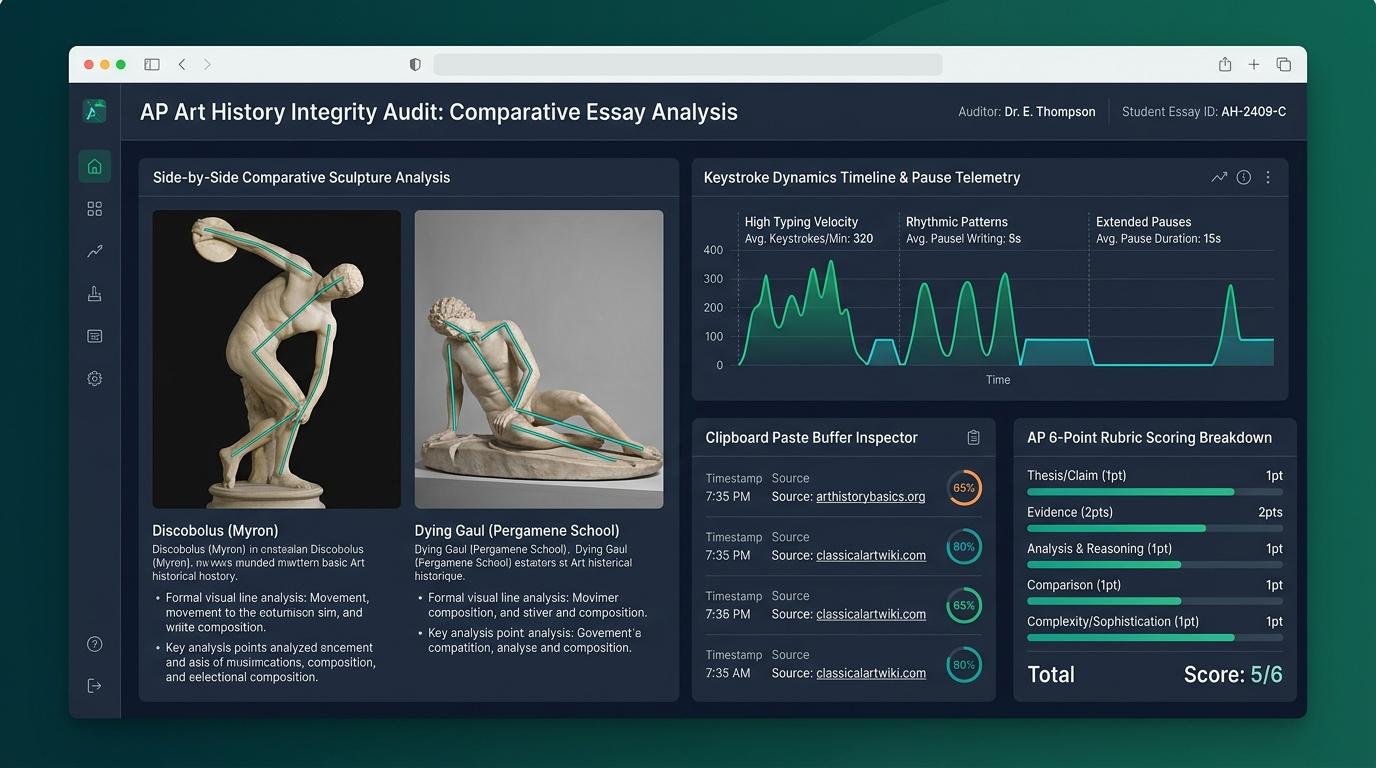
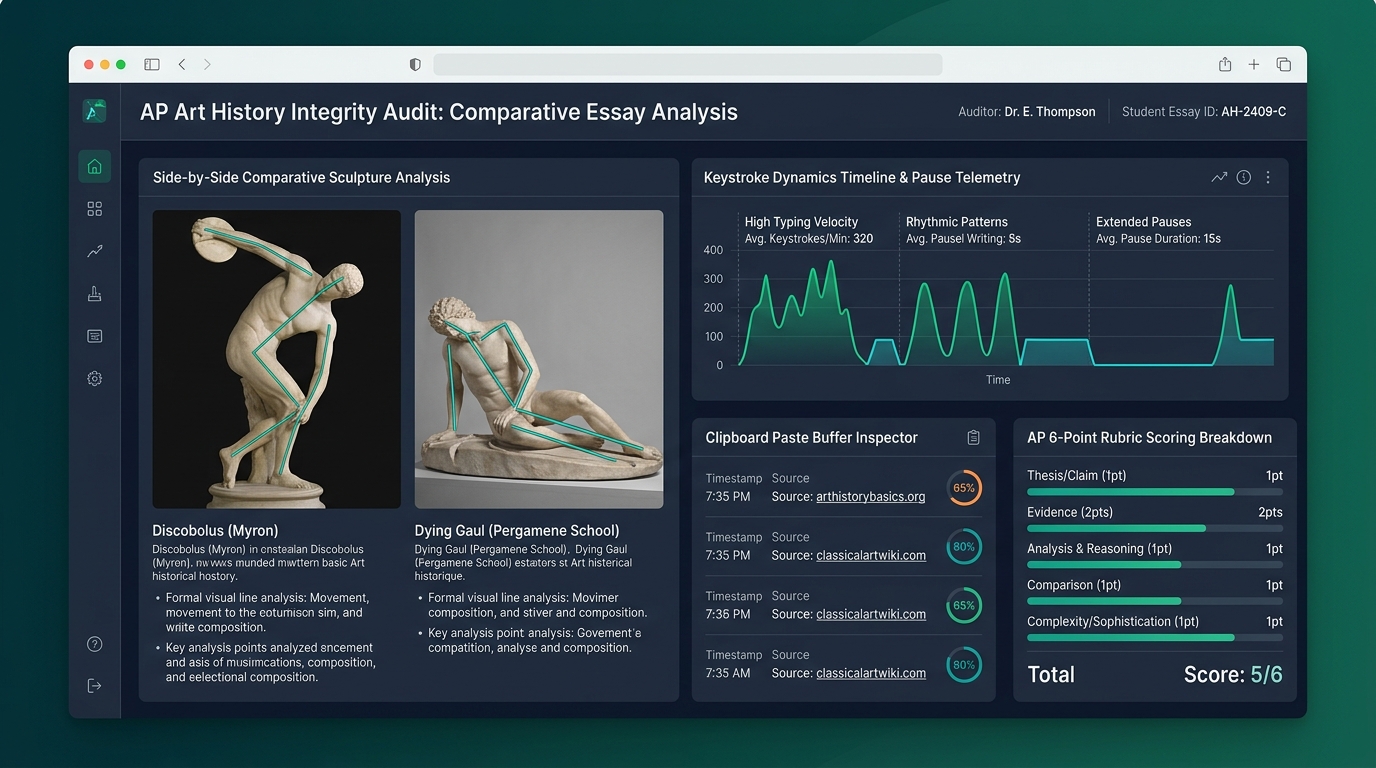
Executive Summary & Art History Integrity Mandate
In the Advanced Placement Art History (APAH) classroom, Question 1 of the Free-Response Section—the Comparative Analysis Essay—represents the pinnacle of secondary visual and historical reasoning. To earn top marks on the 6-point College Board rubric, high school students must accurately identify two canonical works from the AP Art History 250 Required Image Set, describe specific formal visual elements across both works, explain how formal choices convey cultural meaning, and synthesize complex contextual factors such as patronage, religious doctrine, and socio-political climate.
However, the ubiquity of 1:1 Chromebooks and Large Language Models (LLMs) has introduced a severe instructional crisis: generative AI easily outputs fluent, pseudo-scholarly prose laden with art historical terminology (chiaroscuro, contrapposto, hieratic scale, triptych) while confabulating non-existent architectural features, hallucinating iconographical symbols not present in the physical works, and inventing fictional patronage lineages. Simultaneously, generic black-box AI percentage checkers trigger rampant false positives on legitimate student writing because formal art historical analysis inherently relies on elevated, formulaic vocabulary.
Checkmark Plagiarism resolves this crisis through a transparent, multi-dimensional evidentiary workflow. By pairing Canonical Visual Concordance Auditing with patent-pending Essay Playback™ (keystroke-by-keystroke 1x–8x replay of the image-to-text drafting rhythm), an External Paste Buffer Inspector, Passage-Level AI Confidence Sliders with honest short-text guardrails (<150w N/A), and Teacher-in-the-Loop AP Rubric Autograding with Canvas, Buzz, and Google Classroom Passback, high school art history educators can audit student writing defensibly, protect honest scholars, and foster restorative visual literacy conferences.
Layer 1: Canonical Visual Concordance
- Figural & spatial existence check
- Architectural structural realism
- Iconographical attribute accuracy
- Patronage & era sanity verification
Layer 2: Writing Telemetry (Checkmark)
- Patent-pending Essay Playback™ (1x–8x)
- Image-inspection pauses (10s–45s)
- External Paste Buffer Inspector
- Passage-level calibrated AI sliders
Layer 3: Restorative Slide Conference
- Split-screen artwork and text view
- Student traces formal visual lines
- Student articulates patron motives orally
- Restorative revision & growth coaching
1. The High School AP Art History Architecture: Decoding the Comparative FRQ
Teaching AP Art History in a modern comprehensive high school is one of the most demanding assignments in secondary humanities education. High school art history educators must guide 10th, 11th, and 12th-grade students through a rigorous, globally encompassing curriculum spanning prehistoric rock art to contemporary digital installations.
The College Board AP Art History exam is divided into two distinct sections:
- Section I: Multiple-Choice Questions (MCQ) — 80 questions in 60 minutes (accounting for 50% of the composite score), testing visual recognition, contextual analysis, and attribution of unknown works.
-
Section II: Free-Response Questions (FRQ) — 6 written essays in 120 minutes (accounting for 50% of the composite score), structured as follows:
- Question 1: Comparison (Long Essay) — Suggested time: 35 minutes; 6 points (assessed on the standardized 6-point College Board analytical rubric).
- Question 2: Visual / Contextual Analysis (Long Essay) — Suggested time: 35 minutes; 6 points.
- Questions 3 through 6: Short Essays — Suggested time: 15 minutes each; 5 points each (covering Visual Analysis, Contextual Analysis, Continuity and Change, and Attribution of unknown works).
AP Art History Section II: Free-Response Exam Blueprint
| FRQ Type | Time Allotted | Point Value | Core Disciplinary Emphasis |
|---|---|---|---|
| Question 1: Comparison | 35 Minutes | 6 Points (Weighted) | Cross-cultural or cross-era formal and contextual comparison of 2 works from the AP 250 image set. |
| Question 2: Visual / Contextual | 35 Minutes | 6 Points (Weighted) | In-depth visual and contextual analysis of a single monumental work or architectural complex. |
| Questions 3–6: Short Essays | 15 Min Each (60 Min Tot) | 5 Points Each (20 Pts Tot) | Q3: Visual Analysis; Q4: Contextual Analysis; Q5: Continuity & Change; Q6: Attribution of unknown work. |
The 6-Point Question 1 Scoring Rubric Breakdown
Question 1 requires high school students to demonstrate sophisticated comparative synthesis across geographic, cultural, and temporal boundaries. The College Board assesses Question 1 using a standardized 6-point analytical rubric:
Work Identification
Accurately identify both selected works by artist, culture, period, date, medium, or geographic location (typically provided one work and selecting a second valid comparative work from the AP 250).
Visual Description of Both Works
Accurately describe at least two specific visual elements for each artwork (1 point for Artwork A, 1 point for Artwork B), focusing on formal elements such as line, composition, medium, light, texture, or color.
Comparative Visual Meaning
Explain at least one similarity or difference in how the formal visual elements of both works convey meaning, express cultural values, or fulfill an aesthetic objective.
Comparative Context / Patronage
Explain at least one similarity or difference in how historical, political, religious, or socio-economic context (including patronage or intended audience) shaped the creation of both works.
Complex Understanding & Synthesis
Corroborate the comparative argument using detailed historical evidence, demonstrating nuance, cross-cultural synthesis, or explaining qualifying factors that unite or distinguish both artistic traditions.
The Cross-Curricular Scope: Navigating the 10 Content Areas
To succeed on Question 1, high school students must draw connections across the College Board's 10 Required Content Areas:
A comparative prompt might ask a student to contrast the political propaganda of the Roman imperial Augustus of Prima Porta (Content Area 2) with the divine royal portraiture of the Egyptian King Menkaure and Queen (Content Area 2), or compare the sacred architecture and pilgrimage dynamics of the French Gothic Chartres Cathedral (Content Area 3) with the Indonesian Buddhist monument Borobudur Temple (Content Area 8).
When students write these essays authentically, the drafting process requires a constant cognitive oscillation: looking closely at high-resolution digital images, translating optical observations into formal vocabulary, checking historical flashcards or class notes, and synthesizing contextual causes. When students outsource this work to generative AI, this critical cognitive loop is severed.
2. The Twin Pillars of Authentic Art History: Formal Visual Analysis vs. Contextual Attribution
To effectively audit comparative essay drafts, high school educators must distinguish between the two indispensable pillars of the discipline: Formal Visual Analysis and Primary Contextual Attribution.
Pillar 1: Formal Visual Analysis
The "What" & "How" — Empirical Optical Evidence
- Line & Contour: Hard-edged linear vs. painterly sfumato; dynamic diagonal axes vs. stable horizontal/vertical balance.
- Value & Light: Diffused atmospheric illumination vs. dramatic chiaroscuro vs. theatrical pitch-black tenebrism.
- Spatial Depth: One-point linear perspective with orthogonals vs. atmospheric recession vs. stacked registers.
- Medium & Substrate: Buon fresco, oil glazes on oak panels, lost-wax bronze casting, reductive marble carving.
- Iconography & Attributes: Dharmachakra wheels, Buddhist mudras (abhaya, bhumisparsha), keys of Saint Peter, royal solar discs.
Pillar 2: Primary Contextual Attribution
The "Why" & "When" — Historical & Cultural Grounding
- Patronage Dynamics: Papal commissions (Julius II), royal propaganda (Louis XIV at Versailles), private merchant banking (Medici, Arnolfini).
- Sacred & Ritual Functions: Hospital altarpieces for the afflicted (Isenheim Altarpiece), temple towers for circumambulation (shikharas).
- Political Hegemony & Legitimation: Divine descent in Augustus of Prima Porta; divine lawgiving on the Stele of Hammurabi.
- Socio-Economic Shifts: Protestant Reformation dismantling church commissions and spurring Northern European domestic markets.
- Material Trade Geopolitics: Lapis lazuli trade routes along the Silk Road; ivory carving networks in the Kingdom of Benin.
When high school students write comparative essays, authentic scholarship emerges when formal visual observations are tethered directly to contextual realities. When students use LLMs, this bridge collapses.
3. The Generative AI Crisis in High School Art History: Anatomy of Hallucinations
In 1:1 Chromebook classrooms using Google Classroom, Canvas LMS, or Schoology, high school teachers frequently assign comparative writing drafts as homework, weekend projects, or formative digital preparation for timed in-class FRQs.
Faced with demanding course loads, students paste prompts into generative models (such as GPT-4o, Claude 3.5 Sonnet, or Gemini 1.5 Pro). While these models possess vast textual knowledge of art history textbooks (such as Gardner’s Art Through the Ages and Stokstad’s Art History), they lack embodied visual perception and physical memory. Instead of looking at the canonical artwork, the LLM constructs an essay through probabilistic token prediction.
This architectural limitation produces four distinct categories of art-historical hallucinations in high school essay drafts:
Figural & Iconographical Confabulation
Inventing phantom figures, attendants, and sacred attributes not present in the physical image.
Architectural & Engineering Anachronisms
Confusing structural engineering innovations across distant historical eras by a thousand years.
Patronage Lineage & Theological Confusion
Muddling patrons, sacred doctrines, and geographic commissioning contexts.
Pretentious Jargon Sidestepping Visuals
Substituting empty hyper-academic rhetoric for concrete formal descriptions, scoring 0 points on the AP rubric.
4. The AP Scoring & Pedagogical Dilemma: Why Generic AI Detectors Fail
When high school AP Art History teachers suspect an essay draft has been generated by an LLM, turning to standard whole-paper AI percentage checkers (or legacy plagiarism scanners) triggers profound technical and ethical failures.
The False Positive Trap (Genuine Students)
- Formal Art Terminology Penalized: Terms like chiaroscuro, contrapposto, hieratic scale, polyptych, fresco secco have low perplexity in academic databases, causing generic scanners to flag authentic writing at 80%–95% AI probability.
- Formulaic AP Essay Templates: Standard comparative structures ("In work A, the artist uses [element] to convey [meaning], whereas in work B...") mimic LLM statistical sequences.
- Harm to Students: Accusing an earnest student who spent hours studying flashcards shatters trust and harms academic confidence.
The False Negative Blindspot (AI Submissions)
- Evasion via Paraphrasers: Students use tools like QuillBot or prompt LLMs to "write at a 10th-grade level", beating generic detectors to receive a clean "0% AI" score.
- Undetected Hallucinations: The detector reports 0% AI, yet the essay describes non-existent figures and inverted lighting vectors.
- Zero Plagiarism Matches: Legacy similarity engines return 0% match because generative models produce original token sequences.
5. The High School Art History Evidentiary Matrix
To evaluate student essay drafts fairly, high school educators and department chairs must compare the evidentiary value of available assessment tools:
High School Art History Evidentiary Comparison Matrix
| Evaluation Dimension | Paper Flashcards & Bluebooks | Generic AI Detector (0–100%) | Google Docs Revision History | Checkmark Essay Playback™ |
|---|---|---|---|---|
| Visual Description Verification | Direct in-class observation of timed writing. | None. Only outputs overall probability. | Coarse version snapshots (every few minutes); gaps exist. | Captures exact pause-and-type cadence as student views image. |
| Iconography & Context Audit | High reliability in timed write; limited scope. | Blind to visual truth; ignores hallucinations. | Shows inserted text chunks but lacks raw clipboard capture. | Identifies sudden pastes of hallucinated iconographic prose. |
| False Positive Protection | Zero false positives. | Rampant (flags formal art terminology). | Low, but requires tedious manual inspection. | Eliminated via passage sliders & replay proof. |
| External Paste Buffer Capture | Not applicable (handwritten). | None. Cannot see student clipboard. | Flags large character additions; no source payload. | Captures exact payload & timestamped paste. |
| AP Rubric Scoring Automation | 100% manual teacher grading. | None. No rubric integration. | None. Word processor only. | Quote-anchored drafts synced to Canvas/Buzz. |
6. Step-by-Step Art History Teacher Audit Protocol
When evaluating comparative essay drafts submitted through Canvas LMS, Google Classroom, Schoology, or Buzz LMS, high school AP Art History educators should employ this systematic 5-step audit protocol:
The 5-Step High School Art History Essay Audit Protocol
Step 1: Canonical 250 Visual Concordance Audit
Place the official high-resolution College Board 250 image beside the student's essay. Verify that every described figure, diagonal axis, light vector, and architectural element physically exists in the canon artwork.
Step 2: Historical Patronage & Theological Sanity Checks
Verify historical chronology, correct patron identification (e.g., Scrovegni for Arena Chapel, Suger for Saint-Denis, Justinian for San Vitale), sacred iconography (mudras, saintly attributes), and physical medium (fresco vs. oil vs. lost-wax bronze).
Step 3: Keystroke Telemetry & Essay Playback™ Audit
Launch Checkmark's Essay Playback™ and scrub at 2x–4x speed. Check for the authentic "look-and-compose" rhythm—10 to 45 second pauses while the student inspects the artwork image, followed by organic typing bursts and synonym refinements.
Step 4: External Paste Buffer Analysis & Payload Inspection
Review Checkmark's Paste Buffer Inspector to see if entire 400-word blocks appeared in a single millisecond paste event. Inspect the raw clipboard text for telltale AI prompt framing (e.g., "Here is a comparative analysis...").
Step 5: The Restorative Art History Slide Conference
Project the artworks on-screen. Invite the student to trace the visual evidence directly on the slide and explain their thinking. If an un-composed paste occurred, use the writing telemetry collaboratively to guide a restorative, formative rewrite.
7. Concrete High School Classroom Case Scenarios
To see these audit principles in action, examine three realistic case studies from high school AP Art History classrooms:
10th Grade APAH: The Hallucinated Breastplate Inscription
Student Submission Extract:
“Augustus's cuirass is decorated with relief carvings depicting the return of the Roman standards, underscored by a Latin inscription declaring him the divine son of Julius Caesar, which directly parallels the hieroglyphic cartouche inscribed across Menkaure's chest.”
Concordance & Telemetry Audit Findings:
- Visual Concordance: The breastplate depicts the Parthian returning the Roman eagle standard and celestial deities, but there is no Latin inscription on the cuirass. The statue of King Menkaure and Queen has no hieroglyphic cartouche across Menkaure's chest.
- Essay Playback™: The entire 550-word draft appeared in Google Docs via two external paste events 14 seconds apart.
11th Grade APAH: The Paraphrased AI Prompt Payload
Incident Profile:
Student submitted a cross-cultural essay comparing mortality and cosmic order in the Isenheim Altarpiece and Shiva Nataraja. The submission passed a generic detector with a 0% AI score after being run through a paraphrasing tool.
Checkmark Multi-Evidence Findings:
- Visual Error: Described the Isenheim Altarpiece exterior as a "sculpted marble relief with gold leaf" (exterior wings are oil on wood panel; sculpted elements are internal).
- Paste Buffer Inspector: Checkmark recovered the original un-paraphrased clipboard capture containing the header: "Sure! Here is a comparative AP Art History essay analyzing the Isenheim Altarpiece and Shiva Nataraja..."
12th Grade APAH: Defending an Honest High-Achieving Scholar
False Positive Dilemma:
An advanced student submitted an exceptional Baroque comparative essay on Bernini's Ecstasy of Saint Teresa vs. Borromini's San Carlo alle Quattro Fontane. A district-mandated scanner flagged the draft at 88% AI-Generated due to dense vocabulary (theatrical chiaroscuro, undulating concave-convex facade, transverberation).
Checkmark Exoneration Telemetry:
- Passage Sliders: Revealed normal human syntactic burstiness across all paragraphs.
- Essay Playback™ (52 Minutes): Proved the student typed sentence-by-sentence, pausing for 20–40 seconds to consult handwritten flashcards, restructuring a complex comparative thesis statement, and revising typos across three iterations.
8. How Checkmark Empowers High School AP Art History Educators
Checkmark Plagiarism is engineered specifically to meet the high-stakes demands of high school writing departments and AP educators:
Patent-Pending Essay Playback™
Scrub through student drafting sessions at 1x to 8x speed like a video. Verify authentic image-inspection pauses and natural compositional momentum.
External Paste Buffer Inspector
Captures and permanently preserves raw external clipboard text before students reword or delete AI-generated payloads.
Passage-Level AI Confidence Sliders
Highlights specific sentences with calibrated confidence sliders; automatically sets <150-word warmups and responses to N/A.
Side-by-Side Source Comparison
Cross-references student prose against live web pages, museum archives, and student repositories to distinguish patchwriting from intentional copying.
Teacher-in-the-Loop AP Rubric Autograding
Autogrades drafts against the 6-point College Board rubric with quote-anchored justifications; syncs scores directly into Canvas, Buzz, and Google Classroom.
Strict Zero Data Retention Guarantee
100% FERPA and COPPA compliant; student essays are NEVER used to train third-party AI models or stored in public repositories.
9. Frequently Asked Questions (FAQs) for High School Art History Teachers
1. How does Checkmark differentiate between authentic formal art vocabulary and AI-generated text?
Generic AI detectors analyze whole-document word predictability, penalizing students who use specialized, low-perplexity vocabulary like chiaroscuro, contrapposto, hieratic scale, or polyptych. Checkmark utilizes multi-factor linguistic analysis (perplexity, burstiness, syntax diversity) combined with patent-pending Essay Playback™ writing telemetry. By evaluating how the text was composed keystroke-by-keystroke, Checkmark verifies authentic human composition regardless of how advanced the vocabulary is.
2. What should I do if a student's essay contains hallucinated visual details, but they claim they wrote it themselves?
Schedule a restorative art slide conference. Pull up the high-resolution AP 250 image on a screen and ask the student to point out the specific visual details described in their essay (e.g., the phantom figure, inverted lighting, or non-existent architectural feature). Then, review the Essay Playback timeline together. If the text was composed authentically, the student will be able to explain their thinking; if it was pasted from an LLM, the paste inspector and lack of drafting pauses will provide clear evidence to guide a restorative rewrite.
3. Can students bypass Checkmark by using "AI Humanizer" tools or manual retyping?
No. While AI humanizers and paraphrasers (such as QuillBot or Undetectable AI) alter surface-level text to fool basic statistical detectors, they cannot fake authentic writing telemetry. An external paste will be captured by Checkmark's Paste Buffer Inspector. If a student attempts to manually retype AI-generated text from a second screen or phone, Essay Playback captures the mechanical, pause-free transcription cadence (steady typing speed without natural compositional or image-inspection pauses), clearly distinguishing transcription from authentic drafting.
4. How does Checkmark handle short visual analysis warm-ups or exit tickets?
Checkmark includes built-in honest short-text guardrails. Any submission under approximately 150 words (such as quick 5-minute bellringers or short visual identification checks) automatically displays N/A for AI detection. This prevents false positive accusations on short texts where statistical sample sizes are too small for reliable linguistic modeling.
5. How does Checkmark's rubric autograder align with the AP Art History 6-point FRQ rubric?
Checkmark allows teachers to upload or select the official College Board 6-point scoring rubric. The AI Rubric Assistant evaluates the essay against each discrete rubric task (Identification, Visual Description for Work A, Visual Description for Work B, Comparative Visual Meaning, Contextual Analysis, and Complex Understanding), providing quote-anchored evidence cards that cite exact lines from the student's essay. Teachers can review, edit, or override any score before syncing grades to Canvas, Buzz, or Google Classroom.
6. Is student data stored or used to train artificial intelligence models?
Never. Checkmark operates under a strict Zero Data Retention for AI Training policy. Student essay drafts, revision histories, and keystroke logs are securely encrypted at rest and in transit, and are never shared with third-party LLM providers or used to train commercial AI models. Checkmark is fully compliant with FERPA and COPPA standards.
7. How does Essay Playback support neurodivergent students or non-linear writers?
Many neurodivergent students or students with 504/IEP accommodations draft essays non-linearly—jumping between paragraphs, drafting bullet points, or heavily revising thesis statements out of sequence. Generic detectors often misinterpret non-linear drafting as anomalous. Essay Playback visually demonstrates the student's authentic cognitive journey, proving original authorship and protecting neurodivergent learners from unjust academic integrity flags.
10. Conclusion: Moving from Suspicion to Restorative Visual Literacy
The ultimate objective of high school AP Art History education is not to police students with punitive software, but to cultivate rigorous, lifelong visual literacy, critical historical empathy, and clear analytical writing.
When high school teachers rely on opaque, whole-document AI percentages, they risk alienating hard-working students and fracturing classroom trust. By adopting Checkmark Plagiarism's multidimensional integrity suite, educators gain the transparent, defensible evidence they need to eliminate false accusations, detect genuine AI fabrications, streamline heavy grading workloads, and guide students toward authentic mastery of the visual world.
Stop Guessing. Start Trusting.
Equip your AP Art History classroom with transparent writing telemetry, visual concordance proof, and quote-anchored rubric feedback that students and parents trust.