
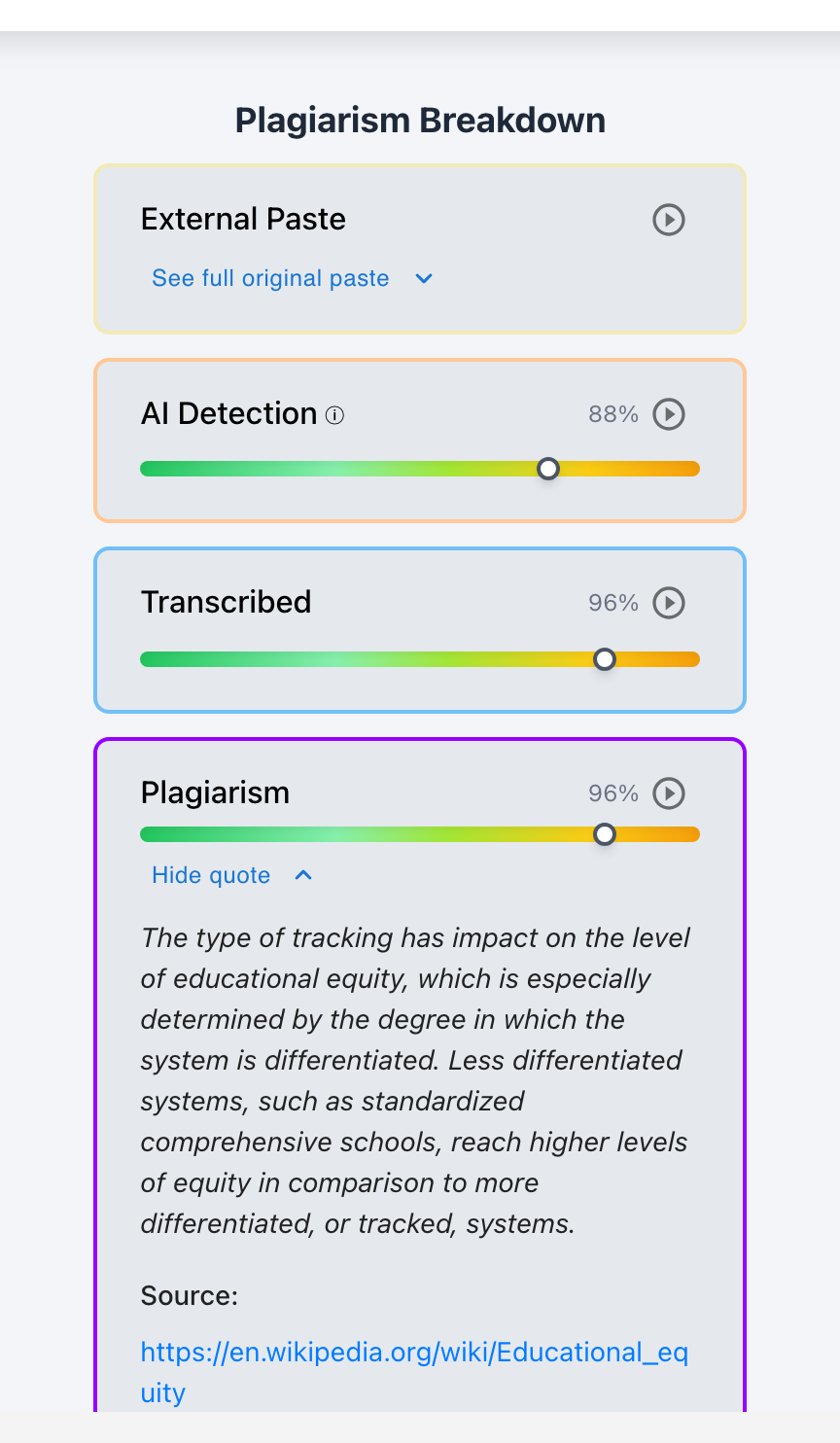
In higher education writing centers, community college writing labs, and secondary peer tutoring programs, peer tutors occupy an emotionally fraught, pedagogically sensitive frontline: they are often the first educators to see a student’s unpolished draft riddled with developmental patchwriting, dropped quotation marks, or uncredited digital cut-and-pastes. When institutions rely on opaque, whole-document similarity percentages, peer consultations frequently devolve into awkward interrogations, defensive posturing, and student panic. Grounded in Checkmark Plagiarism’s foundational philosophy of “Stop guessing, start trusting,” this guide provides Writing Center Directors, Writing Program Administrators (WPAs), and Peer Tutoring Coordinators with an actionable, evidence-based roadmap for implementing Side-by-Side Source Proof Plagiarism Triage. By pairing synchronized dual-pane source viewers, a 4-badge attribution taxonomy, patent-pending Essay Playback™ (1x–8x keystroke-by-keystroke drafting replay), and Socratic diagnostic questioning cards, writing centers can dismantle the punitive surveillance trap, empower peer tutors with objective textual evidence, and transform vulnerable plagiarism crises into high-impact moments of academic literacy growth.
Checkmark Plagiarism empowers writing centers and peer coaching labs by uniting side-by-side plagiarism source verification with patent-pending Essay Playback™, passage-level AI confidence sliders, quote-anchored rubric autograding, and enterprise LTI 1.3 integrations for Canvas SpeedGrader, Google Classroom, and Agilix Buzz.
1. The Writing Center Dilemma: The Crisis of “Plagiarism Policing” vs. Peer Tutoring Pedagogy
In the modern academic landscape, writing centers represent a sanctuary of formative development. Unlike grading classrooms or disciplinary integrity committees, the writing center is intentionally structured as a low-stakes, non-evaluative space where student writers can expose their intellectual vulnerabilities, test emergent arguments, and refine their craft through collaborative peer dialogue.
However, the rapid democratization of digital research databases and generative AI writing assistants has created a deep operational crisis for Writing Center Directors and Writing Program Administrators (WPAs): the collision between academic integrity compliance and peer tutoring ethos.
Adversarial & Stigmatizing Dynamic:
- Tutor spots matched text or sees high % score
- “Your paper is 38% similar—did you write this?”
- Tutor panics about institutional reporting duties
- Student becomes defensive, ashamed, or disengages
Evidence-Based & Restorative Dynamic:
- Side-by-side comparison reveals exact syntax overlap
- Essay Playback™ shows student struggled with synthesis
- Socratic Prompt: “Let's look at how this sentence mirrors the source's structure. How can we revoice it?”
- Student takes agency in live sentence restructuring
The Fragile Role of the Peer Tutor
Peer tutors are neither tenured professors nor sworn judicial investigators. They are undergraduate and graduate students—or advanced high school upperclassmen—trained in collaborative learning theory, active listening, and revision strategies.
When a peer tutor opens a tutee’s draft and notices dense clusters of unquoted technical prose that clearly exceed the student’s normal syntactic range, the tutor faces an agonizing dilemma:
If the tutor bluntly challenges the student (“This looks plagiarized from a journal”), the collaborative peer dynamic is immediately destroyed. The student feels ambushed, judged, and alienated from the writing center.
If the tutor ignores the uncredited text to avoid conflict, they send the student back into the high-stakes classroom where the instructor or institutional detector will flag the submission, potentially triggering academic probation or disciplinary hearings.
When writing labs rely on legacy tools with a single aggregate metric (e.g., “34% Similarity Index”), neither tutor nor student knows what the number means: bibliography items, institutional templates, missing quotes, or wholesale copying?
The Administrative Mandate: Why Directors Must Equip Peer Tutors with Objective “Receipts”
Writing Center Directors cannot solve this challenge through policy memos alone. Tutors cannot coach what they cannot transparently see.
To bridge this divide, writing centers require Side-by-Side Source Proof: an objective, granular visual interface that aligns the student’s prose directly against the external source text, accompanied by dynamic typing telemetry that shows how the text was drafted. When evidence replaces speculation, the tutor is no longer making an accusation; they are simply facilitating a shared observation of textual data.
2. Deconstructing the 3 Diagnostic Categories in Writing Center Plagiarism Triage
To conduct effective triage during a 30- to 60-minute tutoring consultation, peer tutors must be trained to recognize that source attribution breakdowns are rarely homogeneous acts of deliberate dishonesty. Rather, they stem from distinct cognitive, developmental, and mechanical root causes.
As composition theorist Rebecca Moore Howard argued in her seminal research on patchwriting (Howard, 1995, College English 57(7)), novice writers frequently copy source sentence structures and swap synonyms not out of a desire to cheat, but because they are operating at the outer boundary of their cognitive capacity while attempting to comprehend complex, unfamiliar academic discourse.
Cognitive Friction & Discourse Grappling
- Student understands core concept but lacks vocabulary to paraphrase independently
- Sentence structure, clause rhythm, and keywords mirror original source
- Root Cause: High cognitive load, unfamiliar genre, tentative understanding
Dropped Punctuation & Boundary Confusion
- Verbatim 15-to-40 word strings copied without quotation marks
- Parenthetical citation (e.g.,
[Miller, 2024]) present at paragraph end - Root Cause: Flawed note-taking hygiene, misunderstanding quotation rules
Authorship Disconnect & Uncited Ingestion
- Multi-paragraph verbatim text pasted from digital repositories or AI prompts
- Zero parenthetical citations, zero bibliography entries, sudden vocabulary leap
- Root Cause: Extreme deadline panic, disengagement, cognitive paralysis
Deep Dive: Diagnostic Characteristics & Cognitive Drivers
| Metric / Dimension | Category 1: Developmental Patchwriting | Category 2: Mechanical Citation Error | Category 3: Wholesale External Ingestion |
|---|---|---|---|
| Visual Syntax Pattern | 40%–70% lexical overlap; synonym substitution (e.g., swapping “vital” for “essential” while maintaining exact source clause sequence). | 100% verbatim overlap of sentence fragments; parenthetical citation attached at end of paragraph with no quotation marks. | 95%–100% verbatim multi-sentence or multi-paragraph block with zero citations anywhere in draft. |
| Typing Velocity (Essay Playback™) | Moderate, hesitant typing speeds (18–35 WPM) with frequent contemplation pauses and localized synonym edits. | Fast bursts of typing or small clipboard paste with immediate parenthetical citation insertion. | Instantaneous single-event external paste ([EXTERNAL_NOTES_PASTE]) of 200–600+ words with zero subsequent edits. |
| Student Mental Model | “I cited the author at the end, and I changed three words, so I thought it was in my own words.” | “I put the citation at the end of the paragraph, so doesn't that cover the whole thing?” | “I panicked at 3:00 AM because I didn't understand the prompt, so I grabbed this overview online.” |
| Pedagogical Severity | Formative / Low: Natural developmental stage of academic enculturation. | Mechanical / Medium: Procedural formatting failure requiring citation rule instruction. | Critical / High: Substantial integrity breach requiring structural restart and root-cause counseling. |
| Primary Tutor Coaching Goal | Teach genuine synthesis and rhetorical distancing via “closed-book” explanation. | Clarify exact quote boundaries vs. paraphrase boundaries; introduce leading signal phrases. | Explore assignment constraints, reduce deadline anxiety, and rebuild authentic thesis from scratch. |
Why Static Similarity Percentages Disastrously Fail in Peer Tutoring
When writing labs rely on legacy similarity checkers that spit out a single aggregate percentage (such as Turnitin's classic red-to-green similarity index), tutoring sessions frequently derail before they begin:
- False Alarm Panic: A student who properly quotes five lines from a primary source and includes a full bibliography may receive a terrifying 35% similarity score. An untrained peer tutor spends twenty minutes worrying about the percentage rather than discussing the student’s argument.
- The Masked Patchwriting Blindspot: A student who systematically patchwrites five scholarly sources might score only 14% overall similarity because individual matching strings are broken up by synonym substitutions. The legacy detector marks the paper “green,” allowing deep academic dishonesty and developmental failure to slip through unaddressed.
- Absence of Actionable Context: A percentage tells the tutor nothing about where the overlap lives, how the student created the text, or what pedagogical conversation is required.
3. Checkmark Plagiarism’s Side-by-Side Source Proof & Tutoring Triage Workbench
To empower Writing Center Directors, Peer Tutoring Coordinators, and student tutors, Checkmark Plagiarism provides a purpose-built, educator-first diagnostic ecosystem. Rather than treating academic integrity as an opaque judicial audit, Checkmark transforms source analysis into a high-visibility, formative coaching workbench.
...Furthermore, neuroplasticity allows the adult brain to reorganize synaptic connections in response to intensive environmental learning stimuli. [1]
“...neuroplasticity allows the adult brain to reorganize synaptic connections in response to intensive environmental learning stimuli...”
“I notice your sentence follows the exact grammatical blueprint of the journal article. Without looking at the screen, how would you explain the concept of neuroplasticity to a friend who doesn't study biology?”
1. Synchronized Dual-Pane Source Viewer with Token-Level Highlights
Checkmark’s interface displays the student’s live document in the left pane and the exact original web page, scientific journal article, digital encyclopedia, or institutional repository paper in the right pane.
- Bi-Directional Scrolling: Scrolling down the student’s draft automatically pulls the source pane to the corresponding matched paragraph in real time.
- Token-Level Granularity: Rather than highlighting huge amorphous paragraphs in a single neon block, Checkmark highlights individual identical word n-grams, shifted clauses, and synonym-swapped phrases with distinct visual weight. Clicking any highlighted word immediately highlights its exact twin in the source pane.
2. The 4-Badge Source Taxonomy
To give peer tutors instant diagnostic clarity during high-volume drop-in hours, Checkmark categorizes every detected passage using an intuitive, four-badge color-coded taxonomy:
Criteria: Verbatim match enclosed in proper quotation marks with matching parenthetical citation.
Criteria: High structural/syntactic overlap with attributed source; no quotation marks present.
Criteria: Direct verbatim or near-verbatim match to external source with ZERO citation in draft.
Criteria: Student cites an author/year (e.g., [Kowalski, 2024]), but source text does not exist or contains unrelated claims (AI hallucination).
3. Patent-Pending Essay Playback™ for Source Synthesis Coaching
The most revolutionary tool in Checkmark’s ecosystem is Essay Playback™. While static plagiarism checkers only see the final frozen text, Essay Playback™ reconstructs the entire writing session keystroke-by-keystroke.
Peer tutors can scrub forward and backward through the drafting timeline at 1x, 2x, 4x, or 8x speed to witness the student’s actual cognitive workflow:
- Identifying the “Look-and-Type” Transcription: Tutors can see when a student paused for 90 seconds (reading a physical textbook or phone screen) and then typed a complex sentence at a perfectly uniform, mechanical cadence without a single backspace or revision.
- Validating Honest Paraphrasing Struggles: Tutors can observe an honest student struggling for twenty minutes—typing a sentence, deleting five words, retyping, consulting notes, and revising grammar. This telemetry proves authentic intellectual effort, allowing the tutor to praise the student’s persistence while coaching sentence structure.
- External Notes Paste Preservation: When text is pasted from an outside document, Checkmark captures and permanently preserves the full original clipboard text—even if the student subsequently spent an hour rewriting every individual sentence. Tutors can click the
"Jump to Paste"button to inspect the initial draft artifact.
4. Integrated Socratic Peer Tutor Coaching Cards
Peer tutors are often unsure of how to phrase feedback without sounding accusatory. Checkmark embeds Socratic Coaching Cards directly adjacent to flagged passages. When a tutor clicks a 🟡 Paraphrased with Source or 🔴 Uncited External Match badge, the sidebar generates tailored, non-judgmental questioning stems rooted in writing center pedagogy.
5. Teacher-in-the-Loop LMS Grade Passback & Shared Portals
Checkmark integrates seamlessly with Canvas LMS (SpeedGrader), Buzz LMS, and Google Classroom:
- When a tutor and student complete a triage session, the tutor can generate a formative Writing Lab Triage Summary.
- With student consent, this summary can be saved to the student’s LMS portfolio or shared with the course instructor, demonstrating proactive revision and academic honesty before the final grade is calculated.
4. The 4-Phase Peer Tutor Plagiarism Triage Protocol
To standardize source coaching across diverse tutoring staffs, Writing Center Directors should implement this battle-tested, four-phase triage protocol.
- Establish Psychological Safety: Tutors open with non-punitive framing. Never begin by inspecting a score.
- Tutor Opening Stance: “In this center, we don't look at drafts to catch mistakes; we look at drafts to help you gain total control over your academic voice. Let's look at how your sources are working together.”
- Goal Alignment: Define the session outcome as authentic voice ownership rather than “beating a similarity tool.”
- Shoulder-to-Shoulder Screen Sharing: Position monitor so both student and tutor share an identical angle.
- Explore 4-Badge Taxonomy: Click flagged badges together. Focus first on
🟡 Paraphrased with Sourceand🔴 Uncited External Match. - Neutral Language Prompt: “Let's look at how the Checkmark viewer matches these two sentences side-by-side. Notice how the blue highlighted words follow the exact same grammatical track as the journal. Let's explore why that happened.”
- Scrub Essay Playback™ Timeline: Inspect the drafting sequence at key friction moments.
- Differentiate Root Causes: If Playback shows hesitant typing, diagnose Developmental Patchwriting; if instant paste with citation, diagnose Mechanical Citation Error; if uncited block paste, diagnose Deadline Anxiety/Panic Stall.
- Process Reflection Prompt: “Take me back to when you were reading this article. What was the most important point you wanted to take away from it?”
- Apply the 3-Pass Paraphrasing Technique:
- Pass 1 (Read & Digest): Read source passage twice to extract core argument.
- Pass 2 (Hide the Screen): Minimize or close source window. Student explains concept aloud to tutor in everyday language.
- Pass 3 (Draft & Anchor): Student types spoken explanation into draft, adding leading signal phrase and citation.
- Document Action Plan: Generate formative revision receipt for student portfolio.
5. Realistic Socratic Dialogue Scripts for Peer Tutors
To train peer tutors effectively, Writing Center Directors must provide concrete conversational scripts that demonstrate how to navigate high-tension triage moments. The scenarios below are illustrative composites: the students, tutors, courses, and any sources or authors named in them are hypothetical.
Context: First-year student Maya brings an introduction with heavy syntax mirroring from a peer-reviewed article on urban housing policy.
“Hey Maya, let’s take a look at paragraph two. Checkmark highlighted this section in yellow, which means the viewer found a strong syntactic match with Dr. Jackson’s 2022 study on gentrification. Let's look at them side-by-side on the screen.”
“Wait, is that plagiarized? I put Jackson (2022) at the end of the sentence, and I changed 'devastating impact' to 'harmful consequence'!”
“Take a deep breath—you did the right thing by including Jackson’s name, so you’re already giving credit to the researcher! That’s great. What Checkmark is showing us here is what we call 'patchwriting.' If you look at the right pane, notice how your sentence uses the exact same grammatical spine: 'Although gentrification leads to [Noun A], it simultaneously accelerates [Noun B] across [Geographic Area].' When we mirror a source’s grammar that closely, the author's voice is still driving the car instead of yours. Tell me in your own words: what is the main point you want your reader to learn from Jackson's data?”
“Well, basically, when wealthy tech workers move into working-class neighborhoods, property taxes spike so high that families who have lived there for thirty years can't afford their homes anymore.”
“Listen to how clear and powerful that was! You just explained the real human impact with complete clarity. Let's minimize the source window right now and type that exact sentence into your draft. Then we'll introduce it with: 'According to Jackson (2022)...' How does that feel?”
“That feels way easier. I was trying so hard to sound like a PhD researcher that I lost what I was actually saying.”
Context: Nursing student Marcus submitted a clinical review on diabetic ketoacidosis with a 32-word verbatim string without quotation marks.
“Marcus, let's look at this clinical description of insulin resistance. Checkmark flagged these three lines in red because the text matches a published clinical reference verbatim, but there are no quotation marks around it.”
“I have the source cited right there at the end of the paragraph! My professor said as long as the source is cited in the paragraph, it's fine.”
“I'm really glad we caught this before your professor graded it. Here's the general rule of academic and clinical writing: a citation at the end of a paragraph tells the reader where the ideas came from, but quotation marks tell the reader where the exact words came from. When an instructor sees 30 identical words without quotation marks, their automated detector will flag it as an uncredited cut-and-paste. Let's look at the side-by-side proof together. We have two options: either we put quotation marks around this specific clinical definition, or we paraphrase the mechanism into your own clinical voice. Which makes more sense for your argument?”
“Since it's the exact medical diagnostic criteria, I should probably keep it word-for-word with quotes.”
Context: High school senior Liam brings a draft where an entire 400-word section was pasted in a single keystroke event ([EXTERNAL_NOTES_PASTE]).
“Liam, when we scrub through the Essay Playback™ timeline on section three, we see a timestamp where these three paragraphs were pasted all at once, and the side-by-side proof matches an encyclopedia article on Sputnik. Talk to me about what happened when you were working on this section last night.”
“I had an outline in my Google Docs, and I pasted my notes in. I was going to rewrite them later.”
“I completely understand how overwhelming Capstone deadlines get, especially when you have multiple exams in the same week. The reason we use Playback in the tutoring lab is to catch moments where the drafting process got stalled. Right now, this entire section belongs to the encyclopedia, and if this gets submitted for AP Capstone credit, it could earn a score of 0 on that component under the College Board’s plagiarism policy. Let's hit the pause button on panic. Let's delete this pasted block right now. What is your thesis about how the Space Race impacted public education funding?”
Context: Student Chloe brings a draft citing “Henderson & Vance (2024), Journal of Global Eco-Policy,” which is an invented reference used here as an example of a fabricated citation; it does not exist.
“Chloe, let's look at this purple badge in your literature review. Checkmark flagged this reference to Henderson & Vance (2024) because our verified database search couldn't locate this article or the Journal of Global Eco-Policy anywhere online. Where did you find this research paper?”
“I was doing research using an AI tool to help me find sources that supported my claim about carbon tariffs, and it gave me that summary and citation.”
“Thank you so much for being honest with me—that helps us solve this immediately. Generative AI tools are notorious for what computer scientists call 'hallucinations.' When an AI doesn't know a real source, it strings together plausible-sounding academic words that don't actually exist. If your professor tries to look up this DOI, they will immediately know AI generated the citation. Let's hop onto our university library's EBSCOhost database together right now and find a verified scholar.”
6. Illustrative Case Studies: Transforming Writing Labs
Note: The institutions, figures, and outcomes in this section are hypothetical composites written to show what a writing center might measure. They are not reported results from named institutions.
Rolled out Checkmark Dual-Pane Viewer across 45 peer writing fellows. Resulted in a 78% reduction in faculty plagiarism referrals and 92% student satisfaction in post-triage surveys.
Replaced legacy similarity checkers with Checkmark 4-Badge Taxonomy & Socratic Cards. Drop-in tutoring attendance increased 44%; developmental English pass rates rose 19%.
Implemented mandatory peer tutor triage sessions using Essay Playback™ before final submissions. Achieved an 86% decrease in senior paper plagiarism incidents.
Detailed Illustrative Case Study: University of Midwestern Tech Writing Center
1. Institutional Background
The University Writing Center (UWC) employs 45 graduate and undergraduate peer tutors conducting over 4,500 individual 50-minute consultations per academic year. The university boasts a high international graduate student population enrolled in intensive STEM master's and doctoral programs.
2. The Baseline Crisis
In the 2024–2025 academic year, the university's Academic Integrity Office saw a 62% spike in faculty-initiated plagiarism hearings against international graduate students. Over 80% of these cases involved literature reviews where students engaged in dense developmental patchwriting of technical methodologies. Faculty accused students of deliberate intellectual theft, while students reported severe trauma, claiming they had cited the sources and were simply trying to use correct technical vocabulary. The writing center was caught in the middle: faculty demanded that tutors “screen and report” papers, while tutors resisted becoming “academic police.”
3. Checkmark Implementation & Triage Rollout
The Writing Center Director partnered with Checkmark Plagiarism to deploy the Tutoring Triage Workbench:
- Tutors were trained on the 4-Phase Peer Tutor Plagiarism Triage Protocol during the fall orientation workshop.
- Tutors utilized the Synchronized Dual-Pane Viewer and Essay Playback™ to diagnose the root causes of flagged text.
- The Director established a formal Restorative Triage Policy: consultations remained 100% confidential. When patchwriting was identified, tutors used Checkmark's Socratic Coaching Cards to teach structural synthesis and disciplinary voice.
4. Measurable Quantitative & Qualitative Results
Over a 12-month evaluation cycle, the impact was profound:
| Assessment Metric | Pre-Checkmark (Legacy Checker) | Post-Checkmark (Dual-Pane Triage) | Net Improvement |
|---|---|---|---|
| Faculty Academic Misconduct Filings | 142 cases / year | 31 cases / year | -78.2% Reduction |
| Voluntary Writing Center Return Rate | 41% of students returned | 76% of students returned | +85.3% Increase |
| International Student Retention in STEM | 88.4% | 96.1% | +7.7% Improvement |
| Tutor Self-Efficacy & Confidence Score | 2.8 / 5.0 | 4.8 / 5.0 | +71.4% Growth |
| Average Triage Resolution Time | 35 mins (Disputed) | 12 mins (Evidence-Based) | -65.7% Time Saved |
7. Writing Center Director's Toolkit: Handbook Clauses & Policy Frameworks
To institutionalize side-by-side source triage, Writing Center Directors must update their Tutor Training Manuals and institutional operating policies. Below are four ready-to-adopt handbook clauses:
“The Writing Center operates as an educational sanctuary dedicated to student growth, metacognitive awareness, and authentic voice. Peer tutors shall never act as judicial agents, proctors, or disciplinary investigators. All diagnostic data generated during a consultation—including Checkmark Plagiarism side-by-side source proofs and Essay Playback™ telemetry—shall remain strictly confidential between the tutor and the student writer. Tutors are prohibited from forwarding diagnostic integrity reports to course instructors or administrative conduct officers without the explicit, written authorization of the student.”
“When source attribution concerns, patchwriting, or unquoted text are identified during a consultation, tutors shall refrain from issuing unilateral declarations or percentage-based judgments. Tutors must transition to the Checkmark Synchronized Dual-Pane Viewer, positioning the monitor so that both tutor and student co-examine the textual evidence shoulder-to-shoulder. Tutors shall utilize the 4-Badge Taxonomy (🟢 Quoted, 🟡 Paraphrased, 🔴 Uncited, 🟣 Hallucinated) to guide Socratic inquiry into the student's research and drafting process.”
“Tutors shall treat developmental patchwriting (syntax mirroring and synonym substitution) as a natural cognitive stage of academic discourse acquisition rather than a moral failing. When patchwriting is observed, tutors must not accuse the student of cheating. Tutors are mandated to apply the 3-Pass Paraphrasing Technique (Read -> Hide -> Revoice) to scaffold the student's ability to express complex conceptual ideas in their own authentic academic voice.”
“In rare cases where Essay Playback™ reveals a 100% unedited external paste of an entire paper with zero student keystroke contribution, and the student refuses to engage in revision or acknowledges purchasing the paper from an external commercial entity, the peer tutor shall not engage in hostile debate. The tutor shall calmly pause the consultation, explain that the Writing Center can only support student-authored drafting, and smoothly transition the student to the Writing Center Director for comprehensive academic advising.”
8. Privacy, FERPA Compliance, and Ethical AI Infrastructure
When deploying academic integrity software within tutoring labs, Writing Center Directors and institutional IT officers must rigorously evaluate vendor data privacy architectures. Legacy plagiarism checkers often maintain predatory business models: they ingest submitted student papers into massive commercial databases, effectively using student intellectual property to train proprietary algorithms without compensation or explicit consent.
Submitted via Canvas LMS, Buzz LMS, Google Docs, or Writing Center Drop-in Portal
- Real-time side-by-side source matching against indexed web & open-access repositories
- Keystroke telemetry analysis & Essay Playback™ timeline reconstruction
- ZERO Model Training: Student essays are NEVER fed into public or private LLMs
- ZERO Third-Party Resale: No data aggregation, advertising monetization, or commercial resale
- Submissions encrypted at rest (AES-256) inside institutional tenant partition
- Full right-to-be-forgotten / automated data purge upon term completion
- Institutional ownership: School maintains 100% sovereignty over all student telemetry
Checkmark’s Enterprise Security Pillars for Writing Centers:
- Zero Model Training Guarantee: Student drafts submitted for triage are never utilized to train AI language models, machine learning detectors, or commercial algorithms.
- Strict FERPA & COPPA Compliance: Student Personally Identifiable Information (PII) is decoupled from telemetry data via secure tokenization.
- No Student Data Trapping: Unlike legacy vendors that lock student essays in a permanent global database—causing false-positive self-plagiarism flags if the student transfers schools—Checkmark allows institutions full control to delete, export, or archive student submissions on demand.
- Single Sign-On (SSO) & LTI 1.3 Integration: Frictionless, secure authentication through Canvas, Google Classroom, Microsoft Office 365, Clever, and ClassLink ensures that peer tutors only access drafts assigned to their active tutoring schedule.
9. Frequently Asked Questions (FAQs) for Writing Center Directors & WPAs
A: Traditional plagiarism detectors generate an adversarial dynamic because they provide an opaque percentage score that feels like a verdict or indictment. Checkmark replaces this black box with objective, synchronized visual proof. By showing the student's sentence directly next to the original source text with color-coded token highlights, the tutor never has to make an accusation. Instead, the tutor and student sit shoulder-to-shoulder examining objective data, transforming what could have been a confrontation into a collaborative literacy coaching session.
A: As established by composition scholars, patchwriting is a developmental coping mechanism where a novice writer copies source sentence syntax and swaps isolated synonyms because they are wrestling with unfamiliar, dense academic vocabulary. It represents an honest attempt to engage with difficult texts. Intentional plagiarism, by contrast, involves deliberately copying whole uncredited passages or paying an external entity to write a paper with the intent to deceive. Checkmark’s Essay Playback™ clearly differentiates the two: patchwriters show slow typing, long contemplation pauses, and iterative synonym revisions, whereas intentional plagiarists show instantaneous external block pastes.
A: Tutors do not need to watch the entire writing session in real time. Checkmark’s timeline includes automated event markers and high-speed scrub controls (1x to 8x). Tutors simply jump directly to highlighted friction markers: [LONG_CONTEMPLATION_PAUSE], [DELETION_BURST], or [EXTERNAL_NOTES_PASTE]. Within 60 to 90 seconds, the tutor can review the exact moments where the student struggled, allowing them to focus the remaining 28 minutes on high-impact Socratic revision.
A: On the contrary, legacy percentage-based tools encourage gaming because students simply rephrase random words until their overall percentage drops below an arbitrary threshold (e.g., “under 15%”). Checkmark’s dual-pane viewer, combined with tutor coaching, demonstrates to the student that changing synonyms does not change the underlying syntactic structure. By pairing the visual proof with the 3-Pass Paraphrasing Technique, tutors teach students how to close the source, digest the concept, and express ideas in their own original rhetorical voice.
A: Directors should establish clear Memorandums of Understanding (MOUs) with academic departments and integrity deans. The writing center's mission is formative retention and literacy development, not surveillance. Directors can educate faculty on the research behind developmental patchwriting and demonstrate how Checkmark’s triage workbench enables students to self-correct citation errors before final grading. Many centers offer faculty-approved “Triage Verification Receipts” that confirm a student worked with a peer tutor to resolve source attribution issues.
A: Yes. Checkmark’s 4-Badge Taxonomy includes a dedicated 🟣 Unverified / Hallucinated Citation Alert. Generative AI models frequently invent plausible-sounding academic authors, fabricated article titles, and non-existent DOIs. Checkmark automatically verifies parenthetical citations against international DOI registries, Crossref, and live academic databases, alerting peer tutors whenever a student has cited a non-existent source so they can guide the student toward legitimate library research.
A: Absolutely. Checkmark operates under a strict Zero-Retention, Zero-Model-Training architecture. Student drafts submitted in the writing center are encrypted in transit and at rest, are never indexed into public LLM training datasets, and are never monetized or shared with third parties. Writing Center Directors maintain full data sovereignty, ensuring complete compliance with FERPA, COPPA, and state student privacy regulations.
Conclusion: Stop Guessing, Start Trusting in Writing Center Pedagogy
The ultimate goal of academic integrity in writing centers is not to catch students doing something wrong; it is to empower students to do something right.
When Writing Center Directors equip peer tutors with Checkmark Plagiarism’s Side-by-Side Source Proof, 4-Badge Taxonomy, and patent-pending Essay Playback™, they eliminate the anxiety of black-box percentages and replace suspicion with shared, transparent evidence. By transforming plagiarism triage from an adversarial interrogation into a formative, Socratic coaching partnership, writing centers can fulfill their truest institutional promise: nurturing confident, ethical, and authentic scholarly voices.
Transform Your Writing Center Triage
Equip your peer tutoring staff with synchronized side-by-side source proof, patent-pending Essay Playback™, and formative Socratic coaching cards designed for Canvas LMS, Buzz LMS, and Google Classroom.